
Allocated gold is not automatically safe just because the paperwork says “allocated”. What happens if a bullion dealer goes bankrupt depends on whether your metal is identifiable as yours, how it is held, and what your agreement says. Taking physical possession gives you direct control. If the dealer holds the metal, it may need to be distinguished from the dealer’s own inventory during insolvency.
It may seem that gold bought in your name remains yours even if the dealer fails. The key distinction is whether you own specific bullion held for you, or have only a contractual claim for metal or money the dealer owes you.
This article explains how allocated ownership, bailment and dealer inventory can affect recovery in Australia, and why records and possession matter. You’ll also learn what insolvency may mean for different storage arrangements, so you can assess the practical risks without mistaking a label for proof of ownership.
Key Takeaways
- Read the custody terms to distinguish specifically allocated bullion from pooled holdings or a contractual promise to deliver metal.
- Keep purchase records and custody statements together; clear documentation can help establish which bullion belongs to you.
- A dealer’s bullion inventory and customer-owned metal may be treated differently in insolvency, depending on ownership and custody arrangements.
- Compare continued dealer custody with physical possession or private vault storage to decide which arrangement best suits your priorities.
What Does a Gold Storage Bankruptcy Actually Mean for Your Metal?
Insolvency does not automatically determine who owns metal held by a dealer. The outcome depends on whether the bullion was delivered, allocated to you, or remains part of an unpaid order.
Unfulfilled prepaid metal orders
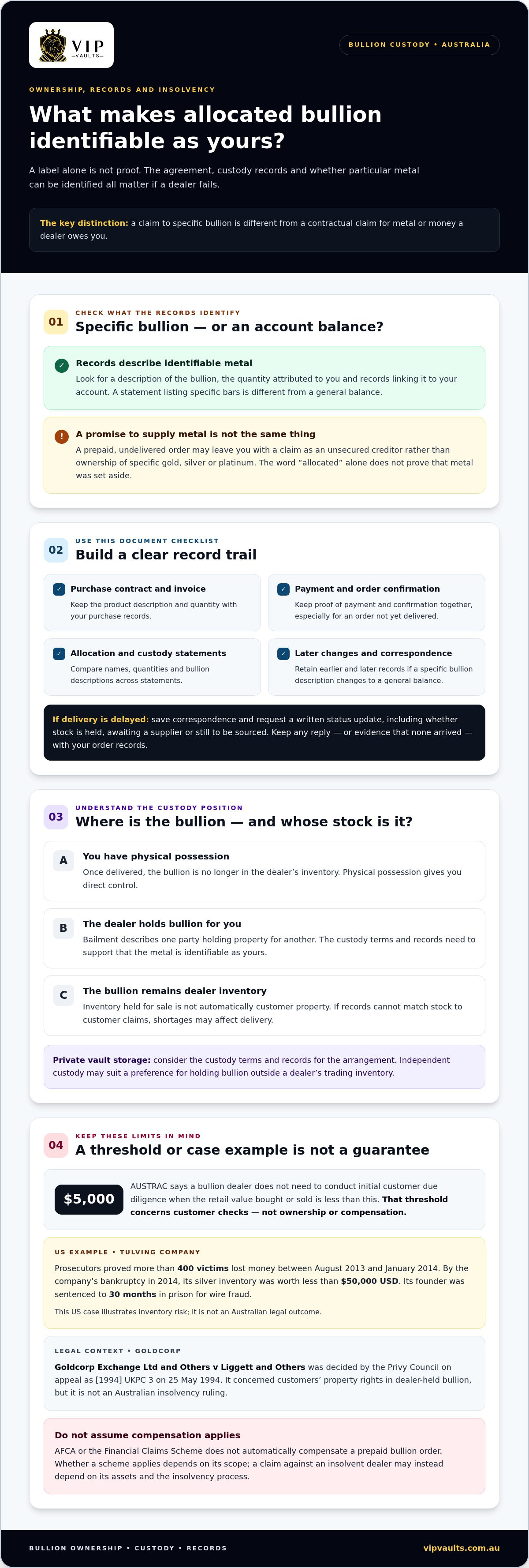
A prepaid order is money paid for precious metals that the dealer has not delivered. If insolvency begins first, you may have a claim as an unsecured creditor rather than ownership of specific gold, silver or platinum. That distinction matters: the word “allocated” alone does not prove that identifiable assets were set aside for you.
Keep the invoice, payment record, order confirmation and any allocation statement together. These documents can show what you bought and whether the dealer recorded particular bullion against your order.
Limits of compensation cover
Do not assume AFCA or the Financial Claims Scheme automatically compensates you for a prepaid bullion order. The relevant question is whether the transaction and entity fall within the applicable scheme’s scope. A claim against an insolvent dealer may instead depend on its assets and the insolvency process. Court filings and formal notices can explain how creditors should submit claims.
If your order remains unfulfilled, save all correspondence and send the dealer a written request for delivery or a refund. Keep any response, or evidence that none arrived, with your order records. If the dealer has failed to meet its obligations, report the issue to relevant professional organisations and, where appropriate, local authorities.
A supplier delay may explain a late shipment, but it does not prove your bullion has been allocated or that delivery will follow. Ask for the order status and estimated dispatch date in writing. Compare the reply with your original confirmation and any later notices before deciding what to do.
Separately, Australian Transaction Reports and Analysis Centre says a bullion dealer doesn’t need to conduct initial customer due diligence when the retail value of bullion bought or sold is less than $5,000. That threshold concerns customer checks, not ownership of prepaid metal or compensation after insolvency.
Bailment and ownership of allocated bullion
Bailment describes an arrangement in which one party holds property for another. For bullion, the key question is whether records identify the metal as yours, rather than showing only an order or account balance.
“Allocated” is meaningful only when the agreement and records support the claimed ownership. Look for a description of the bullion, the quantity attributed to you, and records linking it to your account. A statement listing specific bars, for example, differs from a balance showing an entitlement to a quantity of gold. That distinction can matter if the dealer’s liabilities exceed its assets.
Australian insolvency processes govern how a failed company’s property and creditor claims are handled. The basis of a customer’s claim is therefore important: a claim to identifiable property differs from a claim that the company owes metal or money. The evidence, custody terms and company records help establish which applies.
A reported case often discussed in allocation debates is Goldcorp Exchange Ltd and Others v Liggett and Others, decided by the Privy Council on appeal as [1994] UKPC 3 on 25 May 1994. It concerned whether customers had property rights in bullion held by a dealer. It is not an Australian insolvency ruling, so avoid treating its outcome as an automatic answer for Australian orders.
Keep the purchase contract, invoices, allocation statements and later account records together. Compare the names, quantities and descriptions in each document. If a statement changes from identifying bullion to recording only a general balance, retain both versions. This helps show how the arrangement may have changed over time.
For independent custody, consider whether a Bullion Locker suits your preference for holding bullion outside a dealer’s trading inventory. The arrangement should be understood through its own custody terms and records.
Bullion inventory and counterparty risk
A dealer’s inventory is stock held for sale, not automatically property allocated to a customer. If the business uses the same stock to fill orders and meet trading commitments, a shortfall can affect delivery. For example, a general silver balance may not identify particular bars held separately for you.
Counterparty risk is the possibility that a dealer cannot fulfil its side of a transaction. A customer who has paid for bullion may be in a different position from one whose metal is identified in custody records. The distinction depends on the contract, stock records and whether the dealer can match its inventory to customer claims.
The Tulving Company case illustrates why inventory matters. Prosecutors proved that more than 400 victims lost money between August 2013 and January 2014. By the company’s bankruptcy in 2014, its silver inventory was worth less than $50,000 USD. The founder was sentenced to 30 months in prison for wire fraud.
Those facts concern a US case, not an Australian legal outcome. They illustrate how a dealer’s stock position can differ from customer expectations. If a company becomes insolvent, its remaining inventory may need to be considered alongside its other assets and claims.
Before placing an order, record the product, payment, delivery terms and any allocation details. Keep every confirmation and account statement together. If shipping is delayed, ask for a written update stating whether stock is held, awaiting a supplier, or still to be sourced. Compare the reply with your order record.
Once delivery is complete, physical possession removes the bullion from the dealer’s inventory. Taking gold or silver with you after a local purchase avoids relying on a later dispatch. If you choose storage instead, understand whether records identify your bullion separately from stock held for sale. These distinctions help you assess the counterparty exposure attached to each arrangement.
Are bullion bars and coins held by an Australian dealer protected from its creditors?
Not automatically. A dealer’s insolvency does not, by itself, prove that bullion on its premises belongs to customers. The key distinction is between property held for an owner and stock belonging to the dealer. A coin recorded only as general sale inventory, for example, is harder to distinguish from dealer assets than a specific bar linked to a customer record.
Ownership evidence matters. Read the custody agreement and account statements together: do they identify particular bars or coins, or record only a general quantity of gold or silver? A list describing a bar by weight and identifying details provides a clearer ownership trail than an account showing only a balance. Keep copies of the agreement, purchase documents and statements.
Storage arrangements matter too. If a dealer mixes customer bullion with trading stock, records need to show how a customer’s share can be identified. If they show only an entitlement to receive metal later, that may be a claim against the dealer rather than ownership of specific bullion. Read the agreement and actual custody records as a whole.
During insolvency, an administrator needs to establish which assets belong to the company and which are held for others. If you assert ownership, organise the evidence into a clear record: purchase confirmation, proof of payment, custody terms and later inventory statements. Matching dates, quantities and descriptions helps explain your claim.
For direct control, taking physical possession after purchase means the dealer no longer holds that bullion in its premises. If you prefer stored custody, consider arranging a Bullion Locker and keep its custody records with your purchase documents. Clear documentation supports your position, while the metal’s identification and custody terms remain central to any creditor dispute.
During insolvency, the administrator must determine which assets belong to the dealer and which are held for customers. Whether bullion is treated as customer property or dealer stock depends on the custody terms and records identifying the specific metal. A general entitlement may instead be a claim against the dealer.
VIP Vaults & Bullion Exchange Perth: Private Vault Rental
VIP Vaults & Bullion Exchange Perth offers Private Vault Rental and Bullion Locker options for people seeking storage separate from a bullion dealer’s trading inventory. If you hold gold or silver and want to consider storage independently of a purchase, these options provide a practical next step.
Before choosing an arrangement, read its custody terms and understand how your bullion is recorded. Keep purchase documents and storage records together so you can refer to them when reviewing what you own and where it is held. A private vault or bullion locker may suit people who prefer secure storage over leaving metal with the dealer that sold it.
For details about Private Vault Rental or Bullion Locker, contact VIP Vaults & Bullion Exchange Perth or visit vipvaults.com.au.
Choose a custody approach that suits your priorities
Understanding what happens if a bullion dealer goes bankrupt starts with a practical decision: how do you want to hold and control your metal? Consider whether you prefer immediate physical possession, documented custody, or a separate storage arrangement. The right fit depends on your preferences and the records you want to keep with your bullion.
Let that decision guide your next move. Review the terms attached to any purchase or storage arrangement, and keep documents describing your holdings together. If you’re considering secure storage or adding physical gold to your holdings, VIP Vaults & Bullion Exchange Perth offers Gold Bullion alongside private vault and locker options.
For a considered conversation about your next step, contact VIP Vaults & Bullion Exchange Perth. A clear custody plan can help you feel more in control of how your bullion is held.
Frequently Asked Questions
Does “Allocated” on Paper Always Mean Your Metal Is Actually Safe?
No. The word “allocated” alone does not prove that specific bullion exists or is held for you. Compare your account statement with the custody agreement and look for matching descriptions of the metal. A bar identifier on a statement, for example, is more informative than a balance expressed only as a quantity. Records can clarify the arrangement, but the label itself is not proof.
Is my metal allocated, and can the provider prove it?
Check whether your records identify particular bullion or show only a balance or promise to deliver. Compare the latest statement with your original purchase documents and note any changes in quantity or description. Ask what evidence supports the recorded holding, such as an inventory record. If documents do not match, seek a clear written explanation.
Is my metal off the provider’s balance sheet?
A statement saying “off balance sheet” is not, by itself, proof that you own identifiable metal. The contract, accounting treatment and custody records all matter. Read the documents together and check whether they describe your property separately from the provider’s assets. If the records show only a debt or entitlement to receive bullion, that differs from evidence identifying metal held for you.
What Is the Legal Difference Between Allocated and Unallocated Storage?
Allocated storage generally refers to identified bullion held for a customer. Unallocated storage generally records an entitlement to a quantity of metal rather than particular pieces. The legal effect depends on the agreement and evidence of ownership. A record naming a specific bar, for instance, differs from an account showing a general gold balance. Review the contract’s terms on ownership, substitution and delivery.
What Should You Ask Before Trusting Any Storage Arrangement?
Ask whether records identify specific bars or coins, whether the provider can substitute them, and what happens if delivery or access stops. Also ask what statement or inventory record you will receive and how the agreement describes your ownership. Keep the answers with the contract. Clear, consistent terms make it easier to understand what you hold and what steps apply if circumstances change.
What happens operationally if the provider fails?
Understanding what happens if a bullion dealer goes bankrupt means recognising that access or delivery may be interrupted while the provider’s property and records are handled through insolvency. Keep your contract, statements and transaction records available to support any ownership claim. For VIP Vaults’ safety deposit boxes, stored contents are not company assets and cannot be seized if the business is liquidated. Do not assume this specific arrangement applies to other providers.