What can you store in a secure locker, and what belongs somewhere more accessible? If you’re uneasy about keeping valuables at home, the answer isn’t simply to put every precious or important item out of sight. Consider each item’s value, how difficult it would be to replace and how often you need access. Jewellery and bullion may suit discreet off-site storage, while belongings you might need at short notice call for a different plan.
This practical guide explains which valuables may benefit from secure storage and what to consider before choosing a locker. You’ll learn how to organise contents around value, access needs and dimensions, and how to factor in facility terms. It also explains when a private vault or bullion locker may suit precious metals and jewellery. VIP Vaults & Bullion Exchange Perth provides private vault rentals and bullion lockers for these assets. By matching the storage arrangement to what you own and when you need it, you can make a considered choice.
Key Takeaways
- What can you store in a secure locker? Consider valuables such as bullion and jewellery, then weigh their value, replacement difficulty and how often you need access.
- Documents and keepsakes may need different storage decisions. Consider whether you could need them urgently before placing them off-site.
- Compare a home safe, bank custody and a private vault by the type of contents, access arrangements and control you need.
- Shortlist items, note their dimensions and keep a private inventory with photographs where useful.
- VIP Vaults provides private vault rentals and bullion lockers for precious metals and jewellery, including gold, silver and platinum bullion.
What can you store in a secure locker? Start with value and purpose
A secure locker provides a place to store selected valuables outside your home. But what can you store in a secure locker? The right contents depend on more than monetary value. Consider how difficult each item would be to replace, how often you need to retrieve it and whether it will fit the locker’s dimensions.
Secure locker storage means keeping selected belongings off-site in a designated space, subject to the facility’s accepted contents and conditions. The term is often associated with a safe deposit box, but arrangements differ. Dimensions, accepted contents and access conditions can vary, so consider those details when choosing a storage option.
Which belongings are commonly considered for secure storage?
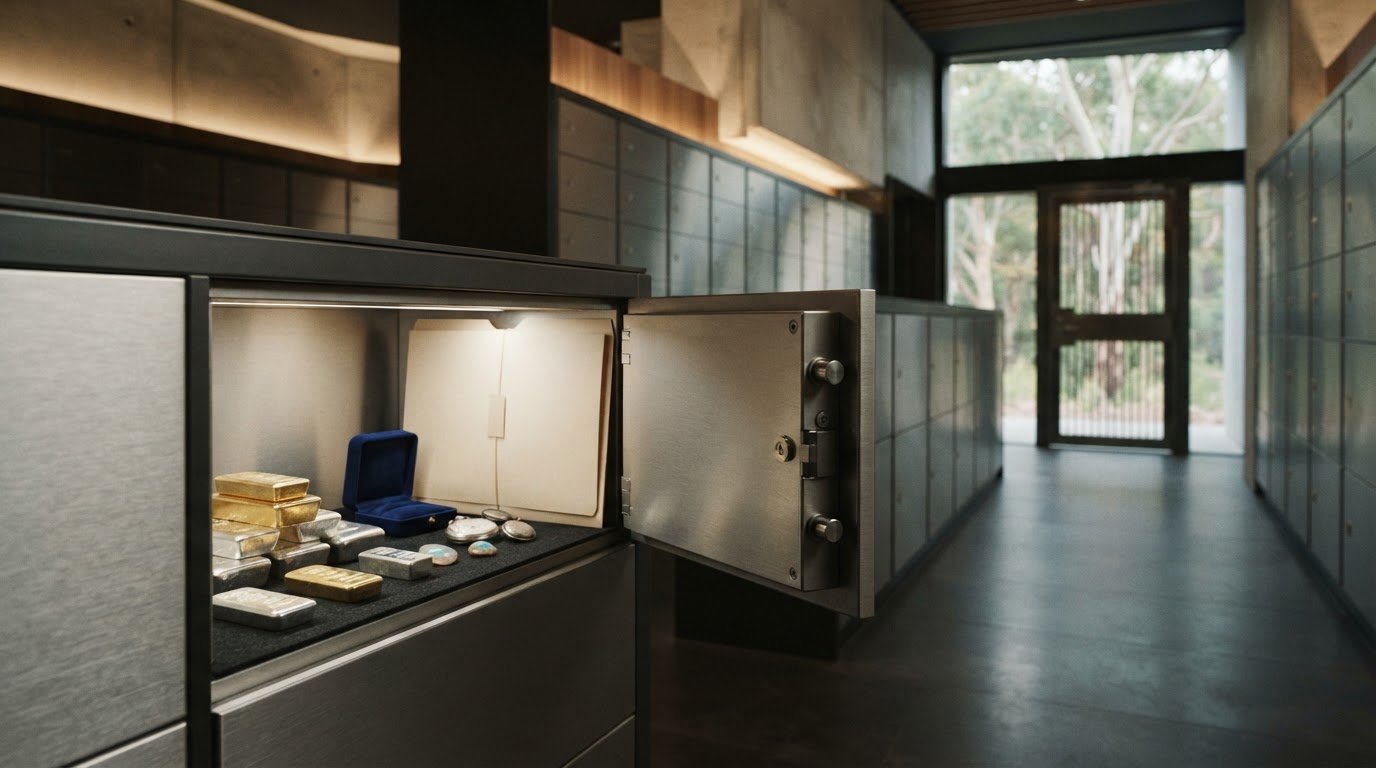
Precious-metal bullion and high-value jewellery are relevant candidates for private vault storage. VIP Vaults provides private vault rentals and bullion lockers for precious metals and jewellery. Gold, silver and platinum bullion are examples of assets that may warrant a considered off-site storage plan.
Documents, family heirlooms and collectables are other items people may consider, depending on the storage arrangement. Compact items can be easier to fit into limited space, while valuables that are rare, costly or difficult to replace may deserve particular attention. This is not a universal list of accepted contents.
How to judge whether an item belongs off-site
Assess each item on its own merits. An object may have modest financial value but deep sentimental importance; another may be valuable because replacing it would be difficult. Weigh both factors alongside the item’s practical role in your household.
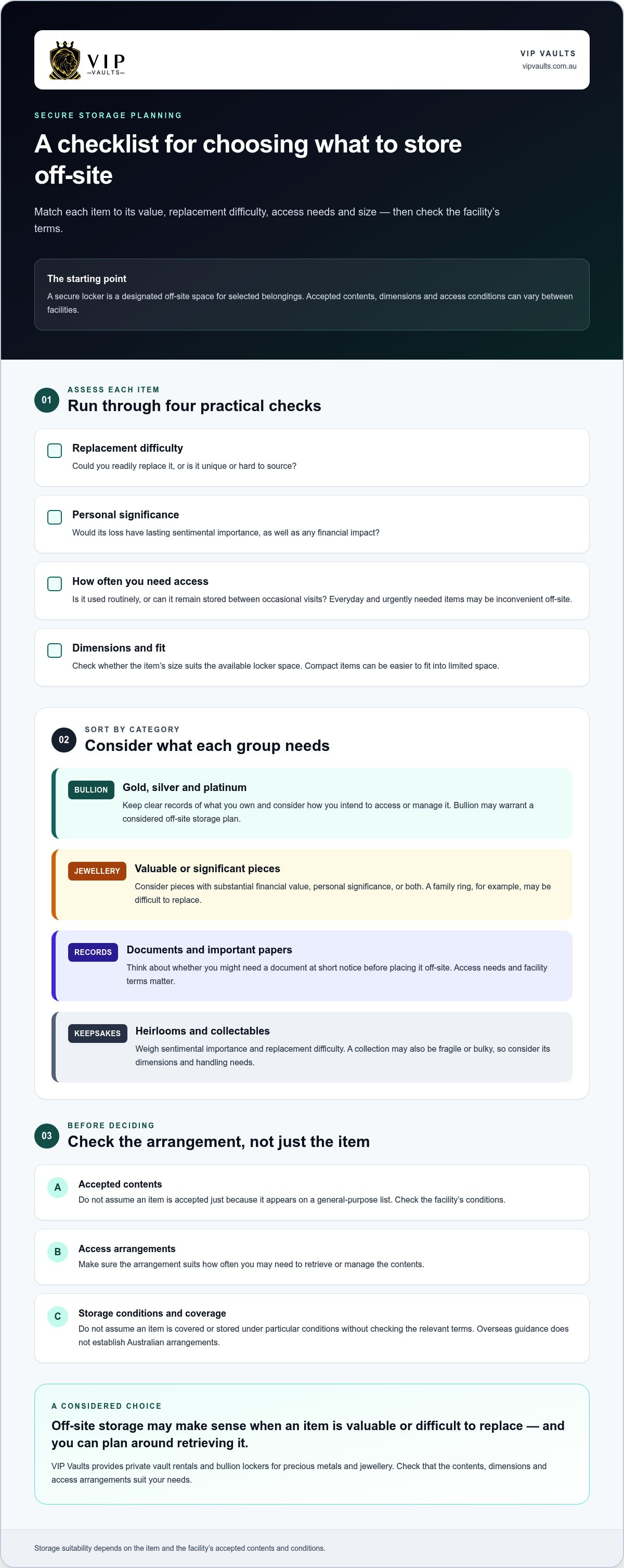
- Replacement difficulty: Could you readily replace it, or is it unique or hard to source?
- Personal significance: Would its loss have lasting sentimental importance?
- Access frequency: Do you need it routinely, or can it remain stored between occasional visits?
- Fit: Will its dimensions suit the available locker space?
Items needed for everyday tasks may be inconvenient to keep off-site. The same applies to documents or belongings you might need urgently. A locker is more suitable when an item’s value or replacement difficulty justifies storing it away from home and you can plan around retrieving it. Factor in the facility’s terms from the outset, since accepted contents and access arrangements differ.
Secure locker contents by category: bullion, jewellery, documents and keepsakes
Assess contents by category rather than relying on a universal checklist. When deciding what can you store in a secure locker, separate precious assets from personal records and keepsakes, then consider how often you may need each item. Bullion and jewellery are among the contents VIP Vaults stores in private vaults.
Precious metals and jewellery
Precious metals include gold, silver and platinum bullion. Each is a distinct asset, so keep clear records of what you own and consider how you intend to access or manage it. If bullion is held through a self-managed super fund, storage is part of a broader investment decision. Read VIP Vaults’ SMSF gold storage guidance for related context.
Jewellery may also be worth storing off-site, particularly pieces with substantial financial value, personal significance or both. A family ring, for example, may be difficult to replace even if its value is not purely financial. VIP Vaults provides private vault rentals and bullion lockers for precious metals and jewellery, making these a practical focus for storage planning.
Documents, heirlooms and other valuables
Important papers, family keepsakes and collectables are general examples of items people might store off-site. Their suitability depends on the facility’s terms and the practical details of each item. A collection may be fragile or bulky; a document may be needed at short notice. Consider dimensions and access before deciding.
The US Federal Deposit Insurance Corporation (FDIC) offers Good candidates for a safe deposit box as a useful reference for common storage considerations. The FDIC is a United States authority, so its guidance about deposit insurance does not establish how Australian storage or insurance arrangements work. Don’t assume a document, keepsake or collectable is accepted, covered or stored under particular conditions just because it appears on a general-purpose list.
For each category, ask what the item means to you, how hard it would be to replace and whether you can manage without it between visits. A compact piece of bullion may serve a different purpose from an heirloom or a frequently needed document. If precious metals or jewellery are your focus, explore VIP Vaults’ private storage options as a discreet off-site alternative.
Private vault, bank custody or home safe: match storage to the item
No single storage method suits every possession. A frequently used document may need to stay close, while precious metals or jewellery kept for longer-term safekeeping may suit an off-site option. To decide what can you store in a secure locker, consider the item’s purpose, how often you need it, its dimensions and the access arrangements for each option.
| Option | May suit | Consider |
|---|---|---|
| Home safe | Items you need regularly | Its design, placement, capacity and suitability for the contents |
| Bank custody | Selected valuables or documents, depending on the service | Access arrangements and the bank’s specific terms |
| Private vault | Selected precious metals and jewellery | Privacy, access conditions, dimensions and facility terms |
This is a general comparison, not a guarantee that every facility accepts the same contents or offers identical access. The US Federal Deposit Insurance Corporation’s FDIC guidance on safe deposit boxes discusses bank boxes in the United States. Its information about FDIC deposit insurance applies to the US, not Australian storage arrangements. Read the relevant Australian facility’s terms rather than assuming another country’s rules or a different provider’s conditions apply.
When a home safe may still be practical
A home safe can be convenient for belongings you use or retrieve often. Its suitability depends on its design, placement and the items you intend to keep inside. Consider capacity too: a safe that works for small documents may not suit larger or heavier valuables. Home storage can be a reasonable choice when convenience is a priority and the safe fits your needs.
When private vault storage may suit valuable items
Off-site private vault storage is an option for precious metals and jewellery, particularly when you don’t need frequent access. VIP Vaults provides private vault rentals and bullion lockers for these categories. Consider how privacy, access arrangements, locker dimensions and facility terms align with your plans. These practical factors are more useful than assuming one type of storage is automatically best for every item.
Explore private vaults in Australia for more context on private vault storage. If precious metals or jewellery are your focus, VIP Vaults’ private storage options offer a relevant place to start.
How to prepare and organise items before using a secure locker
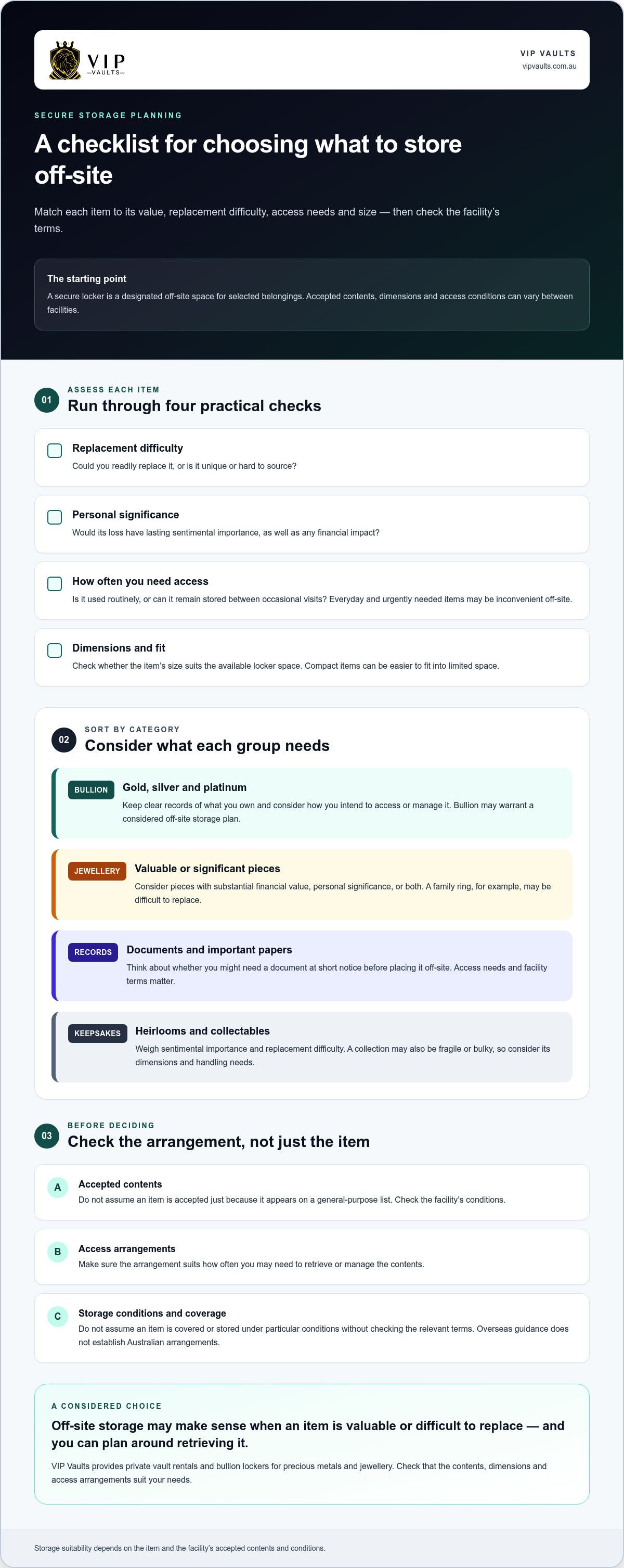
A little preparation makes storage easier to manage and helps you decide what belongs off-site. Before choosing what can you store in a secure locker, work through four steps: shortlist belongings, note their dimensions, organise your records and consider how often you may need to retrieve each item. Review the chosen facility’s terms for permitted contents and access, as these conditions can vary.
Create an inventory that supports your records
Keep a private inventory so you can identify and account for stored items. Record a clear description and, where relevant, details such as a maker’s mark, serial number, distinguishing feature or provenance. Photographs can help document an item’s appearance, particularly if it has unique details.
Keep copies of valuations, receipts or other purchase records separately where appropriate. Treat the inventory as sensitive information: store it securely and limit unnecessary sharing. A concise, up-to-date record is easier to maintain than a long, unwieldy list. Update it when you add or remove belongings.
Plan dimensions, packaging and retrieval
Group belongings by category and note approximate dimensions before arranging storage. Include the size of any container you intend to use, not just the item itself. This gives you a clearer idea of the space required without assuming every locker has the same capacity or accepts the same packaging.
Next, sort items by how often you may need them. Separate frequently retrieved belongings in your planning from items intended for longer-term storage. This helps you assess whether off-site storage fits your routine and the facility’s access arrangements.
- Shortlist: Select items based on value, replacement difficulty and purpose.
- Measure: Note approximate dimensions, including any protective container.
- Document: Record identifying details and take photographs where useful.
- Review: Consider retrieval frequency and read the facility’s terms for contents and access.
Use packaging that keeps items organised without obscuring identifying details or risking damage to delicate pieces. Follow the chosen facility’s instructions and terms for packaging. Preparation is especially useful for precious metals and jewellery, where clear records and thoughtful organisation support your own oversight.
If you’re preparing bullion or jewellery for discreet off-site storage, explore VIP Vaults’ private vault and bullion locker options.
How VIP Vaults supports secure storage for bullion and jewellery
Choosing a storage arrangement starts with the asset and your reasons for keeping it off-site. For bullion and jewellery holders, VIP Vaults offers private vault rentals and bullion lockers designed for these precious assets. The business is privately owned and independent of government and financial institutions, providing a private-sector alternative to bank custody.
A discreet option for precious-metal holders
Bullion can be gold, silver or platinum, and the form you hold may influence how you organise and record it. VIP Vaults’ bullion is sourced from internationally recognised and LBMA-accredited refiners. If you’re weighing up different formats, read this guide to gold coins versus gold bars for considerations relevant to investors.
Private storage may suit bullion owners who want to keep precious metals apart from everyday household belongings. Jewellery can also be relevant, whether its importance is financial, personal or both. As with any off-site arrangement, consider your records, the item’s dimensions and how often you’ll want access. Base your decision on your circumstances, not assumptions about what every locker provides.
Explore private vault and bullion locker storage
For readers asking what can you store in a secure locker, VIP Vaults’ focus is precious metals and jewellery. Private vault rentals and bullion lockers provide storage for these categories. Keep the facility’s terms and access arrangements in mind as you decide whether off-site storage fits your needs.
Approach the decision calmly: identify the assets you want to store, consider their purpose and retrieval needs, and review the relevant terms. That preparation can help you choose an arrangement that suits your holdings without relying on broad claims about security or access.
If you’re considering discreet storage for bullion or jewellery, explore private vault storage options with VIP Vaults.
Make a considered choice for your valuable belongings
The answer to what can you store in a secure locker depends on the item, your reasons for storing it and how often you need access. Bullion and jewellery are relevant choices for private vault storage, while documents, keepsakes and other belongings call for careful consideration of facility terms, dimensions and retrieval needs.
Before deciding, shortlist the items, record identifying details and consider whether a home safe, bank custody or private vault best suits their purpose. A clear inventory and an understanding of access arrangements can help you make an informed choice.
VIP Vaults provides private vault rentals and bullion lockers for precious metals and jewellery. Its gold, silver and platinum bullion is sourced from internationally recognised and LBMA-accredited refiners. As a privately owned business independent of government and financial institutions, VIP Vaults offers a discreet option for precious assets.
Explore private vault and bullion locker storage to consider an arrangement suited to your holdings. Contact VIP Vaults to discuss private vault or bullion locker storage for your precious metals and jewellery.
Frequently Asked Questions
What can you store in a secure locker?
Secure lockers are commonly considered for selected valuables that are compact, significant or difficult to replace. Precious-metal bullion and high-value jewellery are relevant examples for private vault storage. Documents, heirlooms and collectables may suit some facilities, but acceptance isn’t universal. Before choosing contents, consider the item’s dimensions, how often you’ll need access and the facility’s terms. This helps you match the storage arrangement to the item rather than rely on a generic list.
Can you store gold and silver bullion in a secure locker?
Gold and silver bullion are valuable items people may consider for secure off-site storage. VIP Vaults provides private vault rentals and bullion lockers for precious metals, including gold, silver and platinum. Keep purchase records and identifying details organised, and consider how often you may need access to your holdings. Review the locker’s dimensions and the facility’s terms so the arrangement fits both the items and your plans.
Can jewellery be stored in a secure locker?
Jewellery may suit secure locker storage if it’s valuable, rarely worn or difficult to replace. Consider whether you’ll need regular access, and keep a private record of distinguishing features or valuations where appropriate. VIP Vaults provides private vault rentals for jewellery. Consider how your pieces will fit and review the relevant conditions, as locker dimensions and facility terms vary.
Can you store important documents in a secure locker?
Some safe-custody arrangements are intended for important documents, while other lockers focus on different contents. Consider whether you might need an original urgently, how it could be protected from handling or damage, and whether the facility’s terms permit documents. Keep accessible copies separately where appropriate. Don’t assume every locker accepts papers or that off-site storage suits documents you may need at short notice. The right decision depends on the document and its purpose.
Is a secure locker better than a home safe?
Neither option is automatically better for every person or item. A home safe can keep frequently used belongings close at hand, while off-site storage may suit selected valuables you don’t need regularly. Compare the item’s value, retrieval needs and dimensions, along with the terms of the specific arrangement. Avoid relying on broad claims about security or insurance. Consider the practical trade-offs and choose an option that fits how you use and manage the item.
Can you store cash in a secure locker?
Whether cash is permitted depends on the facility’s terms. A locker is not a transaction account or everyday banking service, so consider how quickly you might need access and whether off-site storage is practical for your purpose. Don’t assume cash is accepted, insured or covered under a particular policy. Read the applicable conditions before deciding, and distinguish between storing physical cash and keeping funds in an account designed for day-to-day transactions.
How should you prepare items before putting them in a secure locker?
Prepare a private inventory, note useful identifying details and estimate each item’s dimensions. Photographs can help document distinctive features, while purchase records or valuations can be kept separately where appropriate. Organise items so they’re identifiable without unnecessary handling, taking care with delicate pieces. Review the facility’s permitted contents and access conditions, along with any preparation guidance that applies to that locker. This helps you plan for both the contents and future retrieval.