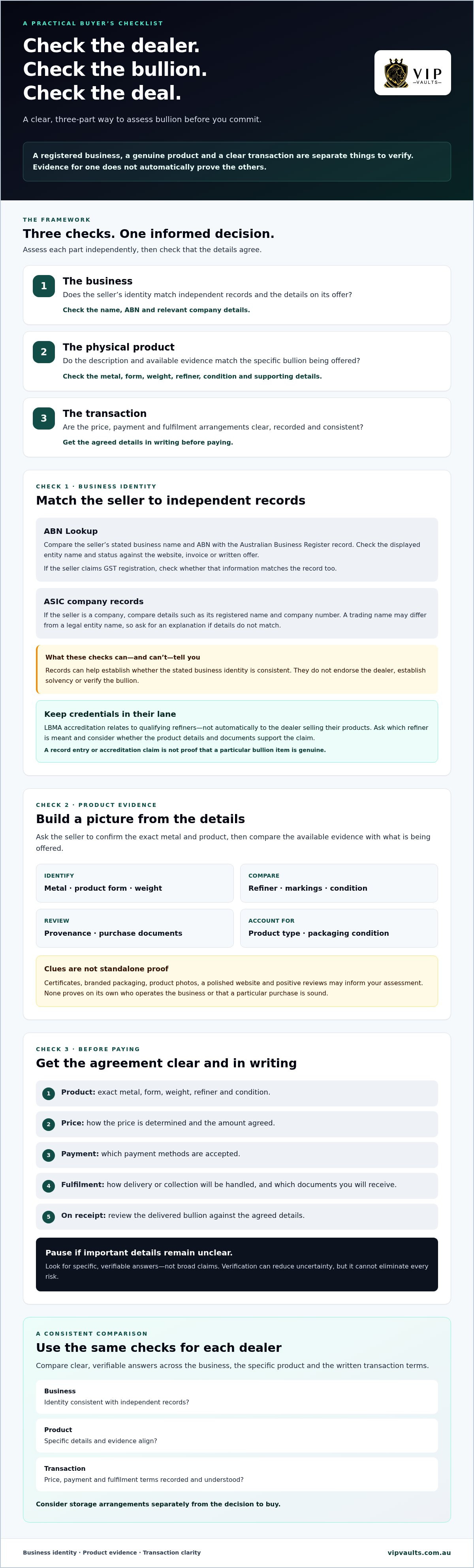
What if the bullion looks genuine, but the dealer or transaction still leaves important questions unanswered? Verifying bullion dealer authenticity means checking more than a polished website, branded packaging or positive reviews. Each can offer clues, but none proves on its own that a business is who it claims to be or that a particular purchase is sound.
It’s reasonable to want clear evidence before committing to a high-value asset. A refiner’s accreditation relates to the refiner, not automatically to the dealer selling its products. A certificate should also be considered alongside other product and transaction details.
This checklist explains how to assess a dealer’s identity and transparency, what provenance and metal specifications to request, and how to review pricing, payment and fulfilment terms before you decide. You’ll also learn why certificates, packaging and online feedback should be treated as parts of the picture, not standalone proof. Comparing dealers against the same checks can help you make a more informed decision.
Key Takeaways
- Verifying bullion dealer authenticity means assessing the business, the specific metal and the transaction as separate parts of your due diligence.
- Check the dealer’s stated business name and ABN against ABN Lookup. Use ASIC records to confirm company details, not as an endorsement.
- Compare provenance, refiner information, markings and purchase documents, while accounting for the product type and whether its packaging is intact.
- Before paying, get the product description, price and fulfilment terms in writing, then review the delivered bullion against the agreed details.
- Look for clear, verifiable answers rather than broad claims, and consider storage arrangements separately from the decision to buy.
Why verifying bullion dealer authenticity means checking three separate things
A dealer can be a real, registered business without every item it sells being independently verified. Equally, genuine bullion can be offered through a transaction with unclear pricing, payment or delivery terms. Treat verification as three distinct checks: the business, the physical product and the transaction.
This distinction matters because a professional-looking website is evidence of presentation, not proof of who operates the business or what a particular bar or coin contains. Product photographs, certificates, branded packaging and customer reviews may inform your assessment, but none should carry the full weight of it. A refiner’s accreditation, for instance, relates to the refiner. It doesn’t automatically accredit the dealer.
The term bullion covers precious metal valued primarily for its metal content, commonly in forms such as bars and coins. Use that as a starting point for your checks: establish who is selling, identify the metal being offered, then confirm exactly what the agreed transaction covers.
- Business: Is the seller’s stated identity consistent with independent records and contact details?
- Product: Do the description and available evidence match the specific bullion being offered?
- Transaction: Are the price and arrangements clear, recorded and consistent with what you agreed?
This is a practical framework, not a reason to assume an unfamiliar dealer is fraudulent. Work through the evidence calmly, ask direct questions and pause if material details remain unclear.
Dealer identity is not the same as metal authenticity
Compare the business name and Australian Business Number (ABN) provided by the seller with the Australian Business Register’s ABN Lookup. If the seller is a company, ASIC records may help you check company details. These records can help establish whether the stated business identity is consistent. They don’t endorse the dealer or verify its bullion. A registered business still requires separate checks of the product and sale.
What a buyer should establish before proceeding
Before committing, ask the seller to confirm the exact metal, product form, weight, refiner and condition. Clarify how the price is determined, which payment methods are accepted, how delivery or collection will be handled, and which documents you’ll receive. Check that the answers are specific and consistent with the written offer. Verification can reduce uncertainty, but it can’t eliminate every risk. Don’t proceed until you understand the terms.
How to check an Australian bullion dealer’s identity and credentials
Start with the business details the seller gives you. In Australia, you can search its Australian Business Number (ABN) using the Australian Business Register’s ABN Lookup service. Compare the displayed entity name and status with the name on the website, invoice or written offer. If the business claims to be registered for GST, check whether that information matches the record too.
A mismatch isn’t automatic proof of wrongdoing. A trading name may differ from a legal entity name, for example. Ask the dealer to explain any discrepancy and provide the correct legal entity details before you proceed. If the seller is a company, search ASIC’s company records to compare details such as its registered name and company number. These checks help confirm identity. They don’t endorse the dealer, establish its solvency or verify the quality of its bullion.
ASIC’s Moneysmart guidance offers advice on recognising investment scams. If a seller also promotes financial products or provides financial services, read ASIC’s guidance on checking investment credentials and confirm whether relevant licensing applies to that activity. Don’t assume a register entry, or the absence of one, proves that bullion is genuine or that a particular seller is approved to trade bullion.
Separate the refiner’s credentials from the dealer’s
LBMA accreditation relates to qualifying refiners, not automatically to retailers or other bullion dealers. If a seller says a product comes from an LBMA-accredited manufacturer, ask for the refiner’s name and check its status against the relevant current source. Then consider whether the product details and documents support the claim. For more on what this credential does and doesn’t establish, read understanding LBMA accreditation for gold investment.
Be alert to claims that sound official but don’t identify what is accredited, by whom, or for which activity. A refiner’s credential is not a dealer credential, and it doesn’t independently confirm the identity or condition of the specific item offered. Ask for precise, checkable details rather than relying on a logo or broad assurance.
Follow up if the business name changes between its website and paperwork, contact details are inconsistent, ownership is unclear, or a claimed licence or accreditation can’t be substantiated. Ask for clarification in writing and compare the response with independent records. As one point of comparison, VIP Vaults & Bullion Exchange Perth provides information about its bullion sourcing and pricing for buyers to assess alongside their own checks. Review its bullion information as part of that independent comparison.
Compare bullion authenticity evidence and know its limits
No single mark or document settles every question about a bullion item. Build confidence by comparing several details against information from the named refiner and the seller’s written records. The value of each clue depends on the product, its manufacturer and whether original packaging is still intact.
| Evidence | What it may help establish | What it can’t prove alone |
|---|---|---|
| Provenance | Where the seller says the item came from and its supply history. | A complete or independently verified chain of ownership. |
| Refiner | Whether the named manufacturer’s product information matches the item. | That the dealer is accredited or that this item came from that refiner. |
| Weight | Whether the stated weight aligns with the product description. | Metal purity or authenticity without appropriate assessment. |
| Markings | Whether visible identifiers appear consistent with refiner information. | Authenticity based on a stamp or logo alone. |
| Serial number | Traceability for products that use unique serial numbers. | That a number hasn’t been copied or that the item is genuine. |
| Purchase documents | The product and terms recorded for the transaction. | The physical composition of the bullion. |
Certificates and sealed packaging can support your assessment, especially where the product is designed to remain in its original packaging. They aren’t conclusive on their own: documents may not relate to the specific item, and packaging can be damaged or replaced. Conversely, an unsealed item isn’t automatically inauthentic. Consider the evidence in context rather than treating one missing feature as a verdict.
Check product details against the refiner’s information
Compare the stated product name, metal, weight and visible markings with reliable information published by the named refiner. Product formats differ: a coin may have different identifying features from a bar, and some items may not carry a serial number. If a detail doesn’t match, ask the seller to explain the difference before paying or accepting delivery. Avoid home tests or destructive methods that could damage the bullion.
Assess provenance, invoices and serial numbers carefully
Request an itemised purchase record that identifies the bullion and sets out the agreed transaction. Where a serial number is used, check that it matches the item and appears on relevant documentation. A number can assist traceability, but it isn’t proof by itself. For format-specific considerations, see gold coins versus gold bars in Australia.
Verifying bullion dealer authenticity is stronger when product details, provenance and purchase records tell a consistent story. If they don’t, pause and seek a clear explanation before proceeding.
Follow these checks before paying for bullion
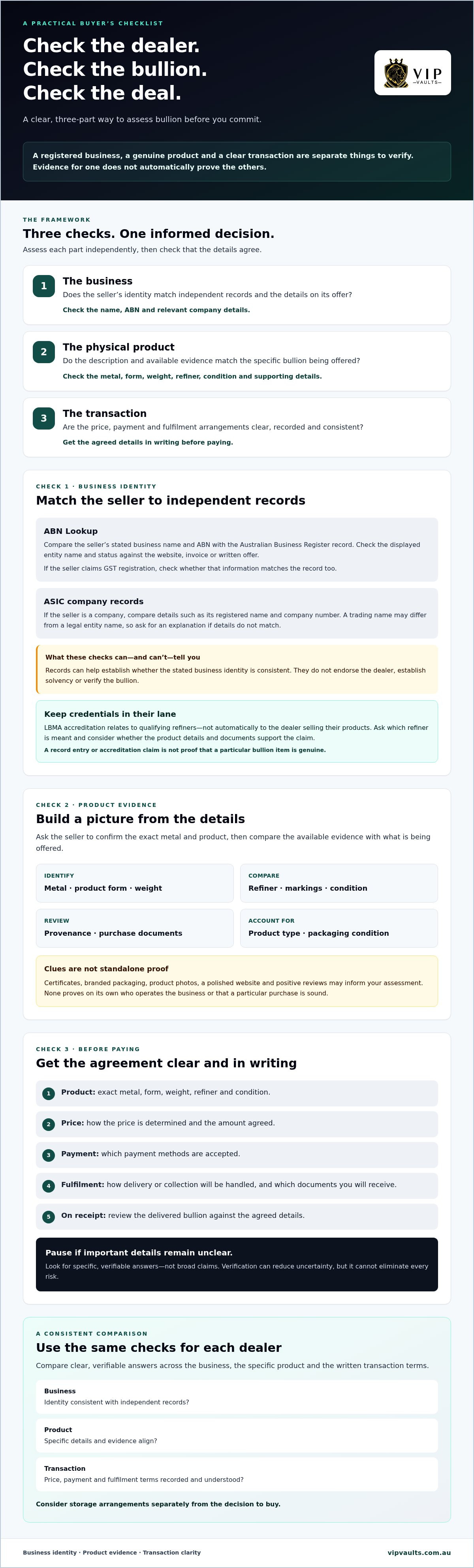
A consistent process makes it easier to spot unanswered questions before money changes hands. Use this sequence to organise your checks, records and decisions.
- 1. Confirm the business identity. Compare the seller’s stated business name and ABN with Australian business records. Check that contact details are consistent across the website, written offer and invoice.
- 2. Match the product to the offer. Confirm the metal, form, weight, named refiner and condition. Ask the dealer to explain any missing or unclear specification or provenance detail.
- 3. Get the transaction terms in writing. Request the agreed price in A$, how it is calculated, payment instructions, delivery or collection arrangements, and the documents you’ll receive. Confirm any conditions that could affect the final amount or fulfilment.
- 4. Verify payment details. If payment instructions change unexpectedly, don’t rely on the new message alone. Contact the dealer through a channel you independently confirmed, such as contact details already checked on its official website, and verify the change before transferring funds.
- 5. Keep a complete record. Save the advertisement or product listing, correspondence, written offer, invoice and payment confirmation together. This gives you a clear reference if questions arise later.
- 6. Review the delivery. Compare the bullion and accompanying documents with the agreed specifications. Where appropriate, photograph the outer packaging and visible identifiers before opening. Raise discrepancies promptly and avoid altering or testing the item yourself.
Written confirmation matters. A phone conversation can clarify a point, but ask for any important change to the product, price or fulfilment terms to be recorded before you proceed. If records conflict, details change without a clear explanation, or the delivered item differs from the agreement, pause. Seek independent guidance rather than trying to resolve uncertainty by modifying the bullion.
Verifying bullion dealer authenticity is not a guarantee against every risk. It is a disciplined way to check that the business, product and transaction align before and after purchase. For a point of comparison, you can review VIP Vaults & Bullion Exchange’s bullion information alongside your own checks.
Choose a transparent bullion dealer and consider storage separately
After checking the business, product and proposed sale, compare how clearly each dealer answers practical questions. Specific, consistent information is more useful than superlatives such as “trusted” or “fully certified” when a claim isn’t supported by evidence. Ask each seller the same questions, then compare their written responses and records.
Questions to ask before choosing a dealer
- Which refiner produced the item, and what product documentation will accompany the sale?
- How is the quoted price calculated, and how long does the quote apply? Ask for the total in A$ and any relevant pricing conditions in writing.
- What payment methods and fulfilment arrangements apply, and what records will you receive?
- How should you raise a discrepancy if the product or documents don’t match the written offer?
Compare the answers for clarity and consistency with the product listing, invoice and independent checks. A dealer who explains what its evidence does and doesn’t establish gives you more to assess than one relying on urgency or broad assurances. Take time to consider the information. Don’t let pressure replace due diligence.
VIP Vaults & Bullion Exchange states that its bullion is sourced from recognised refiners, including LBMA-accredited manufacturers, and describes pricing linked to global markets with live pricing. Treat these as claims to assess: ask which refiner applies to the specific item and confirm the current product and pricing details before deciding.
Consider secure storage after verifying your purchase
Buying bullion and deciding where to keep it are separate choices. Home storage may offer direct control, while a private vault may suit buyers considering dedicated storage. Compare options against your own needs, including access arrangements, security measures, fees, insurance terms and the records available. Ask providers to explain their arrangements rather than assuming that a particular storage option meets your requirements.
VIP Vaults & Bullion Exchange lists private vault rental and bullion lockers among its offerings. Review the terms and current details independently, then decide whether either option aligns with your storage needs. For a broader comparison, read about private vaults in Australia.
Verifying bullion dealer authenticity gives you a basis for comparing sellers, but your purchase decision should rest on evidence you can check and terms you understand. Once you’ve completed those checks, review bullion and private storage options from VIP Vaults & Bullion Exchange as one option to assess.
Make your next bullion decision with confidence
Verifying bullion dealer authenticity means checking the business, the specific metal and the transaction separately. Confirm the seller’s identity through independent Australian records, compare product details with relevant refiner information, and get the price and fulfilment terms in writing. No single certificate, stamp or online review can replace that broader assessment.
Keep the storage decision separate from the purchase. Once you’ve completed your checks, compare storage arrangements against your own security, access and documentation needs.
VIP Vaults & Bullion Exchange states that it sources bullion from internationally recognised refiners, including LBMA-accredited manufacturers, and offers transparent live pricing and private vault rental options. Verify the current details and assess them alongside your own due diligence.
Review bullion and private storage options, then take the time you need to make an informed choice. Careful checks can help you proceed with greater clarity and confidence.
Frequently Asked Questions
How can I verify that a bullion dealer is genuine?
Verifying bullion dealer authenticity means checking the business, the metal and the transaction separately. Compare the dealer’s stated business name and ABN with ABN Lookup, and check ASIC company records if relevant. Ask which refiner produced the item and compare its specifications with reliable product information. Before paying, get the product description, price, payment method and fulfilment arrangements in writing. No single register entry, review or certificate confirms every aspect of a sale.
Does an ABN prove that a bullion dealer is trustworthy?
No. An ABN helps you check whether a business identity and registration details align with the Australian Business Register, but it isn’t an endorsement or a measure of trustworthiness. Compare the record with the seller’s name on its website and documents, and ask about any discrepancy. Then assess the specific bullion and transaction separately. An active ABN does not establish a product’s purity, verify its provenance or guarantee that a purchase will be fulfilled as agreed.
Does LBMA accreditation apply to bullion dealers or refiners?
LBMA accreditation applies to qualifying refiners, not automatically to retailers or bullion dealers. If a seller says an item comes from an LBMA-accredited refiner, ask for the manufacturer’s name and check its current status against the relevant LBMA information. Then compare the item’s description and supporting records with information from that refiner. The refiner’s status doesn’t itself certify the dealer or prove that a particular item is genuine.
Can a certificate prove that a gold bar is authentic?
A certificate can support your assessment, but it isn’t conclusive proof on its own. Check whether it identifies the product clearly and whether details such as the refiner, weight and any serial number match the bar and other purchase documents. Consider the packaging and product type too. If the information doesn’t align, ask the seller to explain before proceeding. Treat a certificate as one piece of evidence, not a substitute for independent checks.
What should I check on a bullion bar before buying it?
Confirm the bar’s stated metal, weight, refiner, condition and any visible markings or serial number. Compare these details with reliable information from the named refiner and the seller’s written offer. Ask what documentation accompanies the sale and whether the bar is being supplied in its original packaging, if applicable. Features differ between products, so don’t assume every bar has the same markings or identifiers. Avoid tests that could damage the bar.
Is it safe to buy bullion online in Australia?
Buying bullion online can be assessed with the same careful checks as any other purchase, but no online transaction is risk-free. Verify the business identity independently, review the exact product details and obtain the price, payment instructions and delivery terms in writing. If payment details change unexpectedly, confirm the change through contact information you verified separately. Don’t rely solely on website design, reviews or product photographs, and pause if key details remain unclear.
What should I do if bullion I receive does not match the invoice?
Pause and contact the seller promptly in writing. Describe the difference between the delivered item and the invoice, and keep the invoice, correspondence, payment record and packaging. Photograph the package and visible product identifiers where appropriate. Don’t alter, clean or test the bullion yourself, as this may affect its condition. Ask the seller to explain the discrepancy and outline how it will be addressed. If the response doesn’t resolve the issue, seek independent guidance.