
What if a vault’s most impressive security claim tells you less than its written terms? Knowing what to look for in a vaulting service means looking beyond persuasive language and comparing what’s documented, how your assets are held and how retrieval works.
It’s reasonable to want clear answers before entrusting valuable assets to off-site storage. Fees, custody arrangements and access conditions can be difficult to compare, particularly when you’re storing bullion, jewellery or assets held under a particular ownership arrangement. The right choice depends on how these details fit your needs, not on security labels alone.
This guide sets out a practical framework for comparing vaulting services in Australia. You’ll learn what to look for in security documentation, which service terms to read closely and how to assess access and retrieval against the assets you plan to store. It also explains the distinction between private vault rental and bullion locker arrangements. VIP Vaults & Bullion Exchange Perth offers private vault rentals and bullion lockers for precious metals and jewellery, providing a discreet option for specialist storage.
Key Takeaways
- Match the storage arrangement to your assets, ownership structure, discretion preferences and expected access needs.
- Learn what to look for in a vaulting service by distinguishing documented security evidence from broad claims, and noting its scope, date and issuer.
- Compare the rental basis, included services, additional charges, contract term and cancellation conditions. Keep storage fees separate from bullion prices.
- Use a four-step access test to consider retrieval frequency, stated arrangements, authorised users and the retrieval process.
- Apply a scorecard to rate evidence, contract clarity, asset fit, access fit and cost transparency as documented, unclear or unsuitable.
What to look for in a vaulting service starts with your assets
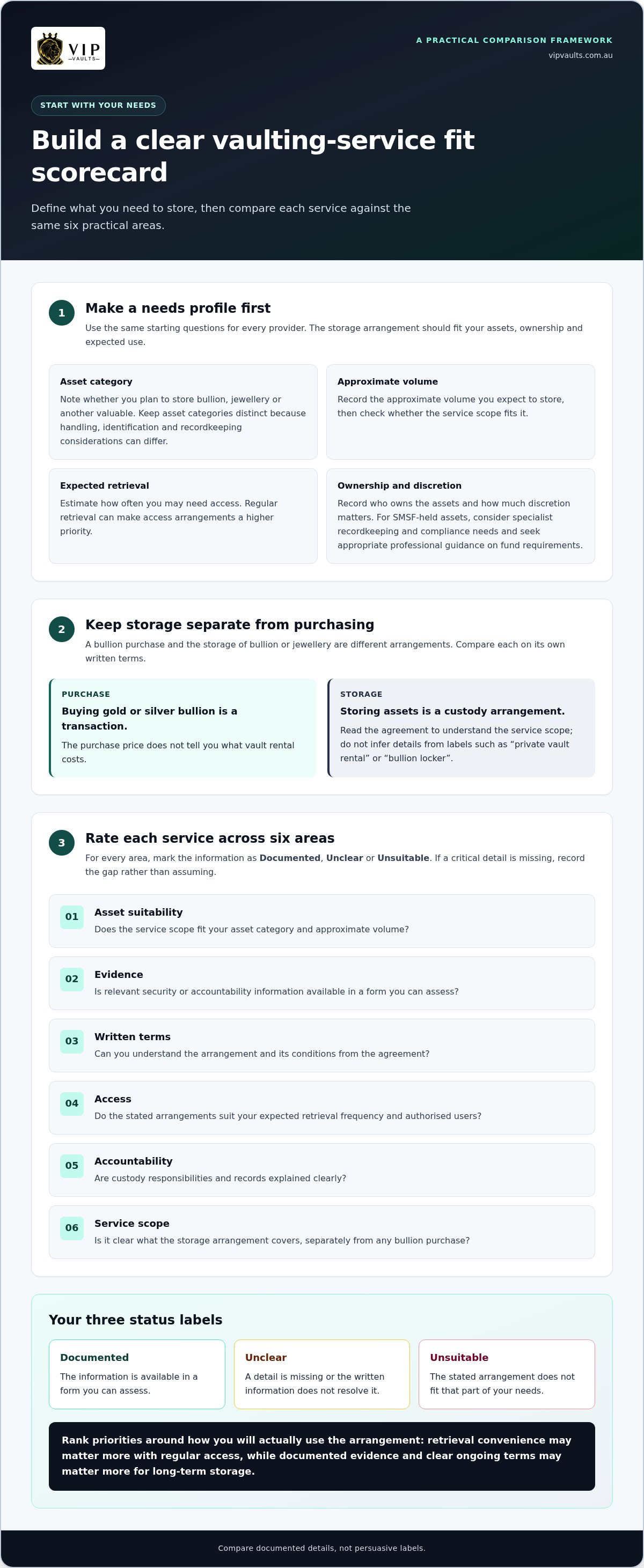
Begin with the decision that shapes every comparison: what are you storing, who owns it, how often might you need to retrieve it, and how much does discretion matter to you? An arrangement for investment-grade bullion may not meet the practical needs of someone storing jewellery they want to access occasionally.
Separate storage from purchasing. Buying gold or silver bullion is a transaction; storing bullion or jewellery is a custody arrangement governed by its own terms. A provider may offer both, but the purchase price of precious metals does not tell you what vault rental costs. Likewise, “private vault rental” and “bullion locker” can describe different offerings. Read the written agreement to understand the service scope rather than inferring details from its name.
For background on the different purposes and forms of vaults, see What is a Vault? For an Australian overview of private storage, the Australian private vaults guide provides broader context.
Which assets and ownership arrangements shape the decision?
Make a brief needs profile before comparing providers. Note whether you plan to store bullion, jewellery or another valuable; estimate its approximate volume; and record how frequently you expect to retrieve it. Keep asset categories distinct: bullion and jewellery can have different handling, identification and recordkeeping considerations. If assets are held through an SMSF, treat ownership as a prompt to consider specialist recordkeeping and compliance needs, and seek appropriate professional guidance on fund requirements.
How should you rank your vaulting priorities?
Rank your priorities instead of treating every feature as equally important. Consider the strength of security evidence, discretion, retrieval convenience and cost transparency. Someone expecting regular access may put retrieval arrangements near the top; someone storing assets long term may give greater weight to documented evidence and clear ongoing terms. Your ranking should reflect how you’ll actually use the arrangement.
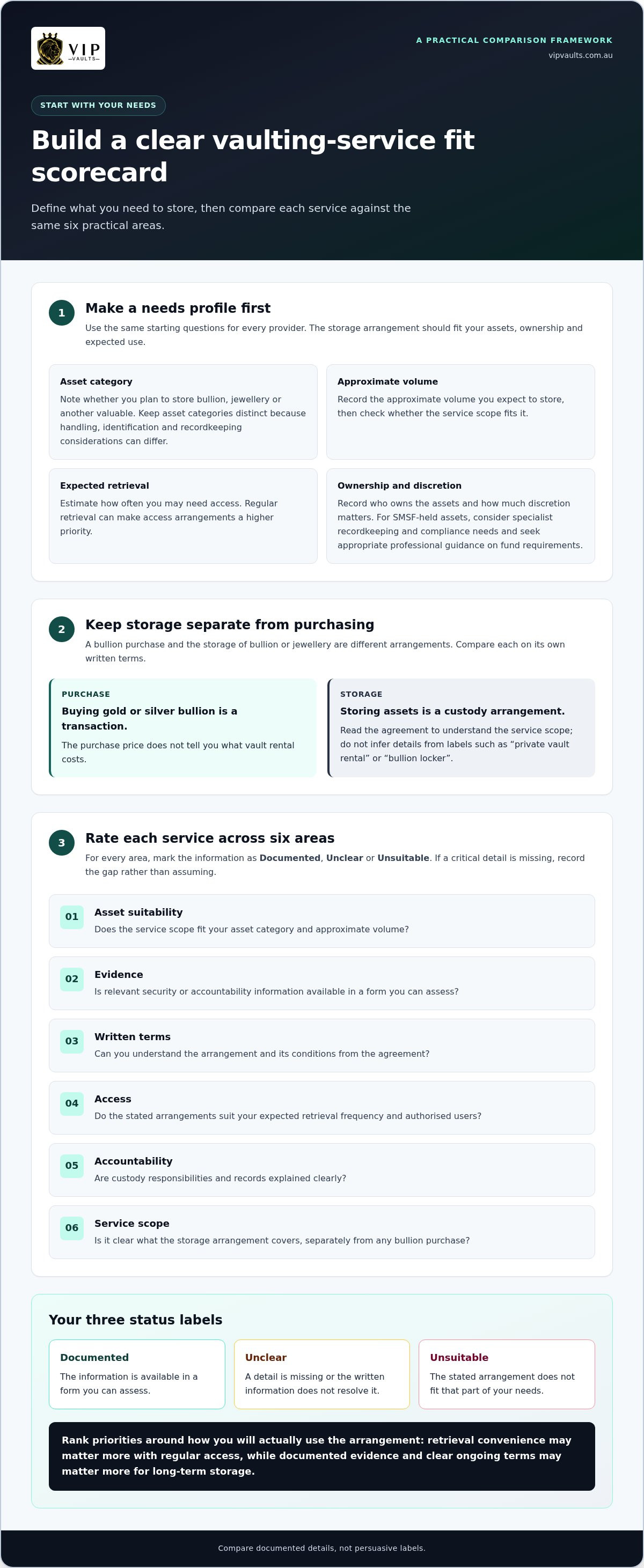
Use a simple fit scorecard to keep the decision grounded. For each area, mark the information documented, unclear or unsuitable:
- Asset suitability: Does the service scope fit your asset category and approximate volume?
- Evidence: Is relevant security or accountability information available in a form you can assess?
- Written terms: Can you understand the arrangement and its conditions from the agreement?
- Access: Do the stated arrangements suit your expected retrieval frequency and authorised users?
- Accountability: Are custody responsibilities and records explained clearly?
- Service scope: Is it clear what the storage arrangement covers, separately from any bullion purchase?
This profile turns “what to look for in a vaulting service” into a practical comparison. If a critical item is unclear, record that gap rather than assuming it will work in your favour. You can then assess security documentation, contractual detail and access arrangements against a defined need, not a persuasive label.
How to assess a vaulting service’s security and accountability
Security language can sound authoritative without showing what it covers. A claim such as “high security” is not, by itself, evidence of a particular facility’s protections, oversight or responsibilities. Evaluate the documents behind each claim and whether they relate to the service and assets you’re considering.
Evidence-led security evaluation means judging documented protections by their scope, source and relevance to the assets being stored.
What counts as useful evidence rather than reassurance?
Look for written policies, independent assessments and clearly identified parties responsible for custody or oversight, where these are supplied. For each document, note who issued it, when it was prepared and what it covers. Evidence about one process or location may not establish how every part of a service operates.
Compare like with like. A broad statement about security is difficult to assess unless it identifies the subject of the claim and points to supporting documentation. Terms such as “certified”, “audited” or “protected” need context: what was assessed, by whom and for what purpose? Don’t infer a specific safeguard from general wording, and don’t treat a document’s existence as proof that it applies to your particular storage arrangement.
Keep a simple evidence record as you compare options. For each claim, capture the document or policy name, issuing party, date, stated scope and any limitation. If a detail is missing, mark it as unclear rather than filling the gap with an assumption. This makes differences between services easier to see and gives you a precise basis for reviewing the written agreement.
How should insurance and accountability be compared?
Insurance is a separate question from physical security. Distinguish any coverage described in a service’s written terms from an insurance policy you arrange yourself. Neither the word “insured” nor a general assurance establishes that your particular assets are covered, or that cover is automatic.
Read the terms for the details that determine how coverage may apply:
- Scope and limits: Which assets or events are covered, and what limits apply?
- Exclusions: What circumstances or asset categories are excluded?
- Valuation basis: How is an asset’s value determined, and what records may be relevant?
- Claims process: Who must be notified, what evidence is required, and who handles the claim?
Also identify who is responsible for each step, from recording the stored property to responding to a claim or discrepancy. Keep your own documentation of ownership and valuation, and compare it with the recordkeeping requirements in the service terms. For SMSF-held assets, consider whether the records and responsibilities align with the fund’s needs, and take professional advice on compliance.
VIP Vaults & Bullion Exchange offers private vault rentals and bullion lockers for precious metals and jewellery. Its private vault rental and bullion locker options provide a starting point for readers comparing specialist storage arrangements.
Compare vaulting service agreements, fees and storage terms
A headline rental figure can conceal important differences in what an arrangement covers and how long its terms apply. Compare the written agreement and complete fee structure side by side. This makes it easier to see whether two services offer a similar basis for comparison, rather than choosing on price alone.
Which contract terms should sit side by side?
Build a comparison matrix from the documents, not verbal summaries. Record the rental basis, included services, any stated additional charges, contract duration, renewal process, payment timing and cancellation conditions. Then check whether the agreement identifies you, describes the assets covered and assigns responsibilities to each party. If a term is unclear, note it rather than assuming both arrangements work the same way.
- Rental basis: What determines the rental arrangement, and how is it described in the agreement?
- Included services: What does the stated fee cover, and what sits outside that scope?
- Additional charges: Are any extra costs described, and what circumstances may trigger them?
- Term and renewal: How long does the agreement run, and what does it say about renewal?
- Payment and cancellation: When is payment due, and what conditions apply if the agreement ends?
Read custody, ownership and liability wording closely. The agreement should make clear whose assets are being stored, what the service is responsible for and how responsibility is described if an issue arises. If you’re unsure how a clause affects your position, seek independent legal advice before signing. This is a practical review, not a substitute for advice on your circumstances.
How can readers compare fees without focusing only on price?
Compare the full stated fee structure with the services included. A lower headline charge may not represent the same scope or terms as another arrangement. Note what is recurring, what is charged separately and whether the agreement explains how charges are applied. Don’t treat missing details as included by default; record them as unclear in your comparison.
Keep storage costs separate from bullion purchase pricing. A live gold or silver price relates to buying or selling metal, while a vault rental fee relates to storage under an agreement. They describe different transactions, so one cannot establish the cost of the other. This distinction matters when a specialist offers both precious metals and storage.
For SMSF trustees, documentation and ownership records can warrant closer attention. The SMSF gold storage guide offers relevant context, but consider professional advice for your fund’s specific compliance requirements.
VIP Vaults & Bullion Exchange offers private vault rentals and bullion lockers for precious metals and jewellery. Explore its specialist vault storage options as part of your comparison.
Test a vaulting service against access and retrieval needs
Storage is only practical if the retrieval arrangement fits how you expect to use it. Someone placing bullion away for long-term safekeeping may rarely need access. Someone storing jewellery for occasional use, or assets they may need to retrieve at short notice, has a different priority. Stated access arrangements should match your real retrieval pattern, not an idealised version of it.
“Private” describes an arrangement, not an access schedule. Private vaulting does not automatically mean unrestricted or 24/7 walk-in access. Read the service’s written access terms and consider how they work in ordinary circumstances as well as when retrieval is urgent.
What should you understand about retrieval before choosing?
Use this four-step test to assess fit:
- Estimate retrieval frequency. Decide whether you expect to retrieve assets rarely, occasionally or regularly.
- Review stated access arrangements. Note the stated opening arrangements, whether visits need to be scheduled and any notice requirements.
- Map authorisation. Identify who may access the assets and what the written terms say about identity verification or authorised representatives.
- Check the retrieval process. Understand how a request is made, what steps are involved and how urgent retrieval is addressed in the terms.
These details determine convenience. A scheduled visit may suit long-term storage, while an arrangement requiring advance notice may not suit someone who expects to retrieve items at short notice. Don’t assume the word “private” means you can access assets whenever you choose; assess the written process and how it aligns with your plans.
Will the arrangement work for occasional or delegated access?
Consider who may need to retrieve the assets. If you might authorise another person, look for clear terms describing how that authority is recorded and what identity checks apply. Don’t rely on an informal understanding. For occasional visits, consider whether scheduling steps are manageable; for regular retrieval, give the stated process more weight in your comparison.
Also distinguish a planned visit from an urgent need. A service can suit assets held over the long term yet be less suited to property you expect to access quickly. Review what the agreement says about notice and retrieval requests, then compare those terms with realistic scenarios, such as needing jewellery for an event or arranging access while you’re unavailable. Don’t assume an urgent request will be handled differently unless the written arrangement explains how.
Record your findings alongside your other comparison notes: expected frequency, scheduling or notice conditions, authorised users and retrieval steps. Mark any point that remains unclear, especially if another person may need access. This turns convenience into a defined part of your decision rather than a vague impression.
If private storage for precious metals or jewellery fits your needs, explore private vault rental and bullion locker options from VIP Vaults & Bullion Exchange.
Use a vaulting service scorecard to make your final choice
Once you’ve reviewed the evidence, agreement and access arrangements, bring the comparison together in one scorecard. It helps show whether a service fits your priorities, rather than allowing a polished claim or low headline fee to dominate the decision. Use the same criteria for every option and base each rating on written information you can compare.
How do you apply the scorecard consistently?
First, assign each criterion a priority weight: 3 for essential, 2 for important or 1 for lower priority. Then mark each service as documented, unclear or unsuitable against the same written evidence. For a simple comparison, score documented as 2, unclear as 1 and unsuitable as 0, then multiply by the priority weight. This is a sorting aid, not a security certification.
- Evidence: Is relevant information about security and accountability documented?
- Contract clarity: Can you understand the responsibilities, conditions and limits in the agreement?
- Asset fit: Does the stated service scope suit your assets and approximate storage needs?
- Access fit: Do the written arrangements align with your expected retrieval pattern?
- Cost transparency: Can you distinguish storage charges, inclusions and any stated additional costs?
Choose weights according to your circumstances. For example, frequent retrieval may make access fit essential, while long-term storage may lead you to prioritise documented evidence and contract clarity. Compare like with like: use the agreement, policies and other available written material, not brand language alone. Record missing details as unclear, not as proof of poor security. A low rating on an essential requirement deserves attention even if a service scores well elsewhere; a high total should never override a critical mismatch.
When might a specialist private vault suit your needs?
A specialist arrangement may suit people seeking storage for precious metals or jewellery. VIP Vaults & Bullion Exchange offers private vault rentals and bullion lockers. These are storage categories, distinct from buying bullion. Consider them against your scorecard: assess whether the service type fits your assets, then review the relevant terms and access arrangements in light of your priorities.
Before deciding, revisit any “unclear” ratings that affect a high-priority need. Keep the completed scorecard with your comparison notes so you can see why an option fits, where a gap remains and which conditions matter most. The aim isn’t to find a perfect numerical score. It’s to make a deliberate choice based on evidence and terms that suit your circumstances.
If private storage for precious metals or jewellery is relevant to your needs, explore VIP Vaults’ private vault options as a next step in your comparison.
Take the next step with confidence
Choosing a vaulting arrangement is a decision about stewardship over time. Before committing, revisit any unresolved scorecard item that could affect ownership, access or confidence in the written terms. Compare the arrangement with your records and intended use, then decide whether it offers the discretion and practical fit you need.
VIP Vaults & Bullion Exchange is an independent business offering private vault rentals and bullion lockers for precious metals and jewellery. Keep your needs profile in view as you explore the options. It can help separate a storage decision from a bullion purchase and keep your priorities at the centre. Knowing what to look for in a vaulting service gives you a clear basis for choosing an arrangement that suits your assets and circumstances.
Explore private vault and bullion locker options and take your next step with care and confidence.
Frequently Asked Questions
What should I look for in a vaulting service agreement?
Check that the agreement identifies the account holder and explains how stored property is described and recorded. Ask yourself whether you could reconcile the inventory if you later retrieved only some items. For example, bullion records may need to distinguish bars by refiner, weight or serial number where applicable. Understanding what to look for in a vaulting service agreement can help you spot gaps before they become difficult to resolve.
Is bullion automatically insured when it is stored in a private vault?
No. Storage in a private vault doesn’t automatically mean your bullion is insured. Coverage depends on the written terms and any separate policy you hold. Read the documents for covered events, limits, exclusions, valuation basis and the steps for making a claim. If the terms refer to cover provided through the service, check how it applies to your assets. Don’t assume your full holding is protected.
Can a private vault service store jewellery as well as bullion?
Yes. Private vault services can provide storage for jewellery as well as precious metals, but the arrangement’s terms determine what it accepts and how items are recorded. Before storing a piece, create your own description and dated photographs, and retain purchase or valuation documents where available. These records can help establish which item you placed in storage and support your personal asset records if you later need them.
How much does a vaulting service cost in Australia?
There isn’t one standard price that applies to every storage arrangement. The amount can depend on the rental basis, the space or service selected, the agreement’s term and any separately charged services. Review the written fee schedule and note the payment timing and conditions that may change charges. Keep it separate from a bullion quote: the live price of gold or silver is a trading price, not a storage fee.
What records should SMSF trustees keep for bullion held in storage?
Trustees should maintain records that help show the fund’s ownership and account for its holdings. Depending on the circumstances, this may include purchase invoices, an asset register with descriptions and identifying details where available, storage agreements, statements or transaction records, and documentation of deposits or withdrawals. Keep records consistent with the fund’s accounting and reporting processes. SMSF rules are specific, so discuss recordkeeping and compliance with the fund’s accountant or auditor.
How can I check the provenance of a gold or silver bullion bar?
Start with the purchase invoice and any accompanying documentation. Compare the stated refiner, metal, weight and identifying marks on the bar with those records; where a serial number or assay documentation is provided, retain it with the invoice. Provenance records can support traceability, but paperwork alone doesn’t establish every aspect of a bar’s history. VIP Vaults & Bullion Exchange sources bullion from internationally recognised refiners, including LBMA-accredited manufacturers.
Does a vaulting service replace home or business insurance?
No. A vaulting arrangement isn’t automatically a substitute for your home or business insurance. Policies differ, and cover for property held away from your premises may depend on your specific policy wording. Tell your insurer how the assets are stored and ask whether your policy covers them, including applicable limits, exclusions and evidence requirements. Assess any storage-related coverage separately so you understand where responsibilities begin and end.