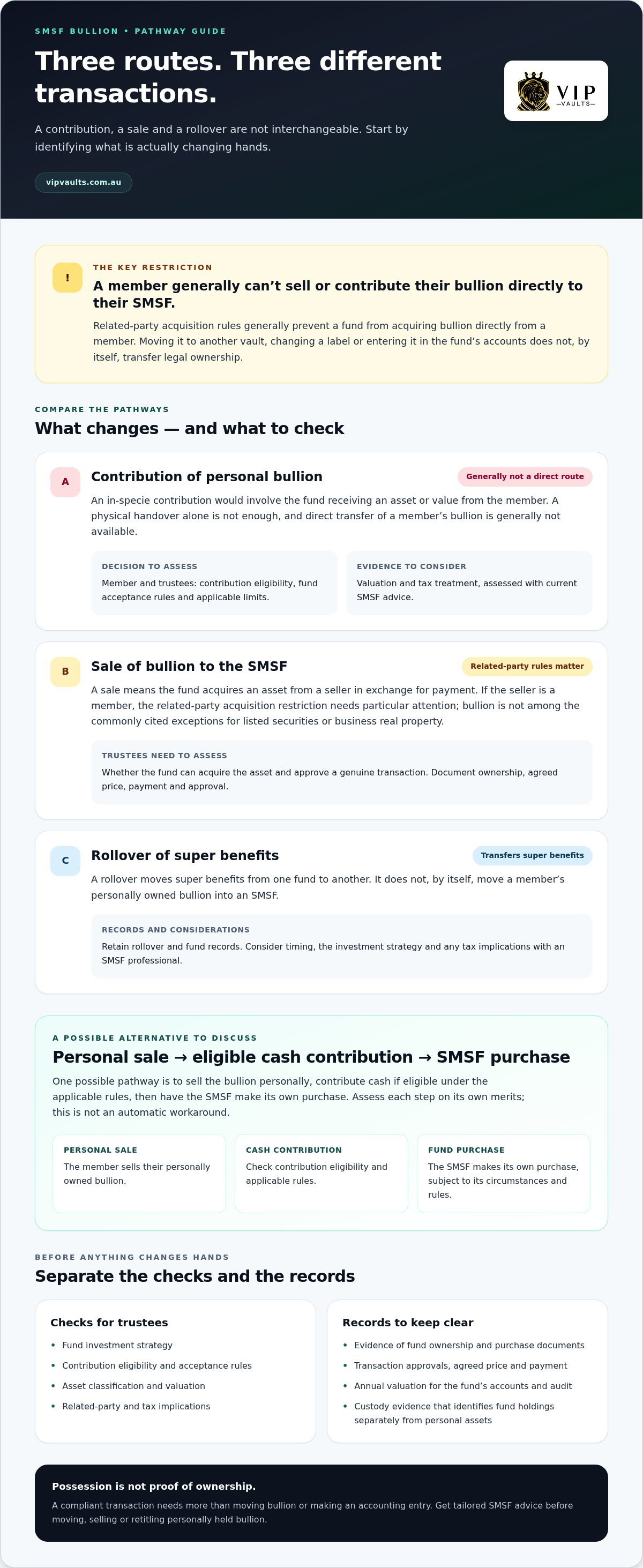

Can bullion you already own simply be moved into your SMSF? Usually, no. Transferring bullion into an SMSF isn’t a simple change of ownership: related-party rules generally prevent a fund from acquiring bullion directly from a member, whether through a sale or an in-specie contribution.
That doesn’t necessarily rule out holding bullion through your fund. One possible pathway is to sell your personal bullion, contribute the cash within the applicable superannuation rules, then have the SMSF make its own purchase. A contribution and a rollover are different transactions, each with its own requirements. Before proceeding, trustees need to consider the fund’s investment strategy, contribution eligibility, asset classification, valuation, and how ownership and custody will be evidenced.
This 2026 Australian guide explains the main ways bullion may enter an SMSF, the compliance questions to address, and the records to retain for the fund’s accounts and annual audit. It also covers secure custody. Private vault or bullion locker storage may help document where fund-owned bullion is held, but storage alone doesn’t establish compliance.
Key Takeaways
- Before transferring bullion into an SMSF, distinguish a personal contribution, a sale to the fund, and a rollover of existing super benefits.
- Don’t move, sell, or retitle personally held bullion until the proposed transaction route has been assessed against SMSF rules.
- Prepare for professional advice by separating evidence of ownership, valuation, transaction approvals, and custody records.
- Keep clear records of fund ownership, purchase documents, payment, and annual valuation to support the fund’s accounts and audit.
- Plan secure custody after the SMSF acquires the bullion, and keep fund holdings clearly identifiable from personal assets.
Can you transfer personally owned bullion into an SMSF? Start with the transaction
Personal bullion doesn’t become an SMSF asset because you change a label, update a spreadsheet, or move it to a different vault. The key question is what transaction, if any, has legally changed ownership and whether it complies with superannuation rules. Under the general related-party acquisition restriction, an SMSF can’t acquire an asset directly from a member. Bullion isn’t among the commonly cited exceptions for listed securities or business real property.
That means a direct sale of your bullion to the fund, or an in-specie contribution of the bullion itself, is generally not a permitted route. But “transferring bullion into an SMSF” can describe several different arrangements. The legal, tax, and accounting consequences depend on the circumstances, so members and trustees should obtain tailored SMSF advice before acting.
What does “transferring bullion into an SMSF” mean?
Keep three things distinct: legal ownership, physical possession, and the fund’s accounting records. Changing storage affects where bullion is held, not who owns it. Likewise, entering bullion in the SMSF’s accounts doesn’t establish that the fund acquired it validly. The records should reflect a genuine, compliant transaction and identify the fund’s asset clearly.
Illustrative example, not advice about eligibility: a member places personally owned gold bars in a vault and tells the trustee to record them as fund assets. The bars have moved, but that alone doesn’t transfer legal ownership or resolve whether the SMSF can acquire them.
Why the transaction route matters
A contribution and a sale are different legal and accounting events. A personal contribution involves contributing value to super, subject to applicable contribution rules. A sale involves the fund acquiring an asset from a seller, so related-party acquisition rules require particular attention when the seller is a member. Don’t assume that calling a sale a contribution changes its legal character.
A rollover is different again. It moves super benefits between funds; it doesn’t, by itself, move a member’s personally owned bullion into an SMSF. One possible alternative to discuss with an SMSF professional is selling the bullion personally, contributing cash if eligible, then having the SMSF make its own purchase. Assess each step on its own merits.
- Contribution: Establish what is being contributed and whether the member and fund meet the applicable rules.
- Sale: Assess the seller, the fund’s ability to acquire the asset, and the transaction documentation.
- Rollover: Confirm that the transfer concerns super benefits held in another fund, not personal bullion.
Before moving, selling, or retitling bullion, have an Australian SMSF specialist assess the proposed route, including related-party, contribution, and tax implications. A compliant fund purchase needs more than physical possession or an accounting entry.
Compare the possible pathways for putting bullion into an SMSF
These routes aren’t interchangeable. A contribution adds value to a member’s super, a sale is an asset purchase by the fund, and a rollover transfers super benefits from one fund to another. The distinctions affect ownership, paperwork, and tax treatment. No route is automatically available: trustees need to assess the fund’s circumstances, investment strategy, and current rules before acting.
| Pathway | Ownership change | Decision-maker | Records and advice to consider |
|---|---|---|---|
| Contribution of personal bullion | Would involve the fund receiving value or an asset from the member. An in-specie bullion contribution is generally not an available way to transfer a member’s bullion directly into an SMSF. | The member and trustees, subject to contribution eligibility and the fund’s acceptance rules. | Seek current advice on contribution rules, caps, valuation, and tax treatment. A physical handover alone isn’t sufficient evidence. |
| Sale to the SMSF | The fund would acquire bullion from the seller in exchange for payment. | The trustees must decide whether the fund can acquire the asset and approve a genuine transaction. | Document ownership, the agreed price, payment, and approval. Get specialist advice on related-party restrictions and any applicable exception. |
| Rollover of super benefits | Super benefits move from one fund to another; personal bullion doesn’t move as part of the rollover itself. | The member initiates the rollover, and the receiving fund handles the benefit under its processes. | Retain rollover and fund records. Assess timing, investment strategy, and any tax implications with an SMSF professional. |
Contributing personally held bullion
Don’t assume a bar or coin can be handed to the trustee and counted as a contribution. In-kind contributions raise questions about whether the fund can accept the asset, how its value is established, and how the contribution is treated under the member’s applicable limits. The Australian Taxation Office’s guidelines for SMSFs are a useful starting point, but they don’t replace advice on an individual transaction. Have a qualified SMSF professional assess the proposed contribution and required evidence before anything changes hands.
Selling bullion to the SMSF or rolling over super
A sale needs to be a genuine purchase, supported by evidence of who owns the bullion, how its price was determined, and how payment was made. A member selling personal bullion to their SMSF raises related-party acquisition concerns. The general restriction and any potential exception require specialist confirmation; don’t assume bullion qualifies for an exception. An alternative to discuss is selling bullion personally, contributing cash if eligible, then having the SMSF make its own purchase.
A rollover isn’t a workaround for these rules. It transfers super benefits, not personally owned bars or coins. For current regulatory context, review the ATO guidance and obtain tailored legal, tax, and SMSF advice. Once ownership and compliance requirements are established, private vault and bullion locker storage may form part of the fund’s custody arrangements.
What compliance, valuation, and ownership checks should trustees make?
Treat these checks as preparation for tailored legal, tax, and SMSF advice, not as a substitute for it. Before transferring bullion into an SMSF, trustees need to establish what the fund would own, how the proposed transaction is authorised, and how the asset will be valued and evidenced. The fund’s trust deed, governing documents, and written investment strategy also need to be reviewed against the proposed holding.
Consider each question separately. A strong custody arrangement can help show where bullion is held, but it doesn’t prove the fund owns it or that the acquisition complies with SMSF rules. Keep separate records for ownership, valuation, trustee approval, and storage, so each part of the transaction can be followed without relying on a single document.
Proving ownership and establishing market value
Build an evidence trail that identifies the bullion and connects it to its owner. Gather purchase invoices, prior ownership records, refiner or manufacturer details, and any serial numbers or other identifying marks. Record the metal, form, weight, and relevant condition. If items are held together, make the fund’s holdings distinguishable in the inventory and custody records.
Valuation evidence should relate to the relevant transaction date and the specific bullion, rather than rely on a broad estimate. Retain the method used, the source of market evidence, and any working papers or independent valuation obtained. SMSF financial statements require assets to be reported at market value at 30 June. Keep support for the figure supplied to the auditor and verify the current valuation requirements.
Checking related-party and SMSF investment rules
Related-party rules can restrict an SMSF from acquiring assets from a member or another related party. Whether a rule applies, and whether an exception is relevant, depends on the asset and transaction. Ask an SMSF specialist to check the current SIS legislation and ATO guidance before trustees approve or complete a proposed transaction.
Then test the proposed holding against the fund’s documented investment strategy and sole-purpose obligations. The strategy should explain how bullion fits the fund’s objectives, diversification, and risk considerations. It shouldn’t be amended simply to justify a transaction after the fact. Trustees should also document the decision and its basis, including why the investment is appropriate for the fund.
- Ownership: Who legally owns each bar or coin before and after the proposed transaction?
- Valuation: What evidence supports the value at the relevant date and at 30 June?
- Approval: Do the fund documents and trustee decision support the transaction?
- Custody: Can records identify the fund’s bullion separately from members’ personal holdings?
Have an Australian SMSF professional review the transaction against current ATO guidance, applicable SIS legislation, and audit requirements. Separating the evidence gives trustees and the independent auditor a clearer basis for assessing the holding.
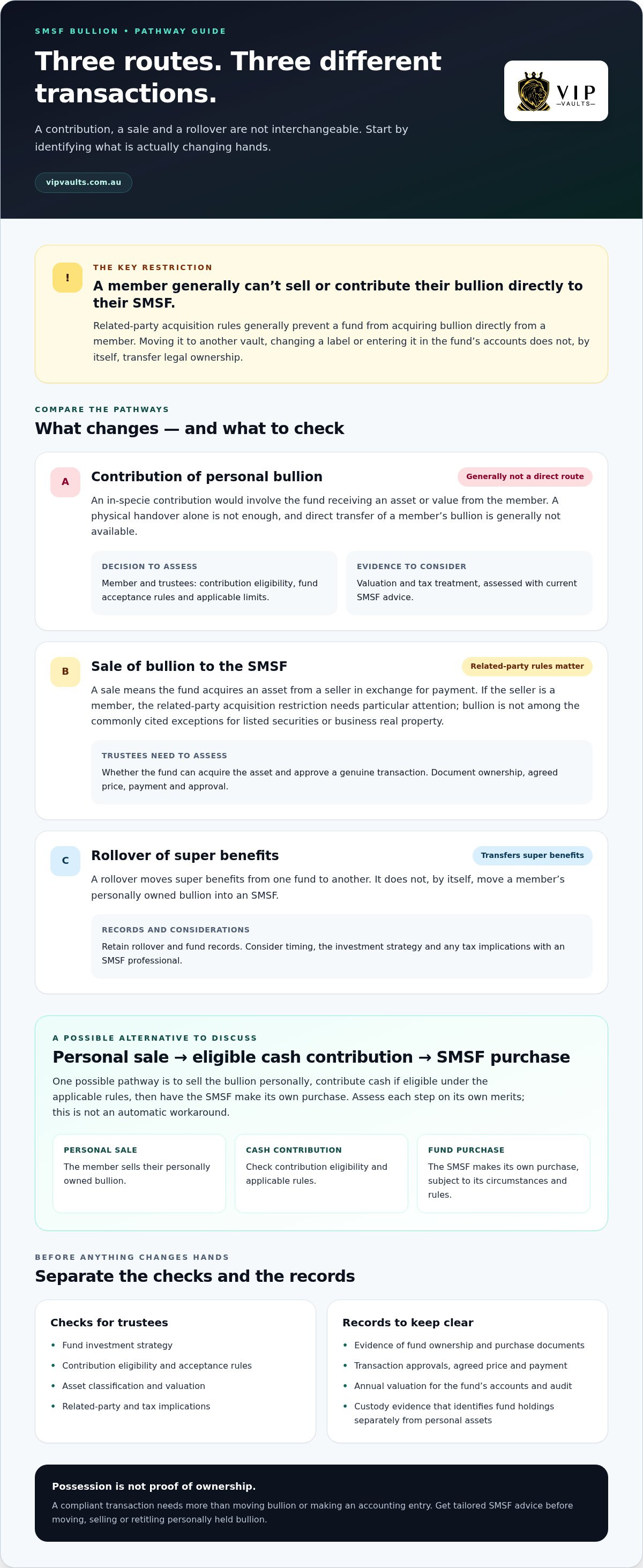
How to prepare and document a bullion transaction step by step
Use a gated process and don’t move, sell, or retitle bullion until the proposed route has been assessed. A physical handover or change of storage can complicate the evidence trail without resolving whether the SMSF can lawfully acquire the asset. Document each stage and proceed only when the trustees understand the transaction’s legal and accounting form.
Before the transaction: establish the facts
Start with an inventory and ownership history. Record who legally owns each item, how it was acquired, and whether any security interest or other encumbrance affects it. Note the metal, form, quantity, refiner, identifying marks, and available purchase documents. Give this information, along with the fund’s governing documents and investment strategy, to an SMSF professional for assessment against the proposed route and current rules.
- Pause: Keep the bullion and its ownership arrangements unchanged while the proposal is reviewed.
- Identify the route: Clarify whether the proposal concerns a contribution, sale, or rollover of super benefits. Don’t treat these as interchangeable.
- Obtain advice: Have an SMSF professional assess legal, tax, and contribution implications, including related-party restrictions where relevant.
- Verify compliance: Confirm the fund documents, investment strategy, trustee decision-making, and transaction requirements support the proposed action.
- Transact only after approval: Complete the agreed steps in the correct order, retaining evidence as each occurs.
- Record and reconcile: Update the fund’s accounts and asset register to reflect the transaction’s actual legal form.
After approval: complete and record the transaction
Build a file that lets trustees and the fund’s independent auditor follow the decision from proposal to ownership. Keep documents together and make sure names, dates, quantities, and values are consistent. For a sale, retain the sale documents and evidence of payment. For a contribution, retain records supporting its treatment. Ask the SMSF professional what other evidence the fund should keep.
A practical file may include:
- Approval: Trustee minutes or written decisions, including the reasoning and relevant fund documents.
- Ownership: Purchase invoices, prior ownership records, and an inventory identifying each item.
- Valuation: Valuation evidence, the method used, and supporting market information relevant to the transaction date.
- Transaction: Contracts, invoices, and payment or contribution evidence, as applicable to the approved route.
- Custody: Records showing where the bullion is held and how fund assets are distinguished from personal holdings.
Keep custody records current if the bullion’s location or arrangement changes. Private vault or bullion locker storage can support a clear custody record once fund ownership and compliance requirements are established, but it doesn’t replace transaction evidence or make a transaction compliant by itself. Private vault and bullion locker storage can form part of your documentation plan.
Plan secure custody after bullion becomes an SMSF asset
Once the SMSF has validly acquired bullion, trustees need a custody arrangement that supports clear ownership records and practical oversight. Storage is one part of the fund’s asset management, not a substitute for meeting SMSF rules. A vault receipt or locker record can help show where bullion is held, but it doesn’t establish that the fund owns it or that the original transaction was compliant.
Make the custody plan consistent with the fund’s documents and the advice trustees have received. Record the storage arrangement, identify the bullion held for the fund, and keep the relevant evidence with the fund’s records. Review those details whenever bullion is moved, added to, or removed from storage, so the inventory remains aligned with what the SMSF actually owns.
Separate SMSF bullion from personal holdings
Fund and personal bullion should be clearly distinguishable in the records and custody arrangements. A separate locker may help with physical separation, but it doesn’t by itself establish legal or beneficial ownership. Trustees should retain evidence showing how the fund acquired each item and ensure the fund’s inventory identifies its holdings separately from members’ personal assets.
For each bar or coin, record details such as metal, form, weight, refiner, and identifying marks where available. Keep storage statements, deposit or collection records, and a dated note of any movement. Document who authorised access or a change in custody, and reconcile those records with the fund’s asset register. Consistent records help trustees monitor the holding and give the auditor evidence to assess its existence and value.
Assess custody as part of the fund’s documented plan
Trustees can consider private vaults and bullion lockers as physical custody options once ownership and SMSF requirements have been established. Assess how the arrangement fits the fund’s investment strategy, record-keeping processes, and professional advice. Don’t treat discretion or secure storage as proof of compliance, or assume a particular insurance or access arrangement without reviewing the applicable terms.
For additional context, read this SMSF gold storage guidance alongside information on private vaults in Australia. These can help trustees consider how physical custody relates to a bullion plan, while legal, tax, and SMSF questions remain matters for qualified professionals.
A clear custody plan also matters when transferring bullion into an SMSF through a properly assessed transaction: the fund’s ownership records, inventory, and storage evidence should tell one consistent story. Once trustees have established the fund’s requirements, bullion storage options can form part of the custody arrangements.
Make your next move with clarity
Before transferring bullion into an SMSF, make the next step a documented decision, not a physical move. Have your SMSF professional assess the proposed transaction and clarify what evidence the fund should retain. Once ownership and compliance requirements are settled, trustees can consider custody arrangements that suit the fund’s documented plan.
VIP Vaults & Bullion Exchange Perth offers private vault rentals and bullion lockers, as well as investment-grade bullion sourced from internationally recognised refiners, including LBMA-accredited manufacturers. These options can support a considered custody plan, but storage doesn’t determine whether an SMSF transaction complies with the rules.
Keep professional advice, transaction records, and custody planning aligned as you work through each step. Explore secure bullion storage options for the fund’s physical custody arrangements.
Frequently Asked Questions
Can I transfer gold I own personally into my SMSF?
Generally, you can’t simply contribute personally owned gold in specie or sell it directly to your SMSF. One possible route to discuss with an SMSF professional is selling the gold personally, contributing cash if eligible, then having the fund make its own purchase. When transferring bullion into an SMSF, assess each step separately, including contribution eligibility, the fund’s purchase, and the tax consequences for your circumstances.
Can an SMSF buy bullion from a member or related party?
Generally, an SMSF is prohibited from acquiring an asset from a related party, including a fund member, and bullion isn’t among the usual exceptions for listed securities or business real property. Don’t assume changing the transaction’s label makes it permissible. Have an SMSF specialist assess the seller’s relationship to the fund, the asset, and the current rules before any agreement or payment is made.
How is bullion valued when it is transferred into an SMSF?
Use a supportable market value for the relevant valuation date, taking account of the bullion’s metal, weight, form, and identifying details. Spot pricing may inform a bullion valuation, but the evidence should explain how the figure applies to the specific holding. Retain the pricing source, calculation, and date. The fund also needs market-value records for its financial statements at 30 June, with current requirements checked with its adviser.
Does moving bullion into an SMSF count as a super rollover?
No. A rollover moves super benefits from one super fund to another; it doesn’t transfer bars or coins that you own personally. For example, moving a cash balance from another fund into an SMSF is a rollover, while personally owned bullion remains a separate asset. Ask the receiving fund and your SMSF professional how any rollover should be processed and recorded.
What records should I keep when bullion enters an SMSF?
Keep a transaction file that connects the fund’s decision to the asset it holds. Depending on the route, this may include trustee minutes, contracts, invoices, proof of payment or contribution records, ownership history, and valuation evidence. Add an inventory identifying each item and records showing where it is held. Keep documents together by transaction date so the auditor can trace the asset’s acquisition and subsequent reporting.
Can an SMSF store bullion in a private vault?
Yes, a private vault can be a custody option for SMSF bullion, provided trustees document the arrangement and can distinguish fund assets from personal holdings. Professional storage isn’t compulsory for investment-grade bullion, but clear evidence of location, inventory, and ownership can assist fund administration and audit. Some coins may be classified as collectables, which can have different storage requirements, so confirm the asset’s classification before deciding where to keep it.
Should I move my bullion before speaking to an SMSF accountant?
No. Keep the bullion and its ownership arrangements unchanged until an SMSF professional has assessed the proposed transaction. Moving it may change its location, but it doesn’t establish fund ownership or make an acquisition compliant. First gather purchase records, item details, and information about how you acquired the bullion. This gives your adviser a clearer basis to assess the options before you sell, contribute, or arrange custody.