Could the way an SMSF stores a physical asset matter as much as who owns it? For trustees, SMSF compliance for physical assets involves more than recording a purchase. The asset’s classification, investment purpose, custody arrangements and supporting records all contribute to a clear compliance picture.
It’s understandable to feel uncertain when bullion, rare coins, artwork and other tangible assets can sit under different rules. Personal access, storage choices and related-party dealings can also raise questions, particularly when it’s time to substantiate ownership and value for an audit.
This guide explains how the general SMSF investment rules apply alongside the specific requirements for collectables and personal-use assets. You’ll learn what trustees should document about investment decisions, storage, ownership and valuation, and how independent vault storage may support a broader custody process without replacing the trustee’s responsibility to meet SMSF obligations. The aim is a practical framework for holding physical assets with greater clarity and well-organised evidence.
Key Takeaways
- Build your SMSF compliance for physical assets around the asset’s classification, investment purpose and documented ownership, not simply the fact that it is held by the fund.
- Check whether an item is investment-grade bullion or a collectable. A coin’s rarity or numismatic value may affect how it is treated.
- For collectables, understand the specific restrictions on personal use, storage, insurance and related-party transactions before acquiring or holding an asset.
- Keep an organised evidence trail, including purchase invoices, ownership and custody records, insurance documents where required, and valuation support.
- Independent vault storage can form part of a trustee’s custody arrangements, but it does not replace the fund’s wider compliance responsibilities.
What SMSF compliance for physical assets actually involves
When an SMSF holds something that can be physically stored or handled, the applicable rules depend partly on what the asset is. Investment-grade bullion may be treated differently from artwork, jewellery or a rare coin. Classification is only the starting point: trustees also need to consider the fund’s purpose, investment strategy, transactions, custody arrangements and records as one connected process.
Asset ownership alone does not establish SMSF compliance. The key question is whether the asset is held and managed for the fund, without providing a present-day personal benefit to a member or related party. An investment intended to support retirement benefits is different from an item a member can enjoy, wear or use now. Personal access may raise concerns even when the fund paid for the asset.
Start with the SMSF’s purpose and investment strategy
The sole purpose test means the fund must be maintained to provide retirement benefits to members, or benefits to their dependants in limited circumstances. It doesn’t mean an investment will produce a particular return. Trustees need a defensible reason for holding an asset as part of the fund, rather than for private enjoyment or convenience.
Record how the asset fits the SMSF’s investment strategy. Consider its role alongside the fund’s other investments, its risks, liquidity and the fund’s needs. For example, trustees considering bullion could document why it fits the strategy and how they considered the fund’s ability to meet expenses and member benefit payments. Keep the reasoning with the fund’s records and revisit it as circumstances change. The fund’s trust deed and members’ circumstances also matter, so a general example isn’t individual legal or financial advice.
Classify the asset before applying specific rules
Separate the general SMSF investment rules from the additional conditions for collectables and personal-use assets. A label alone may not settle the issue. Bullion, jewellery and artwork are useful examples, but each item must be assessed on its characteristics and context. A coin, for instance, may be valued for its metal content or for rarity and numismatic features. Those distinctions can affect its classification, so trustees should verify the current ATO guidance for the specific coin.
Once the asset is classified, consider the relevant rules before acquiring or storing it. General SMSF obligations still apply, including restrictions on certain related-party dealings. Collectables and personal-use assets have further controls, including restrictions on personal use and particular storage, insurance and leasing requirements. The applicable conditions depend on the asset category, not simply on whether the item is tangible.
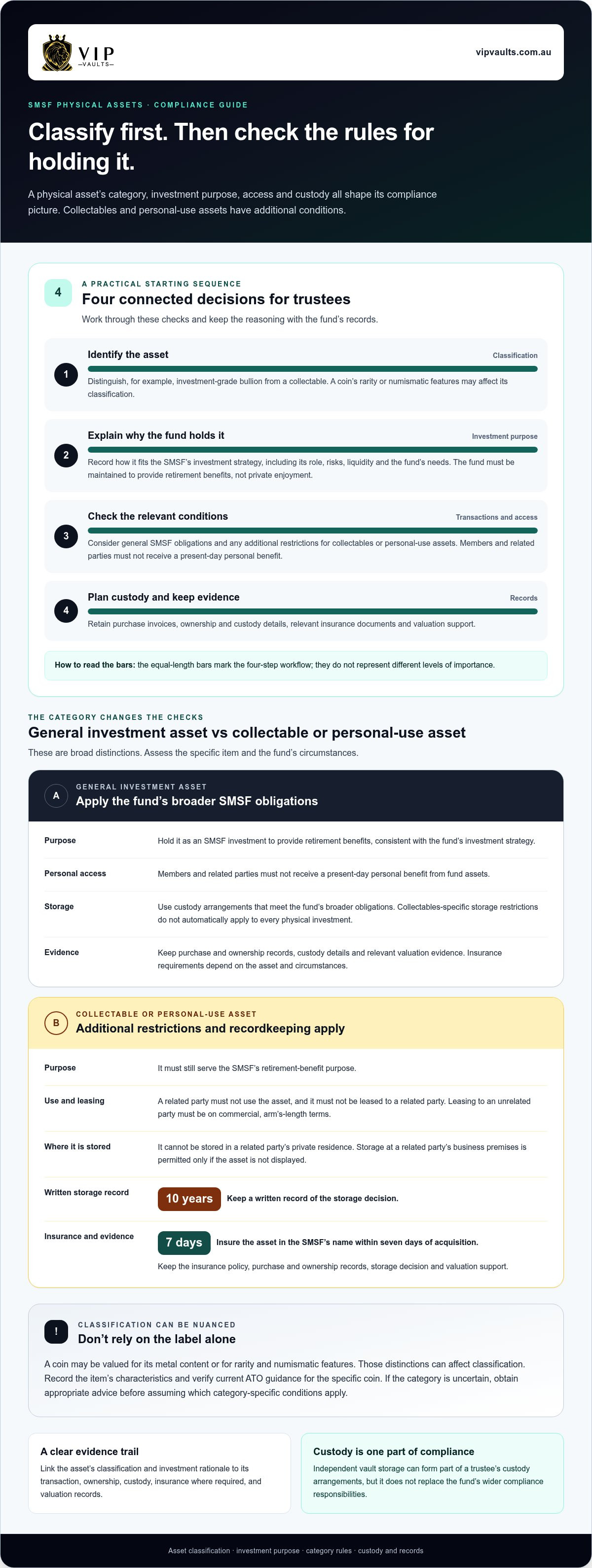
A practical starting point is to document four connected decisions: what the asset is, why the fund is investing in it, how the transaction fits the rules, and how the fund will maintain evidence of ownership and custody. This gives trustees a clear basis for the more specific checks that follow.
How SMSF rules differ across bullion, collectables and other tangible assets
SMSF rules for physical assets depend on both the asset and how trustees hold it. Start by considering the asset’s likely category, then check its purpose, access, storage and supporting evidence. These are general distinctions, not a substitute for assessing the specific item and fund circumstances.
General investment asset
- Purpose: The asset must be held as an SMSF investment to provide retirement benefits, consistent with the fund’s investment strategy.
- Personal use: Members and related parties must not receive a present-day personal benefit from fund assets.
- Storage: Apply the fund’s custody arrangements and broader SMSF obligations. Collectables-specific storage restrictions do not automatically apply to every physical investment.
- Insurance and evidence: Requirements depend on the asset and circumstances. Retain purchase and ownership records, custody details and relevant valuation evidence.
Collectable or personal-use asset
- Purpose: It must still serve the SMSF’s retirement-benefit purpose.
- Personal use: A related party must not use the asset, and it must not be leased to a related party. Leasing to an unrelated party must be on commercial, arm’s-length terms.
- Storage: It cannot be stored in a related party’s private residence. Storage at a related party’s business premises is permitted only if the asset is not displayed. Trustees must keep a written record of the storage decision for 10 years.
- Insurance and evidence: The asset must be insured in the SMSF’s name within seven days of acquisition. Keep the policy, purchase and ownership records, storage decision and valuation support.
Classification needing professional review
- Purpose and use: Document the investment rationale and ensure members or related parties do not gain personal enjoyment or access.
- Storage, insurance and evidence: Don’t assume either set of category-specific conditions applies. Record the item’s characteristics and obtain appropriate advice on its treatment before relying on a classification.
When can precious metals or coins be treated differently?
Investment-grade gold, silver or platinum bullion is generally not classified as a collectable. A coin may need closer assessment if its value reflects rarity or numismatic features rather than primarily its metal content. The word “bullion” on an invoice, or the appearance of a coin, doesn’t settle the question. Check current ATO guidance for the particular item and its characteristics. The ATO’s investment restrictions for SMSFs also explain broader rules, including related-party acquisitions and in-house assets.
What changes when an asset is a collectable?
Collectable status brings specific controls on use, leasing, storage and insurance. Don’t apply these automatically to every tangible investment. For further context on precious-metals custody, the SMSF gold storage guide covers that topic. Independent storage, including private vault rentals and bullion lockers, may form part of documented custody arrangements, but storage alone doesn’t establish compliance.
Common SMSF physical-asset compliance misconceptions to avoid
Physical assets aren’t automatically non-compliant SMSF investments. The risk comes from how each asset is classified, acquired, held and used. Bullion held solely as an investment is not the same as a collectable that a member can enjoy personally, and the relevant obligations can differ.
That distinction is central to SMSF compliance for physical assets. Trustees need to assess the facts, rather than rely on assumptions such as “it’s in the fund’s name, so it must be fine” or “it’s locked away, so the rules are satisfied”.
Does secure storage by itself make an SMSF asset compliant?
No. Secure storage is a control, not a substitute for satisfying SMSF rules. A vault may help establish where an asset is kept and support documented custody arrangements, but it can’t correct an unsuitable acquisition, establish that the fund owns the asset, or supply missing transaction records.
Consider the separate questions trustees need to resolve:
- Purpose: Is the asset held to provide retirement benefits, rather than for personal enjoyment?
- Acquisition: Was the transaction permitted, including under restrictions on acquiring assets from related parties?
- Ownership: Can the fund’s purchase and legal or beneficial ownership be evidenced?
- Classification: Do specific conditions apply to this type of asset?
- Evidence: Are custody records, valuations and any required insurance documents retained?
Physical security and compliance evidence serve different functions. Storage may reduce uncertainty about custody, but it doesn’t itself prove market value, confirm insurance or determine whether an auditor or regulator will accept the fund’s arrangements. Trustees remain responsible for the whole picture.
Can trustees store SMSF assets at home or use them personally?
There isn’t one home-storage rule for every physical asset. Collectables and personal-use assets must not be stored in a related party’s private residence. Other physical investments need to be assessed under the rules that apply to their category, alongside the fund’s purpose and circumstances. Don’t assume that a rule for collectables automatically applies to bullion, or that home storage is risk-free simply because an asset is not a collectable.
Personal use is a separate concern. A member wearing fund-owned jewellery, displaying artwork for personal enjoyment or otherwise accessing an asset for private benefit may undermine the fund’s retirement purpose. For bullion, keeping it at home can also create a perception of personal access, even where trustees intend it solely as an investment. Intent matters, but the actual arrangements and records need to support that intent.
Before deciding on storage, identify the asset and its applicable rules, then document who owns it, where it is held, who can access it and why the arrangement serves the fund. Independent storage can support that custody record, but it does not replace careful acquisition, classification or ongoing documentation.
A practical SMSF physical-asset compliance and records checklist
A reliable process connects each trustee decision to evidence. Use this workflow to organise the fund’s records from the initial assessment through to annual review. The precise documents depend on the asset and the rules that apply to it.
- Classify the asset. Record what the item is and the features that inform its treatment. For a coin, note whether its value is linked mainly to metal content or whether rarity and numismatic features may be relevant.
- Assess its purpose. Explain how the proposed investment fits the SMSF’s investment strategy, risk profile and retirement-benefit purpose. Consider liquidity and the fund’s expected needs.
- Document the decision. Keep dated trustee minutes or other decision records showing the reasoning, classification considered and proposed custody arrangements.
- Check and complete the acquisition. Assess the seller and transaction against applicable restrictions, including rules concerning related parties. Retain the contract, invoice, payment evidence and ownership documentation.
- Safeguard and record custody. Document the asset’s location, who controls access and how custody is evidenced. Keep any required insurance records and the written storage decision for a collectable where applicable.
- Review the asset. Reconcile it to the fund’s records during annual reporting, update valuation support and retain material changes to its location, classification or custody arrangements.
Before acquisition: document the decision
Make the investment case before committing SMSF funds, not only after a purchase raises questions. The record should explain why the asset belongs in the fund’s strategy and how trustees considered its risks and purpose. Check the proposed seller and transaction against acquisition restrictions, particularly where a related party is involved. Keep decision minutes and transaction documents with the fund’s financial records.
Useful acquisition evidence may include an invoice or contract, proof of payment, and documents identifying the asset and establishing the fund’s ownership. For unique items, record distinguishing details so the paperwork can be matched to the physical asset.
After acquisition: maintain evidence over time
Keep custody records current. They should identify where the asset is held, who controls access and what documentation supports that arrangement. Private vault options in Australia can form one part of a documented custody process, but the storage arrangement itself doesn’t establish compliance.
Maintain valuation evidence that supports the reported market value, along with insurance documentation where relevant or required. For collectables, remember the specific insurance and storage conditions that apply. Keep records together in an orderly, retrievable format so the fund can support its reporting and audit.
An SMSF auditor assesses evidence and reports on the fund’s compliance. Trustees remain responsible for investment decisions, accurate records and ongoing obligations. A well-organised file helps show the reasoning behind each decision, but it doesn’t replace those responsibilities. For physical custody, explore private vault rentals and bullion lockers as a storage option for SMSF assets.
How professional vault storage can support SMSF physical-asset custody
For trustees holding physical assets, an independent storage arrangement can help create a clear custody trail. It’s one part of the wider process, not a compliance outcome in itself. The fund must still establish its investment purpose, permitted acquisition, ownership and any rules specific to the asset. Strong SMSF compliance for physical assets depends on keeping those responsibilities distinct from the service used to store an item.
VIP Vaults & Bullion Exchange Perth provides private vault rentals and bullion lockers for investors and SMSF holders. Trustees can consider these as physical-storage options within their documented custody arrangements. Using a storage provider doesn’t transfer trustees’ responsibility for fund decisions, compliance or audit evidence.
What trustees should document about a storage arrangement
Keep records that connect the fund’s asset to its documented storage location. The exact paperwork depends on the arrangement, but trustees should organise evidence that identifies the asset, establishes the SMSF’s ownership and records where it is held.
- Asset identification: Record a description and any distinguishing details that help match the item to purchase and ownership documents.
- Fund ownership: Retain invoices, contracts and other evidence showing the SMSF acquired the asset. Keep these separate from records that relate only to storage.
- Custody: File the storage agreement and relevant receipts or account records, where provided, to show the relationship between the fund and the storage provider.
- Access arrangements: Document who is authorised to make decisions about the asset and how access is managed under the custody arrangement.
Keep insurance documentation and valuation support as separate evidence. A storage record doesn’t prove that an asset is insured or establish its market value. Collectables may have specific insurance and storage requirements, so trustees should assess their records against the rules applying to that asset, the fund’s circumstances and advice from their SMSF professionals.
A discreet custody option for precious metals
VIP Vaults & Bullion Exchange Perth’s private vault rentals and bullion lockers offer a dedicated physical-storage option for precious metals. The business operates independently of government and financial institutions. That describes its independence; it doesn’t imply regulatory approval or determine whether an SMSF’s investment and custody arrangements meet its obligations.
Trustees considering bullion can use the SMSF gold storage guide for further information on precious-metals storage. Keep the fund’s ownership evidence, storage-provider records and any insurance or valuation documents organised as distinct parts of the overall file.
For a physical storage option to include in your custody planning, explore VIP Vaults & Bullion Exchange Perth’s private storage information. The service can support documented custody arrangements, while trustees remain responsible for assessing the complete SMSF compliance position.
Make your next custody decision with confidence
Turn your fund’s decisions into a clear, maintainable process. Before changing how an asset is held or arranging new custody, review the arrangement against the asset’s classification and your SMSF’s obligations. Where the position is uncertain, seek advice suited to your fund before acting. A considered decision, supported by orderly records, gives trustees a stronger basis for managing physical assets over time.
For trustees considering precious metals, VIP Vaults offers private vault rentals and bullion lockers for investors and SMSF holders, with a focus on physical precious metals and secure storage. These services can form part of a custody arrangement, while the fund’s compliance responsibilities remain with its trustees.
Explore private vault storage for physical assets as you plan the next stage of your SMSF custody arrangements. With careful decisions and appropriate support, SMSF compliance for physical assets can be approached with greater clarity and confidence.
Frequently Asked Questions
Can an SMSF invest in physical assets?
Yes, an SMSF can invest in physical assets if the investment is permitted and managed for the fund’s retirement-benefit purpose. Trustees should also consider the trust deed, investment strategy and any rules specific to the asset or transaction. For example, before buying bullion, record how it fits the fund’s strategy and check the purchase arrangements. SMSF compliance for physical assets depends on the whole arrangement, not simply on the asset being tangible.
Are gold and silver bullion treated as collectables in an SMSF?
Investment-grade gold and silver bullion are generally not classified as collectables, but a coin’s classification can depend on what drives its value. A coin valued primarily for its metal content may be treated differently from one valued for rarity or numismatic features. Don’t rely on a product description alone. Check the current ATO guidance against the specific coin’s characteristics before deciding which requirements apply.
Can an SMSF buy a physical asset from a fund member?
Generally, an SMSF is prohibited from acquiring assets from a related party, and a fund member is generally a related party. There are limited exceptions, including certain listed securities and business real property that meets the relevant conditions. Collectables cannot be acquired from a related party. Before any proposed sale, identify the seller’s relationship to the fund and obtain advice on whether an exception applies. Don’t assume a market-value price makes a restricted acquisition permissible.
Can a member use an asset owned by their SMSF?
Generally, a member must not use an SMSF asset for personal enjoyment or private benefit. This is particularly strict for collectables and personal-use assets, which can’t be used by a related party. For other assets, personal access may still conflict with the fund’s retirement purpose. For instance, a member treating fund-owned jewellery as their own to wear is different from the SMSF holding it as an investment. Consider the actual use, not only the stated intention.
What happens if an SMSF cannot prove who owns a physical asset?
If ownership can’t be substantiated, trustees may have difficulty supporting the asset’s inclusion in the fund’s records and financial statements. An auditor may request further evidence, and the gap can prompt closer examination of the transaction and custody arrangements. Gather available invoices, payment records, contracts and correspondence, then document any steps taken to resolve inconsistencies. The outcome depends on the circumstances, so trustees should seek advice rather than assume that possession alone proves SMSF ownership.
How often should SMSF physical assets be valued?
SMSF assets should be valued at market value as at 30 June each year. The evidence needed depends on the asset: a traded bullion product and a one-off artwork may require different valuation support. Keep the valuation method and supporting information with the fund’s records, and update them if a material event affects value. Trustees are responsible for ensuring the reported amount is supportable; an old purchase price may not reflect current market value.