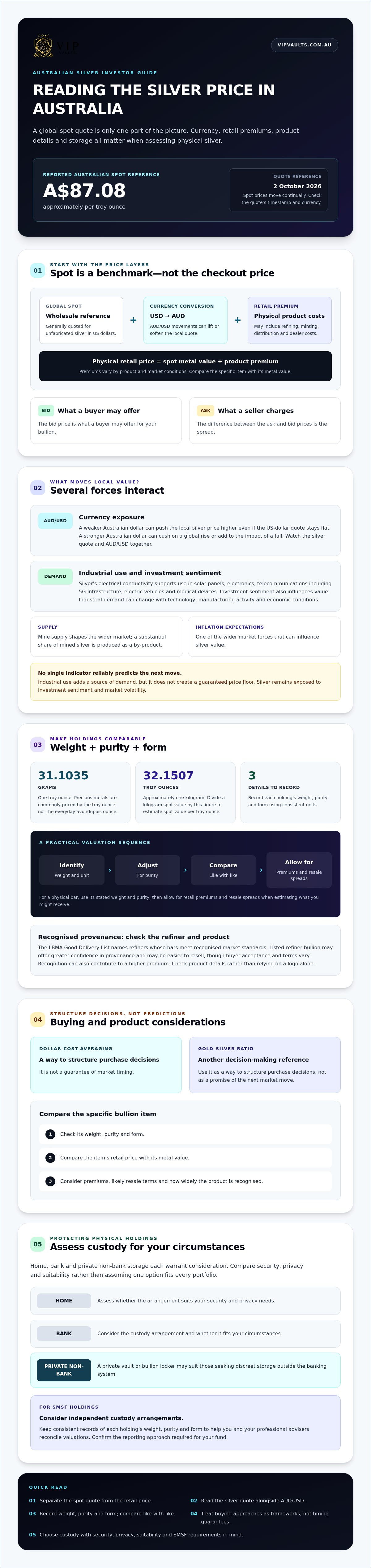
The global silver price is only part of the picture for Australian investors. On 2 October 2026, spot silver was approximately A$87.08 per ounce, but physical bullion can cost more because retail pricing includes premiums. Currency movements also affect how global prices translate into Australian dollars. If you’re searching “silver price australia”, understanding the gap between spot and retail prices can make a fast-moving market easier to assess.
It pays to look beyond a headline quote. Industrial demand from solar energy, electronics and medical devices, investment sentiment and AUD/USD movements all influence local value. Because prices can be volatile, it may be difficult to judge when to buy or how much your holdings are worth.
This guide explains how to read spot and retail prices, assess the forces shaping the Australian market and estimate the value of silver by weight and purity. It also compares considerations for home, bank and private non-bank storage, including why independent custody may matter for larger portfolios and SMSFs. You’ll learn what to consider when choosing internationally recognised bullion and whether private vaulting could suit your physical assets.
Key Takeaways
- Separate the global spot quote from the retail price of physical bullion, and account for how the AUD/USD exchange rate can affect the silver price australia.
- Estimate your portfolio more clearly by recording each holding’s weight, purity and form, then comparing like with like.
- Use dollar-cost averaging and the gold-silver ratio as ways to structure purchase decisions, not as guarantees of market timing.
- Assess storage for security, privacy and suitability for your circumstances, including independent custody arrangements for SMSF holdings.
- Consider whether internationally recognised bullion and a private vault or bullion locker suit your need for discreet storage outside the banking system.
Understanding the Silver Price in Australia: Spot vs Retail
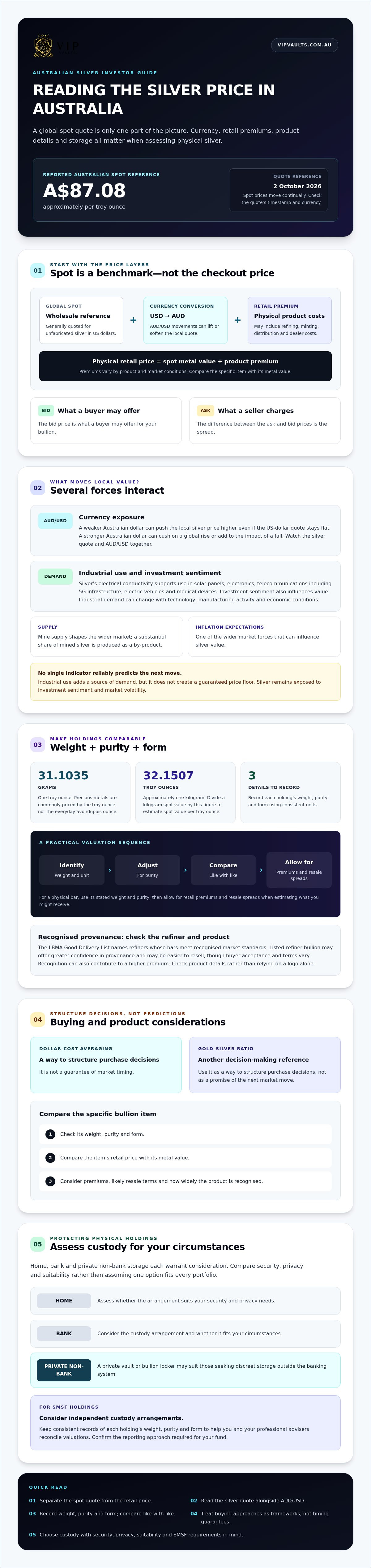
The spot price is the global wholesale reference price for silver, generally quoted for unfabricated metal in US dollars. Australian dealers convert this benchmark into Australian dollars, so the silver price australia reflects both the global silver market and the AUD/USD exchange rate. On 2 October 2026, the reported Australian spot price was approximately A$87.08 per troy ounce. Spot prices move continually, so check the quote’s timestamp and currency before comparing figures.
Spot is a benchmark, not usually the amount an investor pays for a finished bar or coin. The retail price includes premiums for processes such as refining, minting and distribution, as well as dealer costs. Premiums vary by product and market conditions, so compare the price of the specific item with its metal value rather than assuming every product tracks spot exactly. For a broader overview of investment options and risks, see Silver as an investment.
The bid price is what a buyer may offer for your bullion. The ask price is what a seller charges. The difference between the two is the spread.
Troy Ounces vs Grams: Standardising Your Valuation
Precious metals are commonly priced by the troy ounce, which equals 31.1035 grams, rather than the standard avoirdupois ounce used for everyday goods. Using the same unit makes international quotes easier to compare. A kilogram contains about 32.1507 troy ounces, so divide a kilogram spot value by 32.1507 to estimate its spot value per troy ounce. For a physical bar, account for its stated weight and purity, then allow for retail premiums and resale spreads when estimating what you might receive.
For SMSF records, use consistent units and document each holding’s weight, purity and form. Standardised records help you and your professional advisers reconcile valuations. Confirm the reporting approach required for your fund.
The Role of LBMA Accreditation in Pricing
The London Bullion Market Association (LBMA) maintains a Good Delivery List of refiners whose bars meet recognised market standards. Bullion from a listed refiner can provide greater confidence in its recognised provenance and may be easier to resell, although acceptance and resale terms depend on the buyer. Recognition can also contribute to a higher premium than less widely recognised products. Check the specific refiner and product details rather than relying on a logo alone.
Key Drivers Influencing Silver Value in 2026
The local silver price reflects more than global market movements. For Australian investors, the AUD/USD exchange rate can amplify or soften a change in the US-dollar silver price. Industrial demand, inflation expectations and mine supply also shape the wider market. These forces interact, so no single indicator reliably predicts the next move in the silver price australia.
The Currency Shield: Why the AUD Matters
International silver is commonly priced in US dollars. To express that value in Australian dollars, the USD price is converted using the exchange rate. If the Australian dollar weakens, each US dollar costs more in AUD, which can push the local silver price higher even if the global USD quote stays flat. A stronger Australian dollar can have the opposite effect, cushioning a global rise or adding to the impact of a fall.
Currency exposure cuts both ways. AUD weakness may support the value of locally priced bullion, while AUD strength can reduce that benefit. Monitor the silver quote and AUD/USD together rather than treating either as a complete picture of your portfolio’s movement.
2026 Industrial Trends: Beyond Jewellery
Silver’s electrical conductivity makes it useful in a range of industrial applications. Solar panels use silver in their electrical contacts, while electronics, telecommunications equipment including 5G infrastructure, and electric vehicles also contribute to demand. Renewable energy investment may support consumption, but demand can change with technology, manufacturing activity and economic conditions.
Industrial use adds a source of demand that gold doesn’t share to the same extent, but it doesn’t create a guaranteed price floor. Silver remains exposed to investment sentiment and market volatility. The Silver Institute’s World Silver Survey provides context on global supply and demand trends. For a closer look at technology-related uses, read this guide to industrial uses of silver bullion.
Supply matters too. A substantial share of mined silver is produced as a by-product of other metals, so output may not respond quickly to a rise in silver prices alone. If industrial consumption grows faster than available supply, the market may tighten. Changes in mining activity, recycling and demand can shift that balance. Treat “poor man’s gold” as a familiar comparison, not a promise: silver may appeal to investors concerned about inflation, but its price can fluctuate sharply and it isn’t a guaranteed hedge against rising costs.
Consider these drivers together when reviewing your holdings, and keep a clear record of how currency and market movements affect your valuation. If secure custody is part of your bullion plan, explore private vault options for silver bullion.
Calculating Your Silver Bullion Portfolio Value
A spot-price estimate is a useful starting point, not a guaranteed resale figure. To estimate your silver portfolio, work through each holding separately:
- Record the details: Note each item’s form, weight and stated purity.
- Standardise the weight: Convert grams or kilograms to troy ounces if your chosen market quote is per ounce.
- Estimate the metal value: Multiply the silver weight by its purity and the current spot price in the same currency and unit.
- Review product-specific factors: Consider the item’s premium, condition and likely resale terms. An offer may differ from its spot-based estimate.
- Add and document: Total the estimates, date the valuation and retain the records used.
Cast bars, minted bars and legal tender coins can carry different premiums. Cast bars generally have a simpler finish, while minted bars have a finished appearance. Coins may carry a premium linked to their design or collectability. These features can affect buying and resale values, so a calculator based only on weight and spot won’t capture every difference. Larger bars may offer a lower premium per unit of silver, while smaller items can provide more flexibility when selling. A 1kg bar may be a practical middle ground for some investors, depending on budget and resale needs.
SMSF Valuation and Audit Requirements
For an SMSF, keep clear evidence of what the fund owns and how its value was assessed. Retain purchase records, product details, dated pricing references and relevant storage documentation for the fund’s records and annual audit. Ask an independent vault provider whether it can supply holdings statements or valuation documents, and confirm with your accountant or SMSF auditor what evidence they require. See this overview of SMSF gold storage for general compliance context.
Regular valuations can help keep insurance records current. Review them periodically and after significant market movements, and check that the valuation method suits its purpose. Keep supporting records together so you can explain how each estimate was reached and update it as market conditions change.
Cost Basis, Coins and Bars
Keep your acquisition date, purchase price and supporting documents to help establish the cost base if you later sell or transfer silver. Australian silver investments may have Capital Gains Tax implications, so seek tax advice on your circumstances and retain records rather than relying on a live-price calculator alone. For a comparison across metals, read gold coins versus gold bars in Australia.
When assessing the silver price australia, separate estimated metal value from product premiums and likely resale value. Investors holding substantial physical bullion may also compare home arrangements with a private vault rental or bullion locker as part of their custody planning.
Strategic Buying: Timing the Market and Bulk Storage
Silver can move sharply, making a single purchase date feel like a high-stakes call. Dollar-cost averaging (DCA) offers a more structured approach: invest a set amount at regular intervals rather than committing everything at once. This can reduce the effect of buying at one unfavourable price, but it doesn’t remove volatility or guarantee a profit. Choose an approach that suits your investment plan, then review it consistently.
Utilising the Gold-Silver Ratio
The gold-silver ratio is the amount of silver needed to equal the price of one ounce of gold. Some investors use it as a relative-value signal: a higher ratio means silver is cheaper compared with gold, while a lower ratio means it is more expensive by that measure. It isn’t a forecast or a standalone buy signal. The ratio fell below 45 in late January 2026 before returning to around 70, according to J.P. Morgan. This movement shows why the ratio is best treated as context, not certainty.
To use it, decide in advance how a change in the ratio might affect your preferred gold and silver allocation. You could review and rebalance holdings when they move beyond your chosen limits, while considering transaction costs, tax implications and your investment objectives. Don’t assume a return to a historical average is inevitable.
The Challenges of Home Storage for Bulk Silver
Silver’s lower value per unit of weight than gold means an equivalent-value holding generally takes up more space and weighs more. A 50kg-plus holding also presents a practical handling and security challenge at home. The space required depends on the bars or coins you hold, their packaging and how they’re stored.
Before arranging home storage, check your insurer’s policy directly. Cover for bullion may be excluded, capped or subject to specific conditions, so assumptions about standard household contents insurance can leave a gap. Keep details of your items and ask what evidence is required to insure them. Consider delivery privacy too: the delivery process may reveal information about valuable holdings, so review who can access delivery details and how the items will be received.
For a larger portfolio, compare home storage with independent private vaulting. A private vault or bullion locker can offer a discreet alternative to keeping bulk metal at home or relying on the banking system. Ask about access arrangements, documentation, insurance terms and how holdings are recorded before deciding. To explore secure storage for physical silver, consider VIP Vaults & Bullion Exchange Perth private vault and bullion locker options.
Use the silver price australia as one part of your buying plan, and consider custody from the outset. A measured purchase strategy is easier to maintain when you know how each holding will be protected.
Secure Custody: Protecting Your Silver Investment in Australia
Physical silver raises a practical custody question: how will you protect and account for it as your holding grows? Bulk bullion is heavy and takes up more room than an equivalent-value holding of gold, so home storage can become difficult to manage discreetly. Private vaulting offers an independent alternative to keeping metal at home or relying on a bank’s safety deposit service.
Storage arrangements differ, so check how your silver is held and documented. Allocated storage generally means specific bullion is assigned to you, rather than giving you an entitlement to an unspecified pool. Segregated storage usually means your holdings are kept separately from other clients’ assets. Ask the provider to explain the terms in its agreement, how holdings are identified and what records or statements you’ll receive. SMSF investors should confirm custody arrangements with their accountant or auditor.
Private Vaults vs. Bank Safety Deposit Boxes
Bank safety deposit services aren’t available everywhere, and providers may change or withdraw them. Check current availability and terms directly rather than assuming a bank offers a suitable option. A private vault operates independently of the banking system, but that doesn’t remove every custody or investment risk. Review the agreement, ownership records, access conditions and insurance arrangements before placing bullion in storage. Read more about private vaults in Australia and the considerations involved.
Ask specific questions about security features. Depending on the facility, measures may include biometric access controls, seismic sensors and continuous monitoring. Don’t assume a particular feature is in place. Ask the provider what protections it uses, how access is authorised and what procedures apply if you need to inspect or retrieve your holdings.
Bullion Lockers for Silver Portfolios
A bullion locker may suit investors seeking a dedicated option for physical metal. Before choosing one, confirm its capacity and weight limits are appropriate for your bars or coins. Clarify how holdings are recorded, what identification is required for access, whether viewing arrangements are available and how the provider handles collection or transfer requests. These details matter for liquidity planning as well as security.
VIP Vaults & Bullion Exchange provides private vault rental and bullion lockers as a discreet, independent storage option for investors and SMSFs. The service offers storage for physical assets, not banking services. If you’re comparing options for your silver holding, check the arrangement against your record-keeping, access and protection needs.
Explore private storage for your silver bullion with VIP Vaults.
Make Your Silver Strategy Secure for the Long Term
A considered silver investment starts with reading the local price in context. Separate the global spot benchmark from retail premiums, and remember that AUD/USD movements can influence Australian valuations alongside industrial demand and wider market conditions. For a clearer portfolio picture, record each item’s weight, purity and purchase details, then review valuations and relevant tax records regularly.
Plan custody as carefully as purchases. Physical silver can be bulky, so consider how your holdings will be stored, documented and accessed. VIP Vaults & Bullion Exchange offers silver bullion sourced from LBMA-accredited refiners, along with private vaulting independent of the banking system. Private vault rental or a bullion locker may suit investors seeking a discreet storage option.
Take the next step by reviewing your storage needs. Explore private vault and bullion locker options with VIP Vaults for your physical holdings. Clear records and a considered custody plan can help you approach the silver price australia market with greater confidence.
Frequently Asked Questions
How is the silver price in Australia calculated daily?
The Australian silver price is based on the global silver market, converted from its usual US-dollar quote into Australian dollars using the prevailing exchange rate. AUD/USD movements can therefore change the local price even if the global quote is steady. Retail prices also reflect product premiums and dealer pricing. For a meaningful comparison, check the quote’s currency, unit, timestamp and whether it refers to spot or a physical bullion product.
Why is there such a large difference between silver spot and retail prices?
Spot is a wholesale benchmark for silver, not usually the price of a finished bar or coin. Retail pricing includes costs associated with refining, minting and distribution, along with the dealer’s margin. Premiums can differ between cast bars, minted bars and coins, and may shift with demand or availability. Resale offers can also be below retail prices, so compare the product premium and potential buy-back price before purchasing.
Is silver a better investment than gold in 2026?
Neither metal is automatically the better investment in 2026. Silver has industrial uses, including in solar technology and electronics, while gold has different demand drivers. Silver can be more volatile, with its price influenced by both investment sentiment and industrial activity. Compare each metal’s risks, liquidity, premiums and role in your portfolio. Consider your timeframe and financial circumstances, and seek independent advice before making an investment decision.
Can I store my SMSF silver bullion in a private vault?
SMSFs can invest in silver bullion when applicable requirements are met, including minimum purity standards and storage with an independent custodian, according to the research provided for this guide. A private vault may be an option, but confirm the arrangement is appropriate for your fund and how ownership, holdings and valuations are documented. Ask the vault provider for its terms, then check the proposed custody and records with your SMSF auditor or adviser.
What is the Gold-Silver Ratio and why should I care?
The Gold-Silver Ratio shows how many ounces of silver are equivalent in price to one ounce of gold. Investors sometimes use it to compare the metals’ relative values: a higher ratio means silver is cheaper relative to gold by this measure. It isn’t a reliable forecast or a standalone signal to buy. Use it alongside your investment objectives, market conditions and desired portfolio mix, rather than assuming the ratio will return to a particular level.
Is silver bullion subject to GST in Australia?
Investment-grade silver bullion with a purity of at least 99.9% is reported as GST-exempt in the research provided for this guide. The treatment can depend on the product and its characteristics, so don’t assume every silver item is treated the same way. Check the product details and current Australian Taxation Office guidance, or speak with a qualified tax professional if you’re unsure about a particular purchase or your circumstances.
How do I sell my silver bullion back for the best price?
To seek a competitive offer, identify each item’s weight, purity, refiner and condition, then request current buy-back quotes from more than one reputable dealer. Ask whether the quote applies to that exact product and whether testing or other conditions affect the offer. Widely recognised bars may be easier for buyers to assess, but resale value still depends on market prices and the buyer’s terms. Keep purchase records and compare the net amount offered.
What are the risks of storing physical silver at home?
Home storage can expose bullion to theft, accidental discovery, damage or loss, and larger holdings are heavy and take up space. Insurance may exclude bullion, impose limits or require specific security measures, so check your policy rather than relying on standard contents cover. Discreet handling and delivery matter too. Consider whether an independent private vault or bullion locker better suits your holding, and check the provider’s access, documentation and insurance terms.