The most convenient place to keep a valuable item may not be the place that best protects it. If you’re weighing up a safe deposit locker, you’ll want clear answers about what it can hold, who can access it and how custody and insurance work.
A locker is one form of secure storage, but the right arrangement depends on the assets you want to protect and how often you need to reach them. This guide explains how lockers work, which items may suit off-site storage and how to prepare an inventory. It also outlines the access and insurance details to understand before choosing a storage arrangement.
For physical precious metals and jewellery, a private vault can offer a discreet alternative to home storage. VIP Vaults & Bullion Exchange Perth provides private vault rentals and bullion lockers for these assets. Read on to assess your storage needs and consider an option designed for valuables that deserve careful protection.
Key Takeaways
- Match a safe deposit locker to the items you want to store, your access needs and your preferred custody arrangement.
- Understand how the facility’s procedures govern placing and accessing stored assets, while ownership remains yours.
- Compare home and off-site storage in light of your household circumstances and how readily you need to reach your valuables.
- Prepare an inventory with item descriptions and identifying marks, and keep sensitive records private.
- Consider private vault rentals and bullion lockers as specialist storage options for precious metals and jewellery.
What Is a Safe Deposit Box and What Is It Used For?
Some belongings matter too much to leave among the everyday activity of a household. You might want to store valuables away from routine access, reduce the amount you keep at home or keep important items together in a dedicated place. A safe deposit locker is one option. To decide whether it suits you, start by understanding how it differs from a safe you own.
A safe deposit locker is a secured storage space within a facility, accessed according to that facility’s arrangements and terms. The locker provides a place for permitted belongings, while the facility’s procedures govern access and handling. Formats and conditions can vary, so there is no universal locker size, access process or list of accepted contents. For background on the concept and its history, see What is a Safe Deposit Box?
A locker is a storage arrangement, not a change in ownership. Placing an asset in a locker doesn’t by itself transfer ownership to the facility. That distinction matters for items such as bullion or jewellery: storage determines where an item is kept, while ownership concerns who it belongs to.
What kinds of belongings might people store?
People may consider off-site storage for items that are valuable, difficult to replace or not needed every day. Examples include jewellery, original documents and precious metals. Whether an item is accepted depends on the facility’s terms, which also govern how contents may be placed and handled.
Value isn’t only financial. A family heirloom may carry deep sentimental significance, while a document could be practically important even if it has little market value. Before deciding, consider the consequences of loss, damage or being unable to reach an item promptly. An original document needed for an upcoming task, for example, calls for different access planning from jewellery worn only occasionally.
- Financial value: Consider the cost or difficulty of replacing the item.
- Sentimental value: Account for personal significance that a market valuation won’t capture.
- Practical use: Think about how often you may need to retrieve it.
How is a locker different from a home safe?
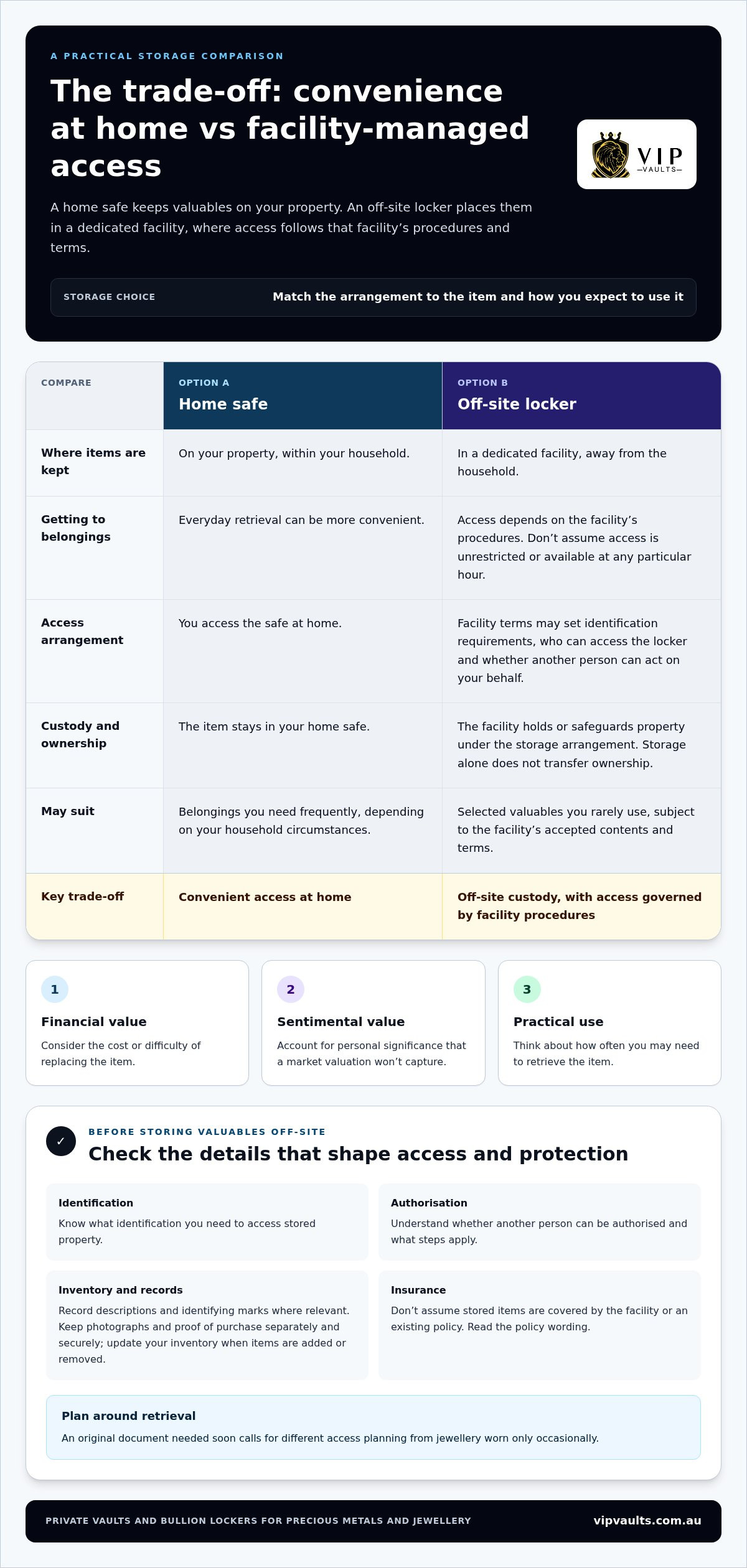
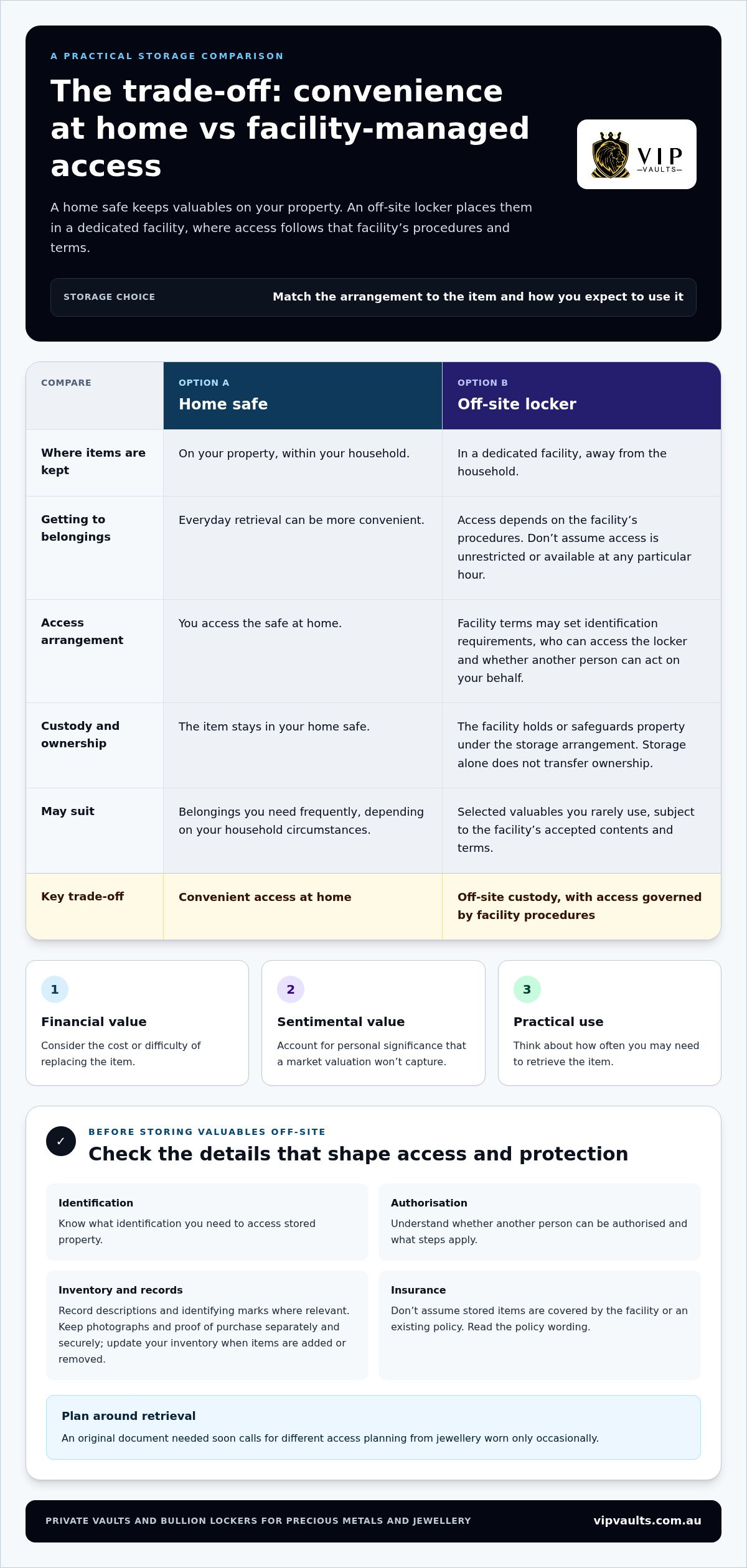
A home safe is kept on your property, which can make everyday retrieval more convenient. A locker places belongings in a dedicated facility away from the household. This changes the custody arrangement: access depends on the facility’s procedures rather than simply opening a safe at home.
Neither option suits every person or item. Home storage may work for belongings you need frequently, while off-site storage may suit selected valuables you rarely use. Consider your household circumstances, access preferences and the facility’s terms. The choice involves a trade-off between convenient access at home and off-site custody. No storage arrangement is risk-free, so match it to the item and how you expect to use it.
How Safe Deposit Lockers Work: Access, Custody and Storage
Using a safe deposit locker generally involves arranging storage, placing assets that meet the facility’s terms, then retrieving or managing them through its access procedures. Before committing, understand what the arrangement allows, how access is authorised and what records you’ll receive or need to keep.
Facility procedures differ. A provider may set requirements for customer identification, permitted contents and who can enter or act on an account. These are not universal rules, so read the relevant terms before placing valuable items in storage. Plan around the access arrangements too, especially if you expect to retrieve an item for a particular purpose.
What does custody mean when assets are stored?
Custody means property is held or safeguarded under an agreed storage arrangement. It describes where an asset is kept and the basis on which it is held. It doesn’t, by itself, mean the facility has bought the asset, that you have sold it or that ownership has transferred.
For bullion, distinguish storage from a purchase or sale. Keeping gold or silver in a locker is separate from acquiring or transferring it. Keep your own records, such as a description, identifying marks where relevant, photographs and proof of purchase. Record what you place into storage and update your inventory if items are removed or added. This gives you a clear account of your belongings without requiring you to disclose sensitive details unnecessarily.
What should readers understand about access?
Access arrangements can vary between facilities. These may cover identification, how an authorised person is recognised and whether someone else may visit or act on your behalf. Don’t assume that access is unrestricted or available at any particular hour. Understand the procedures before storing items, especially if you may need to retrieve one promptly or authorise someone else.
- Identification: Know what identification you need to access stored property.
- Authorisation: Understand whether another person can be authorised and what steps apply.
- Records: Keep an inventory and relevant ownership or purchase documents separately and securely.
- Insurance: Don’t assume stored items are covered by the facility or by an existing policy. Read the policy wording and consider ASIC’s guidance on home and contents insurance.
These details shape how well a storage arrangement fits your needs. VIP Vaults & Bullion Exchange provides private vault rentals and bullion lockers for precious metals and jewellery, as a specialist non-bank storage option. Explore private vault storage for valuables as you consider how custody and access should work for your assets.
Is a Safe Deposit Locker Right for Your Valuables?
Off-site storage can suit some belongings and create inconvenience for others. A safe deposit locker isn’t automatically right for every asset or owner. Suitability depends on the value and significance of your assets, how often you need access and the facility’s terms. Consider those factors together rather than treating storage as a simple choice between “safe” and “unsafe”.
Start with the items themselves. A small quantity of precious metal, important paperwork or jewellery worn only occasionally may have different storage needs from belongings you use regularly. Include sentimental value in your assessment: an heirloom may be irreplaceable to your family even if its financial value is modest. Then consider who needs access, how quickly you might need to retrieve an item and how you’ll keep an accurate record of what is stored.
How do home and off-site storage compare?
The trade-off is not a universal ranking of security. It is a difference in location, access and custody. Your household circumstances matter too, including how comfortable you are keeping selected valuables at home and whether others in your household need access.
| Consideration | Home safe | Off-site locker |
|---|---|---|
| Access | Items are on your property, which may make retrieval convenient. | Retrieval follows the facility’s access procedures and arrangements. |
| Custody | You manage storage within your household. | Property is held at a dedicated facility under agreed terms. |
| Household fit | Consider who can access the safe and where it is kept. | Consider how facility access fits your routine and who may be authorised. |
| Records and cover | Keep an inventory and understand the relevant policy terms. | Keep your own inventory and understand facility terms and any separate insurance arrangements. |
Neither arrangement removes the need to consider records, access and the consequences of an item being unavailable. Convenience and protection are separate questions: decide how often you need access, then review the terms and insurance arrangements that apply to your circumstances.
When might private vault storage be relevant?
Investors holding physical bullion may consider off-site storage as part of deciding where to keep their assets. Jewellery may also be a candidate when it is valuable or meaningful but not needed for everyday use. In either case, be clear about the purpose of storage and maintain your own records. The facility’s terms still determine permitted contents and access arrangements.
VIP Vaults & Bullion Exchange provides private vault rentals and bullion lockers for precious metals and jewellery. The business is privately owned and independent of government and financial institutions. For an overview of this specialist option, explore private vaults in Australia, then assess how the arrangement fits your assets, access preferences and custody needs.
How to Prepare Before Placing Items in a Safe Deposit Locker
Preparation makes it easier to track what you store and plan for future access. Before using a safe deposit locker, decide which belongings suit off-site storage, understand the facility’s terms and create a private record of your items. Use this checklist to organise the process.
Create a clear inventory and document trail
Record what each item is, what distinguishes it and which supporting documents you hold. Keep the inventory and any purchase or valuation records separate from the stored belongings, in a secure location. If you’re considering bullion held through an SMSF, include the fund’s recordkeeping and storage requirements in your planning.
- Choose what to store. Identify items you don’t need to access regularly, such as selected jewellery or physical precious metals. Consider each item’s financial, practical and sentimental importance, then decide whether off-site storage suits its likely use.
- Review the facility’s terms. Read the conditions before bringing anything in. Understand permitted contents, handling and packaging requirements, and any procedures that affect how items can be stored.
- Understand access arrangements. Find out what identification is needed, how access is recorded and how authorised users are managed. If someone else may need access, plan according to the facility’s procedures.
- Prepare a useful inventory. For each item, note a clear description and distinguishing features, such as a hallmark, serial number or visible mark where relevant. Record available purchase or valuation documents and take photographs if they’ll help you identify the item later.
- Keep records discreetly. Store a separate inventory copy securely. Avoid publishing sensitive details or putting access credentials in the inventory. A private note of the categories held can help with organisation without revealing unnecessary information.
- Plan for retrieval and review. Group items by how likely you are to need them, while following the facility’s handling rules. Update your records whenever you add or remove property, and review the arrangement if your access needs or circumstances change.
Keep legal, tax and insurance matters distinct
Storage alone doesn’t settle questions about ownership, tax treatment or insurance. If the items relate to an SMSF, business or estate, get advice from a suitably qualified professional about your circumstances. Read applicable insurance documents carefully too. Don’t assume a facility arrangement or an existing policy automatically covers every stored item.
For precious metals and jewellery, VIP Vaults & Bullion Exchange provides private vault rentals and bullion lockers as a specialist storage option. Explore private vault storage options as you plan what to store and how to maintain your records.
Private Vault Rental and Bullion Lockers at VIP Vaults
Once you’ve considered what you want to store and how you expect to access it, choose an arrangement suited to those assets. VIP Vaults & Bullion Exchange provides private vault rentals and bullion lockers for precious metals and jewellery. This specialist storage option is for people who want to keep physical valuables away from everyday household storage, with the arrangement governed by the relevant facility terms.
The business is privately owned and independent of government and financial institutions. It isn’t a bank and doesn’t provide banking services. Its focus is physical bullion and jewellery, offering a distinct option for owners considering where to hold these assets.
Who may consider a private bullion locker?
Investors holding physical gold, silver or platinum may consider a bullion locker as part of their storage planning. SMSF holders may also be interested in dedicated storage for physical bullion, while recognising that fund-specific decisions can require advice from appropriately qualified professionals. Jewellery owners may value having a specialist storage option for selected pieces that aren’t needed for everyday wear.
The service combines storage with the business’s bullion offering, but those are separate considerations: buying bullion and arranging storage are different decisions. Assess a safe deposit locker or private vault against your assets, access preferences and the terms of the arrangement rather than assuming it will fit every investor or household.
What makes the service relevant to precious-metal owners?
Precious metals are physical assets, so storage planning is part of deciding how to hold them. VIP Vaults & Bullion Exchange offers gold, silver and platinum bullion sourced from internationally recognised refiners, including LBMA-accredited manufacturers. If you want to hold physical metals, considering a storage plan alongside a bullion purchase can help you make both decisions in a more organised way.
The focus is discreet, specialist storage for precious metals and jewellery. That describes the service’s purpose, not a promise that any storage arrangement is risk-free. Consider facility terms, access arrangements, permitted contents, recordkeeping and insurance separately. A clear inventory and an understanding of how retrieval works help you decide whether the service suits your circumstances.
If you’re considering off-site storage for bullion or jewellery, explore private vault rental as a next step. Review the service in light of the items you intend to store and the access arrangements that matter to you.
Choose a storage path that fits your assets
Start by identifying the assets you’re considering storing off-site, thinking about when you may need to retrieve them and noting questions that could affect your decision. A safe deposit locker should fit the way you intend to manage your assets over time, not simply offer a place to put them. Keep your priorities clear as you compare options.
For specialist storage of physical precious metals or jewellery, VIP Vaults & Bullion Exchange is a privately owned Australian business independent of government and financial institutions. It provides private vault rentals and bullion lockers for these assets, and offers bullion sourced from internationally recognised refiners, including LBMA-accredited manufacturers. These services provide a non-bank storage option for precious-metal owners to consider as part of their personal plans.
Explore the service in light of your assets and storage priorities. Explore private vault rental and bullion locker storage and take the next step towards a considered storage arrangement.
Frequently Asked Questions
Is a safe deposit locker the same as a safety deposit box?
Yes, the terms are commonly used for a similar type of off-site storage arrangement. The name alone doesn’t tell you the box’s dimensions, access process or permitted contents, as these details depend on the facility. When comparing options, focus on the written terms rather than whether the provider calls it a locker, box or safe custody service. That will show what you’re actually arranging.
Can I store jewellery in a safe deposit locker?
Jewellery may be suitable if it’s accepted under the facility’s terms. For example, you might consider storing a piece worn only on special occasions rather than something you rely on daily. Before placing it in storage, note distinguishing details such as a hallmark or setting, and keep valuation or purchase records separately. If you need the piece for an event, plan retrieval in line with the facility’s access arrangements.
Does a safe deposit locker include insurance?
Don’t assume that a locker includes insurance for its contents. Cover depends on the facility’s terms and your own insurance arrangements, and exclusions or limits may apply. Read the relevant policy wording carefully, especially how it treats valuables held away from home, and keep evidence of ownership and value. If the cover is unclear, seek guidance from your insurer or a qualified insurance professional before relying on it.
Can someone else access my safe deposit locker?
Another person may be able to access it if the facility’s arrangements allow authorised users and you complete the required process. This matters if a partner or trusted person may need to retrieve an item while you’re unavailable. Find out how authorisation is recorded, what identification the visitor must present and how changes are made. Don’t share keys, credentials or access information informally as a substitute for formal authorisation.
How much space does a safe deposit locker provide?
Space varies by facility and locker type, so there isn’t a standard capacity. Compare the stated internal dimensions and any contents or weight limits with the items you plan to store. Measure boxed documents, jewellery cases or bullion packaging before choosing, and allow for how items must be arranged. A stated weight limit, where provided, doesn’t necessarily describe how much usable physical space the locker has.
What happens if I lose access details for my locker?
Follow the facility’s documented process for lost keys, credentials or other access details. Notify the facility through its official contact channel, be ready to establish your identity and follow its instructions. Don’t attempt to bypass the access system or send passwords, key details or identity documents through an unverified channel. Keeping access information separate from your inventory can reduce the risk of exposing both the contents and the means of entry.
Is a safe deposit locker suitable for bullion?
It can suit physical bullion if the facility accepts it and the storage arrangement fits the quantity and form you hold. Before choosing, consider whether your gold, silver or platinum is in coins, bars or other formats, and review any applicable size, weight and handling conditions. Keep purchase documents and identifying details, such as bar serial numbers where available, in a separate secure record.