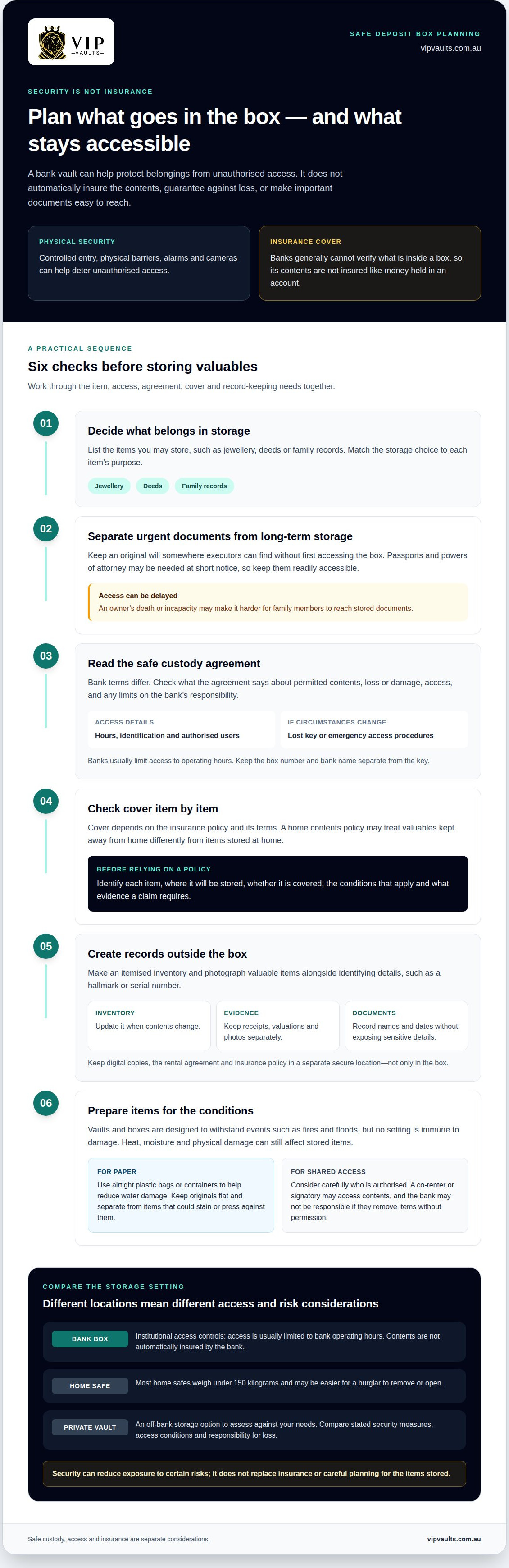
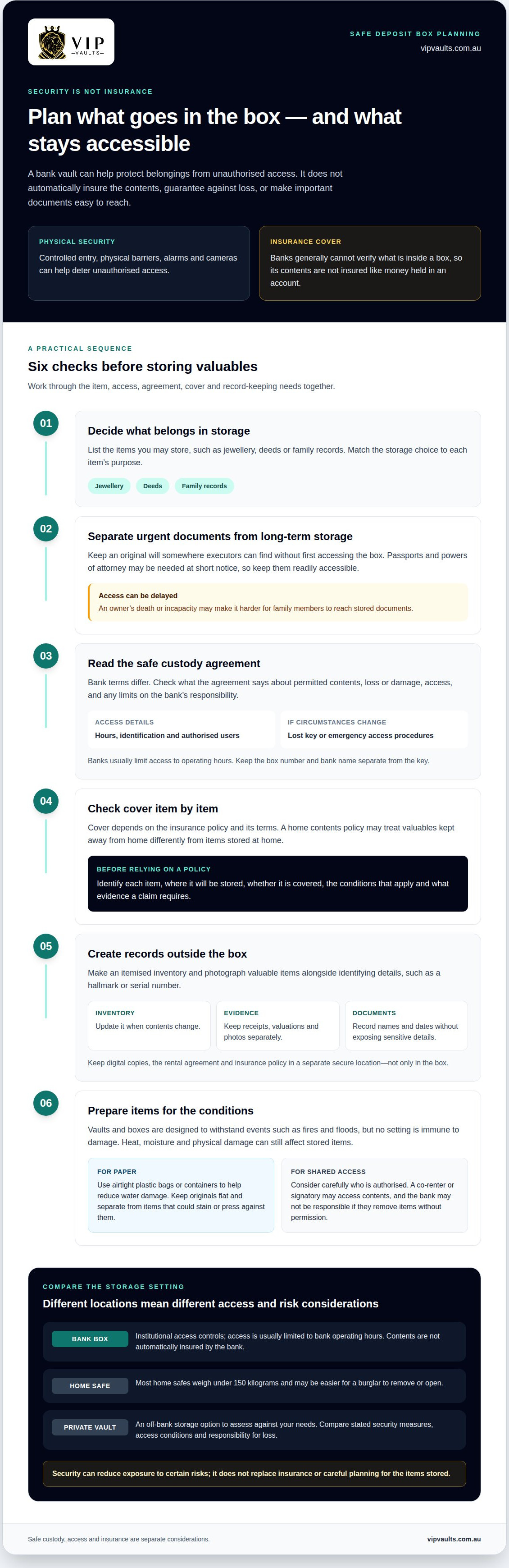
A secure vault is not an insurance policy. In Australia, banks generally don’t insure the contents of safe deposit boxes, including cash and documents. That’s why bank safe deposit boxes are not insured by the bank: it can’t verify what each box contains, even when access to the vault is tightly controlled.
It’s understandable to expect valuables kept inside a bank to have the same protection as money in an account. But physical security and insurance are different: a box can help protect belongings from unauthorised access without covering loss or damage. This article explains what a safe deposit box is, how banks control access, and why that protection doesn’t automatically extend to the contents. You’ll also learn what to consider before storing documents or cash, and how private vault storage may suit valuables you want to keep outside the banking system.
Key Takeaways
- Distinguish the physical security of a safe deposit box from insurance cover for its contents.
- Understand why a bank may not be able to verify or insure what is stored inside a box.
- Consider access, ownership and protection needs before placing important documents or cash in storage.
- Explore private vault rental when you want a secure place for valuables outside a bank safe deposit box.
What Is a Safe Deposit Box?
A safe deposit box is a secured compartment rented inside a bank vault. People use one for items such as jewellery, deeds and family records. Banks have offered this service for around 150 years, but vault security does not make the contents a bank deposit. A bank can record who rents a box and controls access, but it generally cannot verify every item placed inside. This helps explain why bank safe deposit boxes are not insured like money held in an account.
Safe custody is a separate arrangement from depositing money. The rental agreement sets out the bank’s responsibilities and the renter’s obligations. Australian banks’ terms can differ, so there is no single liability clause that applies to every box. Read the agreement for its wording on loss, damage, access and any limits on the bank’s responsibility. The agreement does not, by itself, establish insurance for the documents or valuables stored inside.
Cover for box contents depends on the policy you arrange and its terms. A home contents policy may treat valuables kept away from home differently from items stored at home. Before relying on a policy, identify each item, where it will be stored and what evidence a claim requires. For example, if you store jewellery and property documents, establish whether each item is covered and under what conditions.
Good records can help substantiate a claim. Before storing valuables, make an itemised inventory and photograph items alongside identifying details, such as a hallmark or serial number. Keep receipts, valuations and digital copies in a separate secure location, not only in the box. For documents, record their names and dates without unnecessarily exposing sensitive information. Update the inventory when contents change, and keep the rental agreement with your insurance policy for reference.
Safe deposit box security and disaster protection
A bank vault combines controlled entry with physical barriers. Banks use access procedures, alarms and cameras to protect safe deposit boxes. Some secure vault facilities also use CCTV to monitor access points 24 hours a day, 7 days a week. These measures help deter unauthorised entry, but they don’t show what a renter placed inside or guarantee against every loss.
Vault construction can also offer protection during disasters. Safe deposit boxes are designed to withstand events such as fires and floods, while a bank vault is generally more climate-controlled than a typical home safe. Neither setting is immune to damage. Keep sensitive papers in airtight plastic bags or containers to help reduce water damage, and remember that heat, moisture or physical damage can still affect stored items.
Compared with a home safe, a bank box is kept behind an institution’s access controls; most home safes weigh under 150 kilograms and may be easier for a burglar to remove or open. Private vault services offer another off-bank storage option. Compare the stated security measures, access conditions and responsibility for loss rather than assuming every facility provides the same protections.
Before renting a box, read the agreement for access hours, identification requirements, authorised users and procedures for a lost key or an emergency that restricts entry. Banks usually limit access to their operating hours, so consider whether those hours suit your needs. Keep the box number and bank name separate from the key, which could be lost or stolen.
If you want to consider storage outside a bank, private vault rental is one option to assess against your access and protection needs. Security reduces exposure to certain risks; it does not replace insurance or careful planning for the items you store.
Risks of storing important documents in a box
A secure location can become difficult to access when circumstances change. If the owner dies or becomes incapacitated, family members may face delays accessing the box. Keep an original will elsewhere so executors can find it without first needing the box. Passports and powers of attorney should also be kept somewhere accessible, as they may be needed at short notice.
Joint access requires care. A co-renter or authorised signatory may access the contents, and the bank may not be responsible if that person removes items without permission. Before adding someone, consider whether they need access to every document or valuable. Keep a separate record of who is authorised and what the arrangement allows.
Access can also change following a legal or banking event. A bank may force open a box in response to a court order, search warrant, account delinquency or bank closure. This does not mean the contents are automatically lost, but it can affect access and control. Keep a current inventory and rental agreement outside the box so you can identify stored items and understand the relevant terms.
Paper records can be damaged by water even inside a vault. Place sensitive documents in airtight plastic bags or containers before storing them. Keep originals flat and separate from items that could stain or press against them, such as jewellery or bullion. A secure storage environment can reduce exposure to some hazards, but it cannot make paper indestructible.
For bullion, jewellery and property records, match the storage method to each item’s purpose. Keep documents needed for travel, medical decisions or urgent transactions somewhere readily accessible. Photograph valuable items and store receipts or identifying details separately. If a loss occurs, these records can help show what was stored and support an insurance claim.
Cash stored in safe deposit boxes
Cash in a safe deposit box is physical property, not money held in a bank account. The bank cannot verify how much cash a renter placed there, so it generally does not insure that amount. If notes are lost, stolen or damaged, the renter may have no bank-provided cover to replace them. This is a key reason cash in a box differs from funds recorded in an account.
Before storing cash, read the safe custody agreement. Some banks prohibit cash, while others may restrict it under the rental contract. The agreement sets out permitted contents and the bank’s responsibilities. If cash is excluded, storing it in the box could leave you without recourse under the contract. Check the terms covering loss, damage and any limited payment provisions.
Insurance depends on the policy, not simply on where cash is kept. A home contents policy may exclude cash stored away from home or impose conditions on cover. Review the policy’s definition of cash, location limits and evidence requirements. A photograph of an open box cannot reliably prove the amount stored. Keep dated withdrawal records and an inventory separately, while remembering that records alone do not create insurance cover.
A home safe presents a similar documentation challenge: after a loss, you must establish what was inside. Keep cash records separate from the safe or box, and avoid recording access details alongside them. Consider whether cash needs to be kept there at all, or whether another arrangement better suits its intended use. Assess storage options for valuables separately from those for cash.
If you’re seeking secure storage outside a bank, explore private vault rental as an option for valuables. A vault is not a bank deposit, and it does not automatically insure stored property. Compare the rental terms with your insurance arrangements before deciding where cash or other items belong.
VIP Vaults & Bullion Exchange Perth: Private Vault Rental
VIP Vaults & Bullion Exchange Perth offers private vault rental for people seeking a place to store valuables outside a bank safe deposit arrangement. It may suit people storing bullion or jewellery who want a dedicated option rather than keeping items at home. Bullion lockers provide another storage option for bullion, while gold and silver bullion are available for those looking to hold physical precious metals.
Private vault storage is distinct from a bank deposit and does not automatically insure stored items. Consider what you plan to store, how you need to access it and how your own insurance applies. Contact VIP Vaults & Bullion Exchange Perth to discuss private vault rental or bullion storage.
Make your storage decision with confidence
Understanding why bank safe deposit boxes are not insured helps you decide what to store and what to keep accessible. Match each item to its purpose: a document needed at short notice has different requirements from a valuable kept for long-term safekeeping. Treat storage, access and insurance as separate parts of your plan.
Before changing your arrangements, decide what you need to protect, who may need access and what records you’ll keep outside the storage location. This preparation can help you choose an arrangement with fewer surprises and make your intentions clear to family members or other authorised people.
If you’re considering an alternative for valuables, contact VIP Vaults & Bullion Exchange Perth to discuss your storage needs. Take the next step at your own pace, with a clear understanding of what you want to safeguard.
Frequently Asked Questions
How Are They Protected & Insured?
Safe deposit boxes use controlled access and vault security, but those measures don’t insure the contents. Banks don’t verify each renter’s property or its value, which is why bank safe deposit boxes are not insured. Treat physical security and financial cover separately: read the rental agreement, then check whether your own policy covers items stored away from home.
Why are Australian bank safe deposit box contents not covered by the Financial Claims Scheme?
The Financial Claims Scheme concerns eligible deposit balances, not belongings kept in a rented compartment. A watch or paper deed remains physical property in storage; it isn’t recorded as an account balance. Even if a bank participates in the scheme, that doesn’t make box contents protected deposits or compensate you for their loss.
Does Australian bank insurance cover valuables stored in a safe deposit box?
Don’t assume a bank’s insurance provides personal cover for your valuables. A safe custody agreement describes the bank’s responsibilities, while cover for your jewellery or collectibles is a separate question. For example, if you store a watch in a box, look for written confirmation in your own policy that the item and its off-site location are covered.
Are safe deposit box contents covered by home and contents insurance in Australia?
Home and contents cover depends on the policy wording and the item. Check the sections on belongings away from home, valuables limits, exclusions and evidence required for a claim. A policy that covers jewellery at home doesn’t automatically cover it in a bank box. Compare the wording with the specific items and storage location you’re considering.
How can Australians insure jewellery, cash, documents, or other items kept in a bank box?
Ask your insurer about cover for each item while it is stored off-site, and accurately disclose its location and value. Keep an inventory, photographs and purchase or valuation records separately from the box. For cash, first read the bank’s rental terms, as some agreements prohibit it. Keep original documents you might need urgently somewhere accessible.
What are the risks of keeping cash, jewellery, or important documents in a safe deposit box?
Loss or damage may leave you without automatic compensation, while restricted access can complicate urgent plans. A passport stored in a box, for example, may be unavailable when travel arrangements change. Jewellery can also be harder to claim for without clear ownership and value records. Review who else can access the box, and keep essential documents available outside it.