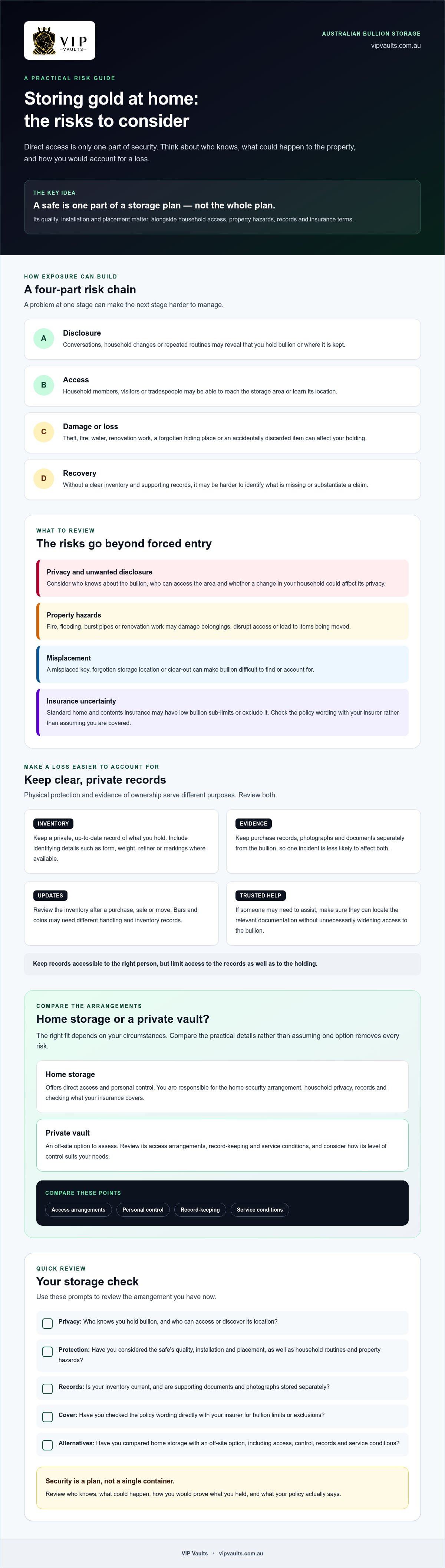

Keeping gold close can feel reassuring, but easy access is only one part of security. If you’re researching “risks of storing gold at home Australia”, consider what could happen if someone discovers its location, the property is damaged or you need to prove a loss. A safe may help manage some risks, but it won’t automatically resolve insurance limits, household access or recovery.
It’s understandable to value having bullion within reach, especially when you want direct control over a physical asset. Home storage may suit some circumstances, but its effectiveness depends on your setup, who knows about the holding and the terms of your policy. Standard home and contents insurance may impose low sub-limits for bullion or exclude it, so check the wording with your insurer rather than assuming you’re covered.
This guide sets out practical risks and a checklist for reviewing security, property hazards, records and insurance. It also compares home storage with a specialist private vault, including access arrangements, service conditions and the level of control each option offers.
Key Takeaways
- Understand the risks of storing gold at home Australia, from unwanted disclosure to property damage and challenges recovering a loss.
- Review who knows about your bullion and whether changes in your household could affect its privacy and protection.
- Check your policy wording directly with your insurer, and keep clear records of what you hold.
- Compare home storage with a private vault by considering access arrangements, personal control, record-keeping and service conditions.
- Use a practical checklist to assess your current arrangements, then decide whether an off-site option such as a private vault rental or bullion locker suits your needs.
What are the risks of storing gold at home in Australia?
Keeping physical bullion at home gives you direct access, but you’re also responsible for protecting it and keeping track of it. The risks of storing gold at home Australia owners should consider go beyond whether a safe can be locked. Theft, accidental misplacement, fire or water damage, unwanted disclosure and difficulty establishing what you owned after a loss can all affect the outcome. This guide focuses on bullion stored in a private residence, rather than jewellery worn regularly.
A secure container is one part of a storage plan, not the whole plan. Consider where the bullion is kept, who can access or discover it, how you document your holdings and what you could do if it goes missing or is damaged.
Why a home safe does not remove every risk
A safe may deter casual access, but protection depends on more than the lock. Its quality, installation and placement matter, as does whether household members, visitors or tradespeople can reach the area. A safe also won’t prevent every property hazard, such as water entering the storage area, or ensure you can prove what was inside. Consider household routines as well as the container itself.
Which types of gold storage are in scope?
Bars and coins may need different handling and inventory records. Bars can be easier to identify by product details, while a coin collection may need item-by-item descriptions. This guide focuses on practical storage questions, not investment performance or price movements. For more on format and handling differences, see this guide to gold coins versus gold bars in Australia.
Think of the exposure as a chain:
- Disclosure: Conversations, household changes or repeated routines may reveal that you hold bullion or where it’s stored.
- Access: The more people who know the location or can access the area, the harder it may be to maintain discretion.
- Damage or loss: Fire, water, renovations or a forgotten change of hiding place can damage bullion or make it difficult to find.
- Recovery: Without a clear inventory and supporting records, it may be harder to identify what’s missing or substantiate a claim.
Home security involves physical measures and personal practices. A foundational overview of home security measures can help frame the wider picture, but your storage decisions should reflect your residence and circumstances. No single measure removes every risk.
How can gold kept at home be exposed to theft, damage or loss?
Home storage risks don’t begin and end with forced entry. A visitor who notices a safe, a household member discussing a holding or routines that show when a property is unattended can affect your privacy. Limit knowledge of your bullion to people who need it, and avoid sharing unnecessary details in public conversations or online. The Australian Bureau of Statistics reports on household crime, including break-ins and theft. Its latest crime victimisation data provides national context, but it can’t predict the risk to an individual home or show that bullion is more likely to be targeted.
Damage, misplacement and proving ownership
Property hazards vary. Fire, flooding, burst pipes or renovation work may damage belongings, disrupt access or lead to items being moved. Bullion can also go missing in everyday ways: a key is misplaced, a storage location is forgotten or an item is accidentally discarded during a clear-out. Keep your arrangement discreet, but document it clearly enough that you, or someone authorised to help, can locate and account for the holding.
Recovery depends on good records as well as physical protection. Keep a private, up-to-date inventory with purchase records and identifying details, such as the form, weight, refiner or markings where available. Store copies of photographs and documents separately from the bullion, so one incident is less likely to affect both the holding and the evidence of ownership. Limit access to these records too.
Clear records can help distinguish what you own from what may be missing, especially if your holdings change over time. Review the inventory after a purchase, sale or move. Make sure a trusted person who may need to assist knows how to locate the relevant documentation without unnecessarily widening access to the bullion itself.
Extra considerations for SMSFs
If gold is held through a self-managed super fund, don’t assume personal home-storage arrangements meet the fund’s obligations. Requirements can depend on the asset and circumstances, so confirm current rules with an appropriately qualified adviser and relevant authoritative sources. Our guide to SMSF gold storage requirements offers a starting point for further research.
If you’re considering an off-site option, review private vault rental and bullion locker options. Check the provider’s access arrangements, service conditions and insurance terms before deciding.
Home storage versus a private vault: what should you compare?
Neither home storage nor off-site storage is automatically the safer choice for every owner. Each shifts responsibility in different ways. When weighing the risks of storing gold at home Australia owners may face, compare who controls access, how easily you can reach your bullion, what records are available and which terms apply if something goes wrong.
Use this framework to guide your questions, not as a guarantee of protection. Confirm home insurance details with your insurer, and ask any storage provider to explain access procedures, service conditions and the scope and exclusions of any insurance arrangements.
| Factor | At home | Private vault |
|---|---|---|
| Access | You manage access and can keep bullion close, subject to your household routines. | Access follows the provider’s procedures and conditions. Check when and how you can access your holdings. |
| Personal control | You select and manage the storage arrangements, including who knows about them. | You rely on the provider’s stated processes and service terms for storage and access. |
| Household exposure | Exposure may be affected by visitors, household changes and property hazards. | The bullion is stored away from your residence, but off-site arrangements have their own terms and risks. |
| Records | You maintain your inventory, purchase documents and supporting evidence. | Ask what account or holding documentation is provided and what records you should keep yourself. |
| Insurance and service | Ask your insurer whether bullion is covered, and under what conditions or limits. | Confirm with the provider whether any cover applies, along with its exclusions and service conditions. |
When might keeping some gold at home suit an owner?
Home storage may suit someone who values direct access and can manage the responsibilities involved. Consider your household circumstances, whether the safe is properly installed for its intended use, who can access the storage area and whether your records are current. If those arrangements are difficult to maintain, convenience alone may not make home storage a good fit. There’s no universal quantity that determines the right choice.
When might off-site storage be worth considering?
A larger holding, a shared household or limited suitable storage space may prompt you to explore an off-site option. Compare provider independence, access procedures, documentation and service terms before deciding. A private vault doesn’t remove every risk or automatically include insurance. VIP Vaults & Bullion Exchange Perth offers private vault rentals and bullion lockers. Read more about private vaults in Australia as you assess whether specialist storage suits your circumstances.
How can you reduce the risks of storing gold at home?
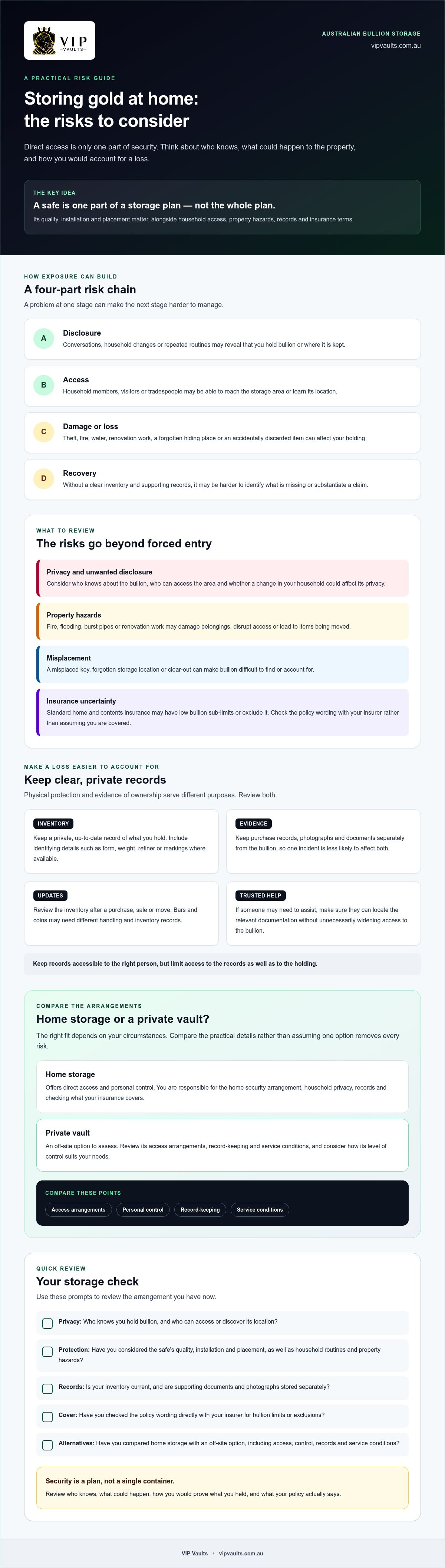
A practical review can help you manage the risks of storing gold at home Australia without relying on one measure alone. Work through these five checks, then revisit them if your household or storage arrangements change.
- Minimise disclosure. Limit knowledge of your bullion to people who need to know. Avoid sharing unnecessary details in conversations or online, and be aware of routines that could draw attention to your storage arrangements.
- Assess the storage setup. Consider whether your chosen storage is appropriate for your residence, installed as intended and exposed to hazards such as water or renovation work. Don’t assume a safe alone addresses every risk.
- Check your insurance. Contact your insurer and ask in writing whether bullion is covered, what limits or exclusions apply and what evidence you’d need to provide for a claim. Contents policies can have specific conditions for valuables, so don’t rely on general descriptions or assumptions.
- Document your holdings. Keep purchase records and a current inventory with useful descriptions and identifying details. Store this information securely and separately from the gold, and update it after a purchase, sale or other change.
- Review access. Know who can reach the storage location and manage keys or combinations carefully. Reassess access when household circumstances change, and review the setup after moving or renovating.
Review security, access and household arrangements
Make your review proportionate to your circumstances. Ask whether anyone who no longer needs access still has it, whether household routines have changed and whether you can account for every key or combination. Avoid sharing access details broadly. A periodic review can help you catch gaps before they become difficult to resolve.
Check insurance and keep useful records
Ask your insurer to confirm the relevant cover, limits, exclusions and proof requirements in writing. Keep records securely, but make sure they remain accessible if you need to establish what you held. These steps support good household management, but they don’t guarantee that a claim will be accepted or that every loss can be recovered.
If home storage no longer fits your circumstances, compare access procedures, service conditions and insurance terms with any off-site provider before deciding. Explore private vault storage options as one alternative to assess alongside your home arrangements.
Is a private vault a suitable alternative to storing gold at home?
A private vault is worth investigating if you’d prefer not to manage every aspect of bullion storage at home. It isn’t the right choice for every owner, and moving gold off-site doesn’t remove all risk. The decision depends on how you weigh direct access and personal control against household exposure, provider procedures and the responsibilities of an off-site arrangement. Considering the risks of storing gold at home in Australia is a useful starting point, not a reason to choose one option automatically.
VIP Vaults & Bullion Exchange offers private vault rentals and bullion lockers for precious metals. Before choosing any provider, ask for clear answers about what is stored, how access works and what the service terms mean for you.
Questions to ask before choosing off-site gold storage
Clarify how the arrangement works before committing. Ask who holds custody of the bullion, how your assets are identified in the provider’s records and what documentation you’ll receive. Confirm access procedures and any conditions that could affect when or how you can retrieve your holdings. Don’t infer security features from general descriptions; ask the provider to explain its processes directly.
- Records: How are your holdings identified, and what statements or documentation will you receive?
- Access: What are the access procedures and applicable service conditions?
- Insurance: Does any cover apply to your stored bullion? Ask for its scope, limits and exclusions in writing.
- Provider: What is the provider’s ownership and operating structure? VIP Vaults & Bullion Exchange describes itself as privately owned and independent of government and financial institutions.
Verify answers directly and review the written terms before deciding. Insurance arrangements can vary, so don’t assume cover is included or applies to every loss or circumstance.
Choose a storage arrangement that matches your needs
Home storage may suit owners who value direct access and are comfortable managing the arrangements themselves. Off-site storage may be worth exploring if household circumstances, available storage or the amount of responsibility involved make home storage less suitable. Consider whether a private vault rental or bullion locker better matches your holding and access needs, then compare the provider’s documentation and conditions with your own requirements.
There’s no universal answer. Take time to compare the arrangements, ask for details and decide once you understand the trade-offs. Discuss private vault and bullion locker options as part of your assessment.
Choose the storage arrangement that fits your circumstances
The risks of storing gold at home Australia owners should weigh include more than theft. Household access, property damage, misplaced bullion and incomplete records can all complicate protection and recovery. A safe may be part of your arrangements, but it works best alongside careful access management, an up-to-date inventory and a clear understanding of your insurance terms.
Home storage offers direct access and personal control. A private vault or bullion locker is an off-site alternative to compare, not a guarantee against loss. Before deciding, review the provider’s access procedures, service conditions, documentation and insurance terms, and consider how each arrangement fits your household and needs.
VIP Vaults & Bullion Exchange offers private vault rentals and bullion lockers. Its precious metals range includes products from LBMA-accredited manufacturers, and the business is privately owned and independent of government and financial institutions. Explore private vault and bullion locker options and request details to make an informed comparison.
Frequently Asked Questions
Is it legal to store gold at home in Australia?
There isn’t one answer that applies to every situation. Legal, tax or reporting considerations may depend on who owns the gold, how it’s held and the purpose of the holding. For ordinary personal bullion, verify any questions with a qualified Australian professional. If the gold is held through an SMSF or another ownership structure, check current requirements with an appropriate adviser. General storage guidance isn’t legal or financial advice.
Can home insurance cover gold bullion in Australia?
It depends on the policy, the type and value of the bullion, and the insurer’s conditions. A policy may have sub-limits, exclusions or evidence requirements for valuables, so don’t assume standard contents insurance protects an investment holding. Ask your insurer in writing whether bullion is covered, what limits apply, which records you’d need to provide and whether the storage method affects cover. Keep its written response with your policy documents.
What are the main risks of keeping gold at home?
The risks of storing gold at home Australia owners should consider include theft, accidental disclosure, fire or water damage, misplacement and difficulty proving what was held. Which risks matter most depends on the residence, household arrangements, storage method and insurance terms. A safe may help control access, but it doesn’t replace an accurate inventory or suitable records. Consider both how bullion is protected and how you could account for it after a loss.
How can I store gold at home more safely?
Start by limiting unnecessary disclosure and reviewing who can access the storage location. If appropriate for your circumstances, use a suitable, professionally installed safe and manage its keys or combination carefully. Keep a secure inventory with purchase records, descriptions and identifying details, stored separately from the bullion. Ask your insurer to confirm cover and conditions in writing. These steps can help manage exposure, but no home arrangement is risk-free.
What happens if gold stored at home is stolen or damaged?
The outcome depends on the circumstances, the records available and the terms of any applicable insurance policy. Report the incident to the relevant authorities and contact your insurer promptly, following its notification and evidence requirements. An inventory and purchase documents stored separately from the bullion may help establish what you held. Don’t assume a claim will be accepted or paid in full. Keep copies of incident reports and correspondence.
Is a private vault safer than storing gold at home?
A private vault changes where your gold is stored and who manages the storage environment, but it doesn’t remove every risk. Compare the provider’s access arrangements, service conditions, documentation and insurance scope, including exclusions, with your home setup. The right fit depends on how much you value direct access, your household circumstances and your comfort with off-site custody. Ask the provider to confirm its terms directly before deciding.
How much gold should I keep at home?
There’s no universal quantity that suits every owner, and a fixed threshold shouldn’t be treated as a security rule or financial recommendation. Consider your household arrangements, access needs, insurance conditions and ability to maintain accurate records. If the holding is substantial, or belongs to an SMSF or another structure, seek appropriate professional guidance and verify current requirements. You can also compare home storage with off-site options before deciding how to hold your bullion.
To compare an off-site option with your home arrangements, explore private vault rentals and bullion lockers from VIP Vaults & Bullion Exchange.