
The safest-looking place for your savings may not preserve what they can buy. Cash is useful and familiar, but persistent inflation or a weaker Australian dollar can reduce its purchasing power over time. Protecting assets from currency devaluation starts with understanding which risk you’re exposed to, not reacting to a headline or trying to predict the next market move.
It’s reasonable to question whether savings alone can keep pace, and comparing alternatives can feel complicated. Inflation is a rise in prices across the economy; currency depreciation is a fall in the Australian dollar’s value relative to other currencies. They’re related, but affect purchasing power in different ways. Bonds, shares, international investments and physical precious metals each have distinct risks, costs and potential benefits.
This guide explains the main forms of currency risk facing Australian investors and compares common ways to manage exposure, without presenting any strategy as a guarantee. It also offers a practical framework for considering gold or silver bullion, including price fluctuations, direct ownership and secure storage. The aim is to help you assess the trade-offs and make decisions that fit your circumstances.
Key Takeaways
- Understand how a falling Australian dollar differs from rising domestic prices, and how each can affect what your savings buy.
- See why exchange rates respond to changing economic conditions and market sentiment, making precise forecasts uncertain.
- Compare cash, diversified investments, international exposure and precious metals, including access considerations around US Treasury Inflation-Protected Securities.
- Use a practical framework for protecting assets from currency devaluation by assessing your exposure, goals, time horizon, liquidity needs and concentration.
- Explore how physical bullion offers direct ownership while its market value can fluctuate, and what to consider about sourcing and secure storage.
How currency devaluation affects Australian purchasing power
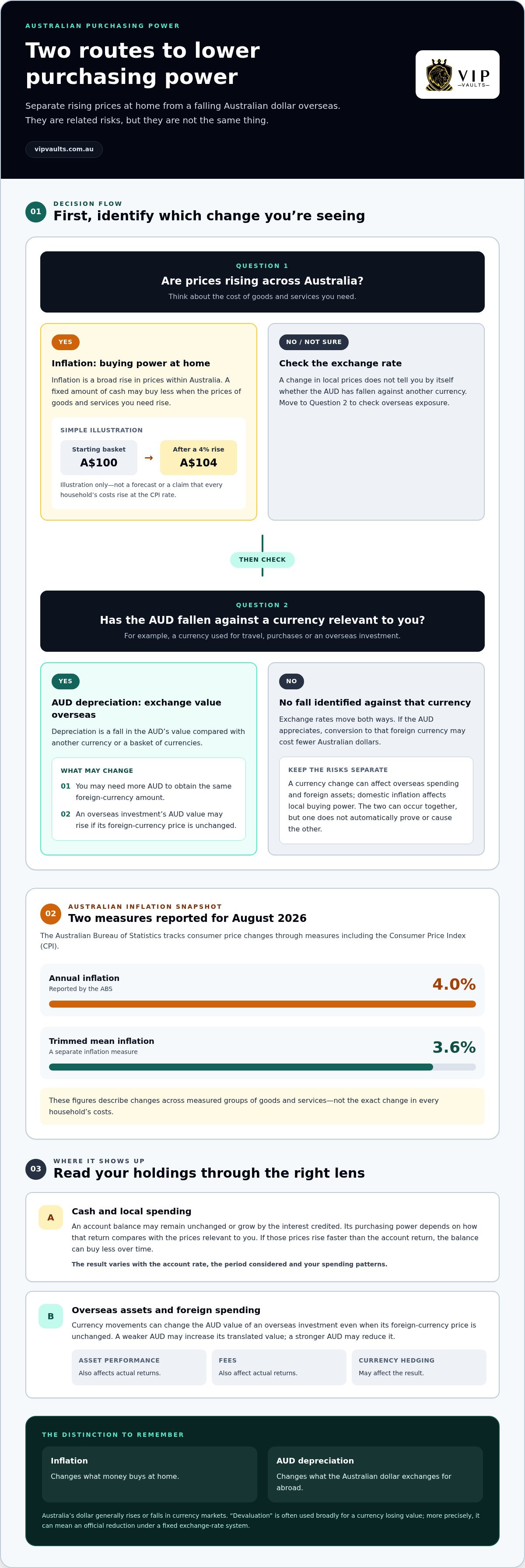
Currency weakness can affect an Australian’s finances through two related but distinct channels: prices at home and the exchange value of the Australian dollar (AUD) overseas. Identifying which is changing helps clarify your exposure before considering ways of protecting assets from currency devaluation.
Inflation and AUD depreciation: what is the difference?
Inflation is a broad rise in prices within Australia. The Australian Bureau of Statistics (ABS) tracks changes in consumer prices through measures including the Consumer Price Index (CPI). The ABS reported annual inflation of 4.0% in August 2026, while the trimmed mean inflation measure was 3.6%. These figures describe changes across measured groups of goods and services, not the exact change in every household’s costs.
As a simple illustration, if a household’s particular basket of goods cost A$100 and its price rose by 4%, the same basket would cost A$104. This is not a forecast or a claim that every household’s expenses rise at the CPI rate. It shows why a fixed amount of cash may buy less when the prices of goods and services a person needs rise.
Depreciation is a fall in the AUD’s value compared with another currency or a basket of currencies. In everyday discussion, “devaluation” is often used broadly to describe a currency losing value. More precisely, devaluation can refer to an official reduction under a fixed exchange-rate system, while Australia’s floating dollar generally rises or falls in currency markets. The concept and its broader implications are outlined in Currency Depreciation.
In brief: inflation changes what money buys at home; currency depreciation changes what it exchanges for abroad. The two can occur together, but one does not automatically prove or cause the other.
Which Australian assets may be exposed?
Cash is stable in nominal terms: an account balance may remain unchanged or grow by the interest credited. Its purchasing power depends on how that return compares with the prices relevant to the saver. If those prices rise faster than the account return, the balance can buy less over time. The outcome varies with the account rate, the period considered and the person’s spending patterns.
Currency movements also affect overseas purchasing power. If the AUD depreciates against a currency used for travel or purchases, Australians may need more AUD to obtain the same foreign-currency amount. If the AUD appreciates, that conversion may cost fewer Australian dollars. Exchange rates move both ways, so neither direction should be treated as certain.
For overseas investments, currency can change the AUD value even when the asset’s foreign-currency price is unchanged. A weaker AUD may increase its translated value; a stronger AUD may reduce it. Actual returns also depend on the asset’s performance, fees and any currency hedging. When reviewing your holdings, separate domestic inflation, which affects local buying power, from exchange-rate exposure, which matters for foreign spending and assets.
What drives currency weakness, and why forecasts are uncertain
An exchange rate is a market price shaped by expectations as well as current economic conditions. Investors compare Australia’s outlook with that of other countries, then adjust what they are willing to pay for each currency. A shift in interest-rate expectations, trade prospects or confidence can move the AUD, sometimes before the underlying economic data changes.
Economic and policy forces behind exchange-rate moves
Interest rates matter in relative terms. If markets expect Australian rates to rise compared with rates elsewhere, AUD-denominated assets may appear more attractive to some investors. But that is not a reliable one-way signal: the expected change may already be reflected in prices, and other concerns can outweigh it. The RBA cash rate was 4.60% in October 2026, following a 0.25 percentage-point increase in September, according to the supplied current RBA data.
Inflation and economic growth can influence expectations about future rates, business activity and investment returns. Trade flows matter too. Demand for Australian exports, the prices those exports earn and the cost of imports can affect demand for AUD. Government decisions and central-bank policy may influence confidence and expectations, but no single policy announcement dictates the exchange rate.
Currency values respond to multiple interacting forces, not one reliable signal. Longer-term pressures, such as differing growth prospects or persistent changes in trade, can sit alongside short-term market sentiment. Investors may quickly reprice currencies in response to economic releases, political developments or geopolitical events. These forces can reinforce each other or pull in opposite directions.
Why a currency forecast is not a protection plan
A forecast can be plausible and still be wrong about timing, scale or direction. New inflation data, a change in central-bank expectations or an unexpected global event can alter its assumptions. Even if the broad direction proves correct, an investor’s entry point and timeframe can affect the outcome. A past currency episode is context, not proof of what the AUD will do next.
That distinction matters when considering protecting assets from currency devaluation. A forecast-led decision is a bet on a particular exchange-rate outcome. A resilience-focused decision instead asks whether your assets, income and likely spending needs are overly exposed to one currency or economic condition. It accounts for the possibility that the AUD could strengthen as well as weaken, rather than relying on one prediction to protect purchasing power.
For a practical review, note which holdings are in AUD, which depend on overseas markets, and whether future expenses may be in another currency. Consider how each could respond under more than one scenario. This won’t remove uncertainty, but it can clarify trade-offs before you choose an approach.
If physical ownership is part of that review, gold and silver bullion can be considered alongside the separate question of private storage. Bullion’s market value can fluctuate, so assess it against your circumstances rather than treating it as a guaranteed answer to currency risk.
Comparing ways to protect assets from currency devaluation
No single asset responds in the same way to inflation, exchange-rate movements and market stress. Comparing options by their purpose, access and trade-offs can help you decide what role, if any, each might play. Diversification can spread exposure across asset types, but it can’t eliminate risk or prevent losses.
The table is a starting point, not a performance forecast. An asset’s outcome depends on its price, costs, time horizon and, for international holdings, currency movements.
| Option | Exposure and potential role | Limitations | Access considerations |
|---|---|---|---|
| Cash | Supports day-to-day spending and near-term liquidity. | If returns lag the prices of goods and services, purchasing power can erode. | Accessible through cash accounts, subject to account terms. |
| Diversified investments | Spreads exposure across different investments and markets. | Values can fall, and diversification does not remove market risk. | Access depends on the investment structure and its terms. |
| International holdings | Add exposure to overseas assets and currencies. | Currency changes can add to or detract from returns measured in AUD. | Available through different investment structures, each with its own costs and features. |
| Physical precious metals | Provides direct ownership of a tangible asset without an issuer. | Gold, silver and platinum prices can fall; none guarantees an inflation or currency hedge. | Consider purchase and resale arrangements, secure storage and insurance. |
Diversification, cash and market-based investments
Cash has a clear practical role: it can be available for planned expenses or emergencies. Its nominal balance may be steady, but its real purchasing power depends on the return earned compared with rising costs. Market-based investments may offer exposure to different sources of returns, but prices can fluctuate and losses are possible. Overseas assets add another variable: their AUD value reflects both the underlying investment and currency conversion. A favourable exchange-rate move may help; an unfavourable one may reduce the translated return.
Australian investors should also distinguish local products from overseas securities. US Treasury Inflation-Protected Securities (TIPS) are US government bonds, not a domestic Australian product. Australians cannot access them as though they were locally issued; exposure would involve an overseas investment or fund structure, with its own currency, access and cost considerations.
Physical precious metals: potential role and trade-offs
Physical bullion is held directly rather than as a claim issued by a company or fund. That distinction doesn’t make it immune to financial, market or practical risks. Its market price can move sharply, and the amount received on resale may differ from the purchase price. Before buying, consider how you would sell, where the metal would be stored, and what insurance arrangements apply. For context on local market pricing, consult the Gold Price Australia investor reference and compare the quoted price with the product’s terms.
Protecting assets from currency devaluation means balancing exposures, not relying on a single hedge. Weigh liquidity needs, diversification and ownership responsibilities together before deciding whether bullion belongs in your broader plan.
A practical framework for deciding whether bullion fits
Physical bullion may suit some financial plans, but it isn’t a universal answer to currency risk. Before deciding, consider the purpose it would serve, the assets you already hold and the practical responsibilities of ownership. This five-step framework can help you assess the fit without relying on a forecast.
- Define the risk. Identify what concerns you: rising costs in Australia, currency movements affecting overseas spending, or reliance on a particular asset or institution. A clear concern makes it easier to judge whether bullion addresses it.
- Review existing exposure. Take stock of cash, investments, property and any overseas holdings. Consider how much of your financial position already depends on the same markets or economic conditions. Adding bullion can create concentration rather than balance if its share becomes too large.
- Set a role. Decide what you expect tangible metals to contribute to your wider position. Consider whether your priority is direct ownership, diversification or another purpose, and avoid assuming bullion will rise when other assets fall.
- Assess the trade-offs. Weigh price volatility, purchase and resale arrangements, storage, insurance and access. Ask whether you could hold through price changes and whether you might need to sell at a particular time.
- Plan ownership. Consider how you’ll hold the bullion, keep records and manage storage. Review your time horizon and liquidity needs before committing funds, especially if that money may be required for near-term expenses.
Questions to answer before considering physical bullion
Ask yourself what role metals would play, how readily you may need access to the funds, and how you would respond if prices fell. Consider possible selling requirements and whether you understand the practical steps involved in ownership. Personal holdings and assets held through a self-managed superannuation fund (SMSF) are not interchangeable. SMSF investment decisions involve fund-specific obligations and circumstances, so seek advice from appropriately qualified financial and tax professionals before acting.
Compare bullion formats and ownership considerations
Coins and bars can differ in format and may have different purchase and resale considerations. Neither is automatically the better choice for every buyer. Compare the terms and understand how the price relates to the metal’s market value. VIP Vaults & Bullion Exchange Perth sells gold and silver bullion at live market rates, sourced from recognised refiners, including LBMA-accredited manufacturers. The bullion remains subject to market-price fluctuations.
Include storage in your decision, not as an afterthought. Physical ownership means planning how the metal will be kept secure and how you’ll access it. Private vault rentals and dedicated bullion lockers are storage options. When comparing coins and bars, consider your intended purpose, ownership arrangements and potential resale needs.
For protecting assets from currency devaluation, focus on suitability rather than certainty. To explore bullion and private storage options, consider how each fits your ownership and access plans.
Buying and storing bullion with VIP Vaults
Once you’ve considered bullion’s role in your wider position, the next questions are practical: what are you buying, how will you hold it, and how might you access or sell it? VIP Vaults & Bullion Exchange Perth is an Australian precious-metals dealer and private storage provider. It sells gold and silver bullion and offers private storage options. It isn’t a financial adviser, and bullion should be considered an asset with risks, not a guaranteed response to currency movements.
What to understand when purchasing bullion
VIP Vaults & Bullion Exchange Perth sells gold and silver bullion at live market rates, sourced from recognised refiners, including The Perth Mint and LBMA-accredited manufacturers. Live pricing provides a market-linked reference at the time of purchase, but doesn’t fix the price you may receive if you later sell. The market value of physical bullion can rise or fall, and storage doesn’t prevent a price decline or guarantee a return.
Before purchasing, understand the terms of the specific bullion and how its price is determined. Think through your intended holding period and possible resale needs. Physical ownership also means making a separate plan for safekeeping. Start by considering what storage arrangement suits how you intend to hold and access the metal.
How private storage fits into physical ownership
Private storage addresses the physical custody question without changing the market risks of the asset itself. VIP Vaults & Bullion Exchange Perth offers safe deposit boxes and dedicated bullion lockers. With a safe deposit box, only the box holder can access it; staff cannot open it. Access requires biometric identification and the holder’s unique physical key. VIP Vaults & Bullion Exchange Perth is privately owned and independent of government, banking and financial institutions.
Safe deposit boxes include complimentary insurance of A$10,000, with additional cover available. Bullion lockers use dual-key security, and the client holds the only keys. Private viewing rooms provide a discreet space to access stored items. Include storage in your ownership plan alongside access, insurance arrangements and records of your holdings. If bullion is held through an SMSF rather than personally, consider the fund’s requirements and obtain advice from appropriately qualified professionals about tax, superannuation and financial matters before making decisions.
Explore bullion and private storage options to see how physical ownership and secure custody could fit your plans. Take the next step after defining the role you want bullion to play, reviewing your existing exposure, considering liquidity and price risk, and planning how the metal will be held. That measured process supports informed choices about protecting assets from currency devaluation, without treating bullion as a promise of protection or performance.
Make your next step deliberate
Protecting assets from currency devaluation is not about finding a single asset that removes uncertainty. It’s about making choices you can understand and sustain through changing conditions. Before acting, write down what you want your assets to do, when you may need access to them, and what level of volatility you can accept. Use those priorities to guide further research and, where appropriate, seek advice suited to your financial and tax circumstances.
If physical bullion is part of your consideration, give equal attention to the purchase decision and the arrangements for holding it. Compare the practical responsibilities with your goals before deciding.
Explore bullion and private storage options as you consider your next steps. A measured, well-informed decision can help you feel more confident about the plan you choose.
Frequently Asked Questions
What does protecting assets from currency devaluation mean?
It means considering how your financial position may respond if money loses purchasing power or the Australian dollar weakens against other currencies. It doesn’t mean every holding must be moved into a different asset. Someone saving for an overseas trip may focus on future exchange costs, while a household planning local expenses may pay closer attention to domestic prices and the return on savings.
Is gold a reliable hedge against currency devaluation?
Gold can be one asset to consider, but it isn’t a reliable or guaranteed hedge in every period. Its price may rise or fall, and the result depends on the purchase price, holding period and eventual sale value. When assessing gold, compare its role with your existing investments and consider whether you can tolerate price fluctuations without needing to sell at a particular time.
Can currency devaluation affect Australian savings?
Yes, though the effect depends on what the savings are intended to buy. A weaker Australian dollar can make overseas travel, imported goods or foreign-currency expenses more costly in AUD. Savings held in an Australian-dollar account aren’t automatically reduced in nominal terms by that exchange-rate move, but their overseas purchasing power may change. Consider the currency of future expenses as well as the account balance.
How does inflation differ from currency devaluation?
Inflation refers to a broad increase in prices within an economy. Currency devaluation, more commonly called depreciation for Australia’s floating dollar, describes a fall in the AUD compared with another currency. A household might experience higher grocery prices without the AUD falling, or face a weaker exchange rate while domestic prices change at a different pace. The terms describe different pressures.
Are silver and platinum affected by currency movements?
Yes. If an internationally traded metal is priced in a foreign currency, a change in the AUD exchange rate can affect its quoted Australian-dollar value, even if its foreign-currency price is unchanged. The metal’s own market price can also move, so currency is only one influence. Silver and platinum can rise or fall, and neither should be assumed to track gold or provide a dependable hedge.
What happens to overseas investments when the Australian dollar falls?
If an overseas investment’s value in its own currency stays the same, a lower AUD can increase its translated value in Australian dollars. But the investment itself may also rise or fall, and the exchange rate can move in the opposite direction. For instance, a foreign share’s AUD value reflects both its market price and conversion rate. Currency hedging, where used, can change that exposure.
How can I store physical bullion securely in Australia?
Consider whether you need a private safe deposit box or a dedicated bullion locker, and plan how you’ll manage access, records and insurance. VIP Vaults offers both. Only the box holder can access a safe deposit box, using biometric identification and their unique physical key. Boxes include A$10,000 complimentary insurance, and additional cover can be arranged. VIP Vaults is privately owned and independent of government, banking and financial institutions. Storage addresses custody, not the risk of bullion prices falling.