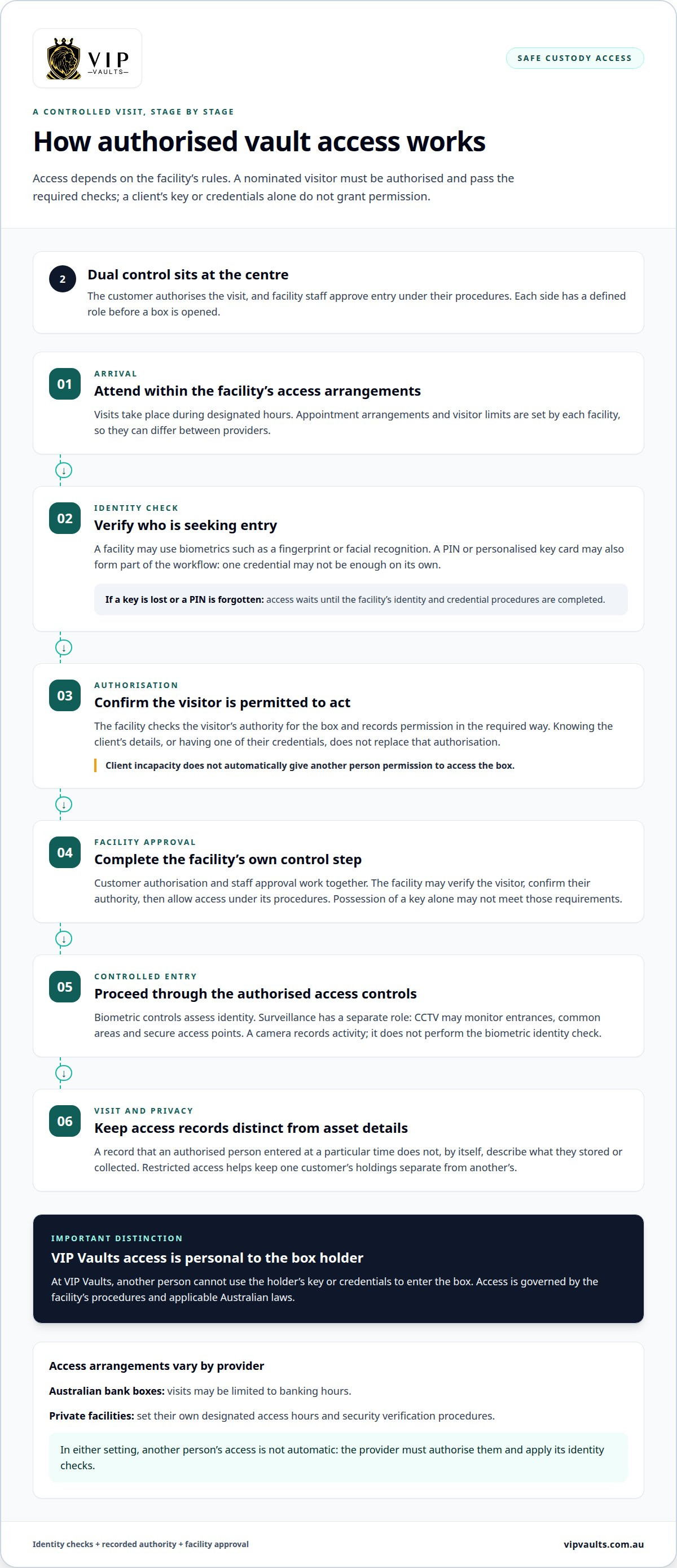
Access on your behalf is permitted only when the facility’s rules authorise it and the nominated person completes its security checks. The private vault access protocols determine who can enter, what authorisation is required and how access is recorded.
It’s sensible to plan access without weakening security. At VIP Vaults, access is personal to the box holder: another person cannot use the holder’s key or credentials to enter the box. The process combines biometric identification with a unique physical key, while digital photo recognition supports identity verification.
This article explains how delegated access can work, including customer and facility dual control, identity checks and the role of surveillance. You’ll also learn how privacy procedures can help protect the confidentiality of your visit and stored assets, and what to understand before relying on someone else to attend a Safe Custody facility for you.
Key Takeaways
- Learn what authorisation a nominated person needs before they can access your Safe Custody facility.
- Understand how customer and facility approvals work together to control access to stored assets.
- See how privacy procedures and security monitoring can support a discreet, controlled visit.
- Follow the main stages of a private vault visit in Australia, from arrival through to authorised access.
Can somebody access my Safe Custody facility on my behalf?
Yes, a nominated person may access a Safe Custody facility if its rules authorise them and they pass required identity checks. The private vault access protocols determine how that permission is recorded and verified.
Biometric identity checks
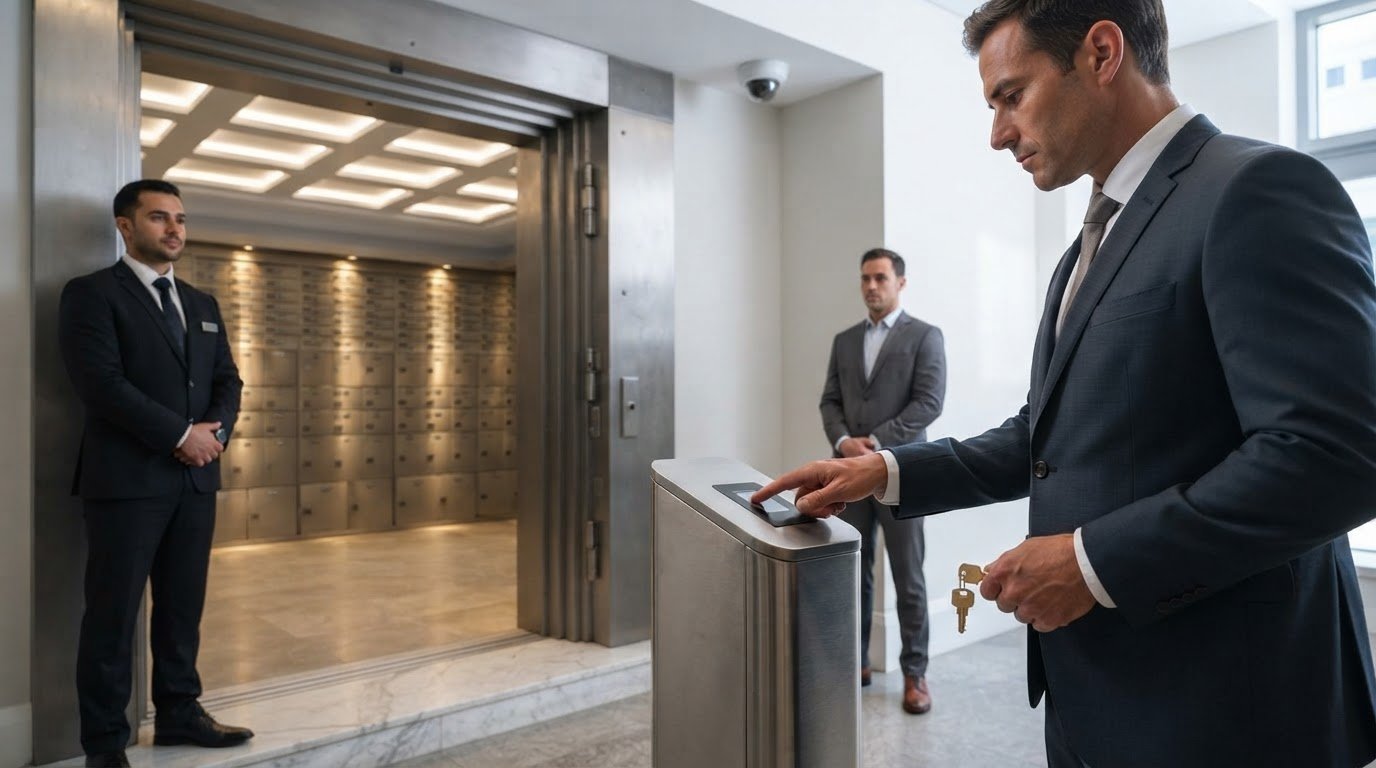
Biometric identity verification uses a person’s physical characteristics, such as a fingerprint or facial features, to confirm who is seeking entry. For example, a 3D camera projects light and maps facial features for identity verification. Fingerprint readers provide another biometric method. These checks help distinguish an authorised visitor from someone who merely knows the client’s details, protecting stored possessions such as jewellery during a deposit or collection.
Biometrics with PIN codes
Some access control systems combine a biometric check with a PIN, personalised key card or both. Each credential provides a separate way to confirm identity or authorisation, so knowing a PIN alone may not be enough to enter. A nominated person must meet the facility’s requirements, rather than rely on the client’s credentials. If a key is lost or a PIN forgotten, access must wait until the facility’s identity and credential procedures are completed. Incapacity also doesn’t automatically give another person permission; access depends on the facility’s authorisation rules.
Access controls and surveillance
Biometric access controls restrict entry to people whose identity the system can verify, while surveillance can monitor facility entrances, common areas and secure access points. Some modern facilities use CCTV around the clock, alongside identity checks before visitors enter storage areas. These measures create distinct checks: a camera records activity, while a biometric reader assesses a person’s identity. For a visitor collecting stored possessions, each control applies to a different part of the access process.
Private vault and bank box access
Private vault and bank safe deposit box procedures both depend on the provider’s rules, but access conditions can differ. Australian bank boxes may limit visits to banking hours, while private facilities set their own designated access hours and security verification procedures. That difference can affect when a deposit or collection is practical, so the facility’s operating arrangements matter. In either setting, another person’s access isn’t automatic: the relevant provider must authorise them and apply its identity checks. A lost key, forgotten credential or client incapacity is handled under those access rules, not by simply lending a PIN or key.
Customer and facility dual-control procedures
Dual control means the customer and facility each authorise a safe deposit box visit. It separates control of the stored property from control of entry.
Dual-control access procedures
In a dual-control arrangement, the customer authorises access and facility staff approve entry under their procedures. Both sides therefore have a defined role before a deposit box is opened. For example, a customer may present their credential while staff complete the facility’s own authorisation step. This distinction matters because possession of a key alone may not satisfy the facility’s access requirements.
Authentication workflows
A controlled workflow applies identity and authorisation checks in sequence, rather than treating one credential as complete permission. The facility may verify the visitor, confirm their authority for the safe deposit box, then allow access under its procedures. A personalised key card or PIN can form part of that process. These layers help prevent a person with one credential from bypassing the other required checks.
Access steps and appointment rules
Access usually follows the facility’s operating procedure: the visitor arrives during designated hours, completes identity verification, then proceeds through authorised access controls. Facilities set their own appointment arrangements and visitor limits, so these conditions differ between providers. A visitor acting for a customer must also have authorisation recorded in the required way. These details determine whether a planned deposit or collection can proceed.
At VIP Vaults, the box holder’s access is governed by the facility’s procedures and applicable Australian laws. The holder-only rule applies to access to the box.
Private vault access and storage costs depend on the type of storage and rental term. VIP Vaults offers safe-deposit boxes and dedicated bullion lockers, with pricing set for each option.
Physical bullion held by Australian investors isn’t covered by the Australian Government’s Financial Claims Scheme. Facility insurance, liability and exclusions are separate matters set out in the rental agreement, so they affect how risks are allocated.
Client confidentiality and privacy
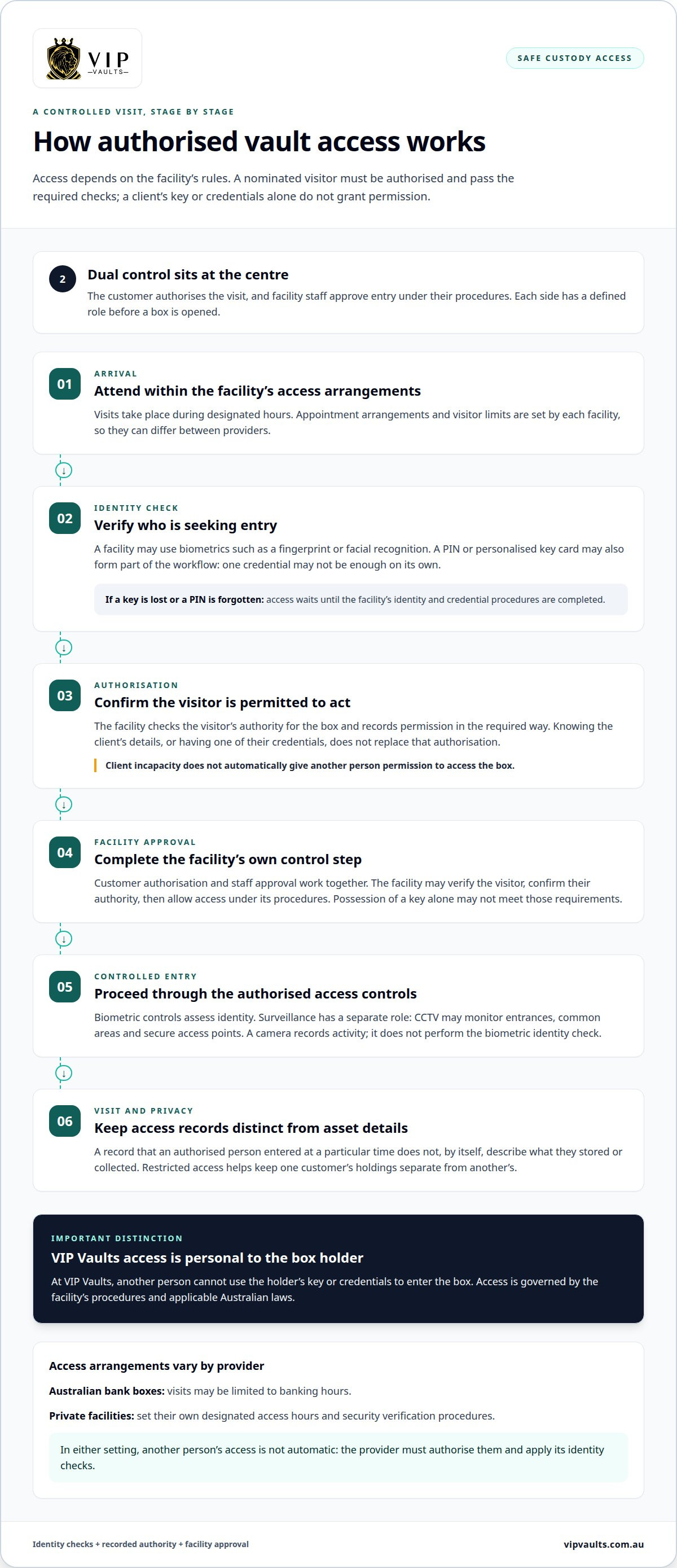
Confidentiality in vault storage concerns both who can enter and what information the process reveals. For example, a controlled visit can verify a visitor’s authority without making the nature or value of stored assets visible to other clients. Restricted access to deposit boxes also helps separate one person’s holdings from another’s. These distinctions matter when possessions include bullion, precious metals or jewellery, where privacy is part of managing secure storage.
Access records and asset details serve different purposes. A record that an authorised person entered at a particular time doesn’t, by itself, describe what they stored or collected. Likewise, a person authorised to enter shouldn’t be treated as authorised to access another customer’s deposit box. Clear permissions help keep access controlled, while the rental arrangement sets out how the customer and facility manage those permissions.
Surveillance and confidentiality can work alongside each other. CCTV may monitor entrances, common areas and secure access points, supporting oversight of movement through a facility. That monitoring is distinct from the private interaction involved in handling a customer’s possessions. For instance, a camera recording activity near an entrance doesn’t itself establish permission to open a deposit box; authorisation remains a separate control.
Privacy also sits alongside ownership records. For SMSF bullion, the Australian Taxation Office requires trustees to verify the bullion’s existence, ownership and secure storage at the end of each financial year. This means privacy does not remove record-keeping responsibilities for fund assets. A suitable storage arrangement should support controlled access while allowing trustees to meet their documentation obligations. For personal bullion, keep records that help you manage ownership.
What are the steps for accessing a private vault in Australia?
At VIP Vaults, access follows the facility’s operating hours and security procedures. The box holder must complete identity verification and use their unique key to access the box.
- Arrange access. Follow the facility’s appointment process and plan your visit during its designated operating hours. If someone is attending for you, ensure their authority is recorded as required.
- Complete identity checks. At arrival, the visitor completes the facility’s identity verification and any security screening required before entering storage areas.
- Pass the access controls. Present the credentials required by the facility, such as a personalised key card, PIN or biometric check. A credential alone may not replace separate authorisation.
- Use the authorised storage area. Facility procedures govern movement to the deposit box or storage area and how access is supervised.
- Complete the visit. Follow the facility’s process for finishing a deposit or collection and leaving the controlled area.
These stages clarify who is responsible at each point. For instance, a nominated visitor may pass an identity check but still need separate permission to access your stored property. Likewise, arriving outside designated hours can prevent a visit, even when the visitor holds the correct credentials. The facility’s agreement and access procedures define appointment requirements, visitor limits and what happens when credentials are unavailable.
For bullion held by an SMSF, access arrangements also sit alongside trustee record-keeping. The Australian Taxation Office requires trustees to verify the bullion’s existence, ownership and secure storage at the end of each financial year. A visit can support inspection, but trustees remain responsible for their fund’s records.
For a storage arrangement with defined access procedures, explore private vault access arrangements and consider how they fit your intended visits.
Visits must be arranged through the facility’s appointment process and made during its designated operating hours. The facility’s agreement and access procedures set any visitor limits and other access requirements.
VIP Vaults & Bullion Exchange Perth: Private Vault Rental
VIP Vaults & Bullion Exchange Perth offers private vault rentals for people seeking a dedicated place to store valuables. Its holder-only access process uses biometric verification and a unique physical key. Consider Private Vault Rental if you want a private storage option with controlled access.
A Bullion Locker suits customers looking to store bullion, while Gold Bullion and Silver Bullion are available for customers considering precious metals. These offerings address different needs: secure storage for assets you already own, or bullion purchases for those looking to acquire precious metals.
Before choosing a storage option, consider what you plan to store and how you expect to access it. VIP Vaults offers private vault rentals, bullion lockers and jewellery storage, with box access limited to the holder. Contact VIP Vaults & Bullion Exchange Perth to discuss Private Vault Rental.
Plan access around the future you want
Choosing how your assets should be accessed is part of planning how you want to protect and manage them over time. Consider who you would trust to act for you, and what arrangements would help that person understand your wishes. Clear decisions made in advance can make future storage planning more deliberate.
Use the private vault access protocols as a prompt to think beyond your next visit. Your needs may change as your holdings, responsibilities or circumstances change. Revisit your arrangements when those priorities shift, so your approach to access continues to suit the way you want your possessions managed.
If private storage is part of your next step, speak with VIP Vaults & Bullion Exchange Perth about an arrangement suited to your needs. Contact VIP Vaults & Bullion Exchange Perth to begin the conversation and consider your options with confidence.
Frequently Asked Questions
How many people can I give authority to access my facility?
For a VIP Vaults safety-deposit box, only the box holder can access it, so another person cannot be given box-entry authority. The authorised-person count for opening the box is therefore zero. Keep arrangements for someone to manage other affairs separate from vault entry. Possessing a spare key or knowing the holder’s credentials doesn’t make another person an authorised box user.
What are they used for?
Private vaults and deposit boxes provide secure storage for valuables kept outside the home. Examples include jewellery, important documents and precious metals such as gold and silver bullion. A safe-deposit box may suit someone storing family possessions, while a bullion locker is designed for storing bullion. Choose according to what you need to store.
What identification and documents are required to access a private vault in Australia?
At VIP Vaults, access requires the box holder’s unique physical key and biometric verification. The biometric methods include a wrist-vein reader, facial recognition and fingerprint recognition, supported by digital photo recognition. Bring your own key and attend for the identity checks. A representative’s identification or proof of their relationship to you does not replace the holder-only access rule.
What security checks and authentication methods do private vaults use?
VIP Vaults uses biometric identification, digital photo recognition, live monitoring, a UL Class-3 certified vault door and police-response alarms graded above bank standards. Biometric checks can include facial recognition, fingerprints and wrist-vein reading. These measures serve different roles: identity checks establish who is seeking entry, while monitoring and alarms support facility security. The box holder also uses their unique physical key for access.
Can an authorised representative or executor access a private vault in Australia?
At VIP Vaults, only the box holder can access a safety-deposit box. An executor or other representative cannot use the holder’s key or credentials as a substitute for being the box holder. Keep estate administration separate from box access: a document appointing a representative does not grant permission to open the box.
What are private vault access hours, appointment rules, and visitor limits in Australia?
Facilities set their own designated access hours, appointment arrangements and visitor limits. Visitors generally need to follow the appointment process, attend during operating hours and complete identity verification and required security checks.