
What if investment confidence came not from finding a risk-free asset, but from understanding the risks you’re accepting? Markets change, and no investment can remove uncertainty. For Australians considering peace of mind investments, it can be difficult to separate careful risk management from sales promises, or to know whether an asset’s ownership and storage arrangements suit their needs. Wanting reassurance is sensible. A promise of guaranteed returns is no substitute for informed decisions.
This guide offers a practical way to assess investment risks against your goals, timeframe and comfort with market changes. Before committing, consider how an investment works, what could affect its value, and how you can access or hold the asset. We’ll also explain why ownership and custody are separate decisions, and what to check when comparing storage options for physical assets such as bullion. The aim isn’t to predict markets. It’s to help you make choices based on what you understand, not on guarantees.
Key Takeaways
- Define what confidence means for your circumstances. Peace of mind investments can’t remove uncertainty or guarantee performance.
- Match investment choices to your goals, timeframe and need to access funds, while recognising that diversification can’t eliminate losses.
- Compare cash, listed investments and physical bullion by liquidity, ownership, changing value and custody arrangements.
- Use a checklist to test risks, access and terms. Separate verified facts from marketing claims and assumptions.
- Assess bullion as one possible asset category, weighing tangible ownership against price movements, resale considerations and storage needs.
What Do Peace of Mind Investments Really Mean?
Peace of mind investing doesn’t mean finding an asset that can’t fall in value or a strategy that guarantees a particular outcome. It means understanding what you’re investing in, why it may suit your circumstances and what could go wrong. Peace of mind is emotional reassurance; investment confidence is a considered view of risk based on evidence and your priorities.
That distinction matters. An investment may feel reassuring because it’s familiar or tangible, but those feelings don’t establish its performance, liquidity or suitability. Your confidence is personal, too. Someone investing for a long-term goal may view short-term price changes differently from someone who may need access to their money soon. Consider both how much risk you’re willing to accept and whether you could absorb a loss without disrupting essential plans.
Why no investment can remove every risk
Every asset and ownership structure has its own uncertainties. Market risk is the possibility that an investment’s value will fall. Inflation risk arises when rising prices reduce what your money can buy. Liquidity risk means you may not be able to sell or access an asset as quickly as you need, or on the terms you want. Counterparty risk concerns the possibility that another party involved in an investment won’t meet its obligations. Custody risk relates to how and where an asset is held, and the arrangements for access and control.
These risks can overlap. Cash, listed investments, property and physical bullion each have different characteristics, and none is automatically safe in every circumstance. Holding different assets can reduce the exposure to any one particular asset or risk, but diversification doesn’t eliminate losses or guarantee steady results. Instead of asking only, “Is this safe?”, ask, “Which risks does this involve, and can I live with them?”
What confidence should be based on
Before investing, be able to explain the asset’s purpose in your overall plan, what may affect its value, how you could access or sell it, and what conditions or costs apply. For physical assets, separate ownership from custody. Owning bullion and choosing where it is stored are distinct decisions. Check the arrangements for verification, safekeeping and access rather than assuming possession alone addresses every concern.
Then identify the uncertainty that matters most to you. Is it a potential fall in value, delayed access, reliance on another party, or the practical responsibility of holding an asset? Clear answers can’t remove uncertainty, but they can help you decide whether an investment fits your goals and capacity for loss. This section provides general education, not personal financial advice. If you need guidance tailored to your circumstances, speak with an appropriately qualified professional.
How Risk, Timeframes and Diversification Shape Investment Confidence
Investment choices make more sense when they’re tied to a purpose. Money set aside for an approaching goal may need to be accessible on a predictable basis. With a longer-term goal, you may have more time to consider fluctuations, but that doesn’t mean you can ignore the possibility of loss. Your timeframe affects how manageable uncertainty may feel, not whether risk exists.
Match investment decisions to goals and timeframes
Start by naming each goal and its approximate timeframe. Ask when you might need the money, how quickly you’d need to access it, and what could happen if the investment’s value fell at that point. Someone saving for a near-term expense may have less room to wait for a market recovery than someone investing towards a more distant goal. ASIC’s Moneysmart guide can help you develop an investing plan around your goals and circumstances.
Separate your comfort with volatility from your capacity for loss. You might feel calm about price movements but still need the funds soon. Or you might have time to wait but find fluctuations difficult to tolerate. Neither feeling alone determines whether an investment suits you. Review your assumptions when your income, responsibilities, goals or access needs change. Peace of mind investments should fit the life you have, not just the one you expected when you first invested.
Understand diversification without treating it as a guarantee
Diversification means spreading investments across different exposures so that your outcome isn’t tied to just one holding, provider or risk. Different asset types may respond differently to economic and market conditions, but they can still fall in value together or fail to offset losses. Diversification doesn’t promise stability, prevent loss or make an unsuitable investment appropriate.
Look beyond the number of holdings. Consider whether your assets depend on the same market, industry, provider or custody arrangement. Several investments can still be concentrated if they share a common vulnerability. For physical bullion, for example, consider the metal’s price exposure alongside who holds it and how you can access it. Ownership and custody are separate parts of the overall picture.
There’s no universal mix that suits every Australian investor. Map your goals, timeframes, access needs and ability to absorb loss, then assess how each choice fits. If physical ownership is part of your research, you can explore private vault and bullion locker options as storage arrangements to compare with your requirements. General information can support your thinking, but it can’t account for every detail of your personal circumstances.
Compare Investment Options by Liquidity, Ownership and Custody
Investments can differ in more than how their value changes. Consider how quickly you could access or sell them, what you legally own, how their value is assessed and who is responsible for holding or recording them. These distinctions make peace of mind investments a matter of informed comparison, rather than assumptions based on familiarity or physical form.
| Asset category | Liquidity and access | Ownership structure | Value fluctuation | Custody considerations |
|---|---|---|---|---|
| Cash | Access depends on where it’s held and any account terms or withdrawal conditions. | May be held directly or as a deposit with a financial institution. | Its purchasing power can change as prices rise or fall. | Check account records, access arrangements and any relevant terms. |
| Listed investments | Can generally be traded through a market, subject to trading access, market conditions and settlement processes. | You hold an interest in an investment, often recorded through an intermediary or platform. | Prices can move with market conditions and the investment’s underlying exposure. | Understand how holdings are recorded, who administers them and how you access account information. |
| Physical bullion | Selling or accessing it depends on the buyer, transaction arrangements and any storage or retrieval terms. | You own a tangible asset, subject to the purchase and ownership records. | Its market value can rise or fall; a tangible form doesn’t prevent price changes. | Decide whether to hold it yourself or assess a storage option, and clarify access and custody records. |
What to assess before choosing an asset type
Use the table as a starting point, not a ranking. Ask how soon you may need access, how the asset is valued, what could affect its price and what steps are involved in selling or withdrawing it. Ease of sale and ease of ownership are different. An asset may be straightforward to hold but take time or specific arrangements to convert into funds. Check applicable fees, terms and product documents directly before making a decision.
For a closer look at the difference between owning bullion and gaining market exposure through an investment product, read this guide to physical gold and gold ETFs.
Why ownership and custody deserve separate attention
Direct ownership of a physical asset differs from holding an interest recorded or administered by an intermediary. Neither structure removes risk. For any option, find out what evidence confirms your interest or ownership, how records are maintained, who holds the asset or administers the account, and what process applies when you want access. For stored bullion, check the specific custody and access terms rather than assuming storage arrangements are the same everywhere.
Compare each option against your priorities and circumstances. A clear view of access, ownership, value movement and custody gives you more useful grounds for confidence than the label “safe”.
Use This Checklist to Make Investment Decisions with More Confidence
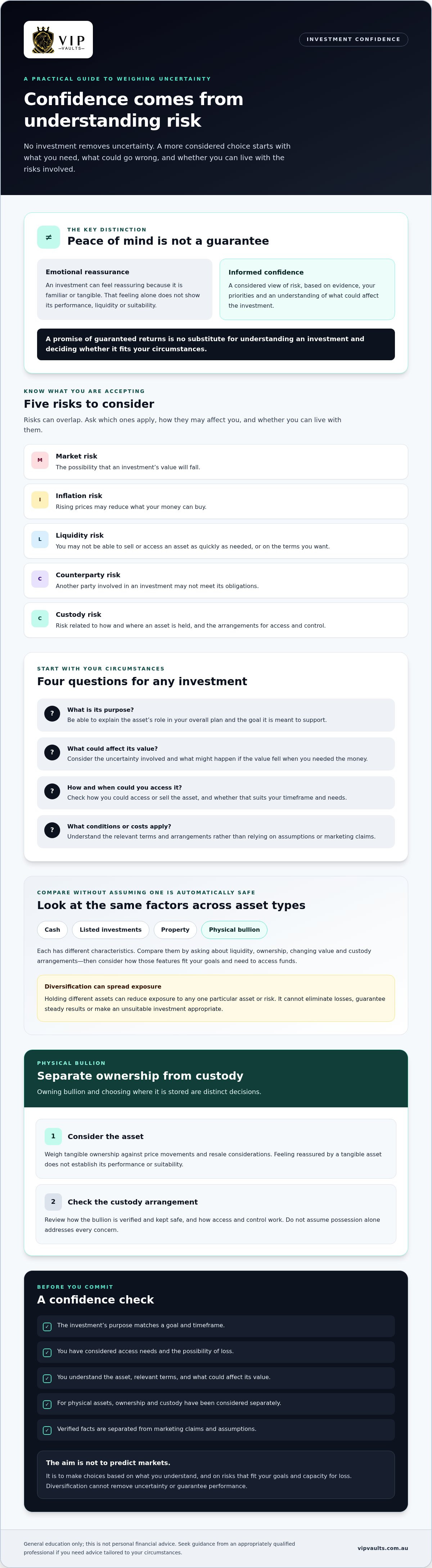
A measured process can help you separate what’s documented from what’s merely suggested. Before committing, work through these checks and keep a record of the answers. If a key detail is unclear, pause and seek clarification instead of filling the gap with an assumption. This helps ground peace of mind investments in evidence and your circumstances.
- 1. Define the goal. State what the investment is intended to help you achieve and when you may need the money or asset. A clear purpose makes it easier to assess whether the choice fits.
- 2. Assess the risks. Ask what the investment is, what may affect its value and what could go wrong. Consider whether you could absorb a loss. Distinguish independently verifiable facts from forecasts, promotional language and your own assumptions.
- 3. Check access. Find out how and when you can withdraw, sell or take possession. Ask what steps apply, whether access depends on another party, and how the process may change in different circumstances.
- 4. Verify the terms. Read the relevant product documents and agreements. Confirm applicable fees, exit conditions, ownership records and how assets or interests are held. For physical assets, check who has custody, how holdings are documented and what access arrangements apply.
- 5. Review your decision. Set a regular review point and revisit the investment if your goals, finances or access needs change. Don’t mistake frequent trading or attempts to time the market for a reliable way to feel more confident.
Questions to ask before committing
Ask the provider to explain important terms plainly, and check claims against written documents rather than relying on verbal assurances. For bullion or jewellery storage, compare the documented custody and access arrangements with your requirements. A guide to Australian private vault options can help you frame questions about specialist storage, but verify the current terms directly.
Some decisions also have personal financial or tax implications. General information can help you frame questions, but it can’t assess your full circumstances. Consider seeking independent guidance from an appropriately qualified professional before acting on advice that affects your finances or tax position.
Review decisions as circumstances change
A review doesn’t need to mean reacting to every market movement. Reassess when something meaningful changes, such as a new financial responsibility, a different goal or a shift in when you’ll need access. A calm, scheduled review helps you check whether the original reasoning still holds without treating short-term price changes as automatic instructions to act.
If physical storage is part of your due diligence, review private vault rental and bullion locker options alongside the ownership, access and custody terms that matter to you.
Where Physical Bullion and Secure Storage Fit into Peace of Mind
Physical gold, silver or platinum bullion may suit some investors’ priorities, but it’s one asset category, not a complete investment strategy. Tangible ownership doesn’t guarantee that bullion will retain its value or outperform other investments. Its market price can move, and selling or transferring it may take time and depend on the arrangements available. Consider how it fits alongside your other assets, goals and access needs.
Questions to consider when holding physical precious metals
Before acquiring bullion, establish what you’re buying and how you’ll confirm its identity and ownership. Ask about the refiner or source, what documentation accompanies the asset, and how you could verify its details. Then consider the practical steps involved in accessing, selling or transferring it. Answers can vary by product and provider, so check the relevant documents and terms directly rather than relying on broad claims about precious metals.
Ownership and custody are separate decisions. You may own bullion while arranging for another party to hold it. In that case, understand how the asset is recorded, what evidence confirms your ownership, who is responsible for its custody and how you can request access. A storage arrangement addresses practical custody needs; it doesn’t determine whether bullion suits your financial circumstances.
Assess storage options against your requirements
Home storage, facilities offered by financial institutions and specialist private vault services involve different responsibilities and terms. Holding bullion at home means considering how you’ll manage its security and records. For any third-party facility, ask about access arrangements, custody terms, documentation and what happens if you want to retrieve or move your property. Check whether any insurance applies, what it covers and what exclusions or conditions may apply. Don’t assume protection is included.
VIP Vaults & Bullion Exchange Perth offers private vault rentals and bullion lockers for precious metals and jewellery. These are storage options to assess, not investment advice. Confirm the current service scope and terms directly, including access and custody arrangements, before deciding whether they meet your needs. Explore bullion and private vault services if you’re comparing options for holding physical assets.
For peace of mind investments, the value of physical ownership depends on understanding both the asset and the arrangements around it. Weigh potential price movement, verification, resale or transfer steps, and custody together. The right choice is one you understand and can assess against your priorities, not one presented as a universal answer.
Build Confidence Through Clear, Informed Choices
Confidence doesn’t come from finding an investment untouched by risk. It comes from understanding why an option fits your goals, how its value may change, when you can access it and how ownership or custody is documented. Peace of mind investments depend on weighing these details against your timeframe and capacity to absorb loss, then reviewing your choices as circumstances change.
Physical bullion may be one part of an investment approach, but it isn’t a complete strategy or a promise of performance. VIP Vaults & Bullion Exchange offers gold, silver and platinum bullion bars and coins, sourced from internationally recognised and LBMA-accredited refiners. The business also provides private vault rentals and bullion lockers for precious metals and jewellery. Check current product and storage terms directly to decide whether these options suit your requirements.
If you’re researching physical bullion or specialist storage, explore bullion and private vault services as part of your due diligence. Verify the details, weigh the trade-offs and choose with care. Informed decisions can help you move forward with greater confidence.
Frequently Asked Questions
What does peace of mind mean when investing?
It means being able to explain why an investment belongs in your plan and what conditions could affect your decision to hold or sell it. Reassurance alone isn’t evidence that an investment is suitable. Consider whether you understand its purpose, the information behind key claims and the possible consequences if events don’t unfold as expected. Confidence grows from informed choices, not certainty about outcomes.
Can any investment be completely risk-free?
No. Even options that appear stable can involve trade-offs, such as reduced purchasing power, limits on access or reliance on another party. The type and level of risk vary, so avoid treating “low risk” as meaning “no risk”. Ask what could go wrong, how likely you are to need access during difficult conditions, and whether the potential consequences are acceptable for your circumstances.
How can I make an investment decision with more confidence?
Write down why you’re considering the investment and what evidence you need before proceeding. Read the relevant documents, clarify unfamiliar terms and check that claims can be independently verified. Consider how the investment fits with your other commitments, not just its advertised features. If personal financial or tax circumstances affect the decision, seek guidance from an appropriately qualified professional who can consider your situation.
Is physical gold a peace of mind investment?
It can provide direct ownership of a tangible asset, but that feature doesn’t make gold immune to changing market prices or guarantee that it will meet your needs. Consider the purchase documentation, how you would establish authenticity, and the practical steps for resale or transfer. Also decide how you would hold it and what responsibilities that choice creates. Suitability depends on your objectives, not simply the asset’s physical form.
What should I check before choosing a private vault?
Request clear written information about the service, including what property may be stored, how custody is documented, how access is arranged and what conditions apply to retrieving items. Confirm any fees and whether insurance is included, excluded or subject to particular terms. Ask who to contact with questions and how changes to the agreement are handled. Compare the provider’s written terms with your storage and access requirements.
Does diversifying investments guarantee greater security?
No. Spreading investments can reduce dependence on a single exposure, but it can’t assure a particular result. Different holdings may still be affected by shared economic conditions, and diversification doesn’t resolve concerns about ownership, providers or custody. Review what each investment contributes and where risks may overlap. A broader spread is useful only if you understand the assets and arrangements involved and they remain consistent with your objectives.
Should I store bullion at home or in a private vault?
Choose by comparing responsibility, access and documented terms rather than assuming one option is best for everyone. Home storage means arranging and managing safekeeping yourself. A private vault places physical custody with a provider under its service terms, so understand those terms before deciding. VIP Vaults & Bullion Exchange offers private vault rentals and bullion lockers. Confirm the current arrangements directly and assess whether they suit your requirements.