
What if your family knows you owned gold or silver but can’t locate it or identify what’s in the holding? Even when metal is securely stored, missing records or unclear instructions can make passing on precious metals to heirs more difficult at an already challenging time.
Planning ahead means recording what you own, where it’s held and which documents can help establish ownership. It also means making sure the person responsible for administering your estate knows where to find that information.
This guide covers how to prepare an inventory, record storage details discreetly and compare options such as a home safe, bullion locker or private vault rental. It also outlines Australian questions to discuss with a solicitor, tax professional or qualified adviser, including how a will, executor duties and capital gains tax may affect a later transfer or sale. Secure storage and estate planning serve different purposes. Addressing both can make the handover clearer for the people you leave behind.
Key Takeaways
- Passing on precious metals to heirs is easier to manage when estate instructions account for physical holdings, not just financial assets.
- Australian estate processes can vary by state and territory, so understand the steps that apply to your circumstances.
- Compare home storage, bank safe deposit boxes and private vaults by how records, access and custody will work for your executor.
- Build an inventory with each item’s metal type, description, weight, refiner or mint, and available purchase records.
- VIP Vaults & Bullion Exchange Perth offers private vault rentals and bullion lockers for precious metals and jewellery as storage options to consider in your handover plan.
Passing on precious metals to heirs: why planning matters
Planning for physical gold, silver and platinum means recording what you own, explaining how those holdings should be dealt with, and aligning that information with your wider estate arrangements. The goal is to connect the metal itself with the instructions and processes that guide its eventual transfer.
Without a clear record, heirs may not know which items exist, where they’re stored or who should be notified. An organised plan gives them a starting point while leaving decisions about control and distribution to the executor or other authorised legal representative. It helps create clarity without assuming that complications are inevitable.
Physical holdings should be part of your broader estate planning principles, including your will and directions for distributing assets. A storage key or note identifying a location can help someone find the metal, but it doesn’t, by itself, give that person legal authority to access or distribute it. Keep practical access information consistent with formal estate instructions, and seek advice from an Australian solicitor about how your arrangements apply.
What makes physical precious metals different to financial records?
A bank or investment account usually has a digital record associated with an institution. A bar or coin is a physical item, and its details may need to be identified from the item, its packaging and your purchase or storage documents. Holdings of the same metal can differ by form, weight, refiner or mint, so a note that says only “gold” may not be enough to identify what the estate holds.
Record each holding as specifically as you reasonably can. For example, distinguish a silver coin from a silver bar, and note any markings or supporting documents that help describe it. Include where it’s stored and how the executor can find the relevant records, while keeping sensitive access details from unnecessary disclosure.
What should heirs be able to understand?
At the discovery stage, heirs need a clear starting point: what may be held, where the records or items are, and whom to notify. The executor or legal representative then determines how the assets are handled under the will and applicable estate process. Finding a key or inventory is not the same as deciding who inherits an item or authorising someone to remove it.
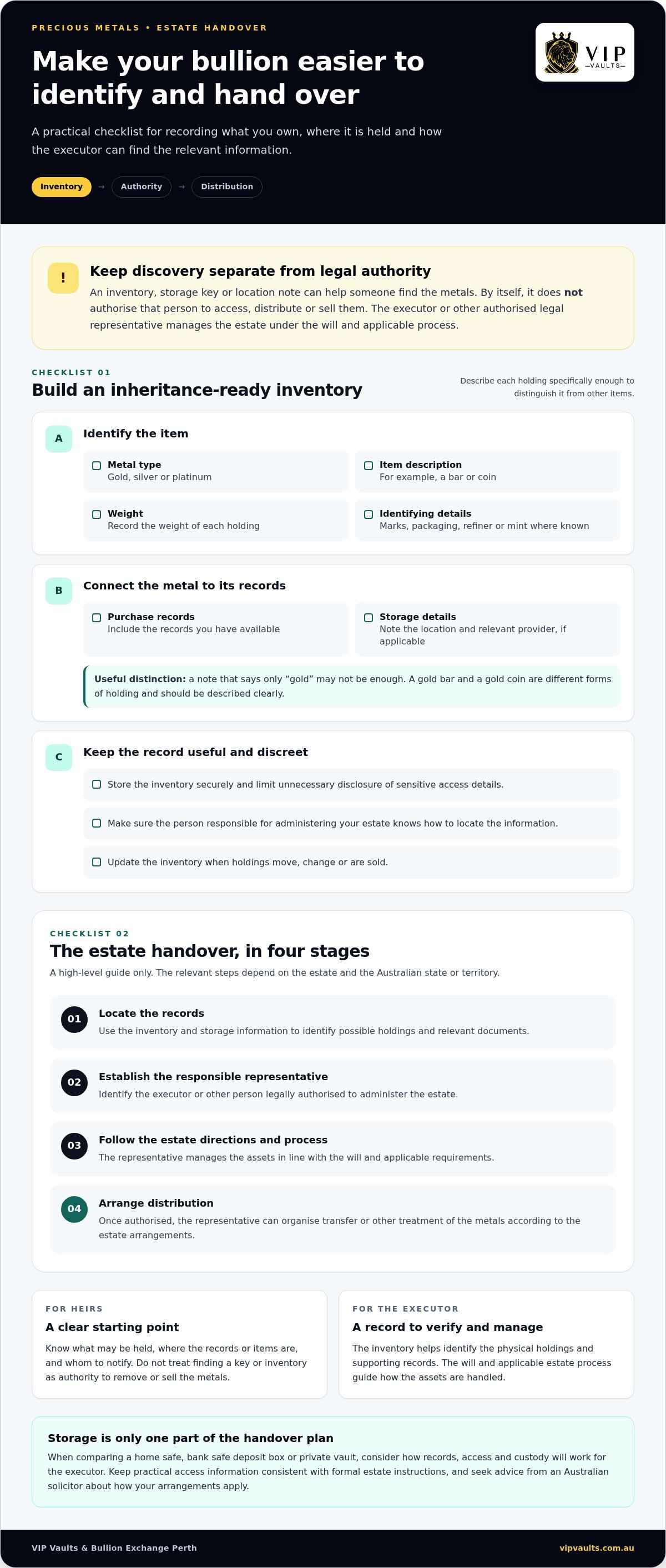
An inheritance-ready bullion record tells the executor what each item is, where it’s held and which records can help verify it.
For a useful record, include:
- Metal type and item description, such as a gold bar or silver coin.
- Weight, and any identifying marks or packaging details.
- Refiner or mint, where known, and available purchase records.
- Storage location and the name of the relevant storage provider, if applicable.
Update the inventory when holdings move, change or are sold. Store it securely, and make sure the person responsible for administering your estate knows how to locate it. This practical discovery information can save time without replacing a will, an executor’s authority or advice on Australian succession requirements.
How precious metals pass through an Australian estate
Passing on precious metals to heirs generally involves more than naming a beneficiary. The items must be identified, the person authorised to administer the estate must be established, and the will and applicable legal process must be followed before distribution can be arranged. The precise steps depend on the estate and the laws and procedures that apply in the relevant Australian state or territory.
A will records the deceased person’s wishes, including how assets are to be distributed. It’s distinct from the legal and administrative process used to deal with the estate. Depending on the circumstances, an executor may need formal authority before dealing with assets. A will, a note of where metals are stored or a family understanding should not be treated as automatic permission for an heir to take or sell them.
- Locate the records. Use the inventory and storage information to identify possible holdings and relevant documents.
- Establish the responsible representative. Identify the executor or other person legally authorised to administer the estate.
- Follow the estate directions and process. The representative manages the assets in line with the will and applicable requirements.
- Arrange distribution. Once authorised, the representative can organise transfer or other treatment of the metals according to the estate arrangements.
This is a high-level guide, not a substitute for checking current requirements. Procedures can differ across states and territories, and the appropriate steps may depend on the estate’s details. An Australian estate solicitor can explain how the relevant process applies, including what documents or authority may be needed before stored items are released or transferred.
Where do executors and legal representatives fit?
An executor generally takes responsibility for administering the estate under the will, subject to the applicable legal process. This can include identifying assets, keeping them secure and arranging their distribution in accordance with the estate instructions. The precise authority and steps depend on the circumstances.
Heirs should avoid collecting, moving or selling metals independently before the responsible representative confirms they’re authorised to do so. This helps maintain a clear custody record and avoids confusion about ownership or distribution. If you’re preparing your own arrangements or an estate is already being administered, speak with an Australian estate solicitor about the situation.
Which Australian tax questions need individual advice?
Tax treatment can depend on the type of metal or item, how and when it was acquired, who owned it, and the beneficiary’s circumstances. The estate’s position and an heir’s later decision to retain, transfer or sell an item may raise different questions. Don’t assume every holding is treated the same way, or that placing assets in a trust removes tax, probate or other legal obligations.
Before an heir sells or transfers inherited metals, get advice from a qualified Australian tax professional. The ATO guidance on deceased estates is a useful starting point for understanding estate-related tax matters, but individual circumstances may need professional interpretation. Clear records and secure custody can support an orderly estate process. A private vault storage option may be worth considering when planning where bullion is held. Storage complements, but doesn’t replace, legal authority or estate instructions.
Home safe, bank box or private vault: compare the handover implications
Storage affects how an executor can locate and account for precious metals, but it doesn’t determine who has authority to access them. When passing on precious metals to heirs, consider both physical custody and the instructions that will guide the estate. Secure storage still needs a current inventory, clear will instructions and a communication plan.
The comparison below focuses on practical handover questions, rather than declaring one option universally safest or easiest. Access rules and estate procedures depend on the provider and applicable legal requirements. For broader Australian context on wills and estate administration, consult Australian wills and estates guidance.
| Storage arrangement | Handover considerations |
|---|---|
| Home safe | The owner controls the physical location, so the executor needs a current, secure location record and instructions for handling it. The record should be discoverable by the right person without exposing sensitive details unnecessarily. |
| Bank safe deposit box | The box is held by a third party. The owner’s account or key details, the provider’s access procedures and the representative’s estate authority are separate matters. The process can depend on the institution and applicable requirements. |
| Private vault | Precious metals are held in a private storage arrangement. The estate plan should identify the arrangement and show the executor how to locate relevant account records and understand the provider’s access process. |
What can a home storage plan make clear?
A useful home-storage plan gives the executor a discreet, current record of where holdings are kept, without creating a widely shared map of sensitive household details. Protect the information, and ensure the person responsible for administering your estate knows how to locate it. If the metals move, update the record promptly. Avoid relying on memory, an old note or a key with no explanation.
Consider separating general inventory information from sensitive access details. The inventory can identify what’s held and who should be notified, while more restricted instructions can be stored and shared carefully. A location note helps with discovery; it doesn’t itself authorise an heir to enter, remove or distribute assets.
What should heirs understand about third-party storage?
With a bank box or private vault, consider three things separately: whose name is associated with the arrangement, what access procedure the provider applies, and who has legal authority to act for the estate. A key or account record may help identify the storage arrangement, but shouldn’t be treated as proof that an heir can collect the contents. Don’t assume the same process applies across Australian providers.
Private vault rental is a storage option, not estate administration. VIP Vaults & Bullion Exchange offers private vault rentals and bullion lockers for precious metals and jewellery. Owners can consider these arrangements as part of a broader handover plan. Whatever the storage choice, align its records with the will and explain how the executor can find the relevant information.
Prepare an inheritance-ready precious-metals inventory and access plan
A practical inventory turns a collection into information an executor can use. Set it up as a secure document, then update it as your holdings or storage arrangements change. The aim isn’t to publish a catalogue of valuables. It’s to help the appropriate representative identify each item, find supporting records and locate the current instructions.
Use this sequence to build the record:
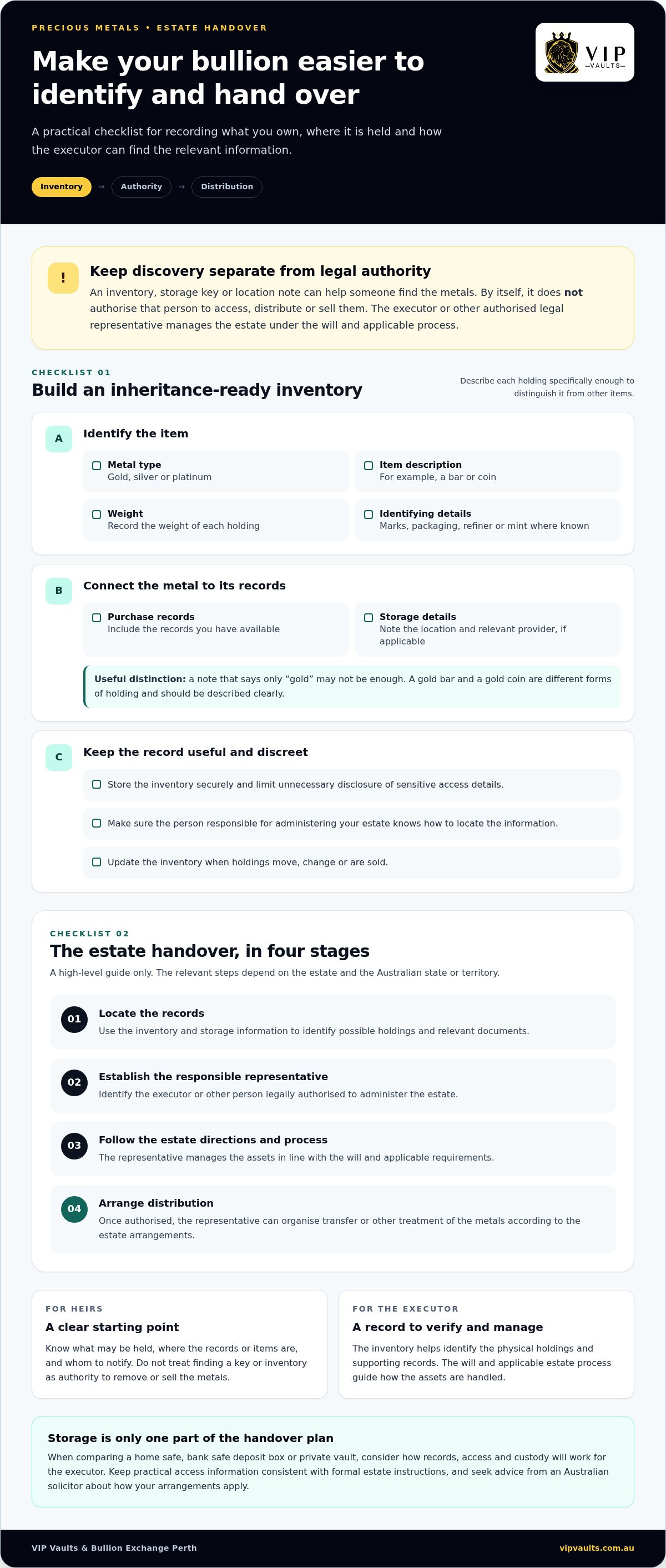
- List each item separately. Record the metal, form, stated weight, identifying marks and refiner or mint where available. Distinguish, for example, a gold coin from a gold bar rather than grouping both under “gold”.
- Connect the paperwork. Note where available invoices, certificates, receipts or other purchase records are held. Use a consistent reference for each item so the inventory entry can be matched with its supporting records.
- Describe the storage arrangement. Identify whether an item is held at home or through a third-party arrangement. Record the relevant provider and account details needed to identify the holding, but don’t include passwords, combinations or other access credentials in a general inventory.
- Keep the record current and protected. Store it securely with your estate documents or in another protected location. Tell the appropriate representative how to find the latest version, without sharing sensitive details more widely than needed.
Which details belong in a bullion inventory?
Use an item’s markings and available documents to describe what you own as accurately as possible. A useful entry might identify a gold bar, its stated weight, visible refiner mark and the location of its purchase invoice. Record what’s known, and don’t guess at missing specifications. If you hold both coins and bars, describe each form clearly, as their features and supporting records may differ.
Keep purchase records with, or clearly cross-reference them to, the relevant inventory entries. A valuation is only a point-in-time estimate, not a permanent figure. Metal prices change, and any estate valuation or tax question should be considered separately with suitable professional advice. For background on the physical forms, learn about gold coins versus gold bars as you describe your holdings.
How can you communicate access instructions securely?
Separate general estate information from sensitive access credentials. The inventory can identify the storage arrangement and where further instructions are held; restricted details should be protected separately. Make sure the executor or other appropriate representative knows how to locate the current instructions, while avoiding unnecessary circulation of keys, codes or account credentials.
Review the plan after a significant purchase or sale, a change of storage location, or an update to your estate documents. Remove outdated copies where practical so they don’t conflict with the current record. These steps make passing on precious metals to heirs more orderly while preserving the distinction between finding an asset and having authority to deal with it.
If you’re considering third-party custody as part of your records and handover plan, explore private vault storage for bullion.
Choose a storage arrangement that supports a clear handover
The right storage arrangement depends on what you hold, where you want it kept and how your executor can identify it later. Consider custody alongside the inventory and estate instructions, not as a replacement for either. Secure storage can help protect physical holdings, but it doesn’t establish who may access them or how they should be distributed.
When comparing private vaults in Australia, weigh the practical arrangements against your circumstances. VIP Vaults & Bullion Exchange offers private vault rentals and bullion lockers for precious metals and jewellery. These storage options can suit physical bullion or high-value jewellery, while legal authority and estate administration remain separate matters.
When might private vault storage fit the plan?
Third-party custody may suit owners who prefer not to keep bullion or jewellery at home. The handover still depends on clear ownership records, an up-to-date inventory and estate instructions that identify the storage arrangement. Consider how the executor will locate the relevant records and follow the provider’s access process. Choose an arrangement that suits your holdings and fits within your wider estate plan.
Think through capacity as well as access. The volume and form of your holdings may affect which storage arrangement is practical; a discussion of high-capacity safe deposit storage can help frame that consideration. Whatever you choose, document the arrangement without placing sensitive credentials in general estate paperwork. Keep the executor’s discovery instructions separate from information that should remain restricted.
What practical next steps should owners take?
Bring the storage plan and estate documents together. Check that the inventory reflects current holdings and locations, then tell the appropriate representative where the latest instructions are kept. If a purchase, sale or move changes the details, update the record. Don’t rely on an old key note or an informal family understanding to explain who can act.
- Review your will and storage records so they describe the same holdings and arrangements.
- Make sure the executor knows how to find current records without circulating access credentials widely.
- Seek Australian legal advice about authority and estate administration, and qualified tax advice about the treatment of inherited metals.
For context on planning your storage, review reliable guidance on private vaults in Australia and consider how custody fits your estate arrangements. VIP Vaults & Bullion Exchange’s private vault rentals and bullion lockers can be part of a discreet plan for physical holdings, but they don’t provide estate-planning or tax advice. A practical next step is to explore private vault rentals or bullion lockers, then record the arrangement clearly alongside your estate instructions. Storage, documentation and professional advice each have a distinct role in a considered handover.
Put your handover plan into action
Choose one practical next step: review your current records, identify any gaps and decide who should know where the latest instructions are kept. A considered plan can help your family approach physical holdings with greater clarity, while leaving formal decisions to the appropriate representatives and advisers.
If you’re weighing storage for bullion or jewellery, VIP Vaults & Bullion Exchange offers private vault rentals and bullion lockers. Its bullion is sourced from internationally recognised and LBMA-accredited refiners. The business is privately owned and independent of government and financial institutions.
Explore the available private vault and bullion locker options as one part of your wider arrangements. Thoughtful passing on precious metals to heirs starts with choices that suit your holdings and the people who may one day need to understand them. Explore VIP Vaults & Bullion Exchange’s private vault rentals and bullion lockers, and keep your handover plan current as circumstances change.
Frequently Asked Questions
Can a will name specific gold or silver items for particular heirs?
Yes, a will may direct specific items to particular beneficiaries, but the appropriate wording and legal effect depend on your circumstances and applicable Australian law. Describe an item clearly enough to distinguish it, such as by metal, form and identifying marks. Keep those details consistent with your inventory, and ask an Australian estate solicitor how best to refer to holdings that may change. Informal notes shouldn’t be relied on to override formal estate documents.
Does inheriting precious metals automatically trigger tax in Australia?
Not necessarily. Tax outcomes depend on the asset, its ownership history, how it passes to a beneficiary and what happens afterwards. Receiving an item and later selling it can raise different tax questions, so don’t assume every inheritance is automatically tax-free or taxable. Before selling or transferring metals, gather available acquisition and estate records and ask a qualified Australian tax adviser to assess the particular circumstances.
Can an executor sell inherited bullion before distributing an estate?
It depends on the will, the estate’s circumstances and the executor’s authority under the applicable legal process. An executor shouldn’t assume every item can be sold immediately, and beneficiaries shouldn’t assume they can direct a sale. Before bullion is disposed of, the executor can obtain legal and tax advice on the proposed action, including how to account for the item and proceeds in the estate.
Should I list every coin and bar in my will?
Not necessarily. A detailed inventory can identify individual coins and bars, while whether those descriptions belong in the will is a separate legal-planning question. Because holdings can change after purchases or sales, discuss with an Australian estate solicitor how formal documents should refer to a separate, maintained record. Check that changes to your holdings don’t leave your estate documents inconsistent with your current intentions.
How can heirs identify bullion if the paperwork is missing?
Start with what remains: packaging, visible stamps or markings, correspondence and any purchase records held elsewhere. These clues may help describe an item, but appearance alone can’t reliably establish its metal content or value. A qualified precious-metals professional may be able to assist with identification. Keep any assessment or new supporting records with the estate papers, and let the estate’s legal representative guide decisions about the item.
Can inherited bullion be divided between several beneficiaries?
Possibly, but counting items isn’t the same as achieving a fair distribution. One larger bar and several coins may differ in weight, form and market value, for example. The executor should consider suitable current valuations and the estate’s directions before allocating items or arranging a sale. If beneficiaries have different preferences, raise them through the estate process rather than removing or exchanging items privately.
What if heirs don’t know where the precious metals are stored?
When passing on precious metals to heirs, a designated representative needs a practical starting point, even if full storage details are restricted. If the location isn’t known, the executor can review available estate papers, correspondence and records of previous purchases or storage arrangements while following the applicable process. Owners can reduce guesswork by telling the appropriate representative where current instructions are kept, without sharing sensitive access details widely.