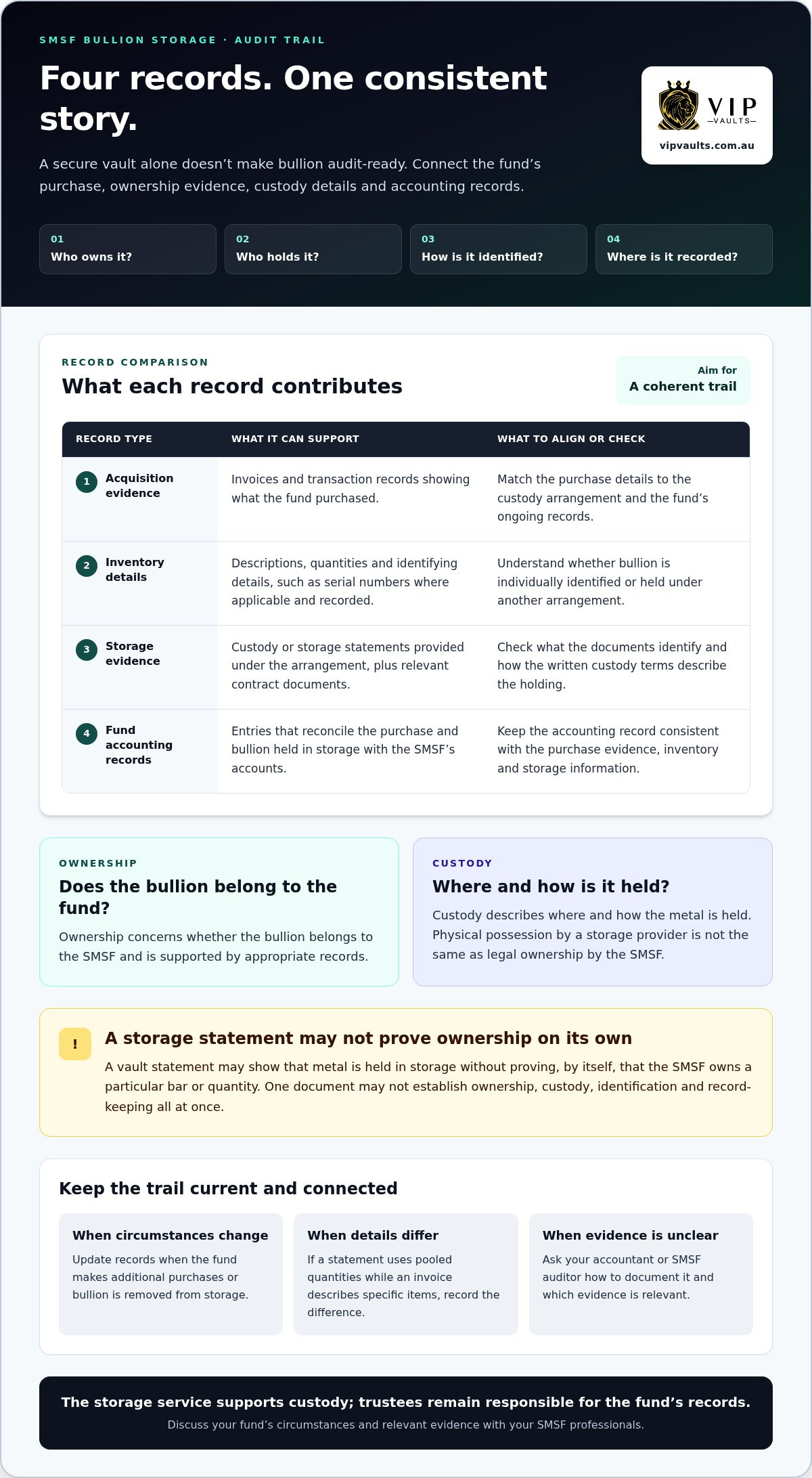

A secure vault alone doesn’t make bullion audit-ready. For trustees considering non-bank bullion storage for SMSF assets, the key is being able to show that the fund owns the bullion, where it is held and how its custody is recorded. The evidence should align with the fund’s investment and accounting records.
Physical security, access and insurance are important, but so are clear ownership documents, inventory records and a reliable audit trail. A storage arrangement doesn’t automatically make an SMSF compliant. This guide explains how to compare custody options and organise the records to discuss with your SMSF professionals. It covers pooled and individually identified storage, security and access arrangements, and how private vault rentals and bullion lockers can suit trustees seeking discreet, independent storage. Consider custody, compliance and audit evidence together when making your decision.
Key Takeaways
- Non-bank bullion storage for SMSF assets can offer an alternative to bank storage, but the storage choice alone doesn’t establish compliance.
- Distinguish legal ownership, custody and asset identification so the fund’s records tell a consistent story.
- Compare storage arrangements by reviewing custody models, access conditions, record-keeping, insurance terms and documented security procedures.
- Use a due-diligence checklist to connect the investment strategy, ownership evidence and custody agreement before deciding.
- Discuss fund-specific requirements with your SMSF auditor or qualified adviser, then consider whether a private vault rental or bullion locker fits the fund’s needs.
Why SMSF trustees consider non-bank bullion storage
Holding physical bullion through an SMSF involves more than choosing a secure place for it. Trustees may prefer a private vault or bullion locker outside a bank, but the storage provider’s role is distinct from the fund’s responsibility to document its investment, ownership and records. Choosing a vault does not, by itself, establish SMSF compliance.
What does non-bank SMSF bullion storage mean?
Non-bank bullion storage is the safekeeping of physical gold or silver in a private vault or locker outside a bank. The storage location does not determine who legally owns the bullion. For an SMSF, custody describes where and how the metal is held, while ownership concerns whether it belongs to the fund and is supported by appropriate records.
Physical bullion means bars or coins, rather than an investment whose value is linked to bullion but which doesn’t involve holding the metal itself. Storage arrangements can include a private vault rental or a bullion locker. Their custody, identification and access terms can differ, so understand the specific arrangement rather than assume every vault service holds or records assets in the same way.
The trustee remains responsible for the fund’s investment decisions and record-keeping. A vault provides storage; it doesn’t replace the trustee’s work or the fund’s professional advice. The Superannuation Industry (Supervision) Act 1993 provides foundational context for SMSF responsibilities. Discuss how requirements apply to your fund with your SMSF professionals.
Why might a trustee consider a private vault?
Some trustees prefer storage independent of traditional banking services. That preference may influence how they want physical assets held, but independence alone doesn’t prove that an arrangement is suitable or compliant. Assess discretion, security, access conditions and how the bullion is identified and accounted for. Dedicated storage may suit a fund’s preferences when the custody terms and supporting records are clear.
VIP Vaults & Bullion Exchange Perth offers private vault rentals and bullion lockers as specialist storage options for investors and SMSF holders. Its privately owned, independent model provides a discreet alternative to traditional banking services. The fund’s compliance decisions remain with its trustees and SMSF professionals. For related context on holding gold through a fund, read these SMSF gold storage considerations.
How to assess SMSF bullion custody, ownership and records
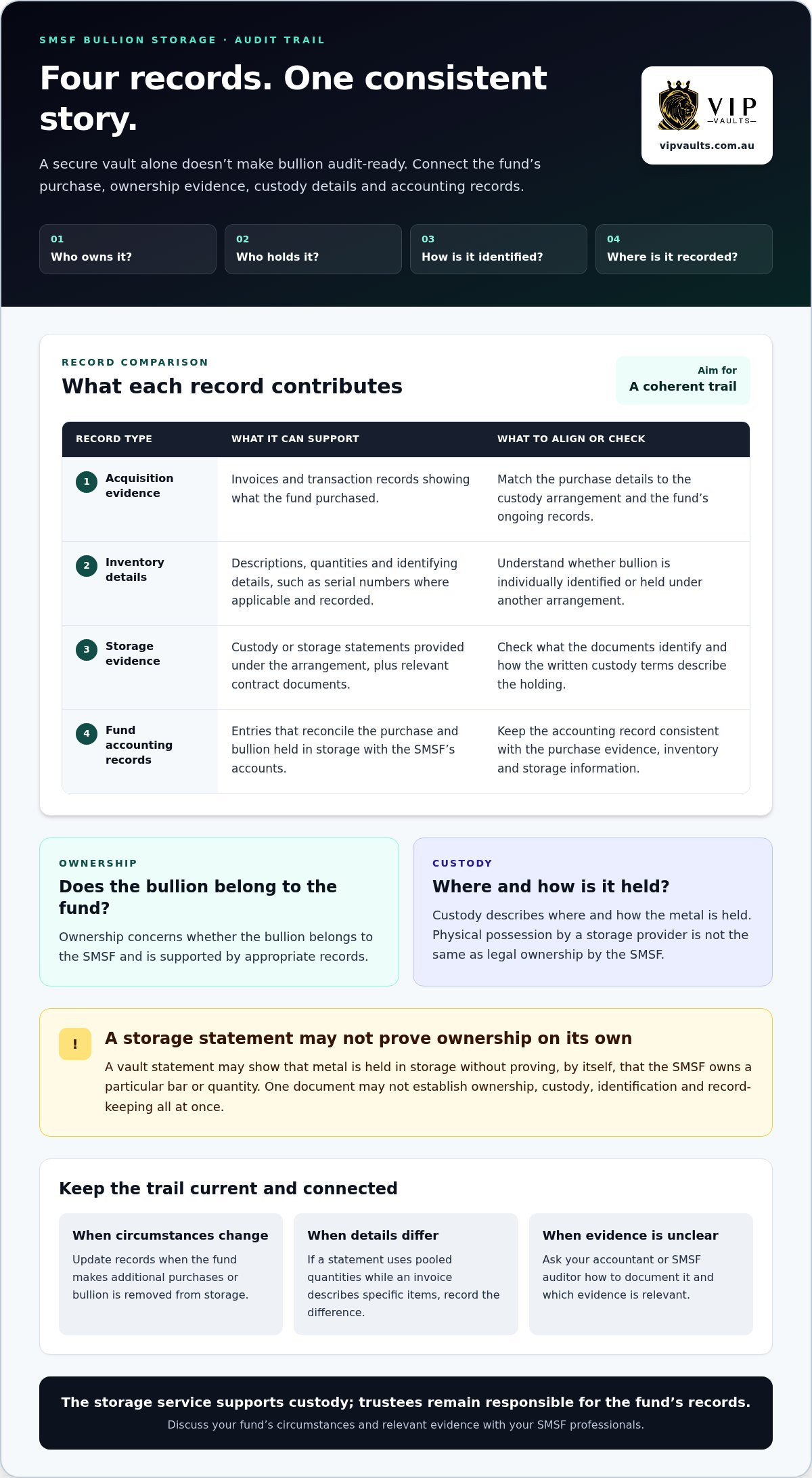
A sound audit trail answers four separate questions: who owns the bullion, who physically holds it, how the asset is identified and where each detail is recorded. These points are connected, but one document may not establish them all. For example, a vault statement may show that metal is held in storage without proving, by itself, that the SMSF owns a particular bar or quantity.
Clear ownership records connect the fund’s purchase, holding and audit trail. Match the acquisition evidence to the custody arrangement and the fund’s ongoing records. Requirements depend on the fund’s circumstances and the terms of its storage arrangement, so discuss your specific position with your accountant and SMSF auditor.
What should trustees understand about ownership and custody?
Physical possession by a storage provider is not the same as legal ownership by the SMSF. Understand whether bullion is individually identified or held under another arrangement, and how that status appears in the relevant documents. Don’t assume all non-bank bullion storage for SMSF assets uses the same custody model or provides the same level of identification. Ask your SMSF professionals to interpret the documents in light of your fund’s circumstances.
The ATO’s guidance on SMSF investments and valuables is useful context when considering how an asset is classified and what obligations may apply. It doesn’t replace advice on your fund’s bullion or custody arrangement.
Which records can support ongoing fund administration?
Keep a clear, consistent record set and discuss with your auditor which evidence is relevant. Depending on the arrangement, useful records to organise may include:
- Acquisition evidence: invoices and transaction records showing what the fund purchased.
- Inventory details: descriptions, quantities and identifying details, such as serial numbers where applicable and recorded.
- Storage evidence: custody or storage statements provided under the arrangement, along with relevant contract documents.
- Fund accounting records: entries that reconcile the purchase and bullion held in storage with the SMSF’s accounts.
Update records when circumstances change, such as when the fund makes additional purchases or bullion is removed from storage. If a statement uses pooled quantities while an invoice describes specific items, record the difference and ask your accountant or auditor how to document it. The aim is a coherent trail, not a folder of unrelated paperwork.
For trustees considering a private vault or bullion locker, private vault storage options can be considered alongside the fund’s record-keeping needs. The storage service supports custody; the trustee and their SMSF professionals remain responsible for assessing ownership and the fund’s requirements.
Compare non-bank bullion storage features without assuming compliance
Non-bank storage is neither automatically compliant nor automatically non-compliant. The relevant question is whether the custody arrangement, written terms and fund records fit the SMSF’s circumstances. Compare practical details, not just general security claims.
| Feature | What trustees should compare |
|---|---|
| Custody model | How bullion is held and whether it is individually identified or recorded another way. Check how the arrangement describes the fund’s interest. |
| Access conditions | Who can access or authorise access, under what conditions, and what procedures apply to withdrawals or other instructions. |
| Records | What inventory details, statements and transaction records are provided, and how they can be reconciled with the fund’s accounts. |
| Insurance terms | What is covered, relevant exclusions and limits, and whose interests are insured. Read the applicable policy terms rather than relying on broad descriptions. |
| Service scope | What the storage service includes, the responsibilities each party accepts, and any applicable fees in current written terms. |
Assess security with the same care. Compare stated monitoring and access controls with documented operating procedures, access conditions and the contract. A feature name alone doesn’t explain how it works or what protection it provides. No security arrangement is risk-free, and security does not replace clear custody documentation.
Insurance is also distinct from compliance. Cover may address specified loss events, but it doesn’t establish that the SMSF owns the bullion or that the investment suits the fund. The SMSF Association’s discussion of SMSF asset rules is useful context, particularly because rules can differ according to how an asset is classified. Have your SMSF professionals consider the fund’s particular assets and documents.
Use this comparison to assess non-bank bullion storage for SMSF assets against the fund’s needs, then discuss the proposed custody and records with its accountant or auditor. Explore private bullion storage with VIP Vaults, including private vault rentals and bullion lockers.
Use this SMSF bullion storage due-diligence checklist
Before arranging non-bank bullion storage for SMSF assets, work through the decision in sequence. This checklist helps organise the review, but it isn’t a complete or universal statement of legal requirements. The right evidence and process depend on the fund and its circumstances.
- Review the investment strategy. Check that the fund’s written strategy addresses precious metals and that trustees have considered the investment in the context of the fund’s objectives, risks and diversification. Refer investment questions to the fund’s qualified adviser.
- Confirm how ownership will be documented. Match the acquisition records to the SMSF and understand how the bullion will be identified and linked to the fund. Keep the purchase evidence with the fund’s records.
- Read the custody terms. Review the proposed service agreement, including how holdings are described, who may access or authorise instructions, and the provisions for access and termination. Make sure the arrangement’s stated responsibilities are clear.
- Organise supporting records. Depending on the arrangement, gather relevant invoices, storage statements, inventory details, agreement documents and written information about security and insurance. This is a working document list, not a fixed compliance checklist. Keep records consistent with the fund’s accounts.
- Arrange professional review. Ask the SMSF auditor what evidence is relevant to assessing the specific custody arrangement. Refer legal interpretation and investment-strategy questions to the fund’s qualified adviser, then retain trustee decisions and supporting material with the SMSF records.
Before settling on a storage arrangement, compare written security and insurance disclosures with the fund’s needs. Read policy terms for coverage, exclusions, limits and insured interests, and consider how the service agreement describes custody and asset identification. Keep a record of why the trustees selected the arrangement and how it fits the fund’s documented approach.
For a broader view of private storage choices, explore private vault options in Australia. VIP Vaults’ private vault rentals and bullion lockers are specialist storage options to consider alongside advice from your SMSF professionals.
Review private vault rentals and bullion lockers at VIP Vaults as part of your storage due diligence.
Arrange non-bank bullion storage with a specialist vault provider
A suitable storage arrangement should fit the fund’s documented investment approach and leave trustees with clear records of the bullion and its custody. A specialist vault provider supplies the storage service, but it doesn’t take over the trustees’ investment, record-keeping or compliance responsibilities. Keep your SMSF auditor or qualified adviser involved as you assess the arrangement.
What can trustees expect from a specialist storage service?
VIP Vaults provides private vault rentals and bullion lockers for investors and SMSF holders. These are physical storage options, not SMSF administration or compliance services. Read the written terms so you understand the service scope, how holdings are described, the access conditions and how the arrangement can be changed or ended.
Clarify how the service’s records will relate to the fund’s documents. For example, understand what storage or inventory information is provided and how it corresponds with the bullion purchase records. Consider the fund’s preference for discreet, independent storage alongside practical requirements identified by its professionals. A vault arrangement doesn’t establish compliance or guarantee a particular audit outcome.
What are the next steps for an SMSF trustee?
Prepare before discussing storage. Gather the fund’s acquisition records and investment strategy, note questions raised by your accountant or auditor, and identify the details you need to understand in the proposed service terms. This makes it easier to assess whether the storage arrangement and the fund’s records fit together.
Ask your SMSF auditor what evidence is relevant to the proposed custody model, and refer fund-specific legal or investment questions to a qualified adviser. Once you’ve completed that review, compare the written service scope and access conditions with the fund’s needs. This process helps trustees consider non-bank bullion storage for SMSF assets without confusing secure custody with SMSF advice.
VIP Vaults specialises in private vault rentals and bullion lockers, providing a discreet storage environment independent of traditional banking services. If you’re ready to discuss private bullion storage, speak with VIP Vaults about its storage options as you continue your professional review.
Make your storage decision with clarity
Choosing non-bank bullion storage for SMSF assets means weighing the custody arrangement, written terms and records together. A vault’s security features matter, but they don’t establish fund ownership or compliance. Keep the fund’s documentation aligned and discuss the proposed arrangement with your SMSF auditor or qualified adviser.
VIP Vaults offers private vault rentals and bullion lockers for SMSF holders. As a privately owned business independent of government and financial institutions, it provides a discreet alternative for trustees considering physical storage. Review the written service scope, security details and access conditions, then assess how they fit the fund’s needs.
When you’re ready to explore a storage arrangement, explore private bullion storage options with VIP Vaults. A considered choice, supported by clear records and professional guidance, can help you move forward with confidence.
Frequently Asked Questions
Can an SMSF store bullion with a non-bank provider?
Yes, trustees may consider a non-bank provider as a storage option, but the provider’s status alone doesn’t establish compliance. Assess how the arrangement fits the fund’s circumstances, including its investment strategy, evidence of ownership, custody terms and ongoing records. Discuss the proposed arrangement and fund-specific requirements with your SMSF auditor or a qualified adviser. Their guidance can help you identify which documents to retain and what questions to resolve.
Does non-bank bullion storage automatically make an SMSF compliant?
No. The storage location alone doesn’t determine whether an SMSF complies with its obligations. Trustees remain responsible for operating the fund under applicable superannuation rules and maintaining appropriate records. Consider whether legal ownership is clear, the investment is addressed in the fund’s strategy, and the custody arrangement is documented. Details vary between funds and arrangements, so seek advice specific to your circumstances from your SMSF auditor or a qualified SMSF professional.
What records should an SMSF keep for bullion held in a private vault?
Organise purchase documents, inventory or identification records, storage statements and relevant service agreements, where these are provided. Together, these can help connect the fund’s acquisition with the bullion held in storage and its accounting records. The evidence needed depends on the custody arrangement and the fund’s circumstances. Ask your SMSF auditor which records are relevant and how they should reconcile with the fund accounts, then retain supporting documents consistently.
Can an SMSF trustee store fund bullion at home instead?
Home storage shouldn’t be treated as a simple yes-or-no decision. It can raise questions about who possesses the bullion, how it’s kept separate from personal assets, what insurance applies and how the SMSF’s ownership is evidenced. The appropriate approach may depend on the asset and the fund’s circumstances. Before storing fund bullion at home or changing its location, seek specific guidance from your SMSF auditor or a qualified adviser.
How should trustees compare insurance for non-bank bullion storage?
Read the written policy terms rather than relying on a general statement that bullion is insured. Review the scope of cover, whose interests are insured, exclusions, limits and the claims process. Compare these details with the fund’s needs and the storage agreement. Insurance is one part of due diligence, not proof of ownership or SMSF compliance. Discuss the terms’ relevance to the fund with a qualified professional if you have questions.
Does an SMSF auditor need to approve the vault provider?
An auditor’s role is to assess the fund and its records against applicable requirements, not to endorse a commercial provider. Ask your SMSF auditor what documents they’ll need to review your particular custody arrangement, such as purchase evidence, inventory details or storage statements. Discuss the arrangement before finalising it where practical. A conversation with the auditor doesn’t guarantee compliance or transfer responsibility from the trustees, who remain accountable for fund decisions and records.