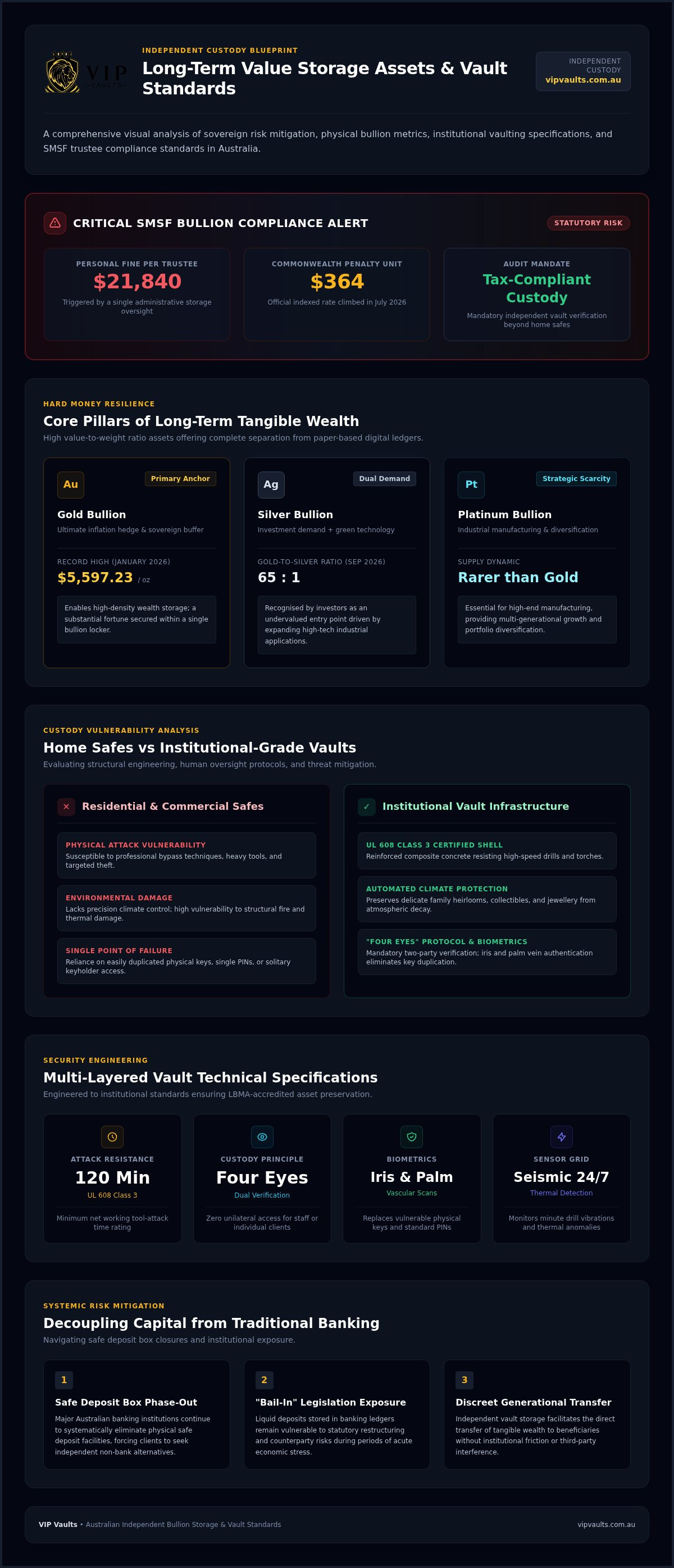

Did you know that a single administrative oversight in how you store your SMSF bullion could now trigger a personal fine of $21,840 per trustee? As the Australian Commonwealth penalty unit climbed to $364 in July 2026, the margin for error when managing long-term value storage assets has never been slimmer. You likely recognise that traditional banks no longer offer the sanctuary they once did, especially as major institutions continue to phase out safe deposit boxes while "bail-in" legislation looms over your liquid deposits. It's a valid concern that requires a more robust, independent solution for your capital.
This guide empowers you to identify and acquire the most resilient tangible wealth available today. We'll show you how to build a diversified portfolio that remains entirely separate from the banking system. You'll discover the essential steps for maintaining absolute privacy and 24/7 peace of mind, from sourcing LBMA-accredited bullion to securing tax-compliant storage. We'll also break down the latest SMSF audit standards to ensure your physical assets are protected by more than just a home safe.
Key Takeaways
- Identify the core differences between volatile paper-based investments and the "hard money" resilience offered by investment-grade precious metals.
- Evaluate the technical specifications of institutional-grade vaults to ensure your private wealth is protected by multi-layered biometric and seismic security.
- Navigate the legal landscape of "bail-in" threats by moving your long-term value storage assets into independent facilities outside the traditional banking system.
- Calculate the exact storage capacity required for your bullion portfolio to remain fully compliant with Australian SMSF audit standards.
- Establish a discreet legacy plan that allows for the secure, generational transfer of tangible wealth without the complexities of institutional interference.
Defining Long-Term Value Storage Assets in a Volatile Economy
A value storage asset is a physical item that maintains purchasing power regardless of currency fluctuations. In a year where global markets have faced unprecedented shifts, the distinction between paper wealth and tangible security has become stark. Paper assets, such as digital equities or fiat currency, rely on the stability of external institutions. If a bank fails or a currency devalues, that wealth can vanish overnight. Tangible long-term value storage assets exist outside this digital ledger. They offer a physical buffer that doesn't require a third party's permission to retain its worth.
Historically, investors have turned to commodities that serve as a reliable store of value because they lack counterparty risk. The most effective assets share a high value-to-weight ratio. This portability ensures that significant wealth can be stored discreetly or moved if necessary. While a warehouse of copper is valuable, it isn't practical for a private individual. Gold, silver, and platinum provide high-density wealth. This allows you to secure a fortune within a single bullion locker rather than an entire industrial unit.
The Core Pillars: Gold, Silver, and Platinum Bullion
Gold remains the cornerstone of wealth preservation. Its performance in early 2026, reaching a record high of $5,597.23 per ounce in January, proved its status as the ultimate hedge against inflation. Silver bullion offers a different dynamic. It's driven by both investment demand and critical industrial applications in green technology. With the gold-to-silver ratio hovering near 65:1 as of September 2026, many investors see silver as an undervalued entry point. Platinum provides a strategic diversification play. It's rarer than gold and essential for high-end manufacturing, making it a robust addition to a sophisticated portfolio that targets multi-generational growth.
Beyond Bullion: Heirlooms and High-Value Collectibles
Physical wealth isn't limited to bars and coins. Jewellery storage is a vital component of preserving family legacies. These items often carry significant emotional weight alongside their intrinsic metal value. You must evaluate liquidity carefully, though. While a custom diamond necklace is valuable, it may take longer to sell than a standard gold bar. The security of these items is paramount. Home safes are often the weakest link in an investment strategy. They're vulnerable to fire, targeted theft, and professional bypass techniques. Moving these heirlooms to an independent vault ensures they remain protected by institutional-grade sensors rather than a residential bolt-down box.
Evaluating Physical Security: Institutional-Grade Vaulting Standards
Protecting long-term value storage assets requires a shift from simple storage to professional custody. A common mistake is equating a heavy commercial safe with a dedicated vault facility. While a safe might deter a casual intruder, it lacks the structural integrity and monitoring required to withstand a professional, sustained attack. True security is found in facilities that adhere to institutional vaulting standards, where the environment is engineered to be as resilient as the assets it holds.
Sophisticated vaulting relies on the "Four Eyes" principle. This protocol ensures that no single individual, including staff or the client alone, can access the contents without secondary verification. This eliminates single points of failure and internal risks. Modern facilities combine this human oversight with multi-layered technology. Biometric authentication, such as iris or palm vein scans, replaces easily duplicated keys or forgotten PINs. These systems are supported by seismic sensors that detect minute vibrations from drilling or thermal changes, triggering an immediate response from 24/7 monitoring teams.
Physical Robustness and Fire Protection
The physical shell of a vault is its first line of defence. High-security repositories often meet UL 608 Class 3 standards, which provide a minimum of 120 minutes of net working tool-attack time. This resistance is achieved through proprietary composite materials and reinforced concrete that withstands torches and high-speed drills. Beyond theft, fire protection is essential. A vault must maintain an internal temperature that protects delicate items, especially if you are utilising jewellery storage for family heirlooms. Climate control prevents the degradation of metals and gemstones over decades of storage.
Digital Security and Privacy Protocols
In an era of cyber threats, the most secure systems are those that remain "off-grid." Independent vaults utilise security networks that are physically separated from the internet, making remote hacking impossible. Privacy is equally critical. Professional vaulting providers organise their data to ensure client anonymity, where your name is never associated with a specific locker number in a way that could be compromised. This discreet approach allows you to manage your wealth with total confidentiality. Investors seeking this level of protection often find that private vault rental offers a degree of independence that traditional banking simply cannot match.
Private Vaults vs. Traditional Banking: Navigating Sovereign Risk
Traditional banks are fundamentally changing their service models. Many major global institutions have already phased out or ceased new leases for safe deposit boxes, reflecting a broader retreat from physical custody services. This trend leaves investors with fewer options for securing long-term value storage assets within the established financial system. This shift isn't just about operational costs; it reflects a deeper structural change in how banks manage risk and regulatory compliance. For a deeper dive into the specific options available today, read our guide on Private Vaults in Australia: Secure Your Wealth in 2026.
Counterparty Risk and Asset Seizure
The primary danger of bank-held wealth is the threat of "bail-in" protocols. In Australia, the Financial Sector Legislation Amendment (Crisis Resolution Powers) Act 2018 allows certain bank liabilities to be converted into equity to stabilise a failing institution. While this typically targets cash deposits, any asset held within the banking system's balance sheet carries inherent counterparty risk. Independent repositories operate under a legal arrangement known as bailment. This ensures your bullion or jewellery is not an asset of the vault operator. It remains your absolute property, held in trust, and cannot be claimed by the vault's creditors during a solvency event.
High-net-worth individuals are increasingly migrating to non-bank alternatives to decouple their physical wealth from institutional instability. Unlike banks, where safe deposit box contents are not covered by government deposit insurance, independent vaults standardise all-risks coverage. These policies are typically underwritten by specialist syndicates like Lloyd’s of London, covering 100% of the replacement value. This provides a level of financial protection that retail banking services don't match.
Access and Control During Financial Crises
Market turmoil often leads to "bank holidays" where branches close and digital systems freeze. If your assets are stored behind a bank's doors, your access is dictated by their operational status and government-mandated restrictions. During a liquidity crisis, this lack of control can be catastrophic for your personal solvency. Independent vaults prioritise client access regardless of the wider financial climate. They aren't subject to the same regulatory freezes that can lock down a retail bank branch during a crisis.
Maintaining liquidity requires the ability to reach your assets when you need them most. Private facilities offer a discreet environment where you can manage your holdings without the public scrutiny or restricted trading hours of a commercial bank. This institutional independence ensures that your long-term value storage assets remain truly yours, providing a reliable sanctuary when traditional systems falter.
Selecting Your Storage Solution: Capacity, Access, and SMSF Compliance
Selecting the right repository for your long-term value storage assets is a logistical decision as much as a security one. You must account for the physical footprint of your portfolio, which varies significantly between metals. Gold's high density allows for substantial wealth to be stored in a compact space; a standard 1kg gold bar occupies less volume than a modern smartphone. Silver bullion, however, requires much more room. An equivalent value in silver often requires a high-capacity bullion locker to accommodate the sheer weight and bulk of the bars. Before you acquire your next asset, it is wise to review the differences between Gold Coins vs Gold Bars Australia to determine how your asset mix will dictate your storage needs.
SMSF Gold Storage: Meeting Audit Requirements
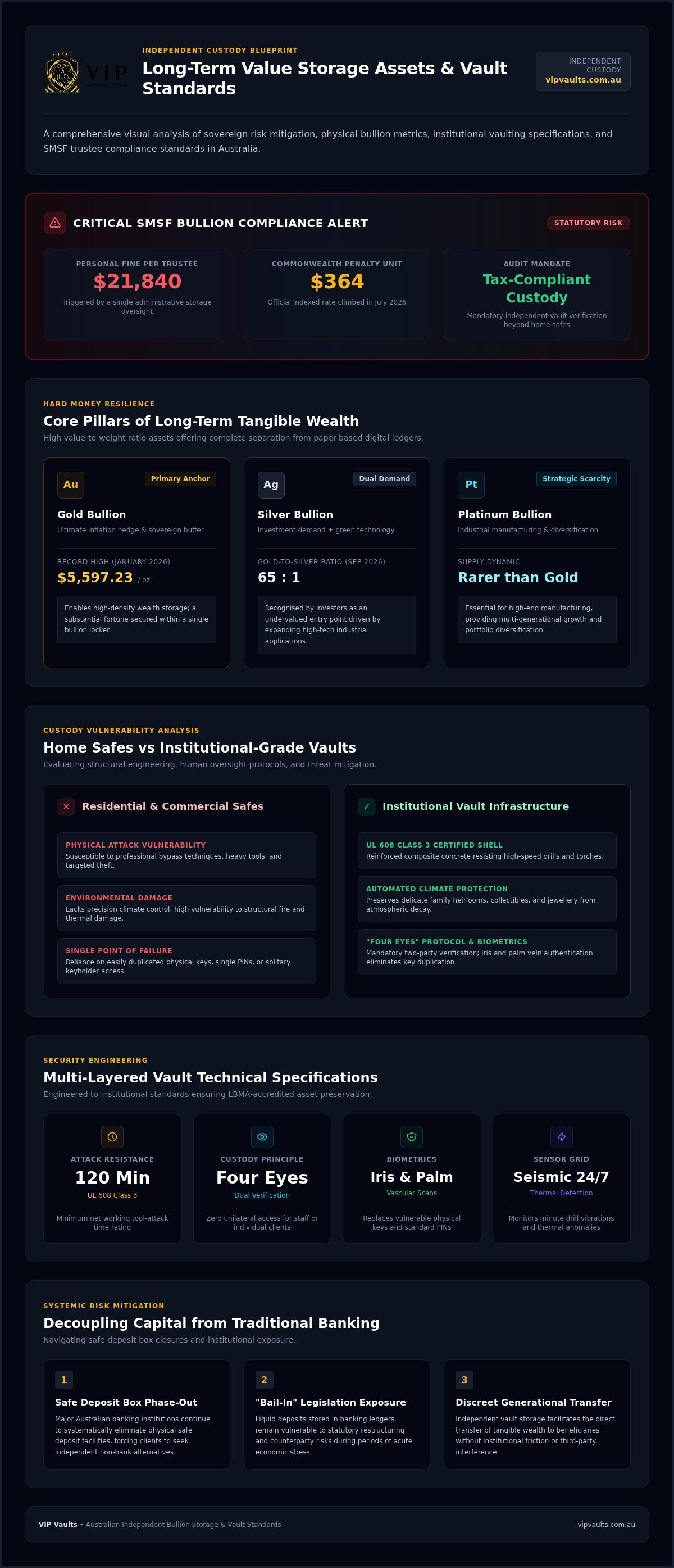
Compliance is a critical factor for those managing wealth within a Self-Managed Superannuation Fund (SMSF). The Australian Taxation Office (ATO) has intensified its focus on physical asset verification for the 2026-27 financial year. As of 1 July 2026, the Commonwealth penalty unit increased to $364. Failing to adhere to the Sole Purpose Test or violating SIS Regulation 13.18AA can result in personal administrative fines of up to $21,840 per trustee. You cannot store SMSF bullion at your primary residence. It must be held in an independent facility where it can be physically verified by an auditor. To ensure your fund stays compliant, refer to our detailed checklist on SMSF Gold Storage: Investing in Gold in Australia (2026).
Bullion Lockers vs. Private Vaults
Your choice of storage should reflect your access requirements and the scale of your holdings. Small bullion lockers are ideal for jewellery storage and gold coins, providing a cost-effective solution for high-value, low-volume items. For "silver stackers" or those with diverse long-term value storage assets, high-capacity private vaults offer the necessary floor space and weight-bearing specifications. These solutions also allow you to customise access levels. You can designate specific family members or business partners who are authorised to access the vault, ensuring your legacy is protected yet accessible to your chosen successors. Professional repositories provide the independent audit trail and insurance certificates that residential safes simply cannot offer.
Ensure your wealth is protected by a compliant and secure bullion locker that meets all Australian regulatory standards.
Securing Your Legacy with Independent Bullion Storage
True wealth preservation isn't measured in months or years; it's measured in generations. Adopting a "set and forget" strategy with physical assets provides a psychological and financial anchor that digital portfolios cannot replicate. By holding long-term value storage assets outside the traditional financial grid, you ensure that your capital remains insulated from the short-term noise of market volatility and currency devaluation. This approach allows you to focus on the broader objective of building a lasting family legacy.
Integrating physical assets into a modern estate plan is significantly more efficient when those assets are held in a professional repository. Rather than leaving heirs to manage the risks of unverified items stored in a residential setting, a private vault provides a clear, audited path for wealth transfer. You can designate successors with specific access rights, ensuring that your bullion and heirlooms are passed on securely and discreetly. VIP Vaults & Bullion Exchange Perth provides a seamless "buy-and-store" workflow for Australian investors, allowing you to acquire investment-grade metal and move it directly into high-security custody without the logistical risks of personal transport.
Buying LBMA-Accredited Bullion
Liquidity is the most critical factor when purchasing precious metals. You should only source bars and coins that carry LBMA accreditation, as this global benchmark ensures your assets are recognised by refiners and dealers worldwide. This accreditation guarantees the purity and weight of your metal, which simplifies the process of future resale. When you buy through an integrated exchange, you benefit from live market pricing. As of September 2026, with gold trading near $4,352.08 per ounce, having access to real-time data ensures you're transacting at the most accurate rates. Sourcing silver and platinum from internationally recognised refiners further diversifies your holdings and protects your purchasing power across different industrial and investment cycles.
The VIP Experience: Professionalism and Discretion
Your first visit to a private repository should feel like entering a refined, high-stakes sanctuary. You'll experience a methodical check-in process that prioritises your privacy while maintaining absolute security. This often includes multi-factor biometric verification, such as iris or palm vein scans, to ensure that only authorised individuals can reach the vault floor. For high-net-worth investors, Member Privileges offer an even higher level of personalised service. These privileges include priority access to new bullion releases and specialised assistance with large-scale acquisitions. This boutique approach combines global security standards with the attentive service of a local specialist, making your asset protection strategy both world-class and accessible. Contact VIP Vaults & Bullion Exchange Perth to secure your long-term value storage today.
Securing Your Generational Wealth in an Uncertain Future
Transitioning from paper-based wealth to physical assets is no longer just a diversification strategy; it's a necessity for those seeking true independence from a volatile banking system. You've seen how institutional-grade vaulting and strict SMSF compliance provide the essential framework for a secure legacy. By choosing long-term value storage assets like LBMA-accredited bullion, you're placing your capital behind a robust, physical shield that remains unaffected by digital instability or institutional "bail-ins".
Protecting your family's future requires a partner that values discretion as much as security. VIP Vaults & Bullion Exchange Perth operates entirely independent of the banking system, providing an institutional-grade security architecture designed to withstand the most sophisticated threats. As a specialist LBMA-accredited bullion dealer, we offer a seamless path from acquisition to high-security custody. Take the first step toward absolute peace of mind and Secure Your Wealth with VIP Vaults & Bullion Exchange Perth today. Your legacy deserves the protection of a dedicated, world-class sanctuary.
Frequently Asked Questions
What are the best long-term value storage assets to buy in 2026?
Investment-grade gold, silver, and platinum bullion remain the premier long-term value storage assets for 2026. These metals provide a high value-to-weight ratio and exist entirely outside the digital financial system. While jewellery and high-value collectibles also serve as stores of wealth, LBMA-accredited bullion bars and coins offer the highest levels of liquidity and ease of verification for multi-generational wealth preservation.
Is it legal to store SMSF gold bullion in a private vault?
Storing SMSF gold bullion in a private vault is not only legal but often the only practical path to compliance. Australian taxation laws require SMSF assets to be held at arm's length from trustees. Storing bullion at a primary residence is highly restricted and can lead to severe penalties. A private repository provides the independent audit trail and insurance certificates required to satisfy annual SMSF audit standards for 2026.
How much does it cost to rent a private bullion locker in Australia?
Rental costs for a private bullion locker depend on the physical dimensions required and the level of insurance coverage selected. Most facilities offer a range of sizes, from small drawers for jewellery and gold coins to high-capacity units for bulk silver. You should look for transparent annual or monthly fee structures that include all-risks insurance underwritten by specialist syndicates like Lloyd's of London.
Are assets stored in a private vault insured against theft or fire?
Assets held in institutional-grade vaults are covered by comprehensive all-risks specie insurance. This typically covers 100% of the replacement value against theft, fire, and other catastrophic events. Unlike bank deposit boxes, which often lack statutory insurance for contents, independent vaults provide a certificate of insurance in the client's name. This ensures your capital is protected by global underwriting standards rather than a bank's limited liability.
Can I access my private vault without an appointment?
Access to a private vault is managed through strict security protocols to ensure client confidentiality. Most high-security facilities require scheduled appointments during business hours rather than 24/7 walk-in access. This methodical approach allows the facility to maintain a discreet environment and ensures that biometric verification and "Four Eyes" access procedures are executed without compromising the safety of the facility or other members.
What is the difference between LBMA-accredited gold and generic bullion?
LBMA-accredited gold is sourced from refiners that meet the London Bullion Market Association's strict standards for purity and ethical sourcing. These bars are recognised globally, ensuring maximum liquidity and the highest possible buy-back rates. Generic bullion may lack this international certification, which can lead to delays or additional assaying costs when you decide to liquidate your long-term value storage assets in the future.
Why is a private vault safer than a bank safety deposit box?
Private vaults offer institutional-grade security and independence from the banking system's "bail-in" risks. While banks are actively closing their safe deposit box facilities, independent repositories invest in advanced technology like seismic sensors and iris biometrics. Furthermore, assets in a private vault are held under a bailment agreement, meaning they are not on the vault's balance sheet and cannot be claimed by creditors during a financial crisis.
How do I transfer my existing bullion portfolio to a secure locker?
Transferring an existing portfolio is a straightforward process managed with professional discretion. You should first secure a bullion locker and verify the insurance requirements for your specific holdings. Once the account is established, you can move your assets from a bank or home safe to the vault facility. Specialist providers can often assist with the verification of bars and coins to ensure your inventory is accurately documented for your records.