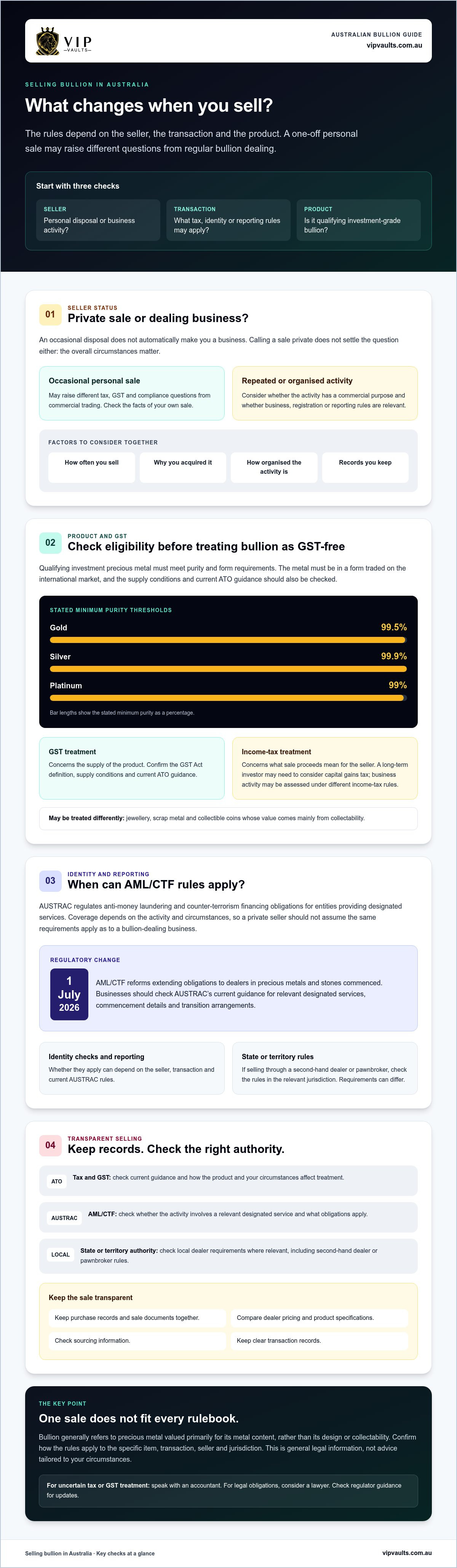

Could the rules for selling the same gold bar change depending on whether it’s a one-off private sale or part of a business? The legal requirements for selling bullion in Australia depend on the seller, the transaction and the product, so one answer won’t fit every situation.
It’s understandable to be unsure. GST treatment, capital gains tax, record keeping and identity checks can raise different questions. Bullion dealing also isn’t automatically the same as providing a regulated investment product. Since 1 July 2026, AML/CTF obligations have extended to dealers in precious metals and stones.
This guide outlines the main tax, reporting and consumer-law issues to check before you sell. It explains how investment-grade bullion may be treated for GST and tax, why private sales can differ from business activity, and when AUSTRAC or state and territory rules may be relevant. Use it as a starting point, then confirm how the rules apply to your circumstances with the ATO, AUSTRAC or a qualified professional.
Key Takeaways
- The legal requirements for selling bullion in Australia depend on whether you’re making an occasional personal sale or trading as a business.
- Check the bullion’s eligibility and current ATO guidance before deciding how GST and tax apply to a sale.
- Identity checks and reporting obligations can depend on the seller, transaction and current AUSTRAC rules.
- Confirm any business, tax-registration and state or territory requirements that apply to your selling activity.
- Compare dealers by checking their pricing, product specifications, sourcing information and transaction records.
Legal requirements for selling bullion in Australia: who needs to comply?
The legal requirements for selling bullion in Australia vary according to the seller’s status, the transaction and the bullion being supplied. An occasional sale of personally held bullion may raise different questions from repeatedly buying and selling metals as a commercial activity. State and territory rules can also intersect with Commonwealth tax and anti-money laundering laws. Check which requirements apply to your situation rather than assuming every sale follows the same process.
Start by identifying the asset. Bullion generally refers to precious metal valued primarily for its metal content, rather than its design or collectability. For background on what bullion is, see the overview, then confirm how Australian tax and regulatory rules apply to the specific item you plan to sell.
Private seller or bullion-dealing business: why the distinction matters
A one-off disposal doesn’t automatically make you a business, but describing a sale as private doesn’t settle the question either. Relevant factors may include how often you sell, whether you acquired bullion with a commercial purpose, how organised the activity is and what records you keep. The overall circumstances matter.
If you’re unsure how your activity should be treated, ask an accountant about tax and GST, or a lawyer about legal obligations. Keep purchase records and sale documents together so a professional can review the facts.
Which Australian authorities may be relevant?
The Australian Taxation Office (ATO) is the key starting point for tax and GST questions. The Australian Transaction Reports and Analysis Centre (AUSTRAC) regulates anti-money laundering and counter-terrorism financing (AML/CTF) obligations for entities providing designated services. Coverage depends on the activity and circumstances, so a private seller shouldn’t assume the same requirements apply as they do to a bullion-dealing business.
As at October 2026, the regulatory information described here states that AML/CTF reforms extending obligations to dealers in precious metals and stones commenced on 1 July 2026. Businesses should check AUSTRAC’s current guidance for the relevant designated services, commencement dates and any transition arrangements. If you’re selling through a second-hand dealer or pawnbroker, check the rules in the relevant state or territory too. Requirements can differ by jurisdiction.
Before acting, check the publication or last-updated date on regulator guidance, particularly where rules have changed. Look to the ATO for tax and GST, AUSTRAC for AML/CTF, and the relevant state or territory authority for local dealer requirements.
In brief: This section provides general legal information, not advice tailored to your circumstances. The rules that apply depend on the seller, transaction, product and jurisdiction.
GST and tax when selling bullion in Australia: what should you check?
GST and income tax are separate questions. A supply may qualify for GST-free treatment under the GST Act, while a gain or profit from selling the metal may still have tax consequences. The legal requirements for selling bullion in Australia depend on the product and your circumstances, so don’t assume that a GST outcome settles how sale proceeds are treated.
When can bullion qualify for GST-free treatment?
Under the current rules described by the ATO, qualifying investment precious metal must meet requirements for purity and form. The stated purity thresholds are at least 99.5% for gold, 99.9% for silver and 99% for platinum, and the metal must be in a form traded on the international market. Check the GST Act definition, supply conditions and current ATO guidance before relying on GST-free treatment. Jewellery, scrap metal and collectible coins whose value comes mainly from collectability may be treated differently.
GST treatment concerns the supply of the product. Income-tax treatment concerns what the proceeds mean for the seller. A long-term investor may need to consider capital gains tax, while activity carried on as a business may be assessed under different income-tax rules. Use the table to identify questions to raise, not to determine the tax treatment of a particular sale.
| Situation | What to check |
|---|---|
| Occasional private disposal | Whether the sale gives rise to a capital gain or loss, and whether the item and circumstances affect the tax treatment. |
| Repeated or business sale | Whether proceeds are treated as business income, and whether GST registration or other business obligations apply. |
| Qualifying precious-metal supply | Whether the metal meets the statutory definition, purity, form and supply conditions for GST-free treatment. This product category can overlap with either seller type. |
What records should sellers discuss with a tax adviser?
Keep purchase and sale documents, transaction dates, quantities, product descriptions and payment evidence. The ATO requires records of bullion transactions to be kept for at least five years. Clear records help an adviser assess when and why you acquired the bullion, how you held it, and whether the sale was an investment disposal or part of business activity.
In short, GST status depends on the supply, while capital gains or business-income treatment depends on the seller’s circumstances and activity. Ask a qualified tax adviser to review your position and check current ATO guidance. For market-pricing context, consult this Australian gold price guide, which isn’t tax advice. To compare bullion product information and pricing, you can also review VIP Vaults & Bullion Exchange Perth.
AML/CTF, identity checks and reporting: when can bullion rules apply?
AML/CTF requirements don’t apply identically to every person selling bullion. A business that provides a regulated designated service may have obligations that don’t apply to someone disposing of personal holdings. Whether the rules apply can depend on the seller’s activities, the service provided and the transaction details. A request for identification or transaction information doesn’t, by itself, mean every seller has the same legal duties.
As at October 2026, the current reform information states that AML/CTF reforms extending coverage to dealers in precious metals and stones commenced on 1 July 2026. Businesses should check AUSTRAC’s latest information for the precise scope, applicable thresholds and any transition arrangements. Confirm the rules in force on the transaction date rather than relying on older summaries.
How to check whether AUSTRAC obligations apply
If you buy or sell bullion as a business, start with AUSTRAC’s guidance on bullion dealers and designated services. Check how your activity is classified and whether the specific transaction falls within a regulated service. Ask a compliance adviser to assess the transaction type, payment method, value and business activity against current requirements.
Keep timing in view. AUSTRAC’s published guidance and commencement information can change, and reform arrangements may affect which obligations apply on a particular date. Record the source and publication or update date you relied on, then confirm any uncertainty directly with AUSTRAC or a qualified professional.
What buyers and sellers should expect from a compliant process
Depending on the circumstances and the dealer’s obligations, a transaction may involve an identity check or questions about the payment and sale. A business may also need to retain transaction records and have procedures for escalating activity that raises concerns. These measures support compliance and help establish a clear record. They aren’t necessarily a sign that a customer has done anything wrong.
Before proceeding, you can ask the dealer why information is needed, how it relates to the transaction and what records will be created. Don’t assume a private seller must carry out the same checks as a regulated business, or that a dealer can never request information for a transaction-specific reason. The relevant law and circumstances matter.
- Check AUSTRAC’s current bullion-dealer guidance and its update date.
- Confirm the applicable service, transaction details and any thresholds with a compliance adviser.
- Seek direct guidance for unusual or complex arrangements.
For a business, checking these details is a practical step in assessing the legal requirements for selling bullion in Australia. For an individual seller, focus on why a check is being requested and whether a separate legal obligation applies to your circumstances.
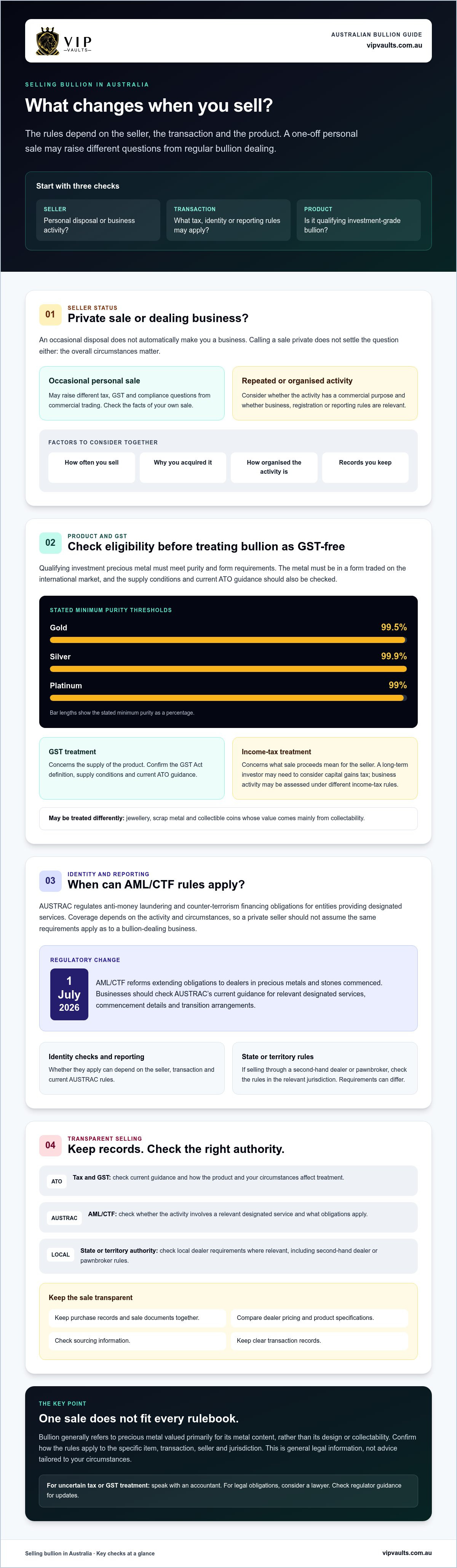
Business, consumer and product rules: how to sell bullion transparently
If you sell bullion as a business, confirm your registrations and record-keeping obligations before trading. Requirements can depend on your business structure, turnover, products and location. The Australian Consumer Law (ACL) may also apply to the transaction, including rules against misleading claims. Use the points below as a practical checklist, then verify the details for your business model.
Business registration, GST registration and operational records
Check your Australian Business Number (ABN) and whether you need to register a business name through the relevant official channels. Ask the ATO whether GST registration is required for your activity and the relevant period. Registration thresholds and timing matter, so confirm current requirements rather than relying on an older summary or assuming every bullion seller has the same obligations.
Organise your records so each transaction can be followed from stock acquisition to sale. Depending on your business, this may include:
- invoices and purchase records, with dates and quantities;
- stock records that identify the metal and product;
- sales documentation showing the price, payment and any applicable charges; and
- records of the basis for product descriptions and other claims.
Also check whether your selling model triggers state or territory requirements, including any rules relevant to second-hand dealing. Ask a lawyer or the relevant authority to confirm whether licensing, registration or additional records apply to your circumstances.
Product descriptions, pricing and consumer protections
Descriptions and advertising should be clear, accurate and supported by evidence. State the metal, weight, stated purity and product form precisely. If you make claims about origin or refiner, keep documentation to support them. Avoid implying that an item has a particular investment status or GST treatment unless its characteristics and the relevant legal conditions have been checked.
Make the pricing basis and any fees or charges clear before the customer agrees to the transaction. A live market reference, for example, is not necessarily the final price offered for a specific item. Explain how the quoted amount relates to the product and transaction. Consumer guarantees and advertising rules may apply depending on the circumstances, so seek legal advice if you’re unsure how the ACL affects your sale.
For a comparison of product formats, read this gold coins versus bars guide. If you’re considering bullion, you can also review gold and silver bullion information from VIP Vaults & Bullion Exchange and compare product descriptions and pricing carefully.
A clear process helps both parties understand what is being sold and on what terms. Confirm each registration, consumer-law and state-based obligation against current official guidance before you begin trading.
Choosing a bullion dealer after checking your Australian obligations
Once you’ve checked which rules apply to your circumstances, compare dealers by how clearly they explain the product and transaction. Transparent pricing, precise specifications and accessible paperwork make it easier to understand what you’re buying or selling. They also give you a useful record to discuss with your accountant or lawyer if tax or legal questions arise.
Questions to ask before buying or selling bullion
Before agreeing to a transaction, ask the dealer to explain how it identifies the product, describes its metal content and calculates the quoted price. Check that the description states the metal, form, weight and purity, and ask what evidence supports claims about origin or refiner. If the price can change with the market, clarify when it is set and whether any fees or other charges apply.
Ask what documents you’ll receive, such as an invoice or transaction record, and what information the dealer needs from you. You can also ask how customer information is handled. Compare the terms and documentation, not just the headline price. A clear process helps you understand the transaction, but it doesn’t determine your tax treatment or establish that every legal obligation has been met. Seek independent advice where the consequences are uncertain.
When secure storage may be a separate next step
Buying bullion, owning it and arranging its storage are distinct decisions. Storage doesn’t change the product’s tax treatment or remove obligations that apply to a seller or owner. If bullion is held by a self-managed superannuation fund (SMSF), trustees should consider the fund’s ownership, investment strategy and storage arrangements under the rules that apply to the fund. Get SMSF-specific advice before acting. This SMSF gold storage guide may be a useful starting point, but it isn’t a substitute for advice on your fund.
For personal holdings, private vault rental or a bullion locker may be options to consider separately from the sale itself. Ask about the arrangement and its terms before deciding whether it suits your needs.
Clear product information and transaction records support informed decisions, but no dealer can guarantee that you’ve met every obligation in your particular case. For general information on gold and silver bullion and storage options, explore VIP Vaults & Bullion Exchange. Review the details independently and seek professional advice where needed.
Make your next bullion decision with clarity
The legal requirements for selling bullion in Australia depend on who is selling, the transaction and the product. Check GST separately from income-tax treatment, keep clear purchase and sale records, and verify whether AUSTRAC or state and territory requirements apply to your circumstances. Business sellers should confirm registrations and consumer-law obligations with the relevant authorities or a qualified adviser.
When comparing dealers, look for precise product descriptions, transparent pricing and accessible transaction documents. VIP Vaults & Bullion Exchange offers gold, silver and platinum bullion sourced from recognised refiners, including LBMA-accredited manufacturers, and provides transparent live pricing. Private vault rentals and bullion lockers are also available as separate storage options. These offerings don’t replace legal or tax advice, so confirm your obligations independently.
Explore bullion and secure storage options and take your next step with clear information and careful preparation.
Frequently Asked Questions
Do I need a licence to sell bullion in Australia?
There isn’t one general licence required for every bullion sale. Dealing in physical investment-grade precious metal doesn’t, by itself, require an Australian Financial Services Licence (AFSL), but state or territory rules may apply to second-hand dealers or pawnbrokers trading in bullion. A private one-off disposal can differ from operating a bullion business. Check the requirements for your activity and jurisdiction with the relevant authority or a lawyer before trading.
Is selling gold bullion subject to GST in Australia?
Qualifying investment-grade gold bullion may be GST-free, but not every gold sale qualifies. The metal must meet the GST Act’s requirements, including at least 99.5% purity and an internationally tradeable form. Jewellery, scrap gold and some collectible coins may receive different treatment. GST is also separate from income tax: a sale may still have capital gains or business-income consequences. Check current ATO guidance and seek tax advice for your circumstances.
Do bullion dealers have to report sales to AUSTRAC?
Some transactions must be reported by a dealer that is an AUSTRAC reporting entity, but not every sale is automatically reported. From 1 July 2026, AML/CTF obligations extend to dealers in precious metals and stones. Dealers must report cash transactions of A$10,000 or more, and suspicious matters can be reportable regardless of amount. Identity checks may apply from A$5,000. Confirm current AUSTRAC rules and any transition arrangements for the transaction date.
Do I need an ABN to sell bullion in Australia?
You generally need an Australian Business Number (ABN) if you’re carrying on an enterprise and meet the ABR’s eligibility requirements. An occasional sale of personal bullion doesn’t automatically mean you’re operating a business or need an ABN. Frequency, commercial purpose and how organised the activity is can all be relevant. Check the Australian Business Register and ATO guidance, and ask an accountant if you’re unsure how your selling activity is classified.
What records should I keep when selling bullion?
Keep purchase and sale invoices, transaction dates, quantities, product descriptions and payment evidence. These documents help establish what you sold, when you acquired it and the proceeds received, which can matter for tax reporting. The ATO requires bullion transaction records to be retained for at least five years. If you sell as a business, maintain appropriate stock and transaction records as well, and ask a tax adviser what else your circumstances require.
Do Australian consumer laws apply to bullion sales?
Australian Consumer Law can apply when bullion is sold in trade or commerce, including sales by a business to consumers. Descriptions, advertising and pricing should be accurate and not misleading. Consumer guarantees may also apply, depending on the transaction and product. A private one-off sale may be treated differently from a business sale. If you’re selling commercially, check the ACCC’s current guidance and obtain legal advice about how consumer protections apply to your model.