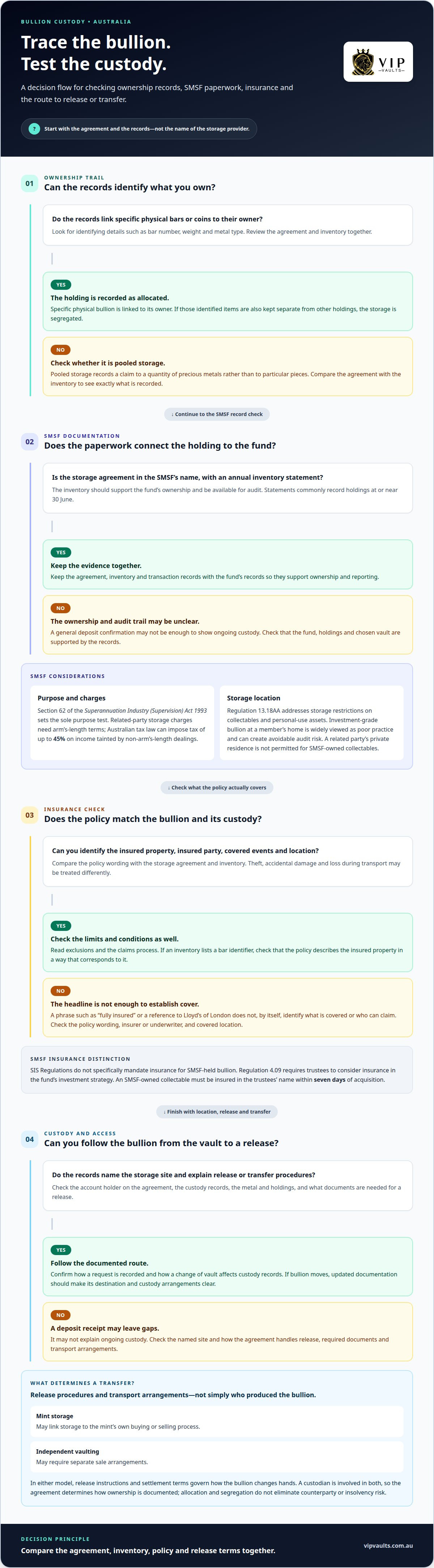
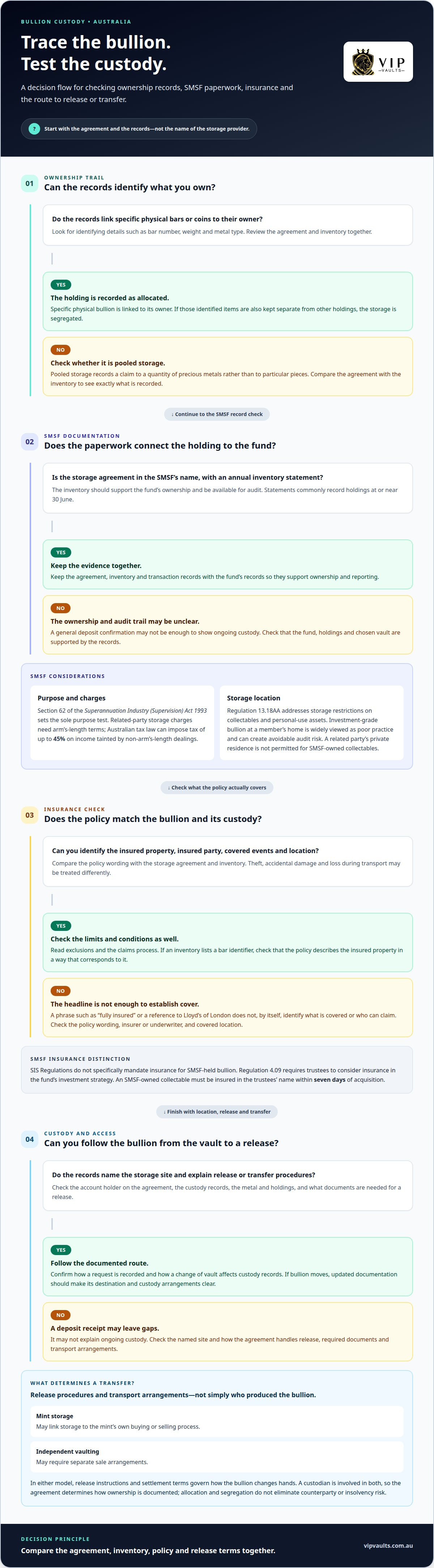
Where your bullion is held matters less than the custody arrangement. In independent vaulting vs mint storage, the key difference is who holds the metal and what the agreement allows if you later want to move it. Transfers depend on release procedures and transport arrangements, not simply on who produced the bullion.
Look beyond where your metals will be stored today. Ownership records, insurance, custody and access to other vault locations all affect how clearly you can manage your holdings over time.
This guide compares independent vaulting and mint storage in Australia, including ownership records, insurance, storage locations and transfer procedures. It also outlines the practical details to weigh when choosing an arrangement that suits your priorities.
Key Takeaways
- Understand whether your bullion is individually allocated to you or held as a claim on a quantity of metal, and how that affects ownership records.
- Assess what insurance covers and how the custody arrangement handles theft, damage or loss.
- Compare vault locations, storage documentation and custody terms to understand how your bullion is held.
- Review the release and transfer process so you know what could affect moving bullion to another location later.
Do I remain the owner of my bullion?
Ownership depends on the storage agreement and its records, not simply on whether a mint or independent vault holds the metal. For Australian SMSFs, the records also need to support the fund’s investment purpose and reporting.
Allocated and segregated bullion
Allocated storage links specific physical bars or coins to their owner, usually through details such as bar number, weight and metal type. Segregated storage keeps those identified items separate from other holdings. Pooled storage records a claim to a quantity of precious metals rather than to particular pieces. For example, a statement identifying a specific silver bar provides a clearer ownership trail than a pooled balance. Review the agreement and inventory together to see what is allocated, physically segregated and recorded.
Counterparty, insolvency and access risks
Both independent vaulting and mint storage involve a custodian, so the agreement determines who holds the bullion and how ownership is documented. Allocation and segregation can distinguish your property from pooled holdings, but do not eliminate counterparty or insolvency risk. Access also depends on the provider’s release process and the agreement’s terms. Compare those procedures instead of assuming either model provides faster access or stronger protection.
Buying and selling depend on the transaction arrangements, not storage alone. A mint may link storage to its own buying or selling process, while an independent vault may require separate sale arrangements. In either case, release instructions and settlement terms govern how the bullion changes hands.
For SMSFs, Section 62 of Australia’s Superannuation Industry (Supervision) Act 1993 sets the sole purpose test, according to the Federal Register of Legislation. Investment-grade bullion is generally not classified as a collectable under the storage framework described here. Australian tax law can impose tax of up to 45 per cent on income tainted by non-arm’s-length dealings, so related-party storage charges need arm’s-length terms. SMSF storage agreements should name the fund, with an annual inventory statement available for audit; statements commonly record holdings at or near 30 June. Keep the agreement, inventory and transaction records together to support ownership and reporting.
Insurance against theft, damage and loss
Insurance is separate from vault security. For Australian SMSFs, rules distinguish bullion from collectables, so identify the asset category before assessing the cover attached to stored metal.
Australia’s SIS Regulations do not specifically mandate insurance for SMSF-held bullion, unlike the requirement for collectables. Regulation 4.09 requires trustees to consider insurance in the fund’s investment strategy. An SMSF-owned collectable must be insured in the trustees’ name within seven days of acquisition. These distinctions matter: don’t assume a bullion arrangement has the same legal insurance requirements as a collectable.
Read the policy, not the headline
Compare the policy wording with the storage agreement. Check whether the insured property is your specific bullion or a broader holding, who is insured, and which events are covered. Theft, accidental damage and loss during transport may be treated differently. A statement that bullion is “fully insured” is not enough by itself: limits, exclusions and the claims process are set out in the policy terms.
A reference to Lloyd’s of London also needs context. The name alone does not identify which bullion is covered, who can claim or whether the policy applies while metal is in transit. Check the insurer or underwriter named in the policy, the insured party and the covered location. Assess mint storage and independent vaulting against the same details rather than assuming their cover is identical.
Security, audits and insurance
Physical security measures and independent audits can support custody records, but neither automatically proves that an insurance claim will be paid. Keep the inventory, storage agreement and policy schedule aligned. If an inventory lists a bar’s identifier, make sure the policy describes the insured property in a way that corresponds to the stored bullion.
For a practical view of how storage arrangements relate to insured bullion, consider a bullion storage arrangement alongside the policy wording. The deciding details are the insured party, covered risks, exclusions and claim process, not simply whether the vault is independent or mint-operated.
Vault locations and custody
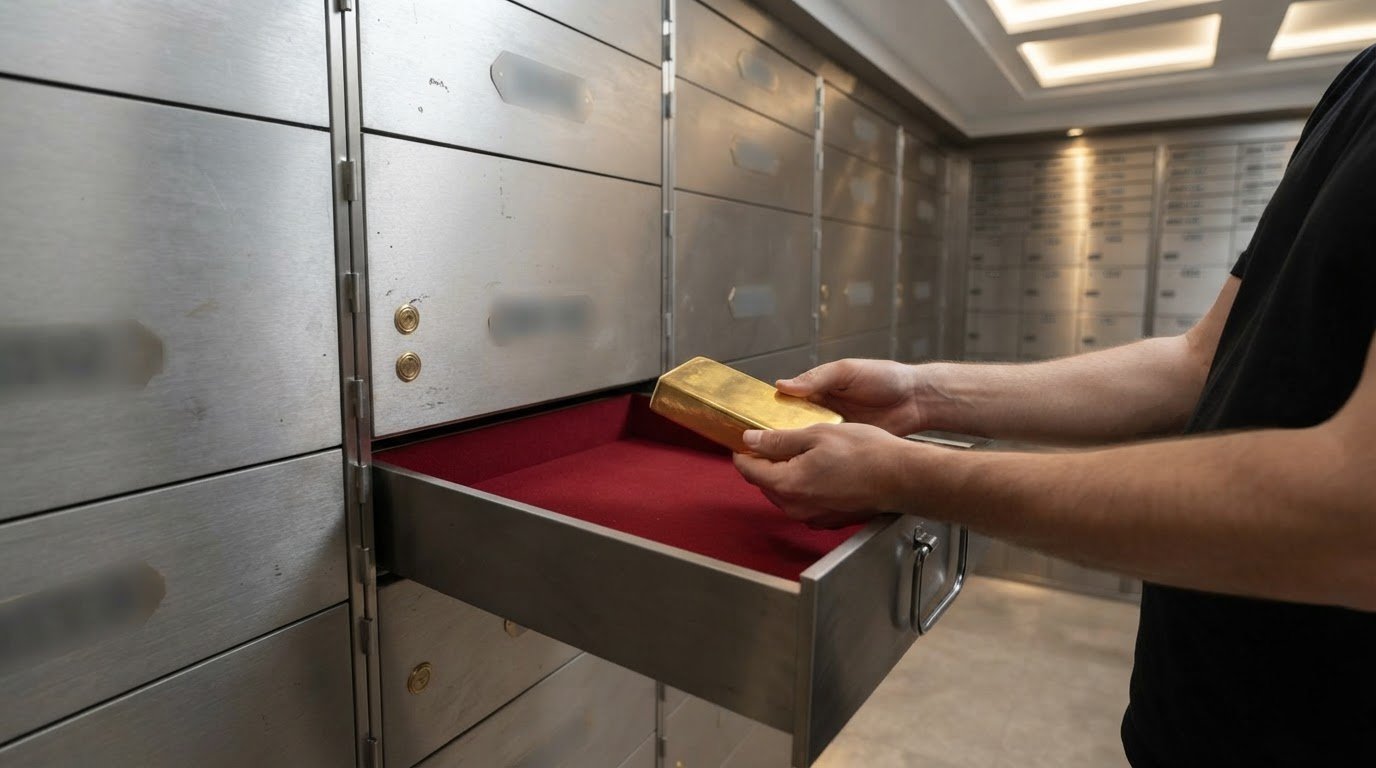
A vault’s location affects where bullion is held and how a release or transfer is arranged. Compare the named storage site, the account holder on the agreement and the custody records. For gold and silver, the paperwork should identify the metal and holdings; it should also clearly describe platinum if included. A deposit receipt alone may not explain ongoing custody.
For SMSFs, Regulation 13.18AA of Australia’s Superannuation Industry (Supervision) Regulations 1994 imposes storage restrictions on collectables and personal-use assets. Investment-grade bullion stored at a member’s home is widely viewed as poor practice and can create avoidable audit risk. A private residence is not permitted for SMSF-owned collectables when it belongs to any related party. Storage location therefore needs to match the asset category.
Independent vault custody can place the storage agreement in the SMSF’s name, with documentation supporting the fund’s ownership. The provider should issue an annual inventory statement that auditors can verify. This record connects the holdings to the fund and its chosen vault. Keep the agreement and statement with the fund’s records rather than relying on a general deposit confirmation.
Customer support matters when you need to understand a location, release procedure or transfer. Ask practical questions about how a request is recorded, which documents are needed and how a change of vault location affects custody records. If you plan to move a gold holding, for example, the updated documentation should make its destination and custody arrangements clear.
Mint storage and independent vaulting can involve different locations and custody arrangements. The provider’s name alone does not establish where your metal is held. Compare the agreement, inventory process and location details. For SMSF bullion, independent storage in the fund’s name, supported by appropriate documentation and an annual inventory statement, can address auditors’ storage concerns. Choose an arrangement whose records follow the bullion if its location changes.
Independent private-vault storage
Independent vaulting means storing precious metals at a private facility operated separately from a mint. The vault custodian holds the bullion under an agreement, while a mint may focus on producing or selling it. This separation offers another custody option, but independence alone does not establish how holdings are allocated, insured or released.
There is no single Australian fee or minimum deposit for independent vaults and mint storage. Each arrangement sets its own terms. Storage fees may depend on the type and quantity of metal, how it is held, and any handling or withdrawal requirements. Where a deposit threshold applies, the provider sets it. Compare the full fee schedule and entry conditions, not just the headline storage charge.
Someone storing silver bullion may prioritise a facility that records specific items and explains how withdrawals work. Another owner may prefer selling through the mint that supplied the bullion. Independent storage separates the vault relationship from the purchase relationship, offering another choice but potentially requiring a separate sale arrangement. The written terms determine how transfers and release instructions work.
Before choosing, map the practical steps: how metal is accepted, how holdings are recorded, what triggers a release and how a change of location is documented. Then compare these with the mint’s storage process. This helps you judge which arrangement suits your preferred level of control, without assuming an independent operator always offers more flexibility.
Independent vaulting can suit owners seeking custody separate from a mint’s trading arrangements. It doesn’t automatically ensure specific allocation, insurance or convenient access; those depend on the agreement and facility procedures. To explore a private facility for your bullion holdings, review private vault storage options and consider how the custody terms fit your plans.
VIP Vaults & Bullion Exchange Perth: Private Vault Rental
VIP Vaults & Bullion Exchange Perth offers Private Vault Rental for people seeking a dedicated place to store bullion and other valuables. If you are weighing independent custody against mint storage, a private vault arrangement lets you separate your storage choice from where you buy your metals.
A Bullion Locker is another option for bullion storage, while Jewellery Storage serves a different need. VIP Vaults & Bullion Exchange Perth also offers Gold Bullion if you are considering a purchase alongside storage. The right choice depends on what you intend to store and how the arrangement fits your ownership and access priorities.
Contact VIP Vaults & Bullion Exchange Perth to discuss Private Vault Rental and your storage needs.
Choose storage that supports your next move
Choose storage that works beyond the initial deposit. Consider how you want to manage, access or eventually relocate your bullion, then select an arrangement whose terms support those plans. Comparing independent vaulting and mint storage is most useful when it helps you decide which custody relationship suits you.
If you are considering private custody, VIP Vaults & Bullion Exchange Perth offers Private Vault Rental and Bullion Locker options. Gold Bullion is also available if you are considering a purchase alongside your storage plans. These services offer a practical way to explore how bullion ownership and storage can fit together.
For a direct conversation about your storage needs, contact VIP Vaults & Bullion Exchange Perth. Take the next step with a considered plan for your holdings.
Frequently Asked Questions
Can I move my bullion to another location later on?
Yes, if the agreement permits the requested release or transfer. Before moving holdings, establish whether partial withdrawals are allowed and what instructions the current custodian requires. The receiving facility may need specific delivery details before accepting bullion. Clarify who arranges transport and what documentation accompanies the consignment, so responsibilities are clear from collection to receipt.
How do independent vaulting and Mint storage differ in ownership and allocated versus unallocated holdings?
The practical difference lies in the account terms and how transactions change your recorded interest. Review purchase documents, account statements and any substitution clauses together. After a partial sale, for example, the statement should show how the remaining holding is calculated. Establish whether the agreement allows a specific item to be replaced with an equivalent one, and how that change is recorded.
How are precious metals insured, audited, and segregated under each storage option?
Compare the valuation basis used for insurance with the method used to value bullion during a claim. For audits, establish whether the review covers physical holdings, account records or both, and how discrepancies are reported. Ask how segregation is handled during packing, internal transfers and dispatch. These details show whether procedures remain consistent after the initial deposit.
Can customers withdraw or take delivery of bullion from independent vaults and Mint storage, and what are the fees?
Delivery arrangements and charges depend on the storage contract. Look for separate terms covering collection, delivery, handling, packaging and transport rather than treating them as a single fee. Establish whether a request can cover only part of a holding and what notice or identification the custodian requires. An itemised schedule clarifies the total cost of the withdrawal method you choose.
How can Australian investors verify a vault provider’s security, audits, and custody arrangements?
Assess whether the provider can clearly explain its procedures, including how it records access, handles exceptions and responds to disruptions. Review the scope and findings of independent assurance work instead of relying only on a general security statement. For an SMSF, ensure the trustee and auditor can obtain the records needed to administer the fund. Clear procedures make responsibilities easier to understand.