A gold bar can look convincing while concealing a cheaper metal inside. To learn how to spot counterfeit gold bars, check more than appearance: compare its weight and dimensions with the refiner’s specifications, inspect the markings and surface, and use suitable tests to assess the metal throughout. No single visual clue proves authenticity.
Inspect the bar’s finish and markings, but remember that a neat stamp or gold-coloured surface cannot show what lies beneath. Tungsten is a notable example: its density is close to gold’s, so a counterfeit containing it may be hard to identify by weight and size alone.
This guide explains how ultrasonic testing can reveal internal inserts or voids, which design and stamping flaws to look for, and how common substitute metals differ from gold. You’ll also see why combining checks gives a more reliable picture than appearance alone, and when secure storage may be worth considering after assessing your bullion.
Key Takeaways
- Compare a bar’s weight and dimensions with its maker’s specifications, then use ultrasonic testing to look for internal inserts or voids.
- Inspect stamps, edges and surface detail for blurry marks, poor definition or distorted logos.
- Remember that tungsten’s density is close to gold’s, so weight alone may not reveal a counterfeit core.
- Once your bullion has been assessed, consider whether a private vault or bullion locker suits your storage needs.
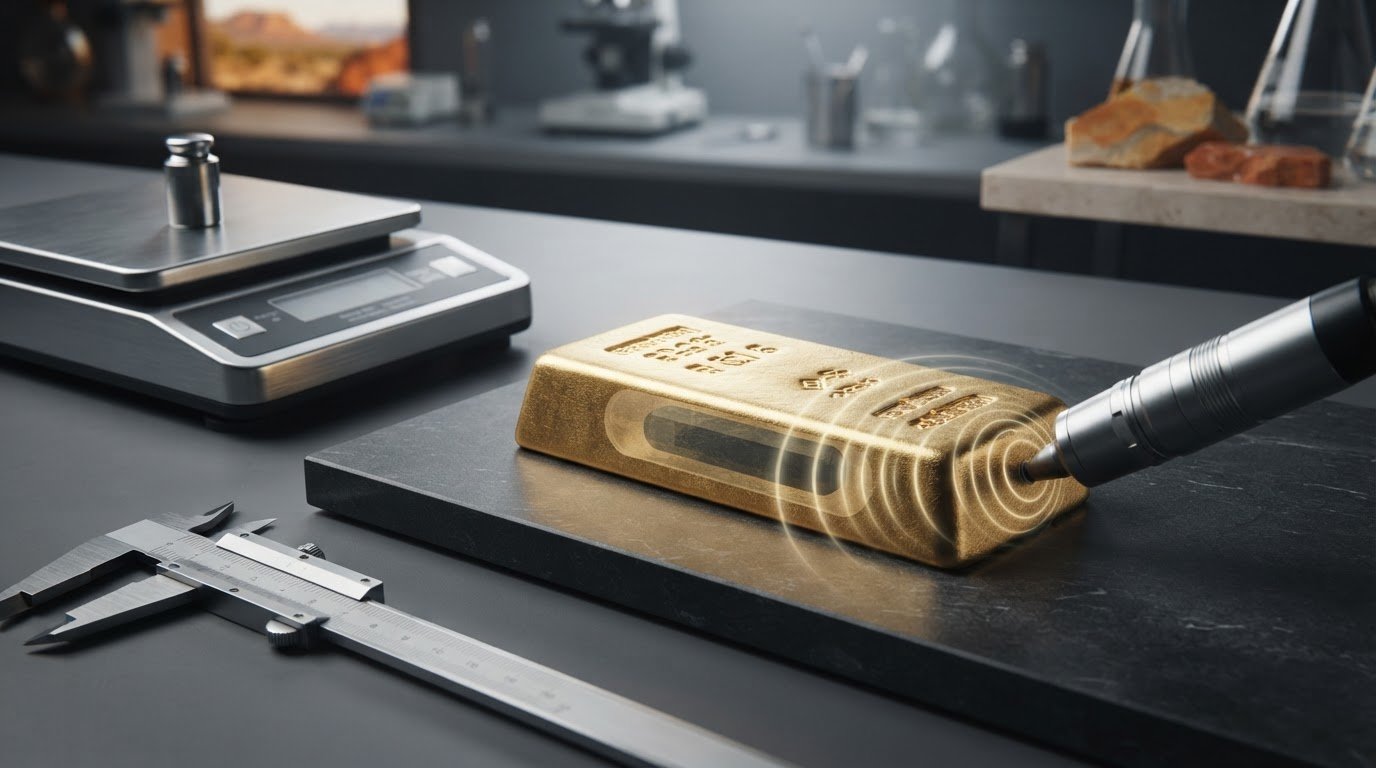
Checking the full thickness of a gold bar with ultrasonic testing
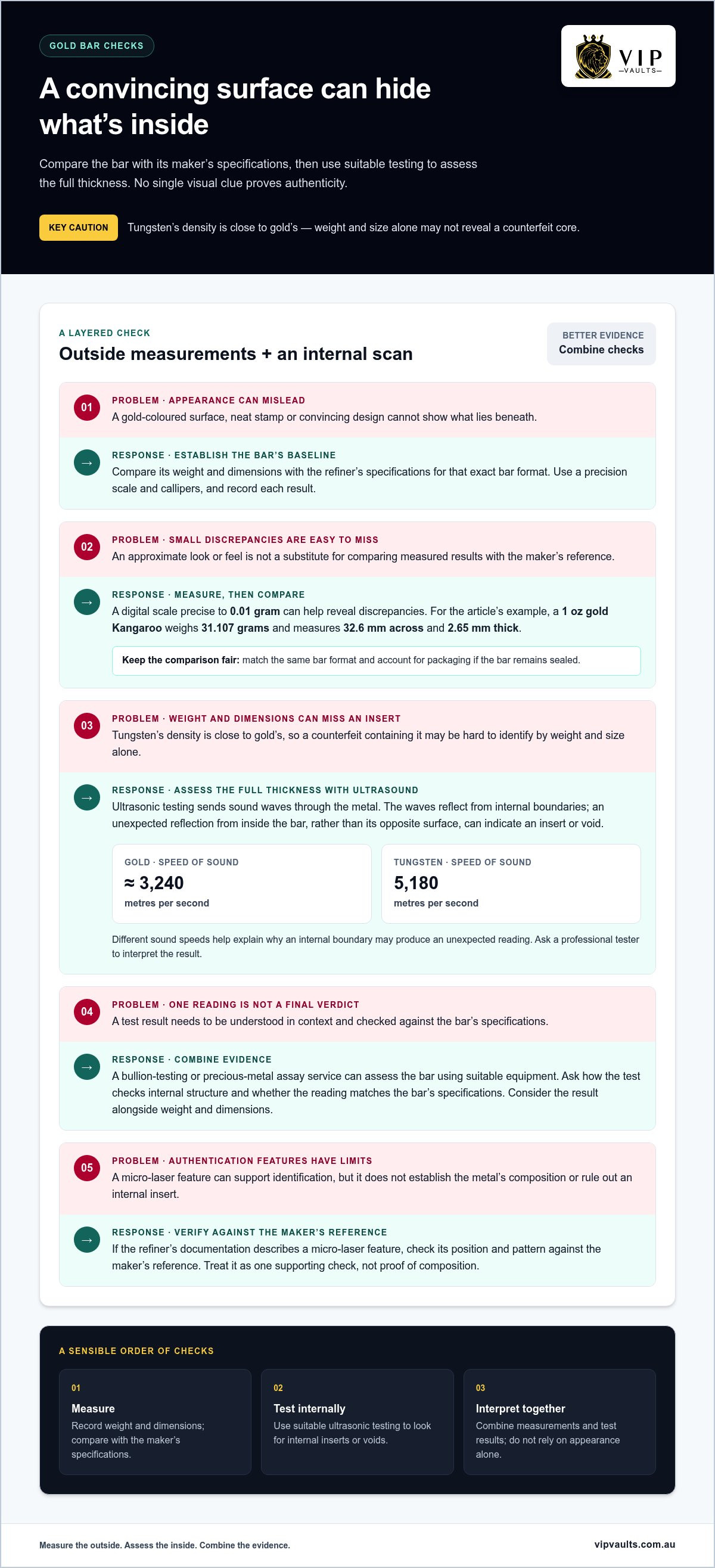
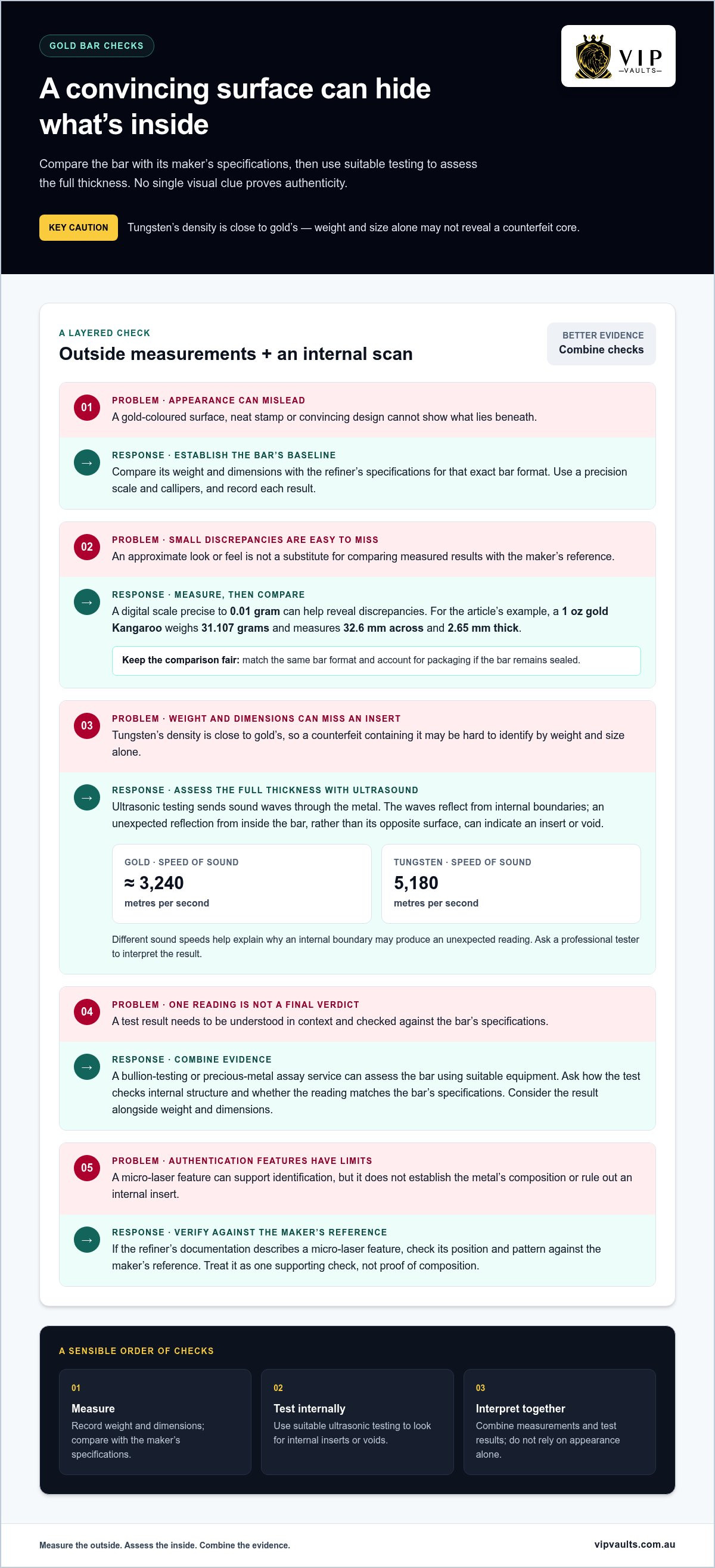
- Compare the bar’s weight and dimensions with its maker’s specifications. Use a precision scale and callipers, then record each result. A digital scale precise to 0.01 gram can help reveal discrepancies. For example, a 1oz gold Kangaroo weighs 31.107 grams and measures 32.6 mm across and 2.65 mm thick. Compare the same bar format, and account for packaging if it remains sealed.
- Use ultrasonic testing to assess the bar’s interior. Sound waves travel through the metal and reflect from internal boundaries. Gold’s speed of sound is around 3,240 metres per second; tungsten’s is 5,180 metres per second. An unexpected reflection from inside the bar, rather than its opposite surface, can indicate an insert or void. This can expose a counterfeit core beneath a convincing exterior.
- Ask a professional tester to interpret the result. A bullion-testing or precious-metal assay service can assess a bar using suitable equipment. Ask how the test checks internal structure and whether the reading matches the bar’s specifications. Combine results with weight and dimensions, rather than treating one measurement as a final verdict.
- Check for micro-laser authentication features. If the refiner’s documentation describes one, inspect its position and pattern against the maker’s reference. A micro-laser feature can support identification, but it doesn’t establish metal composition or rule out an internal insert.
- Buy carefully and retain transaction evidence. Review the dealer’s business details, written terms and receipt. Compare the quoted premium with the current gold spot-price benchmark before paying. If you suspect a counterfeit, keep the bar, packaging, receipt and seller messages intact, and report the matter to local police and consumer protection authorities.
Inspecting surface details and stamping
At home, inspect the bar in clear light and compare its markings with the refiner’s published examples. A magnet may flag some counterfeits, but a non-magnetic result cannot prove authenticity or reveal every internal insert.
- Read every stamp carefully. Check the refiner’s name, stated purity, weight and serial number against the details associated with that exact bar. Look for uneven lettering, inconsistent spacing or marks that appear shallow or poorly aligned. A genuine-looking logo alone is not proof: counterfeiters can copy visible designs.
- Inspect edges and surface definition. Turn the bullion slowly under good lighting and examine the corners, lettering and borders. Industry guidelines indicate that blurry edges, poor definition and distorted logos can signal counterfeit production. Compare the same design with the refiner’s product images, paying attention to the logo’s proportions and the placement of each mark.
- Examine packaging without damaging it. If the bar is sealed in tamper-evident assay packaging, inspect the seal, joins and printed details for cuts, lifting, resealing or mismatched information. Packaging can be copied or replaced, so an intact seal supports the assessment but does not establish the metal’s composition.
- Match the serial and assay details. Check whether the refiner provides a way to verify the serial number, assay card or packaging details through its official records. Make sure the serial on the bar matches the packaging, where both display one. Treat a mismatch as a reason to pause and seek an independent assessment.
- Use at-home checks as screening only. A magnet test can identify a bar that reacts unexpectedly, while visual inspection may reveal poor stamping. Neither test measures purity or checks the full core. Avoid scratching, cutting or using chemicals on bullion, as these can damage the surface without reliably authenticating the bar.
- Protect the bar after inspection. Keep packaging and purchase records together, and store assessed bullion securely. A bullion locker can provide a dedicated storage option once you’ve completed your checks.
Identifying flaws in design and appearance
- Compare the design with the maker’s reference for that exact bar. Check the logo, border, lettering and decorative elements against images of the same product and format. Look for missing details, altered proportions or symbols placed differently. A design copied from another bar of the same refiner may still be wrong for this specific model, so match the full layout rather than the logo alone.
- Examine the relief and edges under steady light. Blurry edges, poor definition and distorted logos can signal counterfeit production. Tilt the bar gradually and observe how the raised and recessed areas catch the light. Genuine-looking details should be consistent with the maker’s reference; soft outlines or uneven relief deserve closer attention.
- Check alignment across the whole face. Look at how the logo, text and decorative borders sit relative to one another. For example, a border that appears centred on one side but shifts noticeably on another may indicate a poorly reproduced design. Compare the pattern as a whole, since an isolated mark can be difficult to judge out of context.
- Review the design from more than one angle. Inspect the front, back and sides, and compare each view with the relevant product reference. Note any design element that appears absent, out of proportion or inconsistent between faces. Keep your observations specific, such as “the border ends early near the lower corner”, rather than recording only that the bar looks unusual.
- Keep the inspection non-destructive. Use a magnifier and clear lighting, not scraping or polishing, which can damage details and reduce the bar’s condition. Record the exact differences you see and retain any accompanying product documentation. Appearance can identify reasons for further scrutiny, but it cannot establish the metal’s composition or authenticate the bar on its own.
Common metals used in counterfeit bars
- Consider what a plated bar can conceal. Counterfeit bars may use inexpensive metals such as tungsten or lead beneath a thin gold coating. The exterior can look convincing while the core contains little or no gold. If you’re learning how to spot counterfeit gold bars, remember that visible colour and finish reveal little about the metal beneath. Treat them as clues, not proof of composition.
- Understand why tungsten is a challenging substitute. Gold has a density of 19.32 grams per cubic centimetre; tungsten’s is 19.25 grams per cubic centimetre, within 0.4% of gold’s. This close match means a tungsten-core bar may have a plausible weight and size. Tungsten costs roughly one fifteen-hundredth of gold by weight, making it an attractive counterfeit filler.
- Don’t rely on weight or density alone. Matching a bar’s stated weight and dimensions is useful, but tungsten’s similar density limits what those checks establish. Gold’s density is much higher than silver’s 10.49 grams per cubic centimetre, while tungsten is close to gold. Use measurements as one part of a wider assessment of precious metals.
- Choose tests that assess the surface and core. X-ray fluorescence can measure gold and trace elements at the surface, but it penetrates only about 0.05 millimetres. A gold-plated tungsten bar could therefore give a misleading surface result. XRF and Sigma testing can be combined to assess the surface and core, respectively. Ultrasonic testing can also reveal internal reflections that suggest an insert or void.
- Avoid scratch tests as a shortcut. Gold scores 2.5 to 3 on the Mohs hardness scale, while tungsten scores 7.5. A scratch can damage the bar without verifying its full composition. To understand how to spot counterfeit gold bars, focus on tests that assess more than the surface. Once your precious metals have been assessed, consider a bullion locker for secure storage.
VIP Vaults & Bullion Exchange Perth: Private Vault Rental
VIP Vaults & Bullion Exchange Perth offers private vault rentals and bullion lockers for people seeking dedicated storage for precious metals. After checking a bar’s authenticity, consider secure storage as another part of protecting physical gold or silver. Bullion lockers are designed for bullion holdings, while private vault rentals provide a discreet place for valuables.
Consider secure storage if keeping bars at home no longer suits your circumstances or you prefer a separate place for your holdings. VIP Vaults & Bullion Exchange Perth also sells gold and silver bullion.
To discuss storage options, contact VIP Vaults & Bullion Exchange Perth or visit vipvaults.com.au.
Make your next bullion decision with care
The same careful approach used to learn how to spot counterfeit gold bars can inform decisions beyond the initial purchase. Treat authenticity, provenance and custody as separate considerations. A bar’s appearance is only one part of ownership; clear purchase records and a considered storage plan can help you manage it over time.
Once you know what you hold, decide how you want to safeguard it and whether dedicated storage suits your circumstances. VIP Vaults & Bullion Exchange Perth offers private vault rentals, bullion lockers and gold bullion. Choose your next step based on your priorities for holding and protecting physical bullion.
For a considered conversation about your options, contact VIP Vaults & Bullion Exchange Perth. Make your decision at your own pace and move forward with greater confidence in your bullion arrangements.
Frequently Asked Questions
What markings and serial numbers should genuine gold bars have?
Markings vary by refiner and bar design, so there is no universal layout. Look for details such as the refiner’s name, stated weight and purity, and a serial number if that product uses one. Compare the characters and their placement with the refiner’s product information. If the bar comes with an assay certificate, check that its details match the bar and packaging.
How can I check a gold bar's weight and dimensions against the refiner's specifications?
Find the specifications for the exact refiner and bar format, then compare like with like. A sealed assay pack can affect the measured weight, so don’t compare a packaged item with specifications for the bare bar. Use a suitable scale and callipers, and record the readings. Check the units, since mixing grams and ounces can make a genuine measurement appear inconsistent.
How do gold bar purity markings such as 999.9 indicate authenticity?
A 999.9 stamp expresses a claimed fineness of 999.9 parts per thousand, or 99.99% gold by mass. It describes the stated purity, not independent proof that the bar contains that amount. A counterfeit can copy a purity mark. Treat it as one detail to compare with the refiner’s specifications, then use appropriate metal testing to assess the bar’s composition.
How do professional dealers and refiners authenticate gold bars using XRF, ultrasound, or specific gravity tests?
Different tests examine different properties. X-ray fluorescence analyses the surface, while ultrasound assesses internal structure. A specific gravity test compares a sample’s mass with its volume to estimate density. Treat no single result as a complete answer, especially when a substitute metal has a density close to gold. Combining methods can give a fuller assessment.
What are common counterfeit gold bar designs and warning signs?
There is no single standard counterfeit design. Warning signs include details that differ from the refiner’s product images, an unrealistically low price, or a listing marked “No Returns”. A counterfeit may also imitate a familiar refiner’s logo and packaging. Treat these clues as reasons to pause and investigate, not as proof on their own: copied branding does not verify the metal inside.