The largest vault isn’t automatically the right choice. When setting up a private vault account, location and the space your valuables need can matter as much as the fee.
Before committing, get a clear picture of the cost. Fees depend on the type of storage and rental term. Compare the listed rates, then read the rental agreement for the minimum term, renewal conditions, included insurance and any separate deposit or optional cover.
This guide explains how to assess fees, what personal information and identity checks may be involved, and what to look for in the licence terms. It also covers permitted use and how to weigh a vault’s location against its size, so you can make an informed choice before proceeding.
Key Takeaways
- Review the fee schedule and licence terms together to understand what affects the overall cost.
- Understand what personal information an account application involves and how disclosure relates to identity checks.
- Read the licence carefully to learn which items and activities the vault permits.
- Choose a vault by balancing its location with the space your valuables require.
Privacy and disclosure of personal information
A private vault account is a rental arrangement for storing physical valuables, not a bank account for holding money. The agreement sets out access and responsibilities. Do not assume stored valuables are protected by Australia’s Financial Claims Scheme; scheme eligibility is separate from storage, so review the terms of your arrangement.
- Read the privacy notice. Before applying, identify what personal information the provider collects, why it is needed, how it is used, and when it may be disclosed. For example, distinguish identity details from contact information and account records.
- Choose the correct account holder. For a business account, confirm which entity will hold the licence and who may act for it. Record the authorised administrators and understand how the provider handles changes to those permissions.
- Limit access credentials. Use only the credentials required for account access. Don’t add generic personal credentials, such as a shared household password, to an account record. Remove access for anyone who no longer needs it.
- Follow the application sequence. Select the account type, provide requested details, complete the provider’s identity checks, review the licence, then accept its terms. Keep a copy of the agreement and any privacy notice for later reference.
- Clarify storage and access. A vault holds valuables, not funds for ordinary payments. The agreement sets out how items are stored, who can access them, and how withdrawal works. Check the stated process before placing or retrieving an item.
- Assess disclosure and scam risks. Be cautious if someone requests passwords, pressures you to bypass written terms, or asks for payment through an unrelated channel. Confirm the request through an established contact method before sharing information.
Identity verification and AML/CTF requirements
- Understand the legal context. According to AUSTRAC, Australian identity verification requirements for vault licensees are linked to the Anti-Money Laundering and Counter-Terrorism Financing Act 2006 (Cth). This connection explains why an application may request identity details before an account is opened. Read the provider’s privacy information alongside its verification instructions.
- Use consistent account details. Enter your name and contact information as requested, and use the same details throughout the application. For a business account, use the business’s correct legal details and identify the person authorised to act for it. Inconsistencies can make the application harder to assess.
- Follow the stated verification steps. Read each instruction before submitting information. Provide only the details and documents requested through the application process. If a field is unclear, use the provider’s stated assistance channel rather than guessing or sending sensitive information through an unrelated message.
- Keep a record of what you submit. Save the application confirmation and any correspondence about identity checks. For example, note which account holder the application concerns and which administrators are authorised. These records can help resolve questions if account details later need to change.
- Protect account access. Create a password that isn’t reused for unrelated accounts, and keep credentials private. Don’t assume information is stored or processed automatically in a particular way; read the privacy terms to understand how personal details are handled and who may access them.
- Complete the process before arranging storage. Follow the application through its identity checks, then review the account terms before proceeding. For details about a private vault rental, consider how the account process fits your storage needs and planned access.
Vault licence agreement and permitted use
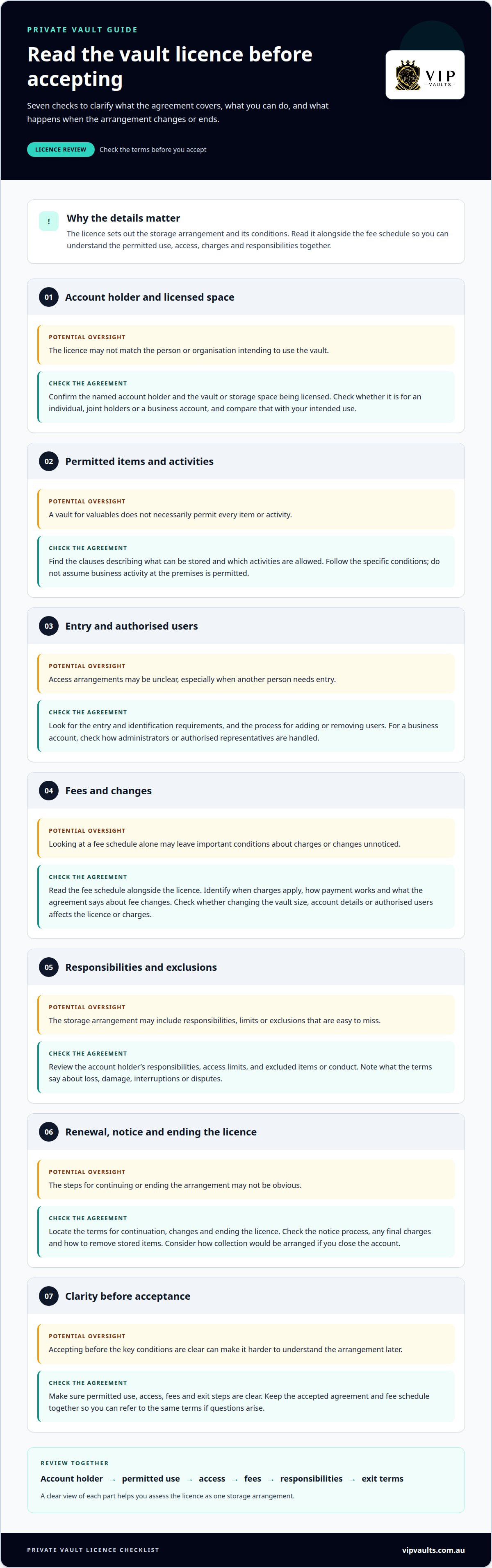
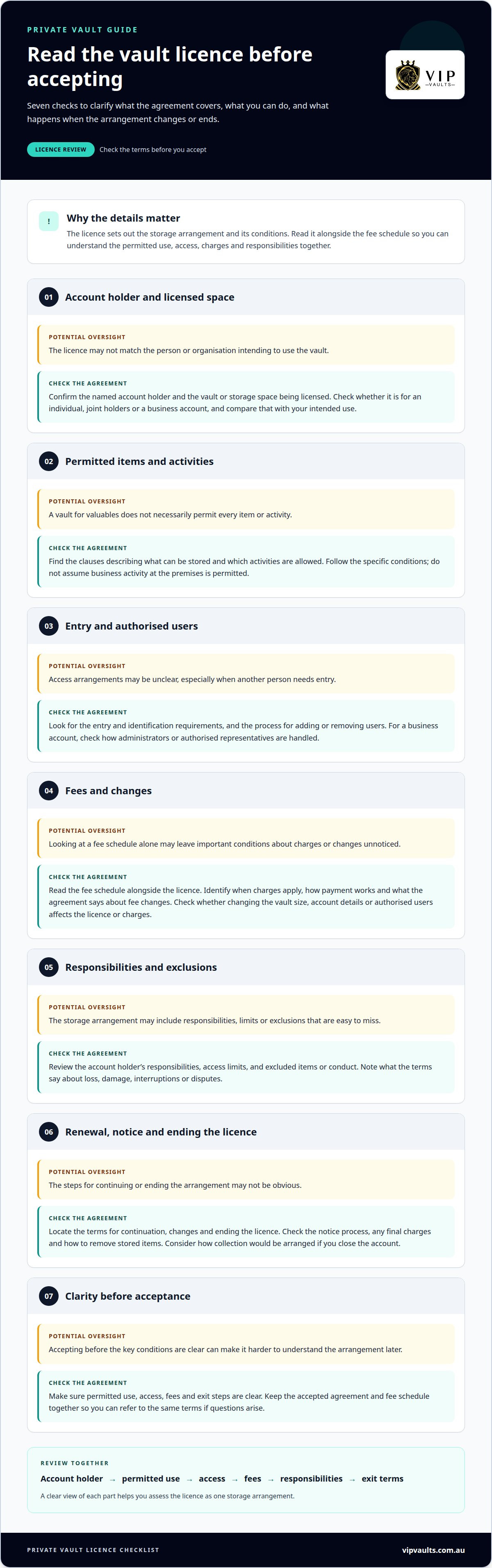
- Identify what the licence covers. When setting up a private vault account, check that the agreement names the account holder and describes the vault or storage space being licensed. Note whether it covers an individual, joint holders or a business account. Compare those details with your intended use before you accept.
- Read the permitted-use clauses. Find the terms explaining what can be stored and which activities are allowed. For example, don’t assume a vault for valuables permits storing every item or using the premises for business activity. Follow the agreement’s specific conditions.
- Check access and authority. Find how the licence handles entry, identification and authorised users. If another person needs access, look for the process to add or remove them. For a business account, understand how the agreement treats administrators or authorised representatives.
- Understand fees and changes. Read the fee schedule alongside the licence. Identify when charges apply, how payment works and what the agreement says about fee changes. Check whether changing vault size, account details or authorised users affects the licence or charges.
- Review responsibilities and exclusions. Look for clauses covering the account holder’s responsibilities, access limits and excluded items or conduct. Note how the terms address loss, damage, interruptions or disputes. These provisions define the responsibilities attached to the storage arrangement.
- Read the ending and renewal terms. Locate the clauses explaining how the licence continues, changes or ends. Check the notice process, any final charges and the steps for removing stored items. For example, plan how you’d arrange collection if you decide to close the account.
- Accept only when the terms are clear. Before setting up a private vault account, make sure the permitted use, access process, fees and exit steps are clear. Keep the accepted agreement and fee schedule together. That record helps you refer to the same terms if questions arise later.
Vault selection by location and size
- Map your likely visits. Identify where you’ll travel from and how often you expect to access stored items. A location near regular appointments may be more practical than one requiring a separate journey. Consider travel time and transport arrangements, not just the distance on a map.
- Think through the access journey. Consider how you’ll get to the facility and what you’ll carry. A compact item, such as jewellery, creates different transport needs from a larger collection of bullion or documents. Choose a location that suits your usual way of travelling.
- List what you intend to store. Write down each item type, its dimensions and whether it has protective packaging. A ring, a document folder and a boxed collectable take up different amounts of space. This practical inventory gives you a sound basis for selecting a vault size.
- Allow room for how items sit. Estimate the space needed for the actual shapes and containers, rather than considering value alone. Flat documents may stack differently from rigid cases. Keep items organised in your plan, so you can judge whether the usable space will suit your collection.
- Consider future changes. Think about whether you may add items or remove some later. A vault that fits today’s inventory may feel restrictive if your storage needs change. Balance suitable capacity against avoiding space you don’t expect to use.
- Compare location and capacity together. Don’t choose by size alone or by convenience alone. For example, a larger vault farther away may not suit someone who expects frequent visits. Weigh the travel routine against the space required, then select the arrangement that best fits both.
- Match your choice to the agreement. Confirm that the selected vault’s stated size and location align with your intended use and access arrangements. Keep those details alongside your inventory and licence, so the basis for your decision remains clear.
Use your inventory and travel routine to explore private vault rental options suited to your storage needs.
VIP Vaults & Bullion Exchange Perth: Private Vault Rental
VIP Vaults & Bullion Exchange Perth offers Private Vault Rental for people seeking a place to store valuables. It may suit you if your storage needs call for a dedicated vault rather than a bank account. Consider your planned access, the space your items require and the licence terms before choosing an arrangement.
For bullion, consider a dedicated bullion locker, which uses dual-key security and has no custodial key retained by VIP Vaults. VIP Vaults also sells gold and silver bullion. Match the storage option to what you plan to store, then review its dimensions, capacity and rental fee.
For information about a private vault arrangement, contact VIP Vaults & Bullion Exchange Perth.
Choose a storage arrangement that fits your next step
Before proceeding, decide what you need to store and how a vault should fit into your plans for protecting and accessing valuables. Setting up a private vault account makes sense once you have identified the items, the space they need and your expected access routine. Consider whether a safe deposit box or a bullion locker is the better fit.
VIP Vaults & Bullion Exchange Perth offers private vault rentals and bullion lockers, as well as gold and silver bullion. These are practical options to consider if you need physical storage or are looking to buy bullion. Compare the available sizes, capacities and rental terms, then reserve a box or book an appointment to discuss your requirements.
Contact VIP Vaults & Bullion Exchange Perth to discuss your storage needs and take the next step with clarity.
Frequently Asked Questions
Are there any fees for using The Vault?
Yes. A private vault is a rental service, so you pay a rental fee rather than interest or bank-account transaction charges. The fee depends on the storage option and term. Check the listed rates and note the separate refundable security key deposit and the complimentary insurance included with a box. Additional insurance can be arranged.
What’s next?
Choose what you intend to store, then match it to a vault size and access routine. Next, review the rental agreement and fee schedule, complete the required account and identity steps, and decide whether to proceed. If you’re considering storage through VIP Vaults & Bullion Exchange Perth, contact the business to discuss a private vault rental that suits your needs.
What does “private vault account” mean in Australia?
In Australia, a private vault account generally means a rental arrangement that gives an account holder access to secure space for physical valuables. It isn’t a bank account for deposits, payments or interest. The vault licence sets out how the space may be used, who may access it, and the conditions for storing and retrieving items. The agreement defines the particular arrangement.
Which Australian providers offer private vault accounts?
VIP Vaults & Bullion Exchange Perth offers private vault rentals and bullion locker storage. These are physical storage services, not bank accounts. Compare the storage options and their terms with your access needs. Safe deposit boxes are accessed by the holder using biometric identification and a unique key; staff cannot open a box.
What documents and eligibility requirements are needed to open one in Australia?
Opening an account involves completing identity checks and supplying the information requested for the account holder. For a business account, prepare the entity’s legal details and identify its authorised representative. According to AUSTRAC, Australian identity verification requirements for vault licensees are linked to the Anti-Money Laundering and Counter-Terrorism Financing Act 2006 (Cth). Application steps follow the provider’s process.
What are the fees, minimum deposits and ongoing costs?
Vault rental fees are recurring charges for storage, not deposits into an investment or bank account. The rental fee depends on the selected storage option and term. A refundable security key deposit is separate, and additional insurance can be arranged. Check the terms to distinguish the rental fee, deposit and optional cover, and understand which charges recur.