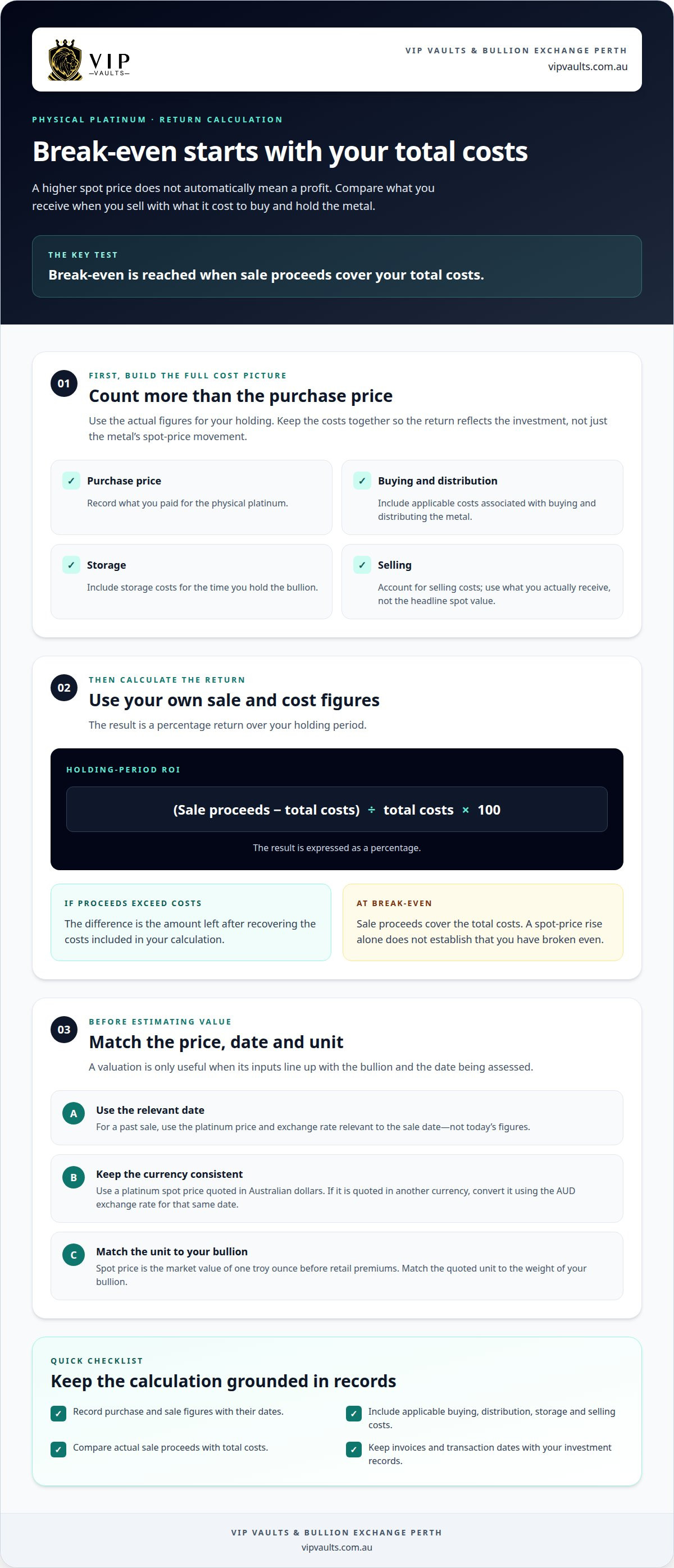

A higher platinum spot price doesn’t automatically mean a profit when you sell. Your return depends on what you paid, the dealer premium, your sale proceeds, and the costs of holding and selling the metal.
Calculating ROI on physical platinum means comparing your net sale proceeds with your total purchase and ownership costs. Subtract those costs from the amount you receive, divide the result by your total costs, then multiply by 100 to express the return as a percentage. The break-even point is reached when your sale proceeds cover those costs.
It’s understandable to focus on platinum’s price movement, but spot price is only one part of the calculation. This guide explains how to include premiums and other costs, calculate your break-even point, and assess how price changes affect your return. You’ll also see why the gap between your purchase price and potential sale proceeds matters when assessing physical platinum as an investment.
Key Takeaways
- Separate platinum’s spot-price movement from the premium paid to buy physical metal to assess what drives your return.
- Use your actual purchase and sale figures to distinguish short-term price swings from the return over your holding period.
- Include the costs of buying, storing and selling when working out the price platinum must reach for you to break even.
- Consider secure storage for physical bullion; VIP Vaults & Bullion Exchange Perth offers Private Vault Rental and Bullion Locker options.
What Is Platinum Investing?
Investing in physical platinum means owning bullion whose value is tied mainly to its metal content and the current spot price. Assess demand, costs, risks, and your holding period before judging its potential return.
-
1. Review returns and industrial demand
Track the purchase price, sale value and costs in a dated investment log. Gross return is the change in value divided by the purchase price, multiplied by 100. For a net result, include relevant buying, selling and storage costs.
Platinum also has industrial uses, including in catalytic converters, electronics, and medical equipment. Manufacturing demand may weaken when production slows and strengthen when it picks up, affecting prices alongside investment demand. Compare physical platinum with gold, silver, ETFs, and mining shares by considering what each represents: bullion is direct metal ownership, an ETF is an investment vehicle, and a mining share represents a company. Their returns respond to different factors, so there is no predictable ranking.
-
2. Assess volatility and investment risks
Review price changes over your intended holding period, not just a recent movement. Platinum has traded both above and below gold, with no fixed price relationship between the metals. Short-term market moves affect the value of physical holdings, while a retail purchase premium can make it harder to sell at a profit.
Include secure storage and resale access in your risk assessment. Physical bullion is metal you own outright, rather than a paper claim that depends on a financial institution. However, selling it may be less straightforward than selling other investment forms. Keep purchase records, product details, and sale proceeds together, then review them periodically against your original investment purpose.
-
3. Check Australian tax treatment
In Australia, consider GST and capital gains tax separately. GST treatment depends on the transaction and product, while CGT treatment depends on your circumstances and records. Don’t assume platinum receives the same tax treatment as another precious metal. Keep invoices and transaction dates so the figures can be assessed accurately.
Calculate holding-period return by subtracting total costs from sale proceeds, dividing by total costs, then multiplying by 100. To annualise that return, use: (1 + holding-period return) raised to the power of 1 divided by the holding period in years, then subtract 1. For authenticity, look for bullion marked with its weight and purity; reputable refiners use XRF testing or fire assay. Collectible value may also reflect rarity, mintage and condition.
Short-term volatility and long-term returns
Assess platinum across several timeframes before deciding whether a price move changes your investment case. A single month may show market volatility, while your full holding period reveals how price changes and ownership costs combine.
-
Track dated price movements
Record the date and platinum price whenever you review your bullion. On 12 October 2026, platinum was down 4.22% over the preceding month. That movement illustrates why a short-term result can differ from the direction of a longer holding. Keep each observation beside your purchase date, rather than relying on memory or an isolated market update.
-
Compare like-for-like timeframes
Use the same start and end dates when comparing platinum with gold and silver. A monthly comparison answers a different question from a multi-year review. Track each metal’s movement separately, and don’t assume platinum will follow either one. Platinum has traded both above and below gold, so their relative prices do not establish a fixed pattern for future returns.
-
Separate market movement from investment outcome
Review your actual holding alongside spot-price movements. Physical bullion has a retail purchase premium, and sale proceeds may not match the quoted spot value. A price rise can therefore coincide with a weaker result after transaction and storage costs. Record these factors so you don’t mistake market performance for your personal return.
-
Set a review routine and secure your holding
Choose a regular review point, such as quarterly or annually, and compare the latest value with your investment records. Use the same method each time, noting price dates, costs and any sale proceeds. Physical metal also needs secure storage. A Bullion Locker can form part of your storage arrangements while you hold bullion.
Calculating the break-even point
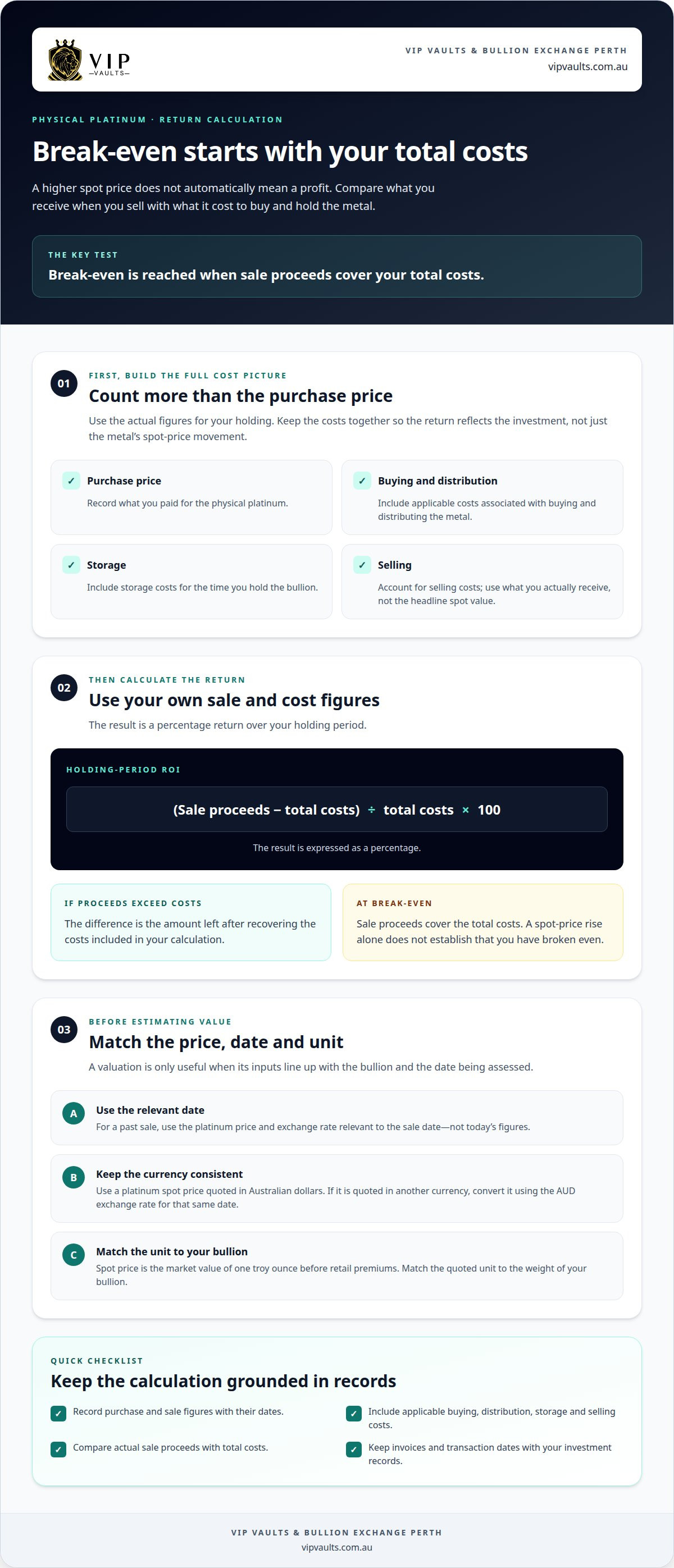
Work out the sale proceeds needed to recover your purchase and ownership costs. For Australian valuations, use a platinum price and currency conversion that match the valuation date.
-
Choose the spot price and exchange rate
Use a platinum spot price quoted in Australian dollars for the date you’re valuing the metal. If the price is quoted in another currency, convert it using the AUD exchange rate for that same date. Pairing a current spot price with an older exchange rate can misstate the estimated value.
Spot price is the market value of one troy ounce before retail premiums. Match the quoted unit to your bullion’s weight before estimating its metal value. For a past sale, use the price and exchange rate relevant to the sale date, not today’s figures.
-
Calculate the return on physical platinum
For calculating ROI on physical platinum, add the purchase price and applicable buying, distribution, storage and selling costs. Subtract this total cost from your sale proceeds, divide by total cost, then multiply by 100 for the percentage return. Use net proceeds after selling costs, rather than the headline spot value.
Your break-even proceeds must cover your total costs. To estimate the spot price needed to break even, account for the amount you expect to receive after selling costs. Physical bars and rounds need secure storage, so include storage costs for the time you hold the metal.
- Keep your inputs consistent when comparing purchases or reviewing a portfolio. Use the same currency, weight unit, and cost categories in each calculation. A consistent method for calculating ROI on physical platinum makes it easier to distinguish price movements from premiums and ownership expenses.
Dealer premiums
Separate the dealer premium from platinum’s spot value, then include relevant ownership costs in your return calculation. This shows how much of your purchase price represents the metal itself.
-
1. Identify dealer premiums
Compare the purchase price with the bullion’s metal value to identify the premium. Physical platinum premiums cover minting, distribution and dealer margin, so the retail price can exceed spot value. On 12 October 2026, reported premiums were 85.06% for a one-ounce platinum bar and 50.05% for a 100-gram bar. These examples show why product size can change the premium’s impact.
Record the premium separately from the spot value. A higher premium means the metal price may need to rise further before a sale recovers your purchase outlay. Larger purchases typically have lower premiums per ounce than smaller ones, but the premium still forms part of your initial cost.
-
2. Account for investment costs
Add applicable storage, insurance, and delivery costs to your records. Each can reduce net proceeds or increase the amount needed to break even. Their relevance depends on your arrangements: delivery may apply when acquiring or moving bullion, while storage and insurance relate to how you hold it.
Don’t treat these expenses as part of the platinum spot price. Record each cost against the relevant date and holding, then include it in your total investment outlay. This gives you a clearer comparison between the amount spent acquiring precious metals and the proceeds received at sale.
- Calculate net return using sale proceeds minus the purchase price, premium and applicable ownership costs. Divide that result by total outlay, then multiply by 100 for a percentage. For example, a rising spot price alone doesn’t establish a positive return if your costs still exceed the sale proceeds.
- If your broader portfolio includes jewellery, consider Jewellery Storage as part of planning for secure asset holding. Keep jewellery-related storage costs separate from platinum bullion expenses so each investment’s return remains clear.
VIP Vaults & Bullion Exchange Perth
VIP Vaults & Bullion Exchange Perth offers private vault rentals and bullion lockers for people considering secure storage as part of their precious-metals ownership costs. These options address the practical side of holding physical assets alongside purchase premiums, resale value, and other expenses. The business also sells gold and silver bullion for readers considering other physical precious metals.
Use the calculations in this guide to understand your break-even point and the costs that affect returns. To discuss secure storage or bullion options, contact VIP Vaults & Bullion Exchange Perth.
Put your next decision on a clear footing
Use your return calculation as one input when deciding how physical precious metals fit your wider plans. Your priorities may include investment exposure, asset security, or keeping different holdings organised. Keep those aims distinct, so a change in market value doesn’t automatically dictate your next step.
A disciplined approach to calculating ROI on physical platinum can help you identify what information you need before making another purchase or sale. Consider your holding period, ownership costs, and how each asset fits your financial circumstances. For broader bullion and storage needs, VIP Vaults & Bullion Exchange Perth offers private vault rentals, bullion lockers, and gold bullion.
To discuss the available options for your holdings, contact VIP Vaults & Bullion Exchange Perth. Take your time, use clear records, and make your next decision with care.
Frequently Asked Questions
What is the break-even point?
The break-even point is the sale value at which your proceeds cover the full cost of acquiring and holding platinum. If storage charges continue during your holding period, include them before deciding whether a quoted resale value represents break-even. A rise in spot price alone doesn’t establish that point, because your sale proceeds may differ from the market value.
How do Australian platinum bullion dealers set buy and sell prices, premiums and spreads?
Dealers generally base prices on the platinum market, then account for the product and transaction. A retail purchase price can include minting, distribution, and dealer margin; a dealer’s buyback offer reflects the price at which it will purchase the metal. The difference between those buy and sell prices is the spread. Product form, weight, and market conditions can affect the quoted figures.
How have Australian-dollar platinum prices performed over different investment periods?
Performance depends on the dates compared and the AUD value used for each date. As a short-term reference, platinum was down 4.22% over the month leading up to 12 October 2026. That single period doesn’t establish long-term performance. For a longer comparison, use consistent start and end dates, convert any foreign-currency prices using the corresponding AUD exchange rates, and include transaction costs separately.
What are the main risks of investing in physical platinum, including price volatility and liquidity?
Key risks include price declines, premiums that take time to recover, storage requirements, and difficulty selling when you choose. Platinum’s industrial demand can also shift with manufacturing activity, affecting market prices. Before buying, consider whether you can hold the metal through price movements and how you would access sale proceeds. Physical bullion avoids reliance on a paper claim, but it still carries market and resale risks.