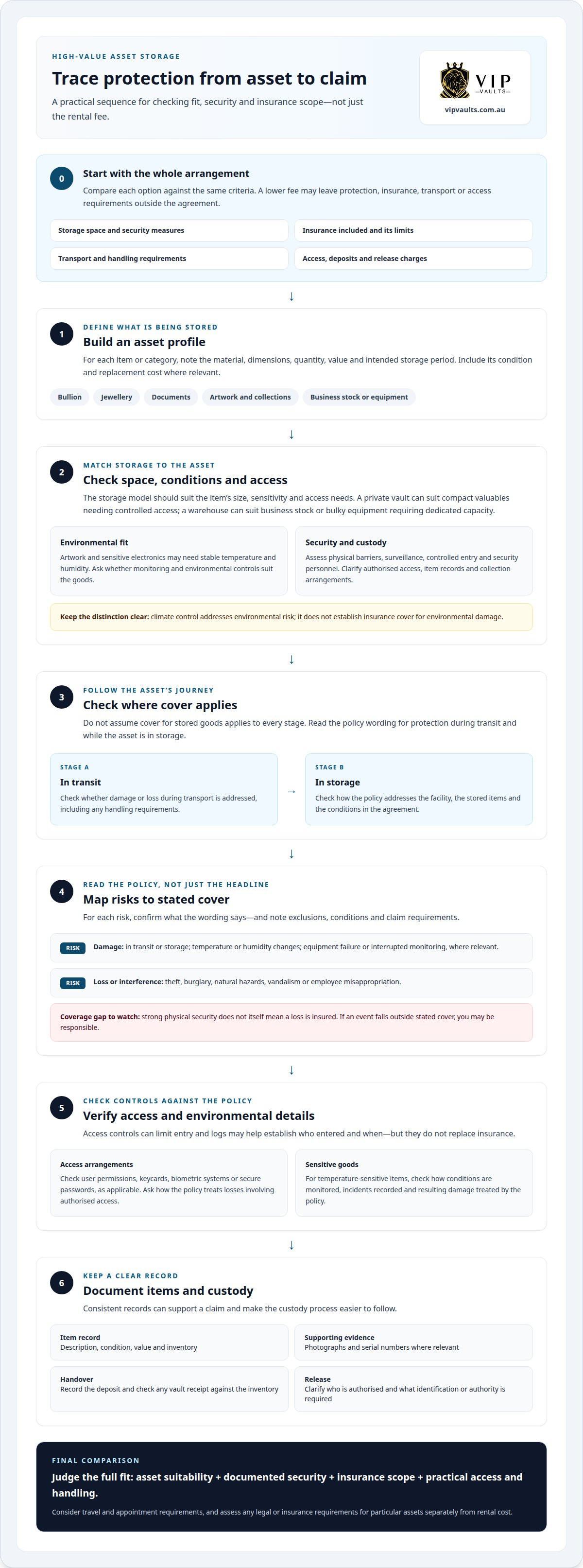
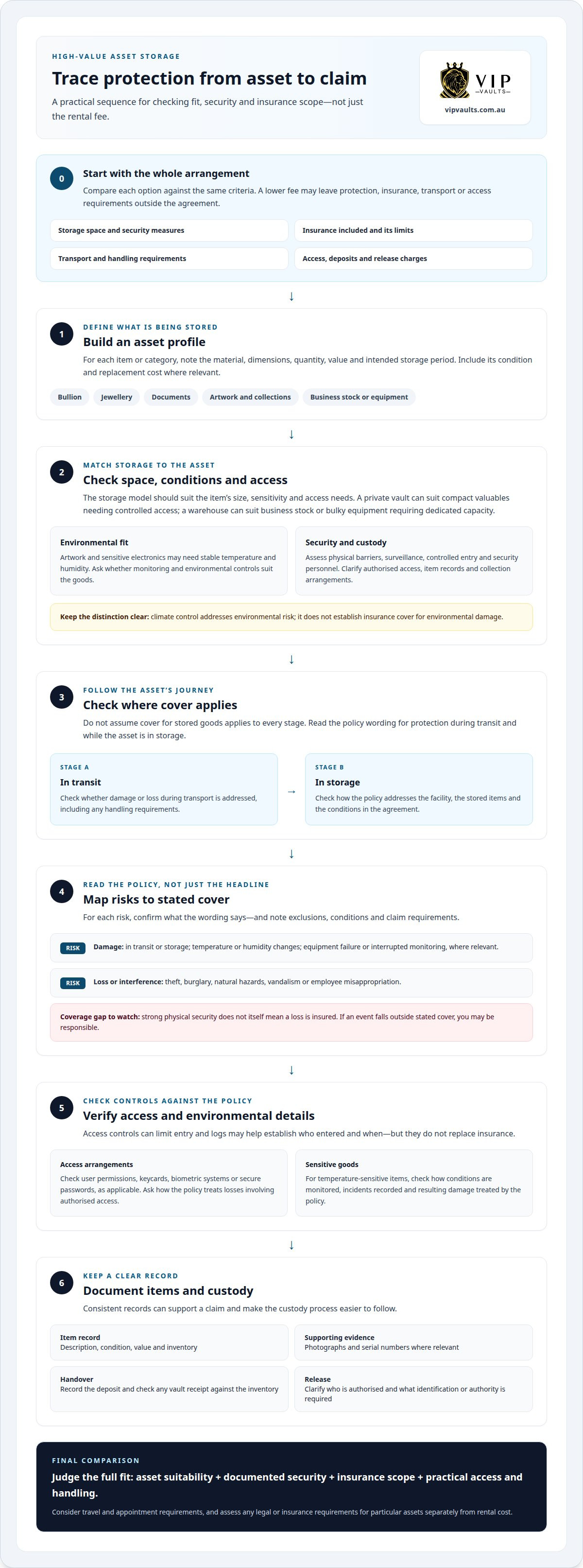
A secure vault is only one part of protecting valuables; insurance terms matter too. When comparing high-value asset storage solutions, check which risks a policy covers, including damage in transit and storage, theft, burglary, natural hazards, vandalism and employee misappropriation. Understand where cover applies and which risks may remain excluded.
Look beyond the headline rental cost. Security measures, insurance arrangements, access conditions and suitability for your assets all affect the value of a storage option. Don’t assume a policy covering stored goods also covers every stage of their journey.
This guide explains how to compare storage costs while accounting for protection, what to examine in facility insurance, and how to match security and environmental conditions to your belongings. It also considers the different needs of bullion, jewellery, documents, collections and business assets, so you can focus on the safeguards that matter.
Key Takeaways
- Compare storage costs alongside the security measures and insurance included, so you can judge the overall value rather than the fee alone.
- Understand which risks a facility’s insurance may cover, including theft, damage, natural hazards and employee misappropriation.
- Match the storage space and environmental conditions to the type, quantity and sensitivities of your assets.
- Document stored items with photographs and serial numbers to help support an insurance claim if something is lost or damaged.
1. High-security storage costs and cost-benefit analysis
Compare high-value asset storage solutions by space, security controls, insurance and handling requirements. Assess each facility against the same criteria rather than comparing rental fees alone. Record whether the quoted cost includes protection, insurance, transport, access arrangements and any deposit or release charges. This makes it easier to spot a lower-priced option that leaves important safeguards out of the agreement. High-security self-storage can offer more space and security features than typical storage units or safety deposit boxes. A standard unit may suit household goods, while bullion or jewellery calls for controlled access and clear custody arrangements.
Compare high-security warehouses with self-storage by matching the storage model to the asset. A warehouse can suit business stock or bulky equipment requiring dedicated capacity; a private vault suits compact valuables needing controlled access. Ask how each option handles item records, authorised access and collection. Include travel and appointment requirements in your cost assessment, because access conditions affect practical value. For temperature-sensitive property, establish whether environmental controls form part of the service or require a different facility.
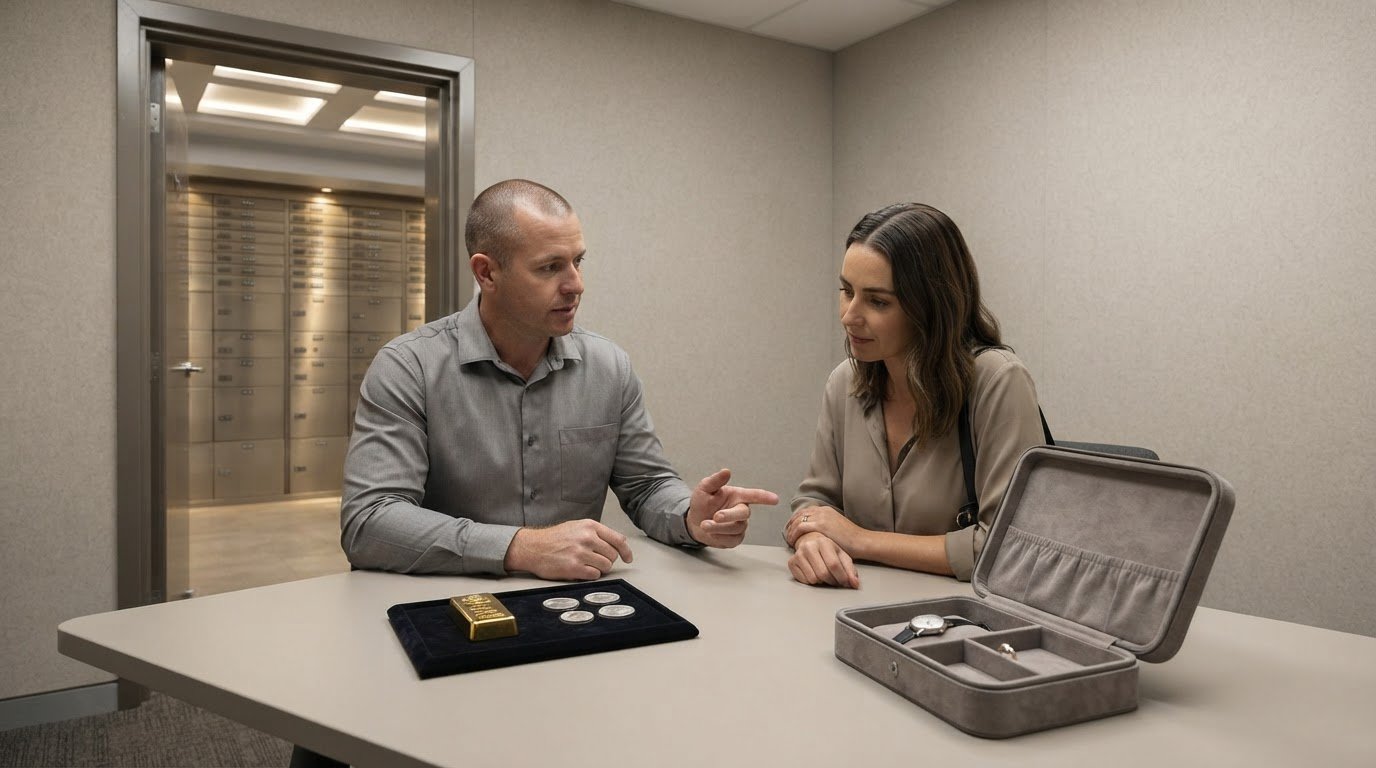
For precious metals, secure transport is part of the protection plan. At handover, document the deposit, identify the items and record who is authorised to arrange their release. A vault receipt can help document custody; check it against the agreed inventory. Clarify the release process for bullion and other valuables, including what identification or authority is required. These steps make the chain of custody easier to follow.
A purpose-built high-security facility may combine physical barriers, surveillance, controlled entry and security personnel. Assess how these measures apply to your assets instead of relying on general claims about security. A small coin collection needs less space than industrial equipment, but both require appropriate access and protection. Compare documented security measures and services alongside price when evaluating high-value asset storage solutions.
For firearms, storage obligations depend on the relevant Australian state or territory. Requirements vary by jurisdiction and circumstances, so don’t assume a general valuables-storage arrangement meets them. Cash, bullion and other valuables may also have different legal or insurance considerations. Assess these separately from rental cost, then consider the full arrangement against the asset’s value, access needs and replacement cost.
2. What risks are covered by the insurance for your high-security storage facility?
Off-site storage places valuables in a facility beyond your direct supervision. The policy wording determines which events are covered and which exclusions or conditions apply. Consider risks such as damage in transit or storage, theft, burglary, natural hazards, vandalism and employee misappropriation. If a loss falls outside the stated cover, you may be responsible even when the facility has strong physical security.
Climate-controlled storage addresses a different risk: deterioration caused by environmental changes. Artwork, electronics and other sensitive goods can be affected by fluctuations in temperature and humidity. Consistent conditions may help reduce that risk, but they don’t establish insurance cover for environmental damage. Match the storage conditions to the item, then examine how the policy treats damage related to temperature, humidity, equipment failure or interrupted monitoring.
For example, temperature-sensitive artwork needs suitable conditions as well as protection against theft. Ask how climate control is monitored, how incidents are recorded and whether the policy addresses resulting damage. A general reference to insured storage doesn’t explain cover for every environmental event. Keep the storage description and asset details consistent across the agreement and insurance documents.
Access control also affects risk. User permissions, keycards, biometric systems or secure passwords can limit entry to authorised people. Access logs may help establish who entered a storage area and when. These controls can reduce opportunities for unauthorised entry, but they don’t replace insurance. Check how the policy treats theft, employee misappropriation and losses involving authorised access, and note any exclusions and claim conditions.
Before depositing expensive or sensitive goods, compare the facility’s cover with the risks the asset faces in storage and transit. Record the item’s description, condition and value, and retain photographs or serial numbers where relevant. Those records can support a claim, while clear policy wording helps define its scope. For jewellery needing dedicated storage, consider secure jewellery storage as part of your assessment.
How a provider assesses the type, quantity, and environmental needs of stored goods
A suitable storage assessment starts with each asset’s material, dimensions, quantity, value and intended storage period. A jewellery collection, a box of documents and a large artwork require different space and handling. These details help determine capacity, access arrangements and suitable conditions. Replacement cost also matters because it helps establish the potential financial impact of loss or damage.
Environmental needs depend on an item’s materials and how they may deteriorate. Artwork and sensitive electronics can require stable temperature and humidity, while bullion needs secure handling and appropriate physical protection. Match each category to suitable storage conditions and monitoring. A facility without the necessary environmental controls may not suit items vulnerable to heat, moisture or fluctuations.
A vulnerability assessment considers the storage location, entry points, security systems and value of the assets. Review how authorised access is controlled, whether it is logged, and whether biometric systems or keycards help restrict entry. The assessment should also cover handling and collection, not just the storage room.
To assess a provider’s security and reputation, examine how its facility controls entry, records access, manages inventory and handles emergencies. Clear procedures for staff training, maintenance and incident response help show how safeguards operate in practice. An itemised inventory, supported by descriptions, photographs or serial numbers, can also make custody records more useful.
A suitability assessment connects each asset’s characteristics with space, environmental conditions and access requirements. Documents may need compact, controlled storage; a rare collection may need a dedicated area; bulky equipment may require warehouse capacity. The facility’s security measures should address the risks identified rather than apply one arrangement to every deposit. This helps ensure the storage conditions suit the goods.
4. Insurance coverage for stored assets
In Australia, the right storage option depends on the asset, its quantity and its risks. A purpose-built vault may suit compact valuables such as bullion or jewellery, while a secure warehouse may better suit business inventory or bulky equipment. Compare physical security, access controls, environmental conditions and insurance together rather than treating storage as a single feature.
Insurance for valuable assets depends on a policy’s covered events, limits, conditions and exclusions. For off-site storage, check whether cover applies during transport and while items are in the facility. Relevant risks may include theft, burglary, natural hazards, vandalism, employee misappropriation and accidental damage. The policy wording determines how each event is covered.
Insurance for stored items isn’t typically included as standard with bank safety deposit boxes. This makes it important to distinguish secure custody from insurance. Surveillance, access records and emergency procedures can support security, but they don’t determine what an insurer will pay after a loss. Climate-sensitive goods also require attention to environmental damage and any policy terms tied to storage conditions.
Accurate records and clear custody processes can support insurance for high-value inventory. An itemised inventory, photographs and serial numbers can help identify goods and support a claim. For example, a business storing equipment can record each item’s description, condition and identifying number. Keep those records aligned with the insured inventory, and document changes when goods are deposited or released.
Assess cover against the asset’s replacement cost, location, transport arrangements and exposure to specific hazards. Business stock may need protection against natural disasters, damage and theft, while jewellery or bullion may need clear descriptions and agreed values. Consider whether the policy is backed by a reputable international reinsurance company, and note exclusions that affect your assets.
For a dedicated option for jewellery, explore secure jewellery storage as part of your storage and insurance assessment.
VIP Vaults & Bullion Exchange Perth: Jewellery Storage
VIP Vaults & Bullion Exchange Perth offers Jewellery Storage for people seeking a dedicated place for valuable pieces they don’t need to keep at home. It’s a relevant next step when your assessment points to compact, high-value items rather than bulky goods or stock requiring warehouse capacity.
For other physical assets, Private Vault Rental and a Bullion Locker provide storage options aligned with private valuables and bullion. Gold Bullion is also available for those considering precious metals alongside their storage needs. These offerings address different requirements, so consider the asset type and how you expect to access it when deciding which is most suitable.
If you’re considering Jewellery Storage or another relevant option, contact VIP Vaults & Bullion Exchange Perth to discuss your needs.
Make your next storage decision with confidence
Treat high-value asset storage solutions as part of an ongoing protection plan, not a decision that ends when you deposit your belongings. As your collection or access needs change, review whether the arrangement still suits your assets and how you use them. A considered choice can provide a suitable place for valuables while keeping your options in view.
For jewellery, Jewellery Storage may suit your needs; Private Vault Rental and a Bullion Locker are options for other holdings. Gold Bullion is also available if you’re considering adding physical bullion to your assets. Choose the offering that matches what you hold rather than expecting one arrangement to suit unrelated needs.
Take the next step at your own pace. Discuss your storage needs with VIP Vaults & Bullion Exchange Perth and consider which option best fits your assets. A clear decision begins with knowing what you want to protect.
Frequently Asked Questions
What risks are covered by the insurance for your high-security storage facility?
Cover depends on the policy wording, insured property and any stated limits or exclusions. A claim may involve theft, burglary, accidental damage or a natural hazard, but the policy sets the terms for each event. Read the schedule alongside the full wording, paying attention to transport, storage, claim evidence and the conditions that apply after an incident.
Why Secure Storage Matters for High-Value Items?
Secure storage helps reduce exposure to unauthorised access, theft and accidental damage by keeping valuables in a controlled location. Recording deposits and releases can also clarify custody. For example, a collector storing rare coins away from home may value restricted access as much as physical protection, particularly if several people could otherwise access the storage area.
What counts as a high-value asset and what storage requirements apply?
A high-value asset is an item whose monetary, operational or personal importance makes loss or damage consequential. Jewellery, bullion, rare collectibles and business-critical equipment can all fit, even though they need different conditions. Requirements depend on the asset’s size, material, sensitivity, replacement cost and any rules applying to its category. A rare stamp collection, for instance, needs different environmental care from metal bullion.
How do home safes, bank safe-deposit boxes and commercial vault storage compare?
A home safe keeps items close, but portable models can be removed and household safes have limited capacity. Bank safety deposit boxes suit compact items, although access follows the bank’s operating hours and insurance usually isn’t included as standard. Commercial vault storage may suit valuables that need dedicated space and controlled entry. Compare capacity, access needs, environmental sensitivity and the protection required.
How much does secure storage for valuables cost in Australia?
There’s no single price for every storage arrangement. Cost depends on the space required, asset type, security and handling needs, storage period, and whether insurance or environmental controls are included. A compact jewellery collection and bulky business equipment have different requirements. Compare the full agreement, including included protection and additional charges, instead of judging value by rental cost alone.
Which Australian companies offer secure storage for jewellery, bullion, art and documents?
VIP Vaults & Bullion Exchange Perth offers Jewellery Storage, Private Vault Rental and Bullion Locker options for jewellery and bullion. These options aren’t designed for every asset category: artwork may need specific environmental conditions, while documents need protection from damage. Match the arrangement to the item’s material, size, preservation needs and access requirements.