
The cheapest gold listing can become the more expensive purchase once it reaches your door. It’s natural to compare advertised prices, but the spot price is only a reference point: the retail price may include a dealer premium, and delivery or payment charges can add to the amount payable. Understanding the hidden costs of buying gold online means looking beyond the figure beside the product.
This guide will help you compare the full cost of buying gold online in Australia before you commit. You’ll learn what to check in the quoted price, shipping and transit insurance terms, payment fees and optional storage arrangements. You’ll also see how product sourcing, seller reliability and potential resale terms can affect ownership, even when they don’t appear on the checkout page.
Use these checks to calculate a more comparable purchase cost, ask informed questions and choose a delivery and storage approach that suits your circumstances. A clear view of the whole transaction can help you make a considered decision, rather than relying on the lowest advertised price alone.
Key Takeaways
- Check the hidden costs of buying gold online by separating the bullion price from checkout charges and costs that may arise during delivery or ownership.
- Compare like-for-like gold products by weight and quoted price, then check whether delivery, transit insurance and packaging are itemised or included.
- Review the seller’s stated sourcing, authenticity process and product documentation before deciding which offer to trust.
- Use a simple pre-checkout record of the product, weight, price, payment charges and delivery terms to make a clearer comparison.
- Consider whether home delivery or optional secure storage better fits your privacy, handling and ownership plans.
Hidden costs of buying gold online: why the displayed price is only the start
You’ve found a gold listing that looks competitively priced, but will that figure match the amount charged at checkout? It’s sensible to check. The hidden costs of buying gold online include more than extra fees: they can also involve trade-offs that affect how easily a purchase can be verified or resold later.
Some costs are explicit, such as charges added to an order. Others are less visible. A product’s provenance, documentation or condition may influence a future buyer’s confidence and the price they’re willing to pay. The comparisons here cover cost categories and practical considerations, not individual sellers or guaranteed purchase or resale outcomes.
What does an online gold quote include?
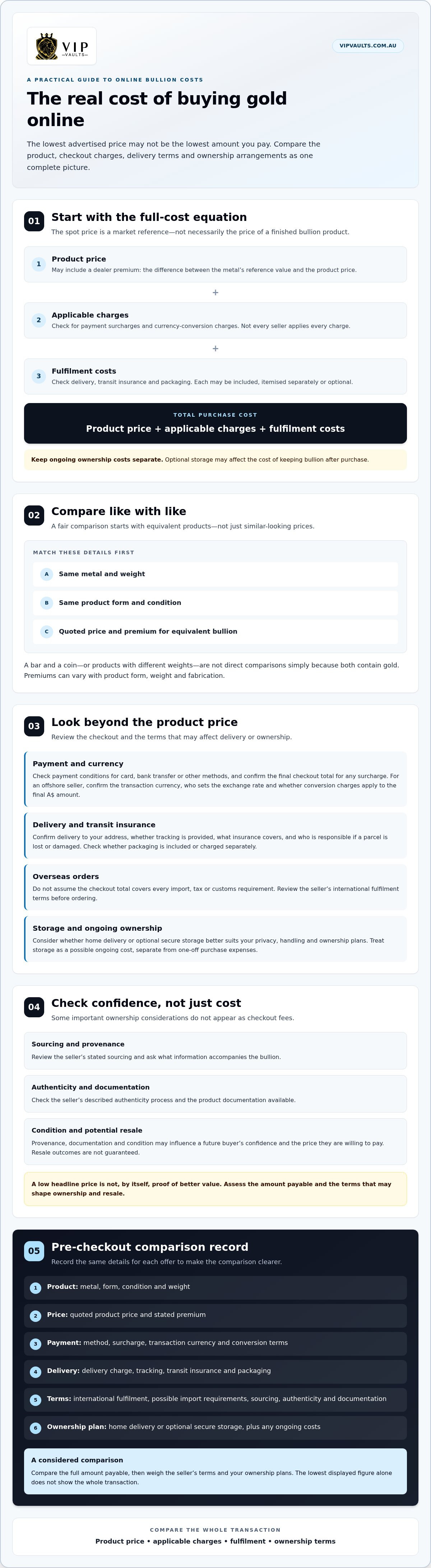
The spot price is a market reference for gold, not necessarily the price you’ll pay for a finished bullion product. A dealer’s quoted price may include a premium, the difference between the metal’s reference value and the product price. That premium can reflect factors such as the product’s form and the costs of making it available for sale.
For a fair comparison, match the details first: the same metal, weight, form and product condition. A bar and a coin, or products with different weights, aren’t direct comparisons just because both contain gold. For broader background on gold as an investment, consider how its different forms and price influences fit your ownership plans.
Why the lowest listed price may not be the lowest total
Use a simple calculation: total purchase cost = product price + applicable charges + fulfilment costs. Check whether the checkout adds payment charges, delivery or transit insurance, or whether any of these are already included. Then consider possible ongoing ownership costs, such as storage, separately from one-off purchase expenses.
A low headline price may also come with trade-offs that aren’t listed as fees. For example, unclear sourcing or limited documentation can make it harder to assess authenticity and may affect resale confidence. Ask what information accompanies the bullion and how the seller describes its authenticity process.
Headline price alone is an incomplete comparison: assess the full amount payable and the terms that may shape ownership and resale. Record the quote and its conditions before ordering. This gives you a consistent basis for comparing offers, without assuming that the lowest displayed figure represents the best value.
Which extra charges can raise the total cost of buying gold online?
Once you’ve identified a suitable product, review the quote line by line. Some charges appear at checkout; others relate to delivery or keeping the bullion after it arrives. Not every seller applies every charge, so use the specific product quote and terms rather than assuming a fee will or won’t apply.
Check whether delivery, transit insurance and packaging are included, itemised separately or optional. A charge described as included may still form part of the total price, while an optional service may change the amount payable if selected. Payment surcharges, currency conversion and international fulfilment terms also deserve attention before you place an order.
Premiums, payment fees and currency conversion
A product’s premium can vary with its form, weight and fabrication. Compare the quoted premium for equivalent bullion rather than treating different formats as interchangeable. Then confirm the payment conditions: a seller may set different terms for card payments, bank transfers or other payment methods. Check the final checkout total for any surcharge.
For an offshore seller, confirm the transaction currency. A price displayed in another currency may be converted by your card provider or payment service, and the exchange rate or conversion charge can affect the final A$ amount. Ask which currency will be charged and who determines the conversion before proceeding.
Delivery, insurance and possible import charges
Read the delivery terms closely. Confirm that the seller will deliver to your address, whether tracking is provided, what transit insurance covers and who is responsible if a parcel is lost or damaged. Check whether packaging is included or attracts a separate charge. Insurance and secure storage can also matter after delivery; Forbes outlines considerations around storage and insurance costs when buying physical gold.
With an overseas order, don’t assume the checkout total accounts for every import, tax or customs requirement. Verify the rules that apply to the product and transaction using current Australian Government guidance before ordering. Australian GST treatment can depend on the specific bullion product and transaction, so confirm it rather than relying on a general statement about gold. Check how GST applies to delivery and insurance charges too.
For a clear comparison, separate costs into three groups: charges at checkout, fulfilment costs for getting the bullion to you, and possible ongoing ownership expenses such as storage. VIP Vaults & Bullion Exchange Perth offers live pricing for precious metals, which can help buyers review a current bullion quote alongside its terms. Explore its gold bullion pricing as one point of comparison, then verify the full costs and conditions for your own order.
How to compare online gold sellers beyond the advertised price
A like-for-like comparison can reveal differences that a headline price hides. Record the details for each offer in a table, and keep optional storage separate from the cost of buying the bullion. This lets you assess the purchase itself first, then decide whether a storage arrangement suits your plans.
| What to compare | What to record or ask |
|---|---|
| Product | Metal, weight, form, condition, refiner and product description |
| Price | Quoted price in A$, quote time, and any stated premium or pricing basis |
| Delivery | Destination, delivery charge, transit insurance, tracking and packaging terms |
| Payment | Accepted methods, any payment surcharge and the currency charged |
| Documentation | What product records are supplied and how the seller explains authenticity checks |
| Storage | Whether storage is optional, and its terms and charges if selected |
For market context, use the Australian gold price reference to understand spot-price movements. Treat spot as a reference, not a direct substitute for a seller’s product quote. Compare quotes taken at a similar time, as market movements can change the underlying reference value.
Product authenticity, provenance and seller transparency
Clear product descriptions should identify the metal, weight and stated refiner, and explain what documentation comes with the bullion. Check how the seller describes its authenticity process rather than relying on a broad assurance alone. Recognised refiners can make provenance easier to assess. LBMA accreditation is a useful point of reference for a refiner’s recognition in the bullion market, but it doesn’t guarantee investment returns or a particular resale price. VIP Vaults & Bullion Exchange Perth states that its bullion is sourced from internationally recognised refiners, including LBMA-accredited manufacturers and government-backed sovereign mints.
Gold bars or coins: compare equivalent products
Compare bars with bars, and coins with coins, matching weight and product condition before judging the quoted premium. Bars and coins can have different product-specific premiums and resale conditions, so a lower quote for one format doesn’t automatically make it the better comparison. For more detail on the differences, read this guide to gold coins versus gold bars.
Finally, assess storage as a separate ownership choice. Compare its terms independently rather than treating it as a compulsory purchase charge. A disciplined comparison of product, provenance and transaction conditions helps make the hidden costs of buying gold online easier to identify before you decide.
A practical checklist for calculating the full cost before checkout
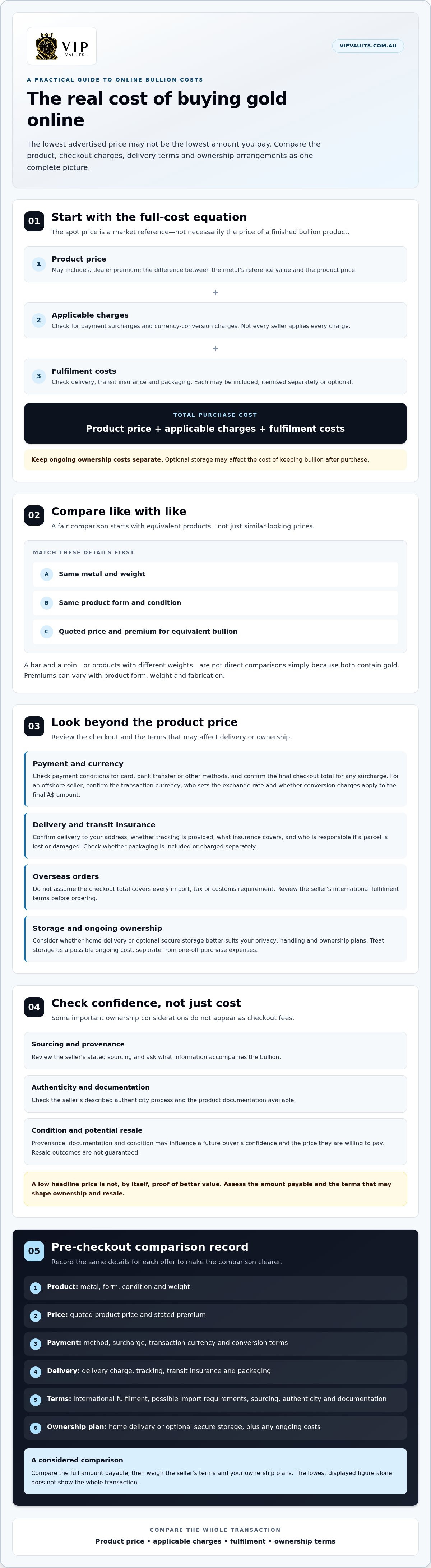
Before placing an order, build a clear record of the amount payable and the arrangements that will affect ownership. This process helps turn a product page into a comparison you can review calmly, without relying on a search result or spot-price headline.
- 1. Identify the exact product. Record the metal, product form, weight, condition and stated refiner. Use the same specifications when comparing other sellers.
- 2. Capture the current quote. Note the quoted price in A$, when it was provided and how long it remains valid. Save the product page or quote with its terms.
- 3. Check payment conditions. Confirm the amount for your chosen payment method, including any stated surcharge. If the seller is offshore, verify the transaction currency and possible conversion charges.
- 4. Add fulfilment charges. Check delivery to your address, packaging, tracking and transit insurance. Add each applicable charge to the product price, and verify any relevant tax or import costs using current guidance.
- 5. Compare the final totals. Keep the quotes and terms for equivalent products side by side. If a charge is unclear or not shown, ask the seller to confirm whether it applies before ordering.
This gives you a practical estimate of the purchase cost: product price + applicable payment charges + delivery and insurance + verified tax or import charges. Don’t count optional storage as a checkout fee unless you’ve chosen it. Record it separately as a possible ongoing ownership cost.
Include storage and the eventual exit
Decide whether you intend to store the bullion at home or use a specialist provider. Check storage charges, access arrangements and insurance terms directly, and don’t assume a storage service or home policy includes cover for bullion. Include any storage cost in your ownership comparison only if it applies to your plan.
Consider resale before buying, too. Ask how the seller describes its buyback process, what conditions apply and how its resale price relates to the market price. The difference between a purchase price and a potential resale price may affect your eventual return, but no seller can guarantee what gold will be worth when you sell.
These checks make the hidden costs of buying gold online easier to identify before checkout. If you’re weighing up bullion and optional storage, review gold bullion and storage options as part of your comparison.
Choose a gold-buying option that fits your ownership plans
The right purchase route depends on what you want to happen after checkout. If you prefer to take possession of physical bullion, online delivery may suit, provided the delivery arrangements and your intended storage are clear. If you’d rather consider the purchase and storage together, a specialist bullion seller that also offers secure storage may be worth comparing.
Neither option is automatically cheaper or more suitable. Include delivery, insurance and any optional storage charges in your comparison, then weigh those costs against your preferences for privacy, handling and access. The aim is to choose arrangements that fit your circumstances, not simply to minimise the amount shown at checkout.
When delivered bullion may suit your plans
Taking delivery gives you physical possession, leaving you to arrange storage. Before ordering, check how the parcel is protected in transit, whether insurance applies and what happens if it’s lost or damaged. Once the bullion arrives, consider where you’ll keep it and check whether your insurance policy covers bullion, as cover and exclusions can vary. Home storage may suit some buyers, but assess its security and insurance on your own terms rather than assuming it’s right or wrong for everyone.
Also consider whether you’re comfortable managing the delivery and subsequent storage yourself. Those practical responsibilities form part of ownership, even if they don’t appear as a separate charge on the product page.
When specialist bullion sales and vault storage may be worth considering
Buying bullion from a specialist that also offers storage can make it easier to assess the purchase and a potential storage arrangement in one place. It doesn’t mean storage is compulsory, or that this route will be the lowest-cost choice. Compare the product quote and storage terms separately, and check what each arrangement includes.
VIP Vaults & Bullion Exchange sells gold and silver bullion sourced from internationally recognised refiners, including LBMA-accredited manufacturers and The Perth Mint. It also offers private vault rentals and bullion lockers. These are options to consider alongside other sellers and storage arrangements, not a universal recommendation.
If secure storage is part of your ownership plan, read this guide to private vaults in Australia and review the terms that apply to your needs. A careful comparison helps put the hidden costs of buying gold online into context, including expenses that may continue after purchase. To review bullion and secure storage options, visit Explore bullion and secure storage options.
Make your next gold purchase with clarity
A confident buying decision starts with the full ownership picture, not just the advertised price. Compare equivalent bullion products and account for applicable payment and delivery charges before checkout. Then assess the seller’s sourcing and documentation, and consider how storage and possible resale terms fit your plans.
The hidden costs of buying gold online can include charges payable now and trade-offs that matter later. A simple written comparison helps you see what’s included, identify questions to resolve and choose between delivery and optional secure storage with greater confidence.
VIP Vaults & Bullion Exchange offers live precious-metal pricing and bullion sourced from internationally recognised and LBMA-accredited refiners. Buyers can also consider private vault or bullion locker storage as part of their ownership arrangements. Explore the available options at Explore bullion and secure storage options.
Take the time to check each term and choose the approach that suits your circumstances. To compare bullion pricing and optional secure storage, explore the available options.
Frequently Asked Questions
What are the hidden costs of buying gold online?
The hidden costs of buying gold online can include charges beyond the bullion quote and trade-offs that may affect later resale. Check for a product premium, payment surcharge, delivery, transit insurance and packaging charges. If you plan to store the gold, include any applicable storage costs in your ownership budget. For overseas orders, verify currency conversion and any relevant import or tax costs before committing.
Is the spot price the price I pay for gold online?
No. The spot price is a market reference, while the seller’s product quote is the amount to compare when assessing a purchase. A bullion product may be priced above the reference value because its form, weight and fabrication can affect its premium. Prices can also move with the market, so check when the quote was issued and whether it remains valid before ordering.
How can I compare the full cost of gold from different online sellers?
Compare equivalent products and use the final checkout quote, not just a search result. Record the metal, weight, form, condition, quoted price in A$, payment method, delivery terms and any insurance charges. Ask about unclear fees and save the quote and conditions. Compare optional storage separately from purchase costs, and verify tax or import charges that apply to your particular product and transaction.
Can buying gold from an overseas website add extra charges in Australia?
Yes, it can, although the charges depend on the seller, product and transaction. An overseas order may involve currency conversion, international delivery, transit insurance or applicable import, customs and tax costs. Before paying, confirm the charge currency and who handles fulfilment, then check current Australian Government guidance for relevant requirements. Verify GST treatment for the specific bullion product and transaction rather than relying on a general assumption.
Does online gold bullion include delivery insurance?
Not necessarily. Check the seller’s delivery terms to establish whether transit insurance is included, optional or unavailable for your order. Confirm what it covers, the delivery destination, tracking arrangements and who is responsible if a parcel is lost or damaged. Don’t assume that discreet packaging means an order is insured. If the terms aren’t clear, request written confirmation before placing the order.
Are storage and resale costs part of the cost of buying gold?
They can be part of the broader cost of ownership, even if they aren’t charged at checkout. Storage is optional, but if you use a provider, check its charges, access arrangements and insurance terms. Resale can also affect your outcome: ask how a seller’s buyback process works and compare its stated buying and selling terms. Future gold prices and resale proceeds aren’t guaranteed.
How do I check whether an online gold seller is reputable?
Review the seller’s business details, product descriptions, pricing terms and delivery conditions. Look for clear information about the bullion’s refiner, provenance, accompanying documentation and the seller’s stated authenticity process. Sourcing from internationally recognised refiners, including LBMA-accredited manufacturers, can help you assess provenance, but accreditation doesn’t guarantee investment returns. Check how the seller responds to questions, and resolve gaps in the information before paying.