
Gold isn’t a reliable month-by-month tracker of grocery bills, rent or power costs. Hedging against inflation with gold is better understood as a possible long-term way to diversify purchasing-power risk, not a guaranteed return. Its price can fall even while inflation rises.
If you’re weighing gold against the rising cost of living, that uncertainty matters. Australian investors also need to consider how global gold prices translate into Australian dollars, how interest rates can affect demand, and the risks and responsibilities of owning a physical asset. Start by deciding what role gold might play in your wider financial plan, rather than assuming it will move in step with the Consumer Price Index.
This guide explains when gold may help preserve purchasing power, what can weaken its inflation-hedging role, and how to assess physical bullion in an Australian portfolio. It also covers how to approach buying and storage together, including the relevance of recognised refiners and a secure storage plan. The aim is to help you decide whether physical gold fits your long-term plans, without treating it as protection from every market shift.
Key Takeaways
- Assess hedging against inflation with gold over a relevant time horizon, rather than expecting it to track Australian CPI each year.
- Consider how real interest rates, investor demand and movements in the Australian dollar can influence gold’s price in A$.
- Compare physical bullion, gold funds and cash by ownership, price exposure, liquidity and storage needs.
- Set your objective and timeframe before deciding how much gold exposure, if any, suits your broader plans.
- If considering physical gold, weigh the purchase decision alongside storage, including bullion sourced from recognised refiners.
Can gold hedge against inflation? Start with what a hedge really means
An inflation hedge is an asset that may help preserve purchasing power over a relevant period. The word “may” matters. A useful hedge doesn’t necessarily rise whenever the Consumer Price Index (CPI) does. It should be assessed over a chosen time horizon, and its performance can vary along the way.
Consider a household whose usual shopping basket costs more over time. If an investment’s value rises, compare that change with the increase in the basket’s cost. A higher nominal price doesn’t automatically mean greater purchasing power: after inflation, the real return may be small, unchanged or negative. When assessing hedging against inflation with gold, compare its return over the relevant period with the change in the cost of living, rather than focusing only on whether its price rose.
What does hedging against inflation with gold mean?
Set a timeframe that matches your concern. A brief period of rising prices and a longer stretch of inflation are different tests. Gold could lose value over a short interval, even if it performs differently over a much longer one. Ask whether its return, after inflation and relevant ownership costs, could support your objective over the period you have chosen.
Why gold is not a guaranteed inflation tracker
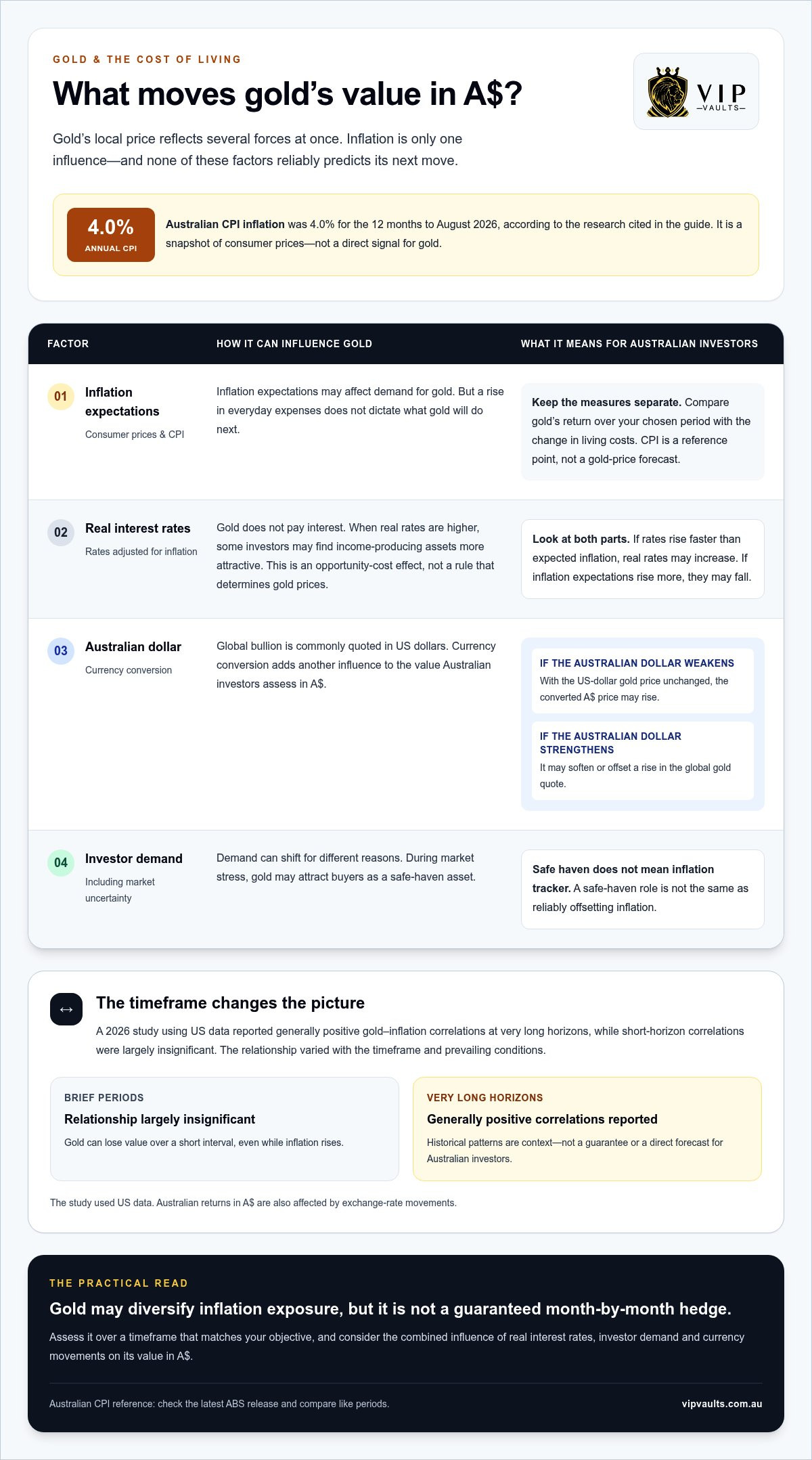
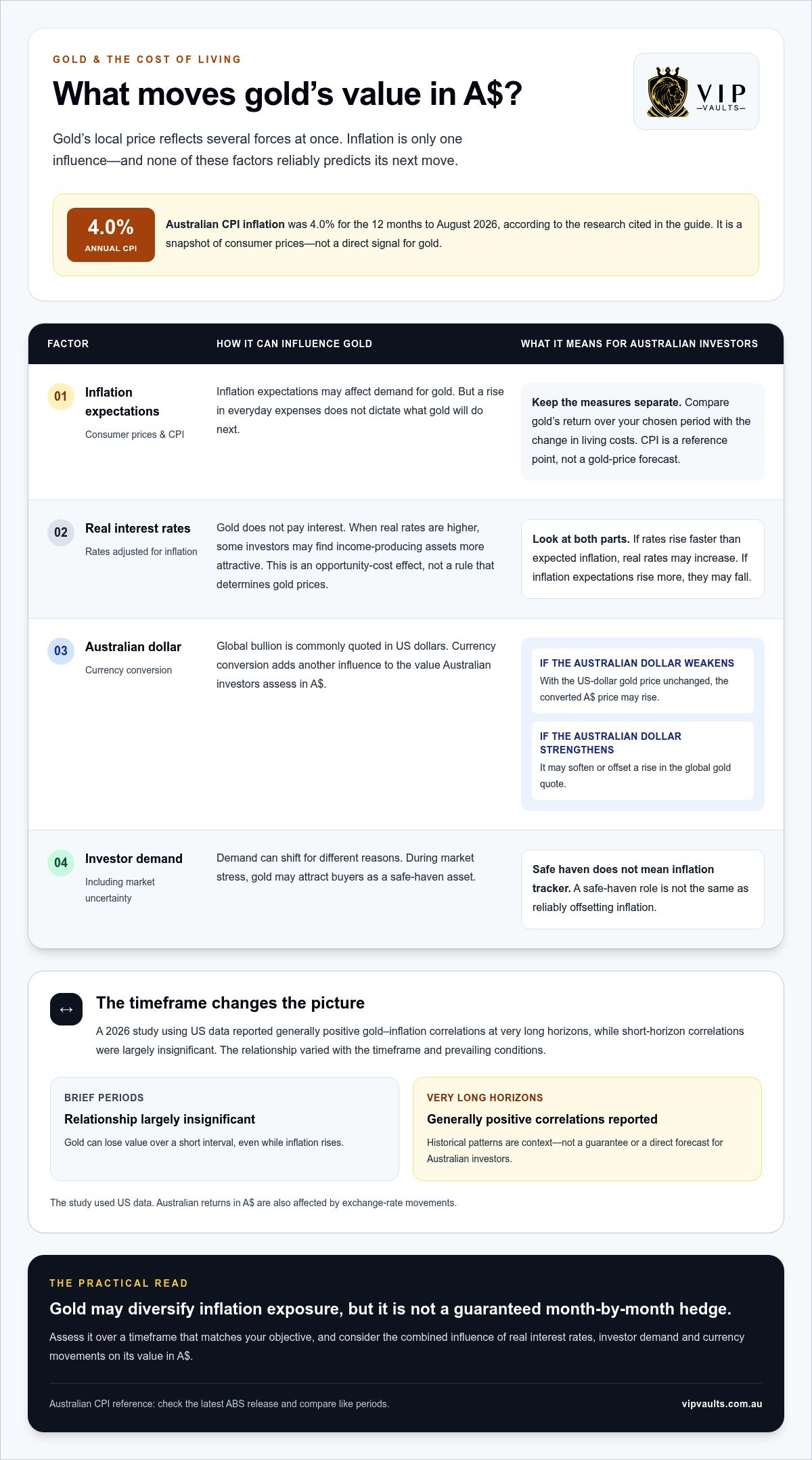
Consumer prices are only one influence on gold. Investor demand, interest rates, currency movements and market uncertainty can all affect its price. A rise in everyday expenses doesn’t dictate what gold will do next. A safe-haven asset may attract buyers during market stress, but that role is not the same as reliably offsetting inflation.
A 2026 study using US data reports a relationship that changes with the time horizon and prevailing conditions. Its findings indicate generally positive correlations at very long horizons, while short-horizon correlations are largely insignificant. In plain English, the association may be more apparent over extended periods than over brief ones, but it isn’t consistent across every timeframe. The US data also cannot be treated as a direct forecast for Australian investors, whose returns in A$ are affected by exchange-rate movements as well as global gold prices.
That distinction is central: gold can diversify inflation exposure, but its price can fall while inflation rises. Historical patterns describe what happened in the data examined. They don’t guarantee a repeat or establish what’s suitable for an individual portfolio. A broader overview of gold’s investment characteristics is available in Gold as an investment, but past relationships are context, not a personal recommendation.
For an Australian investor, the practical test is twofold: consider whether gold has a role across your intended holding period, then assess the risks that could affect its value in A$. Treat short-term price movements separately from the longer-term question of purchasing power. This keeps an inflation-hedging objective grounded in a defined timeframe, rather than an expectation that gold will mirror CPI from year to year.
How inflation, interest rates and the Australian dollar influence gold
Gold’s Australian-dollar price reflects several forces at once. Inflation expectations may affect demand, while interest rates influence the appeal of assets that pay income. Investor demand can also shift for other reasons, including market uncertainty. These factors interact, and no single indicator reliably explains or predicts gold’s next move.
For an Australian inflation reference, use Australian Bureau of Statistics (ABS) Consumer Price Index (CPI) releases. The research available for this guide reports annual CPI inflation of 4.0% for the 12 months to August 2026. That figure is a snapshot of consumer prices, not a direct signal for gold. When using current figures, check the latest ABS release and compare like periods.
Why real interest rates can matter to gold
A nominal interest rate is the stated rate before accounting for inflation. A real interest rate adjusts that rate for inflation, giving a clearer sense of how much purchasing power interest may add. Gold doesn’t pay interest, so some investors may find income-producing assets more attractive when real rates are higher. This is an opportunity-cost effect, not a rule that determines gold prices.
Inflation expectations and nominal rates can move together, but not always by the same amount. If rates rise faster than expected inflation, real rates may increase; if inflation expectations rise more, they may fall. The 2026 study discussed above uses US data and finds that observed gold-inflation relationships vary across interest-rate regimes. Treat this as historical context, not a forecast for Australia: rate settings, inflation and investor behaviour can differ between markets.
Why Australian-dollar gold performance can differ
Global bullion is commonly quoted in US dollars, while Australian investors often assess value in A$. Currency conversion means the Australian dollar can amplify or offset a change in the global gold price. As a result, AUD gold returns can differ from the US-dollar gold price because currency movements add another influence to the local value.
For example, if the US-dollar gold price stays unchanged but the Australian dollar weakens against the US dollar, the converted price in A$ may rise. If the Australian dollar strengthens, it may soften or offset a rise in the global quote. These are simplified illustrations, not predictions. Actual bullion pricing can also reflect market pricing arrangements, so currency movements alone won’t explain every change.
To interpret a local price, look at both the global bullion movement and the exchange rate over the same period. If you’re considering physical bullion, explore gold bullion and storage options as part of the same ownership decision. This doesn’t remove price risk, but it helps frame hedging against inflation with gold in terms relevant to an Australian portfolio.
Physical gold, gold funds and cash: compare the trade-offs
There’s more than one way to gain exposure to gold, and each route involves a different kind of ownership and risk. Physical bullion is a tangible asset held directly. A fund provides exposure through a financial product with its own structure, while a derivative is a contract whose value is linked to an underlying price. Cash serves a different purpose. To compare these options for hedging against inflation with gold, look beyond price movements to access, liquidity and practical responsibilities.
What physical bullion changes for an investor
Buying investment-grade gold bars or coins means owning the metal itself. That brings decisions a fund holder doesn’t face in the same way: how to store and safeguard the bullion, how to handle it, and how to arrange a sale when needed. Resale value may depend on prevailing market prices and the terms of the transaction, so ownership doesn’t remove price or liquidity risk.
Format is another practical consideration. Bars and coins can differ in handling and resale considerations, so assess which form fits your ownership plans. VIP Vaults & Bullion Exchange Perth offers gold bullion sourced from internationally recognised refiners, including LBMA-accredited manufacturers. Recognised sourcing is relevant to the purchase decision, but it isn’t a promise of performance. The gold coins versus bars comparison explores format-specific considerations.
How to compare gold with cash and market-based exposure
Cash is generally accessible for spending or meeting near-term needs. Money in an interest-bearing account may earn income, while physical gold doesn’t pay interest. Gold’s value can fluctuate, and turning bullion into cash involves a sale. Funds and derivatives may be easier to trade through financial markets, but their terms, fees, risks and exposure depend on their particular structure.
- Physical bullion: Direct ownership of bars or coins, with storage, handling and resale to plan for.
- Gold funds: Market-based exposure through a fund structure, not personal ownership of the bullion itself. Review how the fund operates and what risks or fees apply.
- Derivatives: Contractual exposure to price movements, which can involve distinct risks and isn’t equivalent to holding metal.
- Cash: Readily usable for expenses, with potential interest income if held in an interest-bearing account, but no direct gold-price exposure.
No option is a universal winner. Your choice depends on whether your priority is tangible ownership, market access, income, liquidity or a defined role within your wider plans. If you’re considering physical ownership, make storage part of the decision, not an afterthought. VIP Vaults & Bullion Exchange Perth offers bullion lockers and private vault rentals for precious metals. Explore physical gold and storage options to consider the practical side of ownership.
A practical checklist for assessing gold as an inflation hedge
Before considering a physical purchase, work through a clear sequence. It helps separate your reason for holding gold from the practical demands and risks of ownership. Use this checklist to assess whether hedging against inflation with gold fits your circumstances, rather than starting with an assumed allocation or expected return.
- Define the concern. Identify what you want to address. Is your main aim to diversify your assets, own a tangible store of value, or respond to concern about future living costs? A precise objective makes it easier to judge whether gold is relevant and what would count as meeting that objective.
- Set a time horizon. Decide how long you could hold the asset and when you might need the money. Gold prices can fluctuate, so funds needed soon for rent, bills or another planned expense may not suit an asset whose value could change before you sell. Consider whether you could tolerate a fall during your intended holding period.
- Assess your existing exposure. Look at your broader financial circumstances, including other assets, cash needs and any existing exposure to gold. Consider how a change in gold’s value might affect your overall position, rather than assessing the metal in isolation. There’s no single allocation that suits everyone.
- Consider ownership. If you’re considering physical bullion, account for the responsibilities of owning bars or coins, including handling and the process of selling. Compare your objective with possible price volatility and opportunity cost: unlike an interest-bearing asset, physical gold doesn’t provide income while you hold it.
- Review storage and verification. Consider where bullion would be kept and how you would maintain confidence in its authenticity. Refiner recognition is relevant to assessing a purchase. VIP Vaults sources bullion from internationally recognised refiners, including The Perth Mint and LBMA-accredited manufacturers. Storage is a practical ownership decision, not a guarantee of value or performance.
Keep the checklist personal. The right decision depends on your goals, timeframe, financial position and ability to accept price movements. If you’re unsure how an investment fits your circumstances, or need to understand tax implications, consider advice from an appropriately licensed financial adviser or a qualified tax professional. SMSF trustees researching specific requirements can explore this SMSF gold storage guide as a starting point, rather than assuming the same considerations apply to every investor.
Once you’ve considered your objective, timeframe and storage plan, you can make a more informed assessment of physical ownership. Explore physical gold bullion as one possible option, without treating it as a guaranteed response to inflation or a substitute for a broader financial plan.
Buying and storing physical gold: a considered next step
Gold may have a place as a diversifier, but it isn’t a guaranteed solution to inflation. If you’re considering physical bullion, approach the decision in two parts: whether ownership supports your purpose, and how you’ll store the asset. Hedging against inflation with gold still involves market risk, and a considered purchase doesn’t assure a particular outcome.
What to understand before purchasing bullion
Begin with your investment purpose and the period you expect to hold the bullion. Ask whether you could tolerate a fall in market value during that time, and whether you might need to sell to meet a planned expense. Physical ownership differs from indirect exposure through a fund or another market-based product: with bullion, you own the metal and take responsibility for its storage and eventual sale.
Bullion pricing is linked to global markets, so its value can change. Before buying, understand how the quoted price relates to the market and consider the practical steps involved in resale. VIP Vaults offers investment-grade gold bars and coins sourced from internationally recognised refiners, including The Perth Mint and LBMA-accredited manufacturers. Refiner recognition can inform your assessment of the bullion’s source, but it doesn’t predict future performance or remove price risk.
How storage fits into physical ownership
Storage is part of the ownership decision, not a detail to leave until later. Consider how you intend to safeguard the bullion and how your storage choice fits your circumstances. VIP Vaults offers private vault rentals and bullion lockers for precious metals. These are practical storage options, not a guarantee of investment value or a promise about future returns.
Keep your purchase records and bullion details organised so you can refer to them when reviewing your holdings or considering a sale. If you’re weighing physical ownership against indirect exposure, include storage and handling in the comparison, alongside price movements and access to your investment. A clear plan helps you understand the responsibilities involved before committing.
The decision comes down to fit: your purpose, time horizon, tolerance for changing market value and storage plan should make sense together. If physical bullion aligns with those considerations, explore bullion and secure storage as a considered next step, without assuming gold will track inflation or deliver a particular return.
Make your next step a considered one
A sound decision starts with clarity about what you want your assets to do and what responsibilities you’re prepared to take on. If you’re considering hedging against inflation with gold, treat it as one possible part of a broader plan, not a promise that your purchasing power will be preserved. Take time to weigh physical ownership against your needs and circumstances.
For those who decide bullion is worth exploring, the source and storage plan matter alongside the purchase. VIP Vaults offers investment-grade gold bullion sourced from recognised refiners, including The Perth Mint and LBMA-accredited manufacturers. Private vault rentals and bullion lockers are available for precious metals and jewellery, providing practical options to consider as part of physical ownership.
Take the next step at your own pace. Explore investment-grade gold bullion and secure storage to consider whether physical gold aligns with your plans. A measured decision can help you move forward with greater confidence.
Frequently Asked Questions
Does gold pay interest or dividends?
No. Gold bullion doesn’t itself pay interest or dividends; any potential gain depends on its market value when you sell, and ownership may involve storage costs. That makes it different from an investment designed to provide income. If you rely on regular income to meet expenses, consider how bullion would fit alongside those needs. A possible role in hedging against inflation with gold is separate from earning income, and won’t suit every investor.
Can gold lose value while inflation is rising?
Yes. Gold can fall in value or stay flat during a period when consumer prices increase. The relationship can shift with market conditions, including interest rates and currency movements, and across different time horizons. If you may need to sell during a particular period, the sale value could be lower than your purchase cost, even as household expenses rise. Gold doesn’t guarantee an offset to inflation or protect against every investment loss.
How much gold should I hold to hedge against inflation?
There’s no single allocation that suits everyone. Your circumstances, objectives, investment timeframe, cash requirements and comfort with price fluctuations all matter. Consider how a change in gold’s value could affect your overall portfolio, including whether you could meet near-term expenses without selling it. Avoid treating a general percentage as a personal recommendation. If you need guidance tailored to your situation, speak with a licensed financial adviser who can consider your broader position.
Is physical gold better than a gold ETF for inflation protection?
Neither is universally better, and neither guarantees an inflation-adjusted return. Physical bullion means direct ownership, with responsibilities such as storage and arranging a sale. An ETF is a financial product with its own structure and may provide exposure to gold without you personally possessing bullion. Before comparing them, consider how you would access or sell your holding, what costs and risks apply, and whether direct ownership matters to you.
Can an SMSF invest in physical gold in Australia?
An SMSF may invest in physical gold only if the decision complies with the fund’s governing rules and applicable superannuation requirements. Don’t assume a particular storage arrangement satisfies those obligations. Trustees should obtain advice from appropriately qualified SMSF professionals who can assess the fund’s circumstances and record-keeping needs. For further background on storage considerations, see the SMSF gold storage guide.
Is gold bullion subject to GST in Australia?
GST treatment depends on the product and whether it meets the relevant definition of precious metal under Australian tax law. Don’t assume every gold item receives the same treatment. Before purchasing, check current Australian Taxation Office guidance for the specific product you’re considering, and seek advice from a qualified tax professional if the treatment affects your decision. This answer is general information, not tax advice for your circumstances.
What is the difference between an inflation hedge and a safe haven?
An inflation hedge is assessed by whether it may help maintain purchasing power over a period of rising prices. A safe haven is an asset investors may seek during market stress. Gold can be discussed in both roles, but they describe different concerns. An investor worried about market disruption may have a different objective from one focused on living costs. Neither label means gold’s price will always rise in those circumstances.