The gold spot price is a benchmark, not the full price of a physical bar or coin. Understanding the gold spot price versus its premium means separating the market value of the metal from the extra amount added to make, package and distribute a bullion product. In Australia, the AUD/USD exchange rate also affects how global gold prices translate into local value.
It’s easy to assume a rising spot price explains every change in a bullion price. The product’s premium matters too: it can vary with its size, form, production and availability, even when the spot price is steady.
This guide explains what the spot price measures, why it moves during global trading and what a premium covers. It also compares gold and silver premiums, helping you understand how the value of raw metal relates to the price of physical bullion.
Key Takeaways
- Separate the value of the gold itself from the finished bullion product to understand what contributes to its retail price.
- Recognise how global market forces and currency movements can shape Australian gold prices from day to day.
- Compare gold and silver premiums by considering product size and form, not just the metal’s quoted value.
- Use the spot price as a reference point when considering physical bullion and how you intend to hold it.
What Is the Gold Spot Price?
The gold spot price is the current market price for gold intended for immediate settlement. It’s commonly quoted per troy ounce of pure gold, with one troy ounce equal to 31.1035 grams. A per-gram figure can be calculated from that benchmark, helping compare the metal’s value across different bar sizes.
The spot price isn’t the retail price of a finished bullion product. A physical bar or coin sells for more than the spot value of its gold. That premium can reflect refining, minting or casting, packaging, transport and dealer operating costs. Certification and secure packaging may also contribute. In other words, the premium is the difference between the product’s price and the spot value of its precious metal.
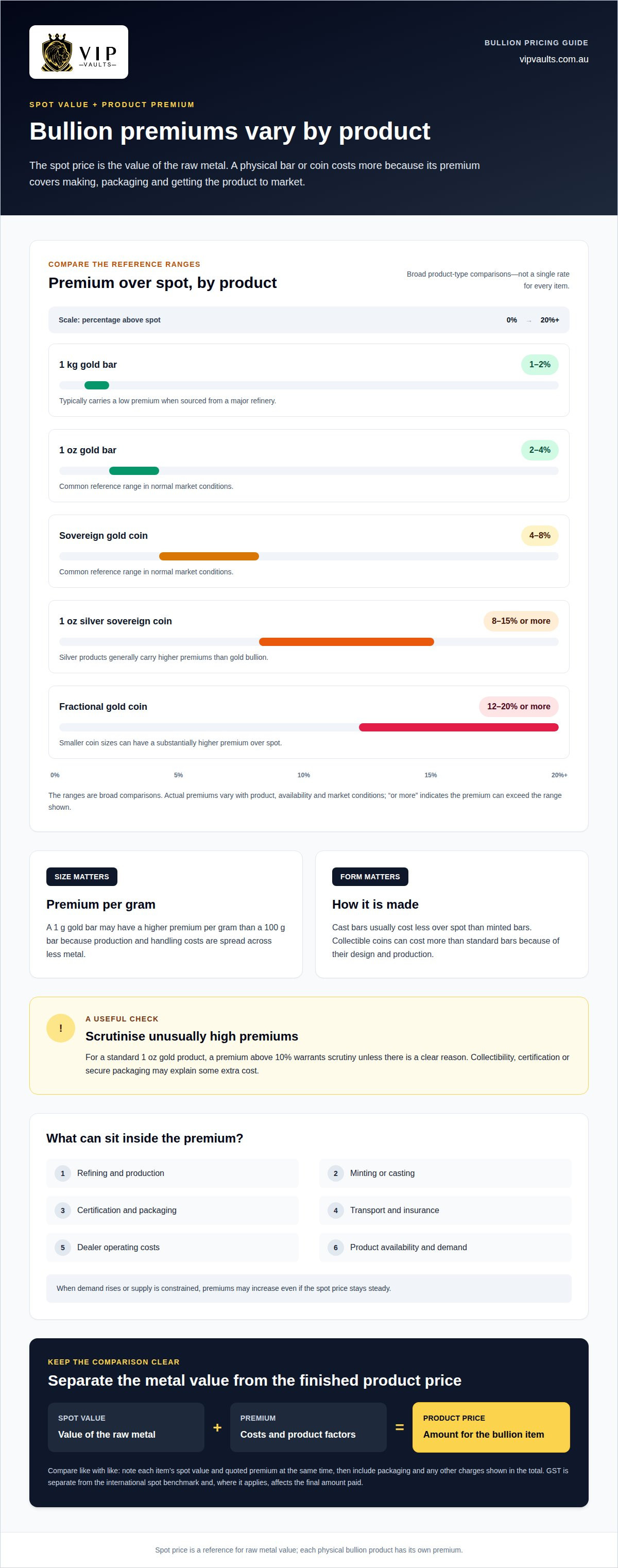
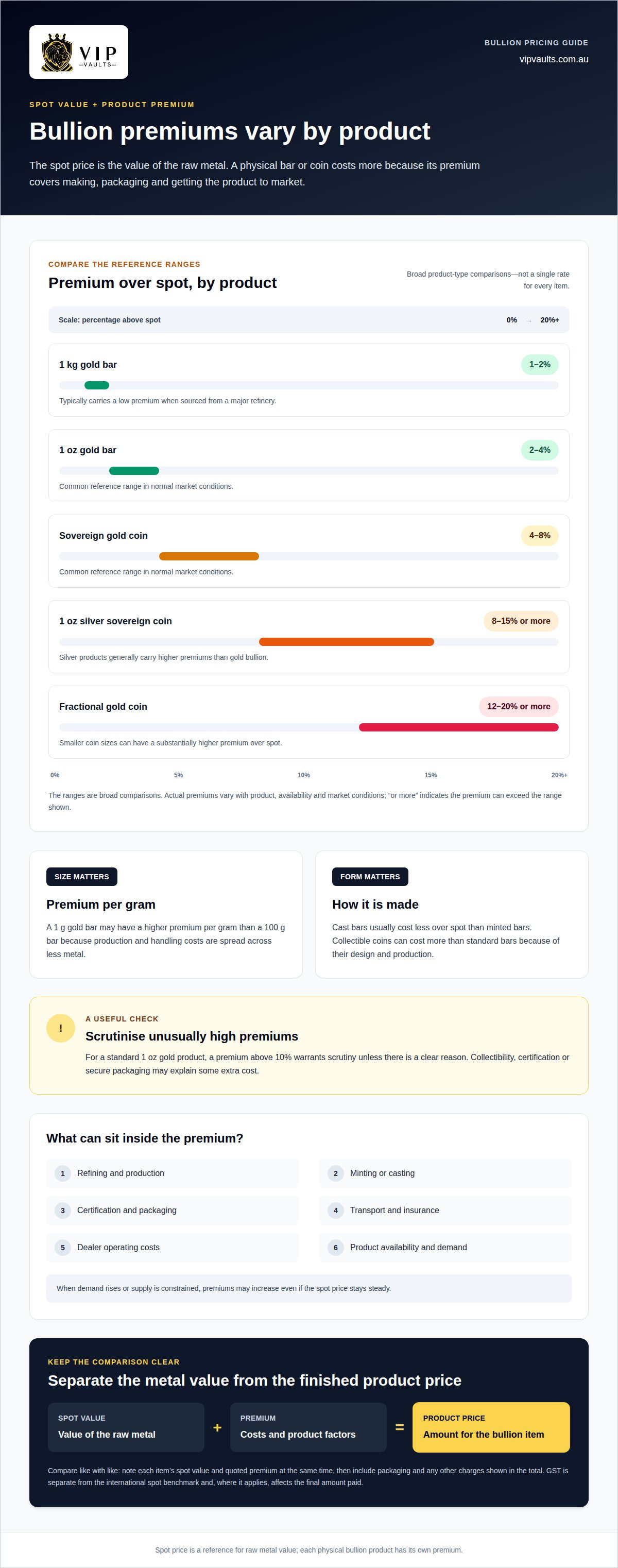
For Australian buyers, common reference ranges in normal market conditions are 2-4% over spot for 1 oz gold bars, 4-8% for sovereign gold coins, and 12-20% or more for fractional gold coins. A 1 kg gold bar from a major refinery typically carries a 1-2% premium. These are broad product-type comparisons, not a single rate for every item.
Product size and production method help explain the difference. A 1 g gold bar may carry a higher premium per gram than a 100 g bar because handling and production costs are spread across less metal. Cast bars usually cost less over spot than minted bars, while collectible coins can carry more than standard bars because of their design and production.
Gold and silver use the same spot-price concept, but their prices are quoted separately, commonly in US dollars per troy ounce. Retail premiums vary by product and market conditions. Silver products generally carry higher premiums than gold bullion, so buying gold and silver at the same percentage premium doesn’t mean paying the same amount. Spot reflects the raw metal’s value; the premium reflects the finished product and its route to market.
Factors that influence daily gold prices
Gold’s market price changes as buyers and sellers respond to new information. Trading on major markets, including COMEX and the LBMA, helps establish spot prices. Demand may strengthen when investors seek a safe-haven asset during geopolitical uncertainty. Shifts in inflation expectations, interest rates or central bank policies can also alter demand and influence prices.
Currency movements add another factor. Gold is commonly quoted in US dollars, so changes in the AUD/USD exchange rate affect its Australian-dollar equivalent. If the US-dollar gold price holds steady while the Australian dollar weakens, the translated local value rises. A stronger Australian dollar can have the opposite effect. As a result, Australian buyers may see local prices change even when the US-dollar quote does not.
Gold and silver both respond to trading, currency movements and investor demand, but each has its own balance of supply and demand. Central bank activity is relevant to gold, while silver’s industrial uses also contribute to demand. Geopolitical events and changing interest-rate expectations can influence both metals, though not necessarily by the same amount or in the same direction.
Premiums move for different reasons than spot prices. Refining, manufacturing, minting or casting, certification, packaging, transport and insurance can all contribute to a bullion product’s premium, along with dealer operating costs. When demand rises or supply is constrained, premiums may increase even if spot stays steady. Product availability and refinery costs can also affect the gap between spot and a dealer’s selling price.
For Australian buyers, the AUD/USD rate affects how a global gold quote translates into Australian dollars. GST is separate from the international spot benchmark. Where GST applies to a transaction, it affects the final amount paid, not the underlying market price of gold.
Gold and silver premium comparison
Gold and silver premiums vary by product, so compare like with like. Assess the metal value, premium and total amount paid separately.
Comparing Gold Bar Prices
When comparing gold bar prices, measure each bar’s premium against its spot value, not just its total price. Match the metal, weight and product form, then compare the premium as a percentage of spot. A larger bar often has a lower premium per gram than a smaller one. This helps you see whether a price difference reflects the weight or the product’s additional costs.
Bullion Value and High Premium Risks
Bullion value comparison separates the value of the metal from the premium paid for the finished product. A high premium can make it harder for the market price to rise enough to cover the additional amount when selling. For a standard 1 oz gold product, a premium above 10% warrants scrutiny unless there’s a clear reason. Collectibility, certification or secure packaging may explain some extra cost.
Silver premiums can differ from gold premiums. Silver premiums can vary with the product and market conditions. A 1 oz silver sovereign coin carries 8-15% or more. Bullion premiums are generally lower for gold than silver, though the product and market conditions matter. Inflation concerns may affect demand for both metals, but don’t make their premiums identical.
For a useful comparison, note each item’s spot value and quoted premium at the same time. Include packaging and any other charges shown in the total, then compare the percentage premium across similar products. Ten 1 oz silver coins typically cost more in total than one 10 oz bar. That comparison helps investors see how product form affects the amount paid, beyond the value of the metal itself.
Gold spot price as the global value of raw gold
The spot price provides a shared global reference for the value of precious metal. It reflects trading in the gold market, not the price charged for every finished bar or coin. The distinction matters: the benchmark helps you assess the underlying metal value, while each physical product has its own price.
Price discovery takes place across international markets. COMEX trading contributes to the gold market price, while the LBMA publishes an auction-based gold price twice daily, at 10:30 and 15:00 London time. These benchmarks provide reference points, but they are not identical to a dealer’s live quote for a particular product.
Gold spot prices can update continuously during global trading hours as buyers and sellers respond to market conditions. The LBMA auction price provides a scheduled reference, while exchange trading reflects changing interest and activity throughout the trading day. Together, these mechanisms help establish a widely used value for raw gold.
For Australian buyers, a global benchmark is a starting point, not a complete local price. The international gold quote is commonly expressed in US dollars, so the AUD/USD exchange rate affects its Australian-dollar equivalent. A local bullion price also reflects the product’s weight, purity, premium and any applicable transaction charges. A lower premium brings a product’s price closer to its metal value, but doesn’t change the global benchmark.
Use spot as a measuring point, not as a promise of a retail price. Compare a product’s quoted gold value with the total amount charged, then consider what accounts for the difference. The benchmark helps explain the raw metal component; product form, availability and market conditions explain why physical bullion can cost more.
VIP Vaults & Bullion Exchange Perth: Gold Bullion
VIP Vaults & Bullion Exchange Perth sells Gold Bullion for readers considering physical gold after comparing spot value and product premiums. If you’re weighing ownership alongside storage, a Bullion Locker or Private Vault Rental may also suit your needs. Silver Bullion is another precious-metal option.
Use the spot price as a reference when assessing bullion, then consider the product premium and how you intend to hold it. Gold Bullion may suit those seeking exposure to the metal, while storage options address the practical question of where to keep physical holdings. The right choice depends on your priorities, including your metal preference and storage arrangements.
For more information about Gold Bullion or storage options, contact VIP Vaults & Bullion Exchange Perth.
Make your next bullion decision with clarity
Understanding gold spot price versus premium can help you assess a purchase in context. Consider how the product fits your plans, including the form of precious metal you prefer and how you intend to hold it.
Rather than reacting to a single market movement, take time to weigh ownership and safekeeping together. Understanding gold spot price versus premium can support a measured decision based on your priorities.
If you’re ready to discuss your next step, contact VIP Vaults & Bullion Exchange Perth. Explore your options with care and move forward at a pace that suits you.
Frequently Asked Questions
What Is a Gold Premium, and Why Does It Exist?
A gold premium is the amount added to a product’s metal value when it’s sold as physical bullion. It reflects the costs of making the item available in finished form, including production, handling and distribution. For example, two bars with the same gold weight can have different premiums if their production methods or packaging differ. The premium is part of the purchase price, not additional gold.
Do Premiums Get Refunded When I Sell?
No, a premium generally isn’t refunded as a separate amount when you sell bullion. The resale offer reflects the current market value, the item’s form and the buyer’s margin. A dealer’s buyback price is typically 1-3% below spot, but the amount offered also depends on the product and market conditions. This means you may not recover the full premium paid at purchase.
How Do I Know If I'm Getting a Fair Dealer Quote?
Compare the quote with the current spot value and with similar products of the same metal, weight and form. Check that the calculation accounts for the premium and any other charges included in the amount payable. A 10 g bar should be compared with another 10 g bar, not a coin or a larger bar. This like-for-like approach makes price differences easier to interpret.
What Affects Premium Sizes?
A bullion product’s premium depends on its weight, form, production and availability. Smaller bars often carry higher premiums per gram because fixed manufacturing and handling costs apply to less gold. A minted bar may also have a different premium from a cast bar. Supply and demand matter too: strong demand or limited availability can push premiums up independently of spot.
What Drives the Premium Higher or Lower?
Production complexity and demand can push a premium higher, while simpler production and greater weight can reduce it per gram. For instance, cast bars are typically simpler to produce than minted bars, and larger bars generally carry lower percentage premiums. Certification, packaging, transport and dealer operating costs also contribute. Market conditions affect availability, which can shift the premium even when spot is steady.
What Is Premium Over Spot?
Premium over spot is the difference between a bullion product’s purchase price and the spot value of its metal, expressed as an amount or percentage. If a product costs more than its calculated metal value, the gap is its premium. Comparing the percentage for similar products helps show how much of the total price sits above the underlying metal value.