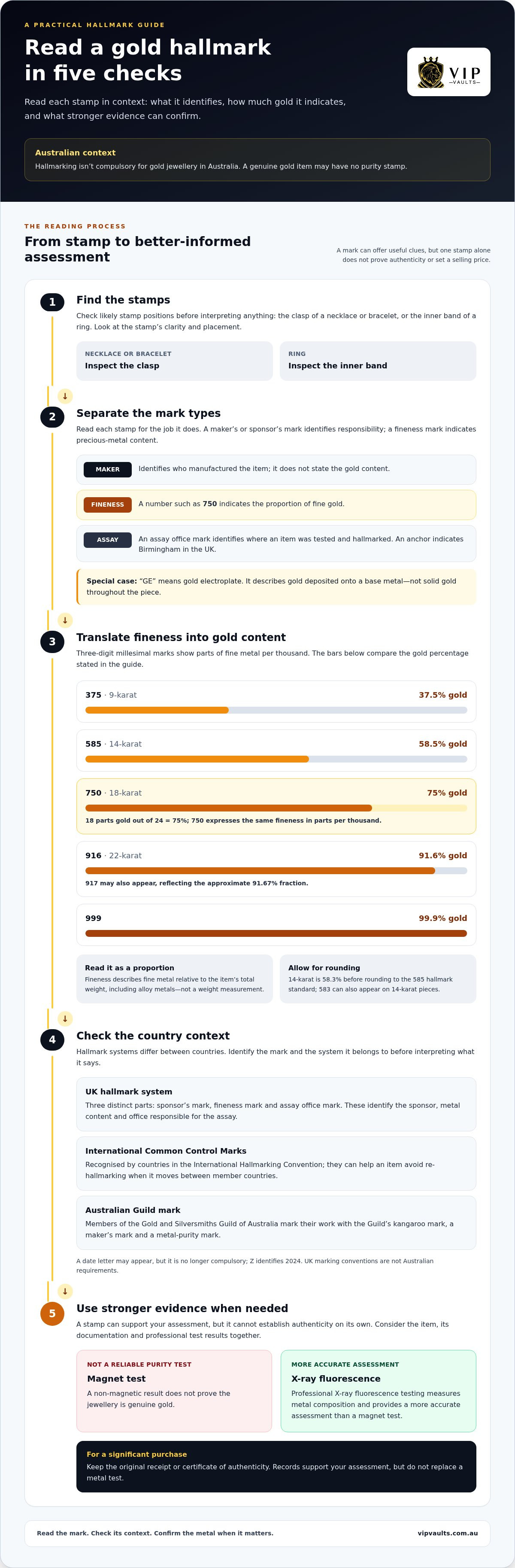

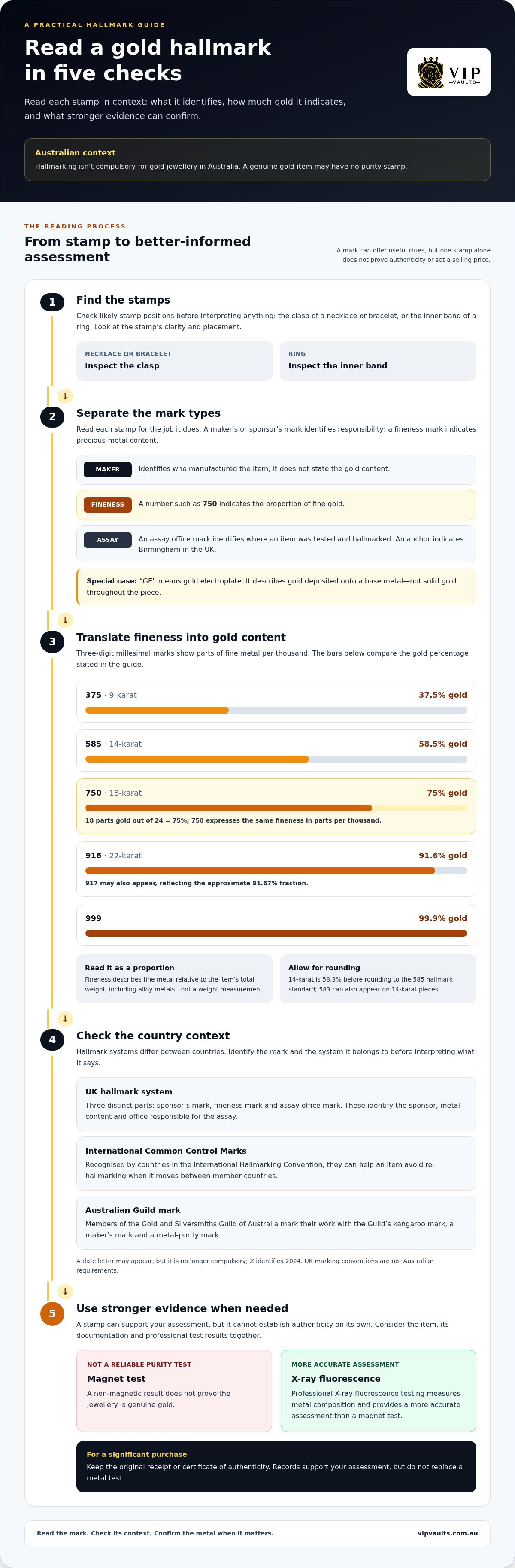
A hallmark is more than a purity number: in Australia, gold jewellery hallmarking isn’t mandatory, and marks can identify who made or sponsored a piece and its gold fineness. Understanding gold purity and hallmarks starts with reading those marks in context: for example, a 750 fineness mark indicates 75% gold.
It’s easy to assume a stamp tells the whole story, but its meaning depends on the mark and the system behind it. This guide explains how sponsor, fineness and assay office marks work, how carat and fineness figures relate, and what other marks may reveal about a piece.
You’ll be better equipped to interpret jewellery stamps without confusing a maker’s mark with a purity mark or assuming every hallmark follows the same country’s conventions.
Key Takeaways
- In Australia, jewellery hallmarking isn’t mandatory, so a piece may not carry a purity stamp.
- Read each mark separately: maker or sponsor marks identify responsibility, while fineness marks indicate precious-metal content.
- Compare carat and fineness figures to understand a gold item’s purity, while allowing for differences in marking systems between countries.
- Don’t rely on a magnet to establish whether jewellery is genuine gold; professional X-ray fluorescence testing gives a more accurate assessment.
Understanding your Jewellery: What does your hallmark mean?
In Australia, hallmarking isn’t mandatory for gold jewellery, so some pieces have no hallmark. When buying or selling, inspect the fineness stamp, maker’s mark and any assay office mark. “GE” means gold electroplate, not solid gold.
Australian hallmarking and maker’s marks
Australian hallmarking is not compulsory for gold jewellery, while a maker’s mark identifies who manufactured an item. That distinction matters: a maker’s stamp identifies its maker, but doesn’t state the gold content. Look for a separate fineness mark, often shown as a millesimal number, and compare it with the item’s description. A date letter may appear, but it’s no longer compulsory; Z identifies 2024.
Jewellery stamps and assay office marks
Stamps can identify a maker, metal purity or other details, and their position can help you find them. Check a necklace or bracelet clasp, or the inner band of a ring. Members of the Gold and Silversmiths Guild of Australia mark their work with the Guild’s kangaroo mark, a maker’s mark and a metal-purity mark. An assay office mark identifies where an item was tested and hallmarked. An anchor indicates Birmingham in the UK.
International Common Control Marks
Common Control Marks are recognised by countries in the International Hallmarking Convention. They can help an item avoid re-hallmarking when it moves between member countries. For a valuable piece bought overseas, distinguish this shared mark from a national assay office symbol or maker’s stamp. Hallmarking standards differ between countries, so a mark’s meaning depends on the system used. Identify the mark and its country context before interpreting what it tells you about the item.
Gold-plated jewellery marks
Gold Electroplate, usually stamped “GE”, means gold has been deposited onto a base metal. It describes a surface layer, not the proportion of pure gold throughout the item. Don’t read “GE” as a fineness mark: it doesn’t mean the whole piece is solid gold. When comparing stamps, distinguish plating terms from millesimal figures that indicate precious-metal content. This helps you assess what the mark says about the jewellery’s material and value.
The sponsor’s mark, fineness mark and assay office mark
Gold purity affects appearance, wear and material value. Alloy metals influence colour and durability, while a higher gold content means more fine gold by weight. The final price also reflects factors such as design and market conditions.
In the UK system, a hallmark’s three parts have distinct roles: the sponsor’s mark, fineness mark and assay office mark. The fineness mark gives the precious-metal content; the other marks identify the sponsor and the office responsible for the assay. Together, these marks help you interpret what a stamp actually says.
Carat gold expresses gold content in parts out of 24. Eighteen-karat gold contains 18 parts gold out of 24, or 75%; a 750 stamp expresses that same fineness in parts per thousand. A 916 mark denotes 91.6% gold, corresponding to 22-karat gold. Some items may use 917, reflecting the approximate 91.67% fraction.
Three-digit fineness numbers are millesimal marks: they show how many parts per thousand are fine metal. For example, 999 means 99.9% gold, while 585 means 58.5%, corresponding to 14-karat gold. A 375 stamp denotes 37.5% gold, or 9-karat gold. Read the number as a proportion, not a weight measurement.
Rounding can explain similar but non-identical marks. Fourteen-karat gold is 58.3% by its 14/24 fraction before rounding to the 585 hallmark standard; 583 can also appear on 14-karat pieces. A 750 stamp indicates 75% gold, the same content as 18-karat gold. Fineness describes fine metal relative to the piece’s total weight, including alloy metals.
Higher-purity gold contains less alloy, and alloy choices, including palladium, can affect colour and physical properties. More fine gold by weight can contribute to material value, but a stamp alone doesn’t set a selling price. If valuable jewellery needs protection between wear, consider jewellery storage.
What Are Gold Hallmarks?
A hallmark is an official quality-control mark used to show the purity of gold or another precious metal. In Australia, hallmarking isn’t mandatory, so a stamp can inform your assessment but doesn’t appear on every genuine gold item.
To assess a mark, compare its symbols and fineness number with the jewellery’s description, then consider the country whose standards it follows. A mark from another country may use different conventions. The UK, for example, has used hallmarks to protect consumers since 1327, but its rules aren’t Australian requirements.
Check the stamp’s clarity and placement, then look for a consistent combination of marks rather than relying on one symbol. A number such as 750 represents a fineness value, while a maker’s mark identifies the manufacturer. A stamp alone cannot establish that the item is authentic: it needs to be considered alongside the piece, its documentation and any professional test results.
A magnet test cannot reliably confirm whether jewellery is genuine gold. Gold’s response to a magnet isn’t a dependable purity test, and a non-magnetic result doesn’t prove authenticity. Professional X-ray fluorescence testing provides a more accurate assessment than a magnet test by measuring metal composition rather than relying on a visual reading of stamps.
In Australia, ask for a professional jewellery assessment using X-ray fluorescence when you need to test metal content. This can help assess a disputed stamp or an item without clear markings. For a significant jewellery purchase, retain the original receipt or certificate of authenticity. These records support your assessment but don’t replace a metal test.
Hallmark systems differ between countries, so distinguish a recognised symbol from proof of testing. A UK hallmark, for instance, follows that country’s marking system; it doesn’t mean Australian hallmarking is compulsory. Read symbols in context and use professional testing when you need stronger evidence to make an informed decision about a valuable piece.
How hallmarks identify precious-metal purity
A fineness marking expresses precious-metal content as a proportion of an item’s total metal weight. Gold’s karat scale divides purity into 24 parts: 12K represents 50.0% gold, while the remaining metal is alloy. A millesimal number uses thousand parts instead, presenting the same kind of information in another format. Understanding gold purity and hallmarks means first identifying which metal a marking describes.
Compare the number with the metal symbol or nearby stamp before drawing a conclusion. A 925 fineness mark indicates sterling silver, not gold. In UK hallmark shapes, an oval indicates silver, a house-shaped mark indicates platinum, and three conjoined ovals denote palladium. These symbols help identify which precious metal is present; a fineness figure then indicates its purity. Marking systems vary between countries.
Gold markings show how carat and millesimal systems express different proportions. A 958 hallmark may identify 23-karat gold, 875 may identify 21-karat gold, and 833 may identify 20-karat gold. These figures describe gold content, not jewellery weight. A 9-karat item contains 62.5% metals other than gold, so its fineness mark represents the gold share rather than the piece’s total mass.
Country-specific symbols can add historical or assay context without stating a new purity value. In UK markings, the crown appears on hallmarked gold of 9, 14, 18 and 22 carats. It also appeared on older 12- and 15-carat pieces, a practice that stopped in 1932. A date letter can indicate when an item was hallmarked; Z identifies 2024, although date letters are no longer compulsory.
Use each marking for its purpose: the metal symbol identifies the material, fineness indicates precious-metal content, and other stamps add context. Understanding gold purity and hallmarks also helps you distinguish jewellery markings from bullion descriptions. Explore silver bullion if you’re considering silver as a precious-metal holding.
VIP Vaults & Bullion Exchange Perth: Private Vault Rental
VIP Vaults & Bullion Exchange Perth offers Private Vault Rental for people who want a dedicated place to store valuable assets. Hallmarks help you interpret jewellery’s metal content; storage is the next consideration when the item isn’t being worn or examined.
If you own gold jewellery or bullion, consider whether keeping it at home suits your circumstances. A Private Vault Rental or Bullion Locker provides an option for storing physical precious metals. VIP Vaults & Bullion Exchange Perth also offers Gold Bullion and Silver Bullion for those considering bullion alongside jewellery.
Choose according to what you need to store: jewellery, bullion, or both. Contact VIP Vaults & Bullion Exchange Perth or visit vipvaults.com.au to learn more.
Make a considered plan for your jewellery
Understanding gold purity and hallmarks can help you make informed decisions about a piece, but it’s also important to preserve its details. Keep a clear record of each item’s appearance, distinctive features and identifying marks. Store purchase documents and certificates with that record, so the information is accessible if you later review, insure or pass on your jewellery.
Consider how you’ll keep valuable pieces secure when they’re not in use. Choose an approach that suits the items you own and how you prefer to protect them. A deliberate plan can make it easier to care for jewellery as part of your broader precious-metal holdings.
For a dedicated storage option, contact VIP Vaults & Bullion Exchange Perth to discuss your next step. Take time to organise your records and choose an arrangement that gives you confidence in how your valuables are kept.
Frequently Asked Questions
Does a Higher Karat Mean Higher Quality Gold?
No. A higher karat means a greater proportion of gold, not automatically better-quality jewellery. Suitability depends on how the piece will be worn, its design and the wearer’s preferences. Alloy metals affect properties such as colour and durability, so a lower-karat piece may suit regular wear better. Assess craftsmanship and condition separately from purity when comparing pieces.
Does an item have to have a hallmark?
No. Gold jewellery in Australia doesn’t have to carry a hallmark. An unmarked item isn’t automatically fake or low purity, but stamps alone tell you less about it. For a purchase or sale, keep the receipt or any certificate with the item’s details. If you need to establish its metal content, arrange a professional assessment rather than treating the absence of a stamp as proof either way.
How can you tell if gold is real?
A stamp can guide your assessment, but it doesn’t prove authenticity by itself. Don’t rely on colour, appearance or a home magnet test as conclusive evidence. For stronger evidence, have the jewellery assessed professionally using X-ray fluorescence testing, which evaluates its metal composition. If you’re buying, retain the seller’s receipt and any certificate, then compare their description with the test findings and the item.
Karat vs Hallmark Numbers: What’s the Difference?
Karat expresses gold content as a fraction of 24; a hallmark number commonly expresses fineness in thousand parts. They describe purity in different formats, not the item’s weight. For instance, an 18K description and a 750 stamp refer to the same gold proportion. Compare the unit or notation, not just the figures, and remember that marks can follow different country conventions.
What Exactly Is A Hallmark?
A hallmark is an official quality-control mark used to identify precious-metal purity. It may appear as a combination of symbols rather than one standalone stamp. Read it alongside the item’s description and country of origin, since marking systems vary internationally. A maker’s stamp can identify who produced a piece, while a hallmark’s purity information concerns the metal itself.
What do the stamps mean?
Jewellery stamps can identify metal purity, the maker, plating or other details about a piece. Interpret each mark by its letters, numbers, symbols and placement; don’t assume every stamp states gold content. For example, a maker’s initials identify something different from a fineness figure. If several stamps are present, consider them together and account for the country’s marking conventions.