
Can gold really be a safe haven if its price can fall? A gold safe haven investment Australia-based investors consider may help diversify a portfolio, but the label is not a promise of stability or profit. Gold prices fluctuate, and short-term market commentary can distract from the factors that matter over a longer horizon.
Gold’s appeal during periods of uncertainty is understandable. Physical bullion is tangible, but its value is shaped by global market movements and, for Australian investors, the exchange rate between the US dollar and the Australian dollar. Local prices can therefore move for reasons beyond changes in the international gold price.
This guide explains when gold may have a role in an Australian portfolio, what can weaken its safe-haven appeal and which market forces influence its value in Australian dollars. It also covers practical considerations for physical ownership, from choosing bullion to arranging secure storage. The aim is to help you assess gold with care, weighing its potential as a diversifier against the risks of ownership.
Key Takeaways
- Assess a gold safe haven investment Australia investors may consider as a potential diversifier, not a guarantee against losses.
- Understand how global gold prices and the Australian dollar can both influence local bullion values.
- Compare gold with cash and shares by considering volatility, income, liquidity and portfolio role, rather than relying on return forecasts.
- Use a five-step checklist to clarify your purpose, time horizon, risk tolerance, exposure type and ownership logistics before buying.
- Separate market risk from storage decisions, and consider how physical bullion will be held securely if you choose to own it.
What does gold as a safe haven investment mean in Australia?
A safe haven is an asset investors may turn to when uncertainty rises or confidence in other markets weakens. The term describes a perceived role, not a promise about an asset’s value. Gold’s safe-haven role is conditional: investors may seek it during uncertainty, but its price can still rise or fall.
For Australian investors considering gold, that distinction matters. Gold may behave differently from shares, which can contribute to diversification. But diversification does not guarantee that one asset will offset losses in another. Depending on market conditions, gold and shares can fall at the same time.
Why investors associate gold with uncertainty
Gold is a physical asset recognised across markets and cultures. That familiarity can influence how some investors view it when economic or geopolitical risks shift. It does not mean every investor trusts gold equally, or that demand will always rise during a crisis.
Investor demand can change as people reassess risk, confidence and the assets they hold. The safe-haven narrative describes possible behaviour; it does not show that gold performed as a refuge in every market period. For an overview of gold’s wider investment characteristics, including its potential role in diversification, see Gold as an Investment.
Safe haven does not mean risk-free
Gold does not produce contractual interest or dividend income. Any gain depends on the price at which it can be sold relative to the purchase price, after relevant costs. Its market value can fluctuate, sometimes sharply. If you need to sell at a particular time, you may receive less than expected.
Consider an investor who holds shares and gold. If shares decline, gold might hold its value or rise, but it could also fall. The outcome depends on the period and the forces affecting each market. Past performance cannot assure future results, and the safe-haven label does not promise protection, capital preservation or a particular return.
Treat the term as a description of possible investor behaviour, not a forecast. Ask what role gold would serve in your circumstances and whether you could tolerate a price decline without needing to sell. This helps separate gold’s perceived resilience from the reality of owning an asset whose market price moves.
What moves gold’s value for Australian investors?
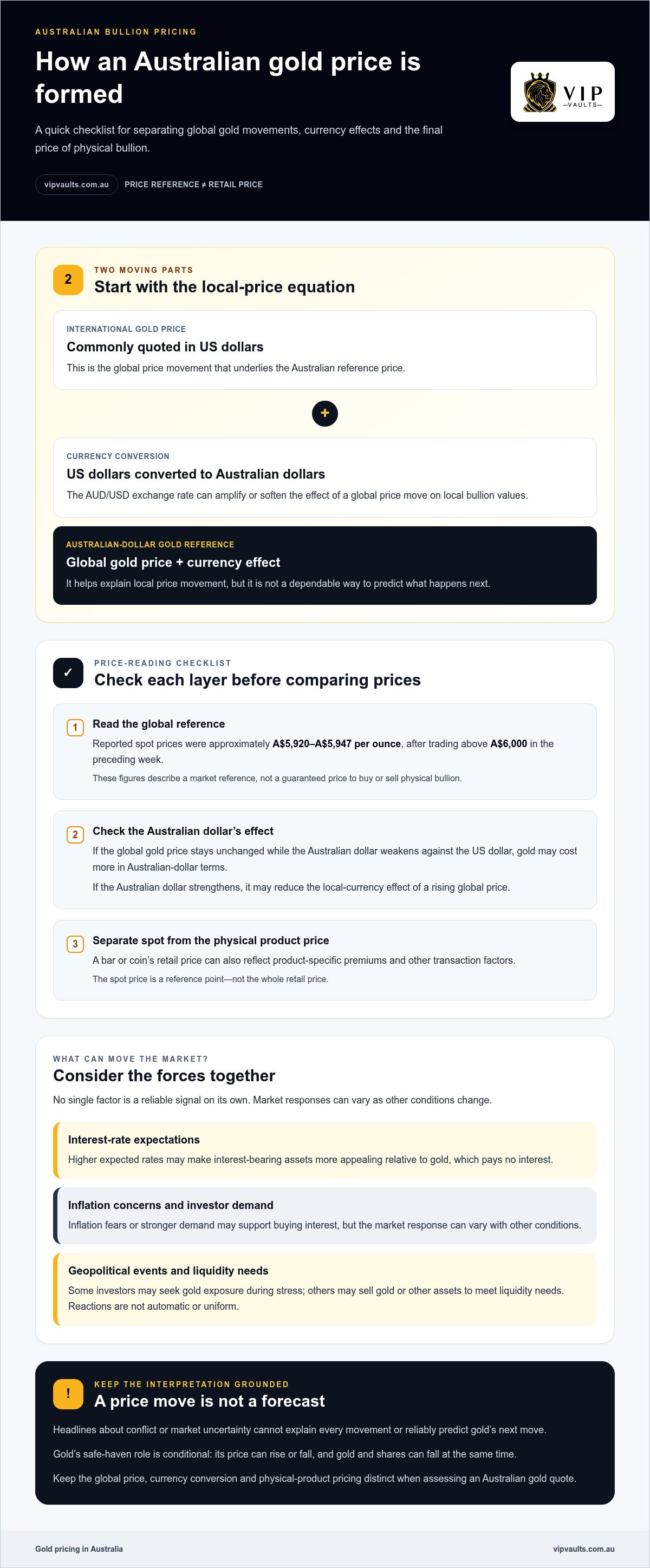
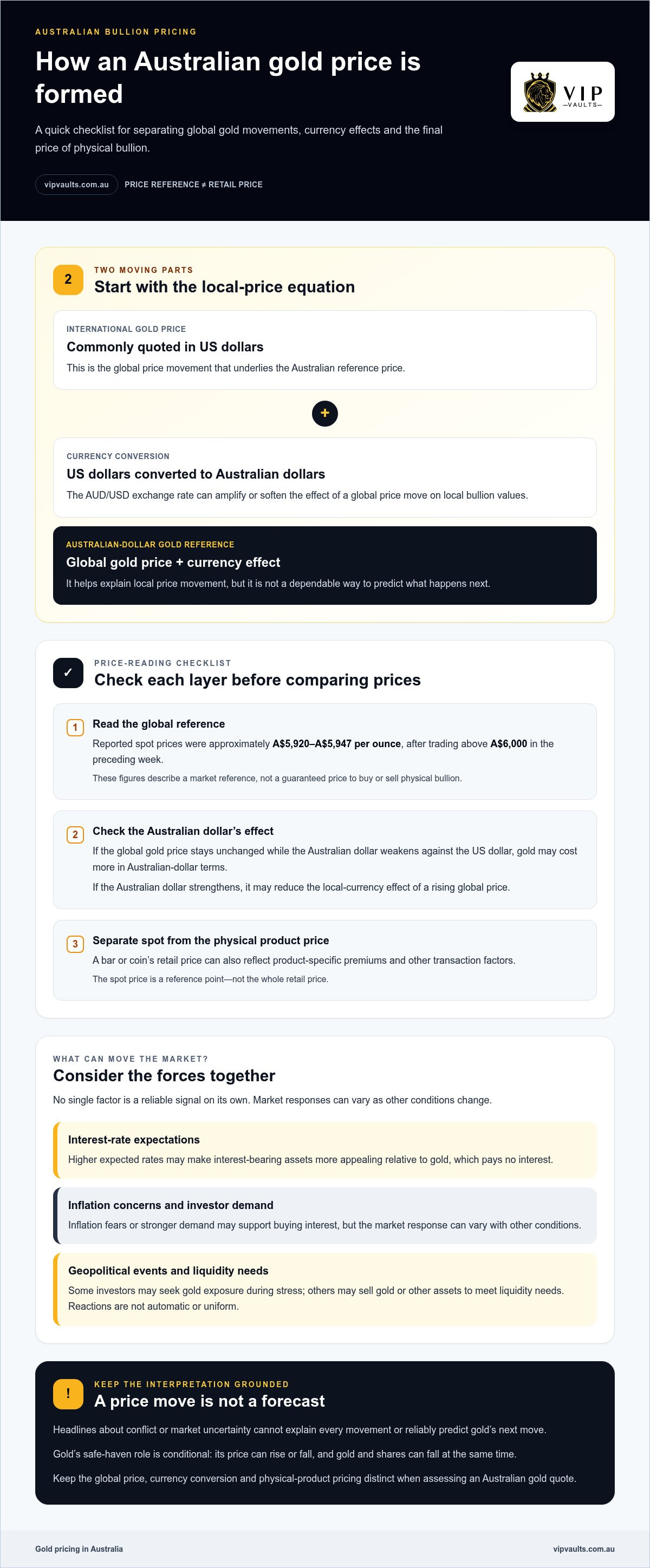
Australian-dollar gold pricing reflects two moving parts: the international gold price, commonly quoted in US dollars, and the exchange rate used to convert that price into Australian dollars. Global gold movements affect the underlying price, while the Australian dollar can amplify or soften their effect on local bullion values.
For example, if the global gold price stays unchanged while the Australian dollar weakens against the US dollar, gold may cost more in Australian-dollar terms. If the Australian dollar strengthens, it may reduce the local-currency effect of a rising global price. These relationships help explain price movements, but they do not provide a dependable way to predict them.
Global gold prices and the Australian dollar
On 20 October 2026, reported gold spot prices were approximately A$5,920 to A$5,947 per ounce, after trading above A$6,000 in the preceding week. These figures describe a market reference, not a guaranteed purchase or resale price for a physical product. Retail bullion prices can also reflect product-specific premiums and other transaction factors.
When interpreting an Australian quote, distinguish the global spot price from the final price of a physical bar or coin. The Australian gold price reference provides further pricing context. VIP Vaults & Bullion Exchange Perth sells bullion at live market rates, while the quoted spot price remains a reference point rather than the whole retail price.
Why crisis headlines do not predict gold’s next move
Interest-rate expectations, inflation concerns and investor demand can all influence gold prices, but none is a reliable signal on its own. Higher expected rates may increase the appeal of interest-bearing assets relative to gold, which pays no interest. Inflation fears or stronger demand may support buying interest, but the market response can vary with other conditions.
Geopolitical shocks can change investor sentiment, but price reactions are not automatic or uniform. During market stress, some investors may sell gold or other assets to meet liquidity needs, while others may seek exposure to gold. Expectations can also shift quickly as events unfold.
The reported pullback after a late-January peak in 2026 is a reminder to treat crisis episodes as specific examples, not forecasts. A headline about conflict alone cannot explain every market movement.
When assessing a gold safe haven investment in Australia, keep the global price, currency conversion and physical-product pricing distinct. Looking at each separately can make a sharp local price move easier to interpret without assuming it signals what comes next. If you are considering physical bullion, explore bullion purchase options as part of understanding ownership, separate from any decision about investment risk.
Gold versus other investments: what does the safe-haven label leave out?
The safe-haven label focuses on how gold may behave during uncertainty. It does not tell you whether gold suits your needs better than cash or shares. Each has different characteristics. Compare access, income, price movement and potential portfolio role, rather than relying on a promise of better performance.
The form of exposure matters too. Physical bullion, a gold fund and shares in a gold-related company are different assets. Their prices, risks, ownership arrangements and costs can differ, so they are not interchangeable.
Gold, cash and shares serve different purposes
| Asset | Value and volatility | Income and liquidity | Potential role |
|---|---|---|---|
| Cash | Its balance is generally stable in dollar terms, though inflation can reduce purchasing power over time. | Usually readily accessible. Interest may be paid depending on the account or product. | Useful for spending needs and short-term reserves. |
| Shares | Prices can fluctuate with company performance, market conditions and investor sentiment. | Some shares pay dividends, but income and access to a sale depend on the investment and market conditions. | Provide ownership interests in companies and may form part of a growth-oriented portfolio. |
| Gold | Market prices can rise or fall and may move differently from shares, but not consistently. | Gold itself pays no interest or dividend. Selling physical bullion involves an ownership and transaction process. | May provide a source of diversification, alongside distinct market and ownership risks. |
This comparison is a framework, not a ranking. Cash can be more accessible but may lose purchasing power; shares can generate income but expose investors to company and market movements. Gold has no income stream to cushion a price decline. Liquidity also depends on the specific holding and how it is bought or sold.
Physical bullion adds ownership and storage considerations
Holding physical gold means deciding what form to own, how to safeguard it and how a future sale would work. These responsibilities sit alongside market risk. Secure storage can address safekeeping, but it cannot prevent the bullion’s market value from changing.
Financial products that track gold can provide price exposure without giving the investor direct possession of bullion, but they carry their own structure and risks. Neither approach is universally superior. The physical gold and ETF guide explores the distinction, while a gold coins and bars comparison can help clarify practical differences between bullion formats.
Before weighing gold against other assets, identify what matters most to you: ready access, potential income, direct ownership or diversification. Comparing those characteristics makes the safe-haven label more useful and keeps the decision grounded in the realities of each holding.
How can Australian investors assess gold’s role before buying?
Before acting on the safe-haven label, turn your interest in gold into a clear purpose and a plan for handling risk. Keep in mind that gold’s suitability depends on your circumstances, not on a standard portfolio allocation or a market headline. This checklist can help you identify what to understand before buying.
- Define the purpose. Write down why you are considering gold. Is the aim to diversify, hold a tangible asset or meet another objective? Be specific about the outcome you expect and what would lead you to review the decision.
- Set your time horizon. Consider how long you could hold the exposure without needing to sell. If you may need the money soon, a price decline at the wrong time could matter more than a long-term investment thesis.
- Assess your risk tolerance. Imagine the value falling after purchase. Would that affect essential spending, other commitments or your ability to stay with your plan? If a decline would prompt an urgent sale, reconsider whether the exposure fits your circumstances.
- Choose the type of exposure to examine. Physical bullion, a fund or another gold-related investment can involve different risks, structures and ownership arrangements. Understand what you would own and how its value and access may differ.
- Plan the ownership logistics. For physical bullion, consider product format, safekeeping, documentation and how you might sell. Storage is a separate practical decision; it does not remove market risk or determine whether gold is suitable for you.
Define the role and risks before choosing an amount
Use your answers to describe gold’s intended role in plain language. For example, you might consider it as one form of diversification while recognising it may not offset losses elsewhere. Avoid choosing an amount because a headline suggests an urgent opportunity. No allocation or purchase timing suits every investor.
Review your liquidity needs as well. If you may need funds for a known expense, consider whether price movements or the process of selling your chosen exposure could complicate access. A considered decision is one where you can explain both why you are buying and what you would do if the price fell.
Check Australian tax and SMSF considerations carefully
Tax and superannuation questions depend on the asset, ownership structure and individual circumstances. General information cannot determine your personal tax outcome or establish whether a particular arrangement meets applicable requirements. Check current Australian guidance and seek appropriately qualified advice for decisions specific to you.
SMSF trustees have separate storage and compliance matters to consider. The SMSF gold storage guide covers that topic separately; it should not be treated as personal financial, legal or tax advice.
Once you have assessed your purpose and practical requirements, explore physical gold bullion options as part of your ownership research.
Owning physical gold: purchase and secure storage considerations
Choosing physical bullion adds practical decisions to the investment question. Consider the product you are buying, how you will keep it secure and what you will need to manage if you later sell. These steps support responsible ownership, but they do not change the market price or remove the risk of a decline. The safe-haven label is no substitute for understanding what you own.
Buying physical bullion and considering storage
Before purchasing, consider the bullion’s form, stated purity and source, and keep clear records of the transaction and what you hold. These details can help you understand your physical asset and organise your ownership arrangements. They do not indicate what the price will do or guarantee a particular resale outcome.
VIP Vaults & Bullion Exchange sells gold and silver bullion at live market rates, sourced from internationally recognised and LBMA-accredited refiners. A live market reference can help explain pricing, but the investment decision remains separate from the purchase and storage process.
Safekeeping deserves separate consideration. VIP Vaults’ bullion lockers use dual-key security: you hold the only keys, and VIP Vaults does not retain a custodial key. This arrangement concerns access to stored bullion. It does not protect against price movements, make gold risk-free or enhance its investment return.
Think through the practicalities before taking possession. Where will the bullion be held? How will you maintain records of your holdings? If you need to sell, what steps will be involved in arranging that transaction? Answering these questions helps you assess whether the responsibilities of physical ownership suit your circumstances, rather than treating storage as an investment strategy.
A discreet next step for physical bullion owners
Physical ownership may appeal to investors who want direct possession of bullion, while secure storage can help manage the practicalities of holding it. Neither decision amounts to a recommendation to buy gold. If you are evaluating a gold safe haven investment Australia investors may consider, keep the roles distinct: assess market exposure on its merits, then decide how you want to manage the asset itself.
For investors who have decided to explore physical ownership, VIP Vaults brings bullion sales and private storage together as separate parts of the process. Consider the product, ownership arrangements and safekeeping requirements at your own pace. Explore VIP Vaults and bullion services to review physical bullion and storage options.
Make your next step a considered one
A gold safe haven investment Australia investors consider should fit a defined purpose, not simply respond to a moment of market anxiety. Before making a decision, write down what you want this asset to do and what would lead you to reassess its role. A clear personal record can help distinguish a deliberate choice from a reaction to the latest headline.
That reflection can guide your practical next step. You may decide to continue researching, seek advice suited to your financial or tax circumstances, or explore what physical ownership involves. There is no need to rush: a sound decision is one you understand and can live with if conditions change.
If you are ready to consider the practicalities of physical bullion, explore physical bullion and private storage with VIP Vaults. Review your options and proceed with clarity and care.
Frequently Asked Questions
Is gold a safe haven investment in Australia?
Gold can serve as a potential safe haven, but it is not reliably protective in every market environment. For a gold safe haven investment Australia investors may consider, weigh its possible role against your timeframe, risk tolerance and need for accessible funds. Someone who may need to sell during a downturn faces different practical risks from someone able to hold through price fluctuations. The label alone cannot establish suitability.
Can gold lose value during a financial crisis?
Yes. Gold’s price can fall during a financial crisis, including when investors sell assets to raise cash or respond to losses elsewhere. If you need funds while markets are unsettled, the price available at that moment may be below what you paid, even if gold later recovers. A crisis can affect demand, liquidity and investor behaviour at once, so gold’s reputation does not rule out short-term losses.
How does the Australian dollar affect the price of gold?
The Australian-dollar value of gold reflects the global gold price converted into Australian dollars. If the exchange rate changes, the local value can move even if the international price is steady. For example, a weaker Australian dollar can increase the converted local price, while a stronger one can reduce it. The effect on a physical product’s retail price may also differ from the spot-price movement.
Does gold protect against inflation?
Gold may retain or gain value during some inflationary periods, but it is not a dependable, immediate shield against rising living costs. Its price can respond to currency movements, interest-rate expectations and investor demand, which may not move in step with inflation. If household expenses rise and you need to sell, the price at that time matters. Treat inflation protection as a possibility, not an assured outcome.
Can I hold physical gold in an Australian SMSF?
An SMSF may be able to hold physical gold, but trustees need to consider the fund’s governing rules, investment strategy, ownership records and storage arrangements under current superannuation requirements. The correct approach depends on the fund and its circumstances. Before buying or changing storage, review current Australian Taxation Office and other authoritative guidance, and obtain advice appropriate to your fund. General information cannot confirm compliance for a particular SMSF.
Is physical gold different from a gold ETF?
Yes. Physical gold means you own bullion directly, so you are responsible for its safekeeping and records. A gold exchange-traded fund gives you units in a financial product designed to provide exposure to gold; you do not personally take possession of bullion by holding those units. The product structure, fees, trading arrangements and risks can differ, so read the relevant documents before deciding which form suits your needs.
What happens to gold prices when interest rates change?
There is no fixed rule. Higher interest rates or expectations of further rises can make interest-bearing assets more attractive relative to gold, which does not pay interest. But gold prices also respond to currency movements, inflation concerns and investor demand. Markets may react to expected rate changes before an official decision, and other forces can outweigh the rate effect. Treat interest rates as one influence, not a stand-alone price signal.