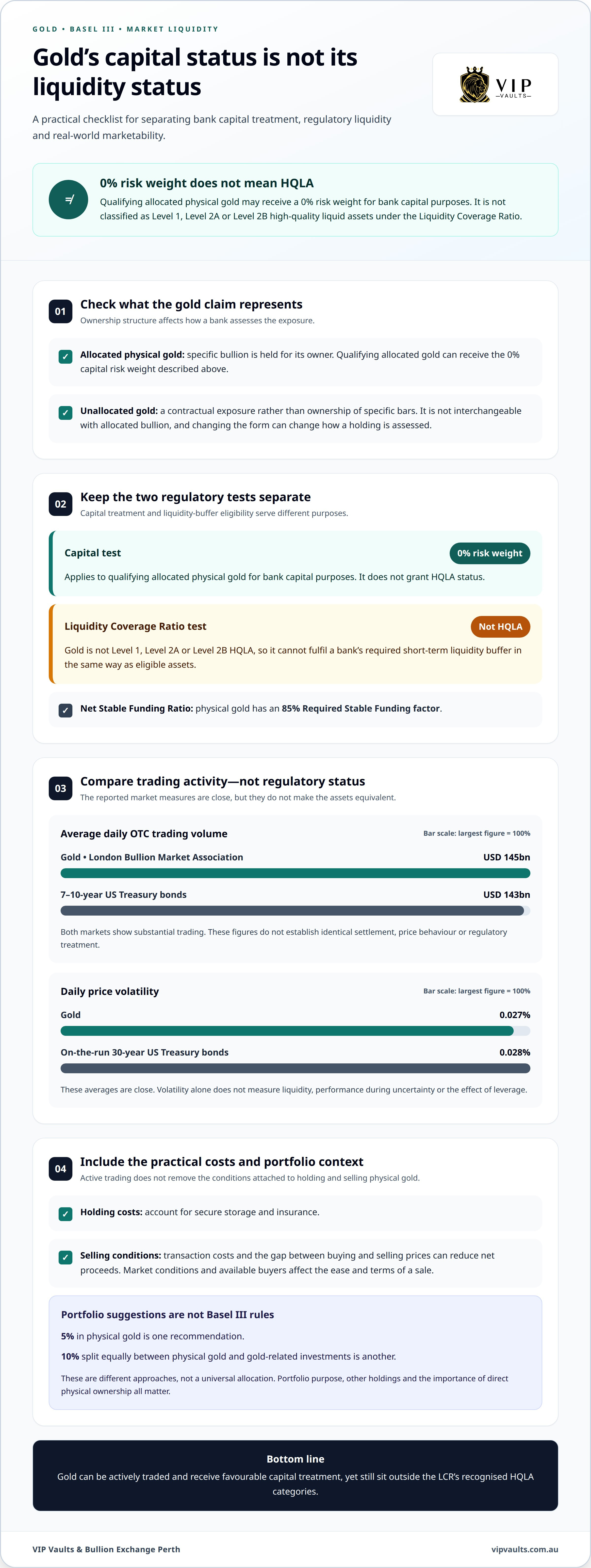

A bank’s capital treatment of gold does not necessarily determine whether it can be used in its short-term liquidity buffer. Under Basel III, qualifying allocated physical gold can receive a 0% risk weight for capital purposes, but gold is not classified as Level 1, Level 2A or Level 2B high-quality liquid assets under the Liquidity Coverage Ratio. That distinction is central to understanding gold as a Tier 1 asset.
It’s understandable to associate gold with security: physical bullion is tangible, and banks can hold it directly rather than as a paper claim. But capital treatment and liquidity treatment are separate tests, so one status does not automatically confer the other.
This article explains how those tests apply, how banks treat allocated and unallocated gold differently, and how gold’s market liquidity compares with US Treasuries. The key distinction is that gold is actively traded, but its role in a bank’s regulatory liquidity buffer is not the same as that of a government bond.
Key Takeaways
- Distinguish allocated physical bullion from an unallocated gold claim: ownership structure affects how banks treat the exposure.
- Assess market liquidity through trading activity, bid-ask spreads and volatility, not regulatory labels alone.
- Gold’s safe-haven role is one consideration; its market behaviour and the conditions for selling still matter.
- Keep the Reserve Bank of Australia’s treatment of gold in its reserves separate from Basel rules for commercial banks.
Is Gold a Tier 1 Asset?
Allocated physical gold can receive a 0% risk weight for bank capital purposes under Basel III, but that does not make it a high-quality liquid asset (HQLA). The distinction matters: capital treatment and liquidity status are separate regulatory tests.
Allocated Gold and Liquid Assets
Allocated gold means specific physical bullion is held for its owner, rather than represented by an unallocated claim. Under Basel III, qualifying allocated physical gold can receive a 0% risk weight, but it is not classified as Level 1, Level 2A or Level 2B HQLA for the Liquidity Coverage Ratio.
That difference matters for banking: a favourable capital risk weight does not mean gold can fulfil a bank’s required short-term liquidity buffer. Under the Net Stable Funding Ratio, physical gold has an 85% Required Stable Funding factor. The gold’s ownership structure and its regulatory purpose therefore affect how its status is understood.
Portfolio Allocation to Gold
Portfolio allocation means deciding what proportion of investments to hold in gold alongside other assets. Suggested allocations vary: one recommendation is 5% in physical gold, while another proposes 10% split equally between physical gold and gold-related investments.
These are different approaches, not a single Basel III rule or a universal allocation. For an Australian investor, the choice depends on the portfolio’s purpose, the balance of other holdings and whether direct physical ownership is important. Treating gold as a Tier 1 asset in a bank capital discussion does not determine its appropriate share in a personal portfolio.
Physical gold and a paper claim backed by gold are not interchangeable forms of ownership. Basel III treatment depends on the exposure: allocated bullion is distinct from an unallocated claim, which represents a contractual exposure rather than ownership of specific bars. Changing the form can therefore change how a holding is assessed.
Basel III followed the 2008 financial crisis and sets separate requirements for capital and liquidity. Gold’s 0% risk weight concerns capital treatment; its HQLA status concerns the liquidity buffer. These terms describe different regulatory functions, not competing descriptions of the same asset.
In Australia, GST and capital gains tax are separate considerations. GST treatment depends on whether gold meets the criteria for investment precious metal. Capital gains tax may apply when bullion is disposed of, depending on the holding and transaction circumstances.
Gold market liquidity compared with US Treasuries
Gold trades across global markets, but trading activity alone does not make it a regulatory liquid asset. Basel III distinguishes market liquidity from the assets banks may count towards their short-term buffer.
Gold is not classified as Level 1, Level 2A or Level 2B high-quality liquid assets under the Liquidity Coverage Ratio. Banks must hold HQLA equal to at least 100% of net cash outflows over a 30-calendar-day stress period. Physical gold’s marketability therefore doesn’t give it the same regulatory weight as eligible government securities.
For comparison, gold’s average daily OTC trading volume on the London Bullion Market Association was USD 145bn. The average daily OTC volume for 7-10-year US Treasury bonds was USD 143bn. These figures show substantial trading in both markets, but they don’t establish identical settlement, price behaviour or regulatory treatment.
Cash and government bonds differ from gold in important ways: cash is directly available for payments, while bonds can be traded and may qualify for liquidity buffers. Gold has no equivalent LCR classification, even when its market is active. The question is not simply which asset trades more, but whether it meets the specific liquidity test.
Daily price volatility was 0.027% for gold and 0.028% for on-the-run 30-year US Treasury bonds. Those averages are close, but volatility alone doesn’t measure liquidity, performance during uncertainty or the effect of leverage. Market depth, execution and the regulatory purpose of a holding also matter.
Physical gold carries risks beyond price movements. Owners need to account for secure storage and insurance, while selling can involve transaction costs and a gap between buying and selling prices. These costs can reduce net proceeds, even when global demand supports active trading.
Gold’s trading activity may suggest an active market, but market activity alone does not determine whether an asset qualifies for a liquidity buffer. Compare its regulatory status, sale process and holding costs with the roles cash or government bonds serve in your portfolio.
Gold’s liquidity and safe-haven characteristics
Gold’s safe-haven reputation describes its perceived role during uncertainty, while liquidity concerns how readily it can be traded. For Australian investors, these ideas are related but not interchangeable.
Gold’s Safe-Haven Characteristics
Gold is often viewed as a safe haven because it is a physical asset, not a promise by a company or government to repay a debt. That distinction can matter when confidence in financial institutions or currencies weakens, but it does not make gold’s price stable or guarantee a gain.
Its safe-haven appeal does not change its regulatory classification. Despite active global trading, gold remains outside the Basel III Liquidity Coverage Ratio’s recognised HQLA categories. Investors weighing gold against other assets should separate its perceived protection from its role in capital, cash flow and portfolio liquidity.
Liquidity During Financial Crises
During a financial crisis, gold remains tradable, but the ease and terms of a sale depend on market conditions and available buyers. Even a liquid market can see wider spreads or price movements when uncertainty shifts the balance between buyers and sellers.
The average intraday bid-ask spread for gold is approximately 2.2 basis points, and its Amihud illiquidity measure was 0.102. These measures describe ordinary trading conditions, not a promise about execution during a crisis. Financial institutions assess liquidity against their obligations, while individual investors also need to consider how quickly they may need funds.
For a practical comparison, ask three separate questions: can the asset be traded, can it be sold at a reasonable price, and can you access the proceeds when needed? Gold’s active trading market addresses the first question, but stress conditions can affect the others. Consult a licensed financial adviser when deciding how gold fits your circumstances, rather than treating a safe-haven label as a complete liquidity assessment.
How does the Reserve Bank of Australia classify gold in its reserves?
The Reserve Bank of Australia’s reserve reporting and Basel III bank-capital categories are different classification systems. Under old rules, gold was classified as a Tier 3 asset and marked down by 50%. That historical treatment explains the Tier 3 reference, but it does not establish how the RBA currently reports its reserves.
A reserve category describes an asset held as part of a central bank’s reserves. A Basel tier, by contrast, describes prudential treatment under banking rules. If an RBA reserve table lists gold as part of its holdings, that reserve label alone does not identify its Basel capital treatment.
The distinction matters because a bank’s capital classification cannot automatically be applied to the RBA. The old Tier 3 label and 50% markdown relate to the rules described above; they are not a current classification for every gold holding. The holder, purpose and applicable framework all affect what a label means.
For Australian readers, the practical point is to check what a statement about “gold reserves” is actually describing. A reference to the RBA concerns reserve holdings; a Tier 1 or Tier 3 reference concerns a banking classification. The same metal can appear in both discussions without those descriptions being interchangeable.
Keep three questions separate when interpreting a claim: who holds the gold, which framework is being discussed, and whether the statement describes historical or current treatment. The 50% markdown belongs to the old rules. It should not be presented as the RBA’s current treatment without a current, RBA-specific source.
This distinction also clarifies the broader debate about gold’s status. A banking label does not, by itself, explain a central bank’s reserve reporting, just as reserve ownership does not determine a commercial bank’s capital treatment. For any Australian policy discussion, name the institution and the framework rather than relying on “Tier 3” alone.
VIP Vaults & Bullion Exchange Perth: Gold Bullion
VIP Vaults & Bullion Exchange Perth offers gold bullion for readers considering physical ownership alongside the regulatory distinctions discussed above. A bank’s capital classification is separate from an individual’s decision to hold bullion directly.
If you’re considering physical gold, the next decision is how it fits your holdings and where to store it. VIP Vaults offers private vault rentals and bullion lockers for storing bullion, while its gold and silver bullion sales provide options for acquiring precious metals. These services address distinct choices: buying gold, arranging secure storage, or considering silver as well.
Turn to VIP Vaults & Bullion Exchange Perth when you’re ready to explore Gold Bullion or storage for bullion as part of your personal arrangements. Contact VIP Vaults & Bullion Exchange Perth to discuss your requirements.
Make your next decision with clarity
Understanding gold as a Tier 1 asset is only one part of deciding whether physical bullion belongs in your plans. Before acting, define the role you want it to play: preserving wealth, diversifying holdings or maintaining access to a tangible asset. Then consider how that objective fits your wider financial position, including the assets you may need to access readily.
Having a clear purpose helps make the next choices more deliberate. Consider ownership and safekeeping together, rather than treating storage as an afterthought. If physical gold is part of your approach, account for both its place in your plans and the practical arrangements for holding it.
For a considered conversation about your next step, contact VIP Vaults & Bullion Exchange Perth. Move forward at a pace that suits your priorities and keep your decisions grounded in a clear plan.
Frequently Asked Questions
What does it mean for gold to be a Tier 1 asset?
It refers to how a banking framework treats an asset for capital purposes, not a guarantee that its value or liquidity is stable. For physical gold, ownership structure matters: allocated bullion is distinct from an unallocated claim. The label alone does not establish that gold will meet a bank’s short-term liquidity needs or count as its Tier 1 capital.
Is gold classified as a Tier 1 asset under Basel III capital rules?
Not as Tier 1 capital itself. Under Basel III, qualifying allocated physical gold can receive a 0% risk weight for capital purposes, but that treatment is different from counting gold as a bank’s Tier 1 capital. It also doesn’t make gold a high-quality liquid asset for the Liquidity Coverage Ratio. The distinction is between capital risk weighting and liquidity classification.
How can Australians buy and store investment-grade gold?
Australians can buy investment-grade gold as bars or coins, then arrange storage to suit their ownership needs. VIP Vaults & Bullion Exchange Perth offers gold bullion sourced from internationally recognised refiners and LBMA-accredited manufacturers. Its private vault rentals and bullion lockers provide options for storing bullion separately from a home collection.