
What if your home and contents policy doesn’t cover the bullion or jewellery you keep at home? The dangers of uninsured precious metals can become painfully clear after theft, fire or accidental loss, when an owner discovers the policy wording doesn’t match their assumptions. It’s worth checking whether your holdings are protected, particularly because their value, type and storage location can affect what cover applies.
This guide explains the financial, practical and documentation risks of going without suitable cover, and what to check before choosing insurance or storage. You’ll learn why policy limits, exclusions, valuations and proof of ownership matter, and what records to prepare in case you need to make a claim. We’ll also compare home, bank and specialist private storage, without assuming that a policy or storage arrangement automatically covers your assets. Before deciding, check the relevant policy wording or storage terms, including security arrangements and any applicable insurance details.
Key Takeaways
- The dangers of uninsured precious metals include more than theft: a loss may leave you needing to prove ownership, value and what happened.
- Check policy wording for covered events, exclusions, limits and storage conditions before assuming bullion or jewellery is protected.
- Keep an up-to-date inventory and supporting records so you can establish what you own and assess its value if a loss occurs.
- Compare home, bank and private vault storage by reviewing access, security arrangements, documentation requirements and written insurance terms.
- Private vault rentals and bullion lockers are options to investigate, but confirm the applicable terms and insurance details before deciding.
Dangers of uninsured precious metals: what is at stake?
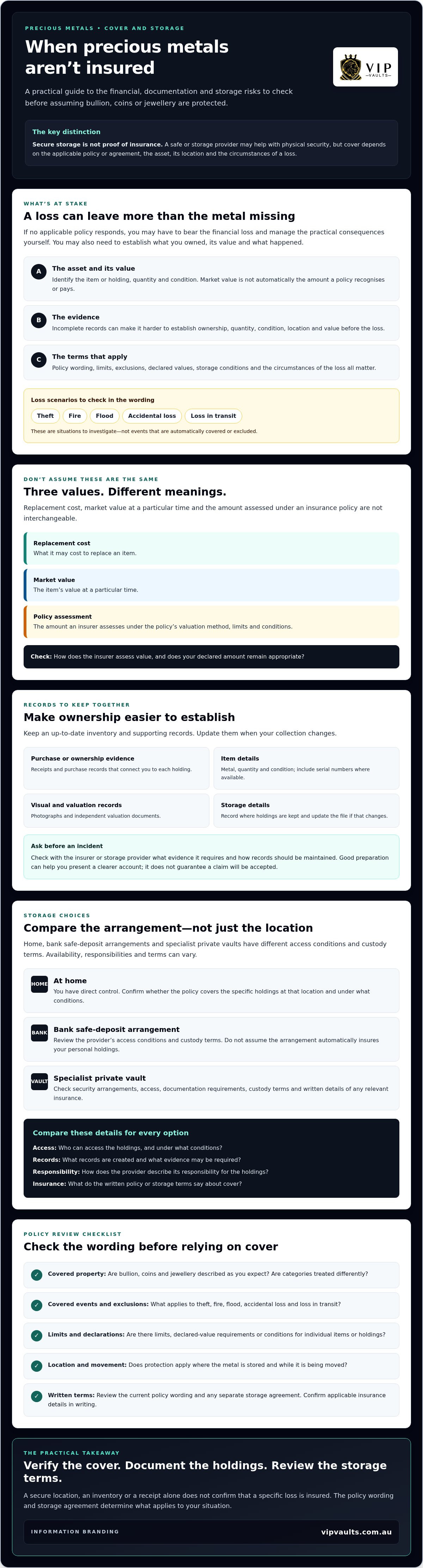
Precious metals are uninsured when you don’t have confirmed insurance protection for the specific asset, type of loss and location involved. Owning bullion, coins or jewellery doesn’t mean a policy covers them. If an incident occurs and no applicable policy responds, you may have to bear the financial loss and manage the practical consequences yourself.
Physical security and insurance address different risks. A safe or secure storage arrangement may help protect your holdings, but it doesn’t establish that the contents are insured or confirm what a policy would pay. For general background, readers can review storing gold safely, then check their own policy and storage terms for the details that apply.
What does uninsured mean for bullion, coins and jewellery?
Distinguish proof that you own an item from proof that a specific loss is insured. A receipt or purchase record may help establish ownership, while cover depends on the policy wording and may be affected by the declared value, location and circumstances of a loss. Bullion and personal jewellery may be treated differently, so check how each category is described and whether individual items or holdings need to be declared.
An asset’s current market value isn’t automatically the amount a policy will recognise or pay. The policy’s valuation method, limits and conditions matter. Confirm how the insurer assesses value and whether your declared amount remains appropriate.
Which events could create an uninsured loss?
Check how your arrangements address theft, fire, flood, accidental loss and loss in transit. These are scenarios to investigate, not events that are automatically covered or excluded. Read the current policy wording and ask whether protection applies at the stated location, while the metal is being moved, and in circumstances relevant to your holdings. If you use a storage provider, review its terms separately rather than assuming they replace your own cover.
Documentation can become critical after an incident. Incomplete records may make it harder to establish what you owned, the quantity and condition of each item, or its value before the loss. Keep records that connect each holding to evidence of purchase or ownership, and update them when your collection changes. This preparation won’t guarantee a claim will be accepted, but it can help you present a clearer account when assessing your options.
How uninsured precious metals can expose owners to financial and practical loss
A loss can raise several questions at once: what is missing or damaged, who owned it, what was it worth, and which policy or recovery process applies? Even if you can establish that a loss occurred, the next steps may depend on clear records and the terms governing where the metal was stored or transported.
Hypothetical: After a break-in, an owner reports missing bullion kept alongside jewellery at home. If their inventory is incomplete, they may need to reconstruct what was held, its quantity and condition, and where it was stored. The insurer can then assess the evidence against the policy wording. This doesn’t determine the outcome, but it shows why preparation matters.
Why proof of ownership and valuation matter
Keep purchase records, serial numbers where available, photographs and independent valuation documents. Where practical, record the metal, quantity, condition and storage location, then update the file as holdings change. Before an incident, ask the insurer or storage provider what evidence it requires and how records should be maintained.
Three figures may differ: the cost to replace an item, its market value at a particular time, and the amount an insurer assesses under the policy. They aren’t interchangeable. Forbes discusses ownership expenses such as storage and insurance costs, but your own records and policy terms determine what applies to your situation.
How storage location can change the risk picture
Home storage gives you direct control, while a bank safe-deposit arrangement or specialist private vault involves a provider’s access conditions and custody terms. These are distinct arrangements, and availability, responsibilities and terms can vary. Compare who can access the holdings, what records are created, and how the provider describes its responsibility for them.
Don’t treat security measures as proof of insurance. A provider’s security arrangements may reduce certain practical risks, but they don’t automatically establish that your personal holdings are insured. Check the applicable agreement and ask for written details of any relevant insurance, including what it covers, where it applies and any limitations.
The dangers of uninsured precious metals include a difficult recovery process as well as the loss itself. If specialist storage is on your shortlist, you could review private vault and bullion locker options from VIP Vaults & Bullion Exchange Perth, then check the relevant terms, security arrangements and insurance details before deciding.
Home, bank or private vault: compare protection for precious metals
Storage choices involve different trade-offs in control, access and responsibility. The right comparison isn’t simply which place appears most secure. Consider how you’ll access your holdings, what records will be created and, separately, what insurance applies to the asset at that location. The dangers of uninsured precious metals can persist even when storage appears secure if cover and responsibilities remain unclear.
| Storage option | Control and access | Security and documentation | Insurance questions |
|---|---|---|---|
| Home | Direct control; access depends on your household arrangements. | Review your security setup and maintain an inventory and ownership records. | Does your policy cover bullion and jewellery at this address, and under what conditions? |
| Bank safe-deposit arrangement | Access follows the provider’s identification, operating and account conditions. | Confirm what the provider records and what responsibility it accepts for items held. | Does the arrangement include insurance, or must you arrange separate cover? |
| Specialist private vault | Access and identification requirements are set out by the provider. | Review the security arrangements, custody terms and records provided. | Request written details of cover, limits, exclusions and claims procedures. |
What should you check before storing metals at home?
Ask your insurer in writing whether bullion and jewellery are covered at the intended location. Check applicable limits, exclusions, security requirements, disclosure duties and the evidence needed to support a claim. Don’t assume a household safe or a standard contents policy is sufficient. Ask how the policy treats each category of holding and whether its terms change when items are moved.
What should you compare in bank and private vault storage?
Bank and private-vault arrangements aren’t interchangeable. Ask who is responsible for custody, what access and identification conditions apply, and what happens if you need to make a claim. Request written information about insurance scope, exclusions, valuation basis and claims procedure. A provider’s security measures don’t establish that your personal holdings are insured.
For more context on private storage, see Private Vaults in Australia: Secure Your Wealth in 2026. Treat it as a starting point, then verify each provider’s current terms directly. Storage security and insurance are separate checks. Confirm both before deciding where to hold your metals.
A practical checklist to reduce uninsured precious-metals risk
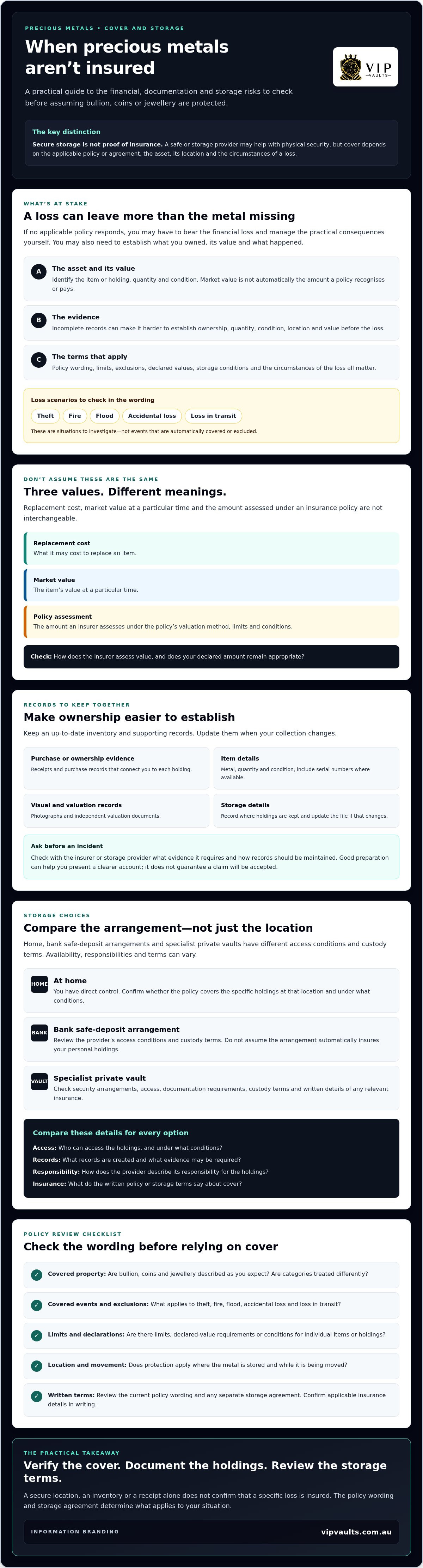
A clear process can reveal gaps before you need to make a claim. Work through these steps for each type of holding and each place it may be stored. Keep written responses with your records rather than relying on a verbal assurance or a general description of cover.
- 1. Inventory: List each holding by metal, form and quantity. Include identifying marks or serial numbers where available, and note its condition and storage location.
- 2. Document: Gather purchase records, photographs and valuation documents. Keep secure copies separately from the metals, and avoid sharing sensitive storage or personal security details publicly.
- 3. Disclose: Tell your insurer what assets you hold and where you intend to keep them. Ask whether bullion and jewellery are treated differently, and what information it needs to assess them.
- 4. Confirm cover: Ask the insurer in writing which events, locations and asset categories are covered. Confirm relevant limits, exclusions, safeguards, valuation method and evidence needed for a claim.
- 5. Compare storage: Review home, bank and private-vault arrangements against your access needs, custody responsibilities, security arrangements and applicable terms. Ask each provider for its current storage and insurance information in writing.
- 6. Review: Revisit your inventory, declared values and written terms when holdings, valuations, policy wording or storage arrangements change.
Ask each party specific questions
For your insurer: Does cover apply to bullion and jewellery at the exact location? Which events are covered, and what exclusions, limits or safeguards apply? How is value assessed, and what evidence would be required to support a claim?
For a storage provider: What are the custody and access conditions? What security arrangements apply? Does the agreement describe insurance, and if so, what assets, events and circumstances does it address? Request the relevant terms and limitations, then check how they relate to any personal policy. A provider’s security arrangements alone don’t confirm insurance protection.
For fund-held bullion, personal circumstances can involve additional considerations. Read SMSF Gold Storage: Investing in Gold in Australia (2026) as a starting point, and speak with an appropriately qualified professional about your fund’s specific financial, tax or SMSF position. Don’t treat general storage information as advice tailored to your circumstances.
These steps can help you assess the dangers of uninsured precious metals with better records and clearer answers. If you’re comparing private vault rental or bullion locker options, review private storage options and request the applicable terms, security arrangements and insurance details before deciding.
Choosing a more secure storage plan for precious metals
A sound storage plan brings together three elements: insurance verified for the relevant assets and location, records that can support ownership and valuation, and a storage arrangement suited to your holdings and access needs. A change in one element can affect the others. For example, moving bullion from home to a vault may mean updating your insurer and checking the provider’s terms.
The dangers of uninsured precious metals aren’t resolved by choosing a storage option that simply appears secure. Compare the written conditions and responsibilities, then confirm how any policy applies to your specific holdings. Keep your inventory and supporting documents current, and retain written answers from both your insurer and storage provider.
When might specialist private storage be worth considering?
Specialist private storage may be worth assessing if you’re looking for an alternative to keeping metals at home. Discretion, dedicated storage and custody arrangements are factors to examine, not outcomes to assume. Consider the quantity and type of your holdings, how often you need access, and what responsibilities you retain under the agreement.
VIP Vaults & Bullion Exchange offers private vault rentals and bullion lockers for precious metals and jewellery. Review the applicable terms and security arrangements, and confirm current insurance arrangements and any coverage limitations directly with the provider. Storage options should be weighed alongside verified insurance, not treated as a substitute for it.
What to confirm before making a storage decision
Request current written details before you commit. Check how access works, what identification or operating conditions apply, who is responsible for custody, and which security controls are in place. Read the agreement carefully so you understand your obligations and the provider’s stated responsibilities.
Ask directly whether insurance is included, who arranges it, which assets and events it covers, and what exclusions or limits apply. If insurance isn’t included, confirm what arrangements you may need to make separately. Then compare those details with your own policy, including any requirements for declaring the new storage location. Don’t rely on informal descriptions or assume a provider’s security measures mean your metals are insured.
A measured decision comes from matching the written terms to your priorities, not assuming one arrangement suits every owner. To discuss private vault and bullion locker options, contact VIP Vaults & Bullion Exchange and request the current storage, security and insurance details relevant to your circumstances.
Take the next step towards clearer protection
The dangers of uninsured precious metals are easier to address when your records, insurance and storage arrangements work together. Keep an accurate inventory, confirm in writing what your policy covers, and compare storage terms against your access needs and responsibilities. A secure location alone doesn’t confirm insurance, so check the details before you decide.
VIP Vaults & Bullion Exchange offers private vault rentals and bullion lockers for precious metals and jewellery. Its bullion is sourced from internationally recognised and LBMA-accredited refiners. Review the current storage terms, security arrangements and insurance details directly with the provider, and don’t assume cover is included.
Enquire about private vault and bullion locker options to explore whether they suit your requirements. With clear information and considered preparation, you can make a more confident decision about protecting your holdings.
Frequently Asked Questions
Are precious metals covered by home insurance in Australia?
It depends on your policy and the circumstances of a loss. A home and contents policy may treat bullion differently from personal jewellery, and limits, exclusions or storage conditions can apply. Check the current policy wording and schedule, then ask your insurer in writing whether each holding is covered at your home, for which events, and up to what limit. Don’t assume general contents cover includes bullion.
Can I insure gold bullion stored at home?
It may be possible, but you’ll need to confirm available cover directly with an insurer. Explain what form and quantity of gold you hold, its declared value, where it will be stored and what safeguards are in place. Ask whether cover applies at that location, during transit and for the events you’re concerned about. Request written details of conditions, exclusions and evidence requirements before relying on the cover.
What happens if uninsured gold or silver is stolen?
If no applicable policy responds, you may have to bear the financial loss. You may also need to establish what was held and provide evidence of ownership, quantity and value if pursuing recovery or dealing with relevant authorities. Purchase records, photographs, identifying marks and an up-to-date inventory can help document your holdings. The dangers of uninsured precious metals include this practical burden as well as the potential loss of the asset.
Does a safe deposit box automatically insure precious metals?
No. A safe deposit arrangement doesn’t automatically establish that its contents are insured. The provider’s agreement may set out access conditions and responsibilities, while any insurance arrangements may be separate or subject to specific terms. Ask the provider for current written details about cover, including what assets and events are included, exclusions, valuation basis and claims process. Check whether you need separate insurance for the contents.
How can I prove ownership and value of bullion for an insurance claim?
Keep purchase records, photographs, serial numbers or other identifying marks where available, and valuation documents. Your inventory should note each item’s metal, form, quantity, condition and storage location where practical. Store secure copies separately from the bullion and ask your insurer what evidence it requires. Market value, replacement cost and an insurer’s assessed amount may differ, so confirm the policy’s valuation method and keep declared values under review.
Is private vault storage insured in Australia?
Insurance arrangements can differ between providers and storage agreements, so don’t assume private vault storage includes cover. Request the current terms in writing and ask whether insurance applies to your specific holdings, who arranges it, which events and locations are covered, and what exclusions or limits apply. Also review access conditions, custody responsibilities and the claims process. Confirm details directly with the provider and compare them with any personal policy.
What should I ask an insurer before storing precious metals?
Ask whether your bullion and jewellery are covered at the intended location and for which events. Confirm limits, exclusions, required safeguards, disclosure obligations, valuation method and the evidence needed for a claim. Ask whether cover changes during transit or when you move the holdings to a bank or private vault. Provide accurate details about your assets and request written answers that refer to your policy, rather than relying on general descriptions.