Could a box that looks large enough still leave your most important belongings awkwardly packed? Choosing the right size safe deposit box takes more than comparing labels: documents, jewellery and bullion each occupy space differently, especially when folders, cases or protective packaging are involved.
If you’re unsure how much room to allow, start with a realistic inventory rather than a guess. It helps you avoid paying for unused capacity or choosing a box that quickly becomes cramped.
This guide shows you how to estimate the space your belongings need, account for item shape and packaging, and factor in how often you’ll retrieve them. You’ll also learn how to compare stated dimensions when providers use different size labels and how to leave practical room for planned additions. Before arranging off-site storage, consider which items belong in secure storage and which you may need close at hand. VIP Vaults & Bullion Exchange Perth provides private vault rentals and bullion lockers for storing precious metals and jewellery as part of a considered storage plan.
Key Takeaways
- Choosing the right size safe deposit box starts with a practical inventory, not a guess based on item count.
- Measure folders, cases and packaging as well as the belongings they hold to estimate the space they’ll occupy.
- Compare storage options by the shape of your items, how often you’ll retrieve them and what you plan to add later.
- Use a checklist to separate everyday essentials from long-term holdings, then plan access around what you store.
- Private vault rentals and bullion lockers are off-site storage options for jewellery and precious metals.
Choosing the Right Size Safe Deposit Box Starts With What You Need to Store
The right capacity gives your belongings room to sit securely without paying for space you won’t use. Start with the items themselves, not a box label or rough guess. A stack of flat documents, a jewellery case and bullion may have very different storage footprints, even if each counts as just one item.
First, separate what you may need to retrieve regularly from belongings intended for longer-term safekeeping. Documents needed for routine administration may call for a different access plan from keepsakes or valuables you expect to leave undisturbed. A safe deposit box is generally used to hold valuables and important items securely. The What is a Safe Deposit Box? overview provides useful background on its purpose and use.
Which belongings should go on your storage inventory?
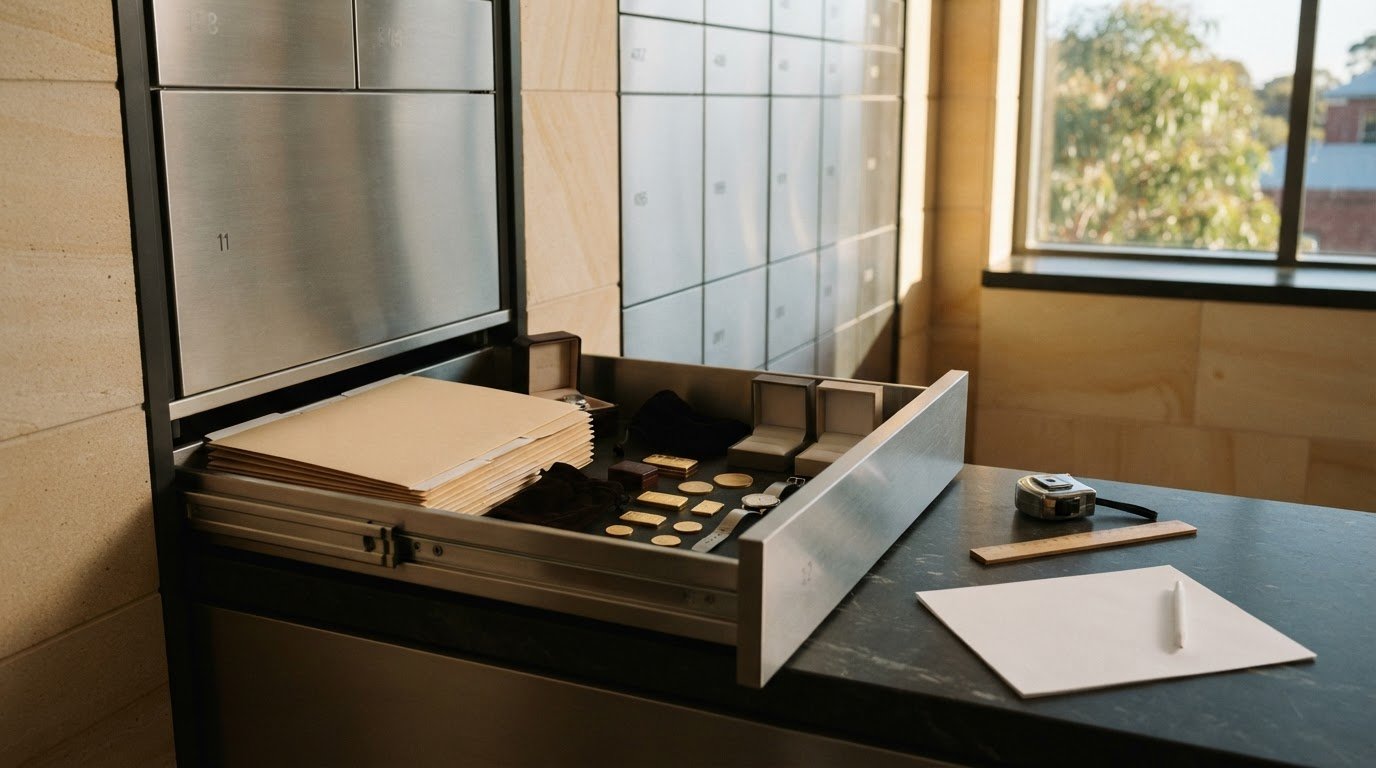
List each item individually or group similar items together, but include everything that takes up room. Record the folders, jewellery cases, bullion packaging, boxes and protective materials you intend to store, not just their contents.
- For documents, note whether they’ll be stored loose, in sleeves or inside folders.
- For jewellery and keepsakes, include the dimensions of their cases or boxes.
- For bullion or other irregular, bulky belongings, estimate the outer length, width and height of the packaged item.
Also mark anything fragile, confidential or sentimental. These items may need careful placement or separation, affecting how you arrange belongings and how much of the available space is practical to use.
Why item count alone can mislead
Ten flat certificates may fit together neatly, while one large keepsake box or protective case can occupy more room than the documents. Containers add bulk, and dividers or separate packaging can prevent items from being stacked or grouped closely. That’s why a simple tally rarely gives a reliable estimate.
Capacity is the usable space available for your belongings in the arrangement you intend to store them. Think about the complete stored arrangement, including packaging and any separation needed to protect or identify items. A box’s stated size is useful only if its shape suits your inventory.
Use your list to establish a practical starting point: what must fit, how it will be packed and which items need to remain easy to retrieve. That inventory turns choosing the right size safe deposit box into a considered decision, rather than a choice based on item count alone.
How to Estimate the Safe Deposit Box Capacity Your Belongings Need
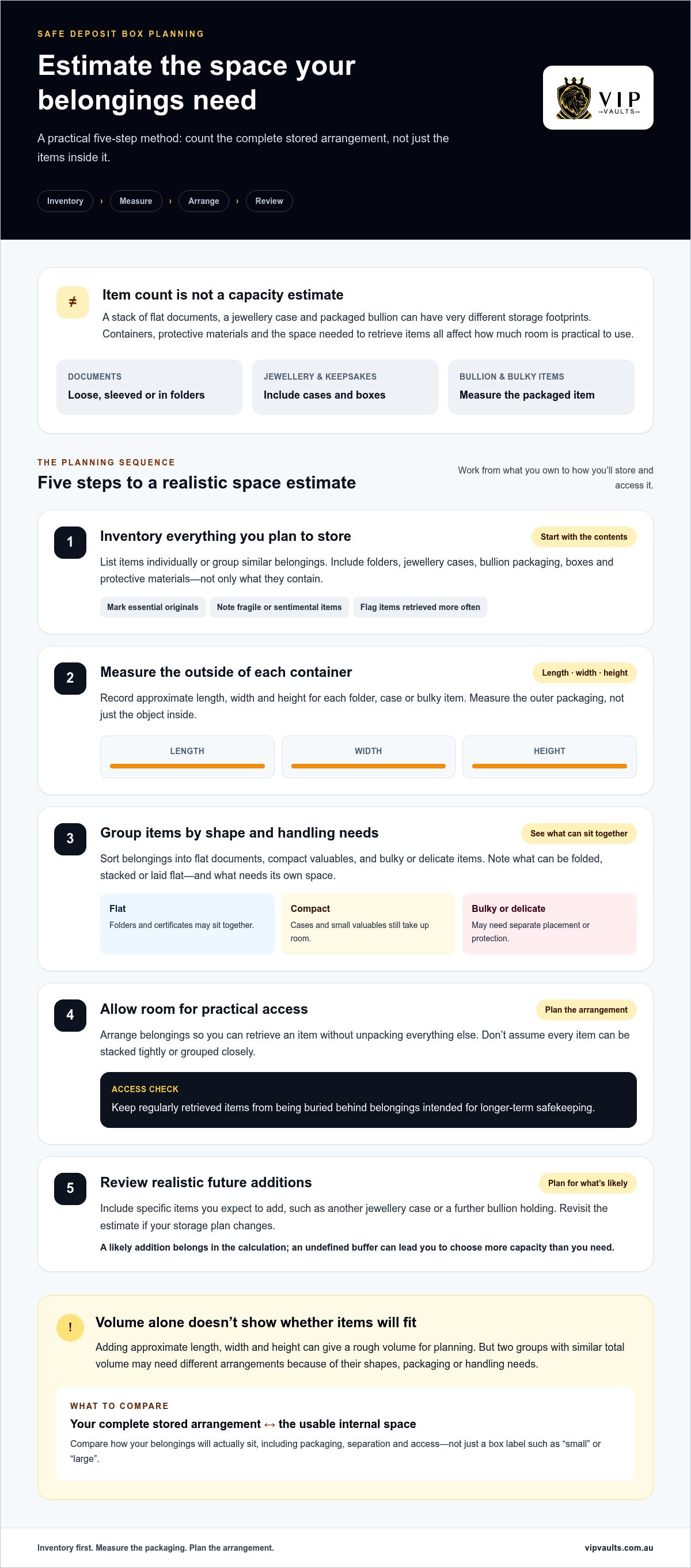
Turn your inventory into a practical space estimate before comparing box labels. The aim isn’t to calculate a perfect volume on paper. It’s to understand the combined footprint of your belongings, packaging and preferred arrangement, then compare it with the usable space available.
- 1. Inventory: List what you plan to store now, including containers and protective packaging. Mark essential originals and items you expect to retrieve more often.
- 2. Measure: Record approximate length, width and height for each folder, case or bulky item. Measure the outside of its container, not only the object inside.
- 3. Group: Sort belongings into flat documents, compact valuables, and bulky or delicate items. This makes it easier to see which pieces could sit together and which need separate space.
- 4. Allow for access: Plan an arrangement that lets you retrieve an item without unpacking everything else. Avoid assuming every item can be stacked tightly.
- 5. Review future additions: Include specific, realistic items you expect to add, such as another jewellery case or a further bullion holding, rather than allowing for an undefined list.
Measure and group items before comparing sizes
Keep grouped measurements together, but note anything that can’t be folded, stacked or laid flat. A folder may fit beside another folder, while a delicate keepsake may need to remain in its own case. Record the shape and packaging as well as the measurements: two groups with similar total volume can require different arrangements.
Estimate capacity by grouping belongings with their packaging, then comparing their combined footprint with the usable space and arrangement available. Adding the approximate length, width and height of each item can provide a rough volume for planning, but it doesn’t show whether those shapes will fit efficiently inside a particular space. Usable capacity depends on the actual arrangement, not volume alone.
Allow for practical access and future additions
Leave room to handle items comfortably, especially if you’ll retrieve some more often. Identify those items in your inventory so they don’t end up buried behind long-term holdings. Revisit your estimate if your storage plan changes. A likely addition belongs in the calculation, but a vague buffer can lead you to choose more capacity than you need.
If your inventory includes substantial or growing holdings, consider how the number, shape and packaging of those belongings affect the space required. A carefully grouped inventory can also help you assess private vault storage options as part of your off-site storage plan.
Compare Safe Deposit Box Options by Belongings, Access and Storage Plans
A useful comparison starts with your own storage scenario, not a label such as “small” or “large”. Facilities may use different names and measurements, so compare the usable internal space and arrangement with your inventory. Choosing the right size safe deposit box also means considering how you’ll access its contents and whether the facility’s security and access arrangements suit your needs.
Match common storage scenarios to capacity needs
Use these scenarios to assess the kind of space and arrangement your belongings may call for. They aren’t fixed capacity recommendations: packaging, item shape and retrieval habits can change the fit.
| Storage scenario | Shape and packaging | Access and additions | What to compare |
|---|---|---|---|
| Compact documents | Folders and flat records can often be grouped together, but covers and sleeves add bulk. | Consider whether you’ll retrieve particular records often and whether you expect to add more folders. | Look for usable space that accommodates the full folder arrangement without bending or compressing documents. |
| Mixed valuables | Documents may sit alongside jewellery cases, keepsakes or a small bullion holding, each with different shapes and packaging. | Think about which items need to remain identifiable or accessible, and what specific belongings may join them. | Consider whether the space allows distinct groups to be arranged without burying or crowding delicate items. |
| Bulky or growing holdings | Larger containers or multiple packaged holdings may be awkward to stack or position together. | Allow for planned additions and the effort involved in retrieving items from a fuller arrangement. | Compare the usable layout with the complete inventory, rather than relying on a size name alone. |
When should you consider a larger capacity?
A larger option may make sense when your measured inventory includes bulky containers, items that can’t be stacked, or realistic additions you expect to store. Extra room is useful only if it supports an orderly arrangement. Consider whether you can identify and retrieve belongings easily, rather than leaving a tightly packed collection behind.
Capacity is one part of the decision. Weigh it alongside the discretion, security and access arrangements that suit your storage plan. For a broader overview, read the private vaults in Australia guide. VIP Vaults offers private vault rentals and bullion lockers for off-site storage of jewellery and precious metals. Explore private vault storage as you assess the fit for your holdings and habits.
A Safe Deposit Box Selection Checklist for Documents, Jewellery and Bullion
Use this checklist to turn your storage plan into a clear, reviewable record before comparing capacity. Keep the inventory discreet: record categories and approximate dimensions, not account numbers, document references or other sensitive identifying details. This makes choosing the right size safe deposit box more deliberate without putting unnecessary private information in your notes.
Prepare an inventory for documents, jewellery and bullion
- ☐ Documents: Separate essential originals from copies, and note whether each group will be stored loose, in sleeves or in folders.
- ☐ Jewellery and keepsakes: Record the outer dimensions of cases and boxes. Mark fragile or sentimental pieces that need careful placement.
- ☐ Bullion: Note whether holdings are coins or bars, and include their cases or protective packaging in your estimate. Their different forms can affect how you organise the space. See the gold coins versus gold bars guide for more on how form and packaging relate to storage planning.
- ☐ Size and arrangement: Estimate the length, width and height of containers and items that can’t be stacked or folded.
- ☐ Handling needs: Flag confidential, delicate or sentimental belongings that may need to be stored separately or retrieved with care.
Group items by type, then consider their combined arrangement. A compact document folder and a boxed keepsake may need different placement even if their estimated volumes seem similar. Keep your notes practical and secure.
Review access, organisation and changing needs
For each group, estimate how often you may need to retrieve it: frequently, occasionally or rarely. Mark priority items so your planned arrangement keeps them accessible without crowding or disturbing long-term holdings. Everyday items you may need at short notice should be considered separately from belongings intended for secure, longer-term storage.
- ☐ Can priority items be reached without moving several other groups?
- ☐ Does the plan allow delicate items to remain protected?
- ☐ Have you included only realistic additions you expect to store?
- ☐ Will you review the inventory if your holdings or access habits change?
Revisit the list whenever you add or remove belongings. Capacity that suited an earlier inventory may no longer support an orderly arrangement. If you’re considering storage for SMSF-related holdings, the SMSF gold storage guide offers further storage context; it isn’t a substitute for legal or tax advice.
Once your checklist is complete, consider VIP Vaults private vault rental and bullion locker options as part of your off-site storage plan.
Choose a Private Vault or Bullion Locker That Fits Your Storage Plan
Your inventory gives you a sound basis for comparing storage options. Before deciding, bring together four considerations: the belongings and their packaging, the usable capacity needed for a practical arrangement, how often you expect to retrieve items, and any additions you realistically anticipate. Choosing the right size safe deposit box is part of a broader storage decision, not simply a matter of selecting the largest space available.
How private vault rental fits a considered storage plan
For precious metals, jewellery and other valuables intended for off-site storage, VIP Vaults provides private vault rentals and bullion lockers. The business is privately owned and independent of government and financial institutions. Its focus is secure storage, not banking services.
Consider discretion and the storage arrangement alongside capacity. A suitable choice should make sense for the items you intend to store and the way you expect to access them. More space alone doesn’t make an option a better fit; an orderly, usable arrangement aligned with your storage habits matters too.
Take the next step with a clear inventory
Use your item list and approximate measurements to guide the decision. Include outer packaging, note belongings that need careful separation, and distinguish items you may retrieve from holdings intended to remain stored longer. This gives you a clearer picture of the space you need without relying on size labels that may differ between facilities.
Before settling on an option, review whether the planned arrangement fits comfortably, whether priority belongings will be practical to retrieve, and whether expected additions are specific enough to include. Revisit the estimate if your holdings or access habits change. VIP Vaults provides private vault rentals and bullion lockers for off-site storage of precious metals and jewellery.
Explore private vault rental and bullion storage and put your storage plan into practice.
Make Your Storage Choice With Confidence
Choosing the right size safe deposit box starts with a clear picture of what you’ll store, how it’s packaged and how you’ll arrange it. Measure containers as well as their contents, then compare your inventory with the usable space rather than relying on size labels alone.
Factor in retrieval habits, too. Arrange priority belongings for practical access, while allowing for realistic future additions to help avoid outgrowing your chosen capacity. Review your inventory as your holdings change.
For precious metals and jewellery, VIP Vaults provides private vault rentals and bullion lockers. Privately owned and independent of government and financial institutions, the business offers discreet off-site storage as part of a considered plan.
Use your inventory to guide the next step. Explore private vault rental and bullion storage and choose a storage arrangement shaped around your belongings and habits.
Frequently Asked Questions
How do I choose the right size safe deposit box?
Choose capacity by matching your inventory to the usable space and arrangement available. List each item and its packaging, group belongings by shape, and consider how often you’ll retrieve each group. Choosing the right size safe deposit box also means allowing room for specific additions you realistically expect, rather than an unlimited buffer. A well-planned arrangement should let you organise and access stored belongings without tightly packing them.
What should I measure before choosing a safe deposit box?
Measure the outer dimensions of folders, cases, boxes and protective packaging, not just the objects inside. Record approximate length, width and height for bulky or irregular items, such as a keepsake box or bullion case. Note belongings that can’t be folded or stacked, and mark fragile items that need careful placement. These measurements help you compare your complete stored arrangement with available usable space.
Should I choose a larger safe deposit box for future valuables?
Consider a larger capacity if you have specific additions in mind, such as another jewellery case or further bullion holdings. Avoid choosing extra space for belongings you might acquire someday without a clear plan. Weigh expected additions against the cost and practical organisation of unused capacity. Revisit your inventory as your holdings change, so your storage arrangement continues to suit what you keep and how you access it.
Can jewellery and documents be stored in the same safe deposit box?
Jewellery and documents can be planned as part of one storage arrangement, but their shapes and handling needs differ. Folders may lie flat, while jewellery cases can take up more space or need separation to protect delicate pieces. Include the outer dimensions of both in your inventory, and plan how to retrieve priority documents or valuables without disturbing other items. Keep confidential or sentimental belongings clearly accounted for in your plan.
Is a safe deposit box size label the same across all providers?
No. Labels such as “small” or “large” aren’t a reliable way to compare capacity because facilities may use different naming systems and dimensions. Compare the stated usable internal space with the outer measurements of your belongings and packaging. Also consider shape and layout: two spaces with similar volume may not suit the same arrangement. Focus on whether your inventory fits comfortably and remains practical to organise and retrieve.
What happens if my belongings no longer fit in my safe deposit box?
If your belongings no longer fit comfortably, review the inventory and remove items that no longer need off-site storage from the plan. Don’t force items into a crowded arrangement, as that can make organisation and retrieval difficult. Reassess your current holdings, packaging, access habits and realistic additions, then consider what capacity suits the revised plan. Update your measurements whenever you add or remove bulky cases, folders or valuables.
Do bullion bars need more space than bullion coins?
Not necessarily. The space required depends on the actual dimensions, quantity and packaging of the bars or coins. Bars may have a different shape from coins, while coin tubes, cases or protective packaging can also add bulk. Measure the outer dimensions of each packaged group and note whether items can be stacked or arranged together. Compare the complete footprint, rather than assuming one bullion form always requires more space.