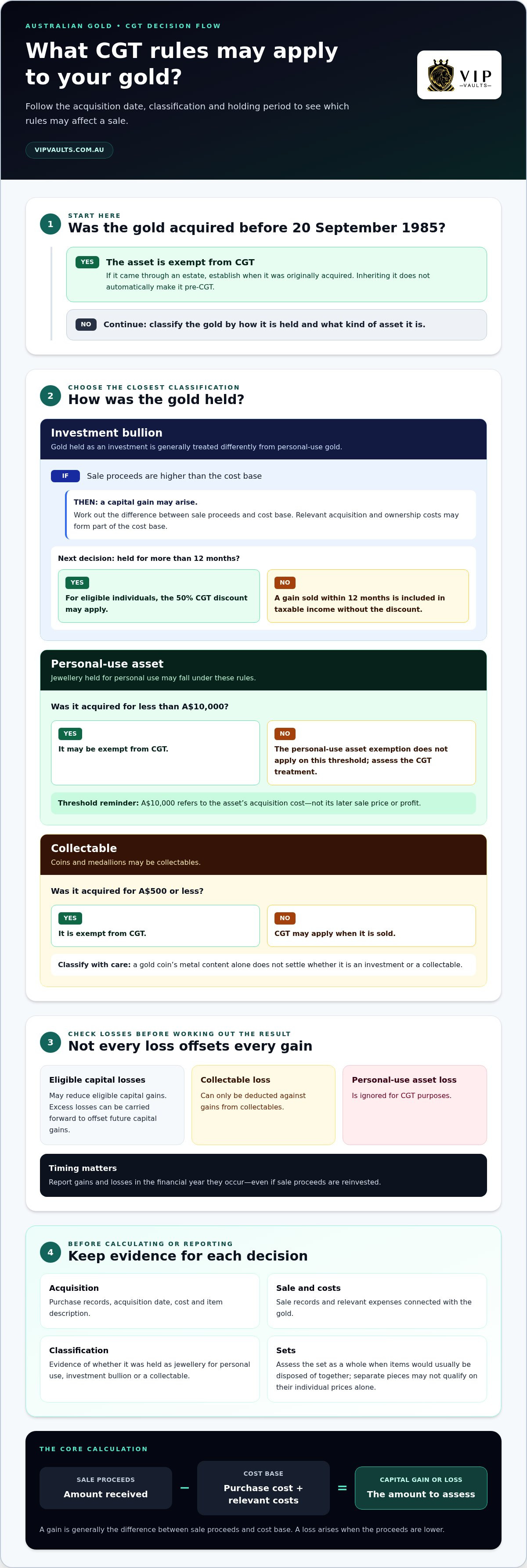
A profit on investment gold can trigger capital gains tax, but the amount you include may depend on how long you held it and the asset’s classification. For eligible individuals, the Australian Taxation Office says the 50% CGT discount may apply when an asset has been held for more than 12 months. Personal-use asset rules can also affect whether some gold items are exempt.
It’s easy to assume that selling bullion means paying tax on the full sale price, or that a personal-use exemption covers every gold item. In practice, the gain is generally the difference between the sale proceeds and the asset’s cost base. The rules depend on the type of gold and how you held it.
This guide explains when capital gains tax on gold in Australia may apply, how personal-use asset and collectable rules differ, and what to consider when reporting a bullion gain. You’ll also learn how the holding period, eligible capital losses and record-keeping can affect the result, helping you understand the tax implications before selling.
Key Takeaways
- Identify whether your gold is bullion, jewellery, a personal-use asset or a collectable, as classification can change the CGT rules that apply.
- Some personal-use assets acquired for less than A$10,000 may be exempt, while collectables have a separate A$500 threshold.
- Capital losses may reduce capital gains, but losses on personal-use assets are ignored and collectable losses are restricted to gains from collectables.
- Keep records of acquisition, sale and relevant costs so you can work out the gain and support your tax return.
- Report gains and losses in the financial year they occur, even if you reinvest the sale proceeds.
What is capital gains tax?
Capital gains tax applies to a profit from selling an asset, rather than the full sale proceeds. For example, a gold coin valued at A$4,000 and later sold for A$4,300 may produce a A$300 capital gain.
Calculating Capital Gains and Losses
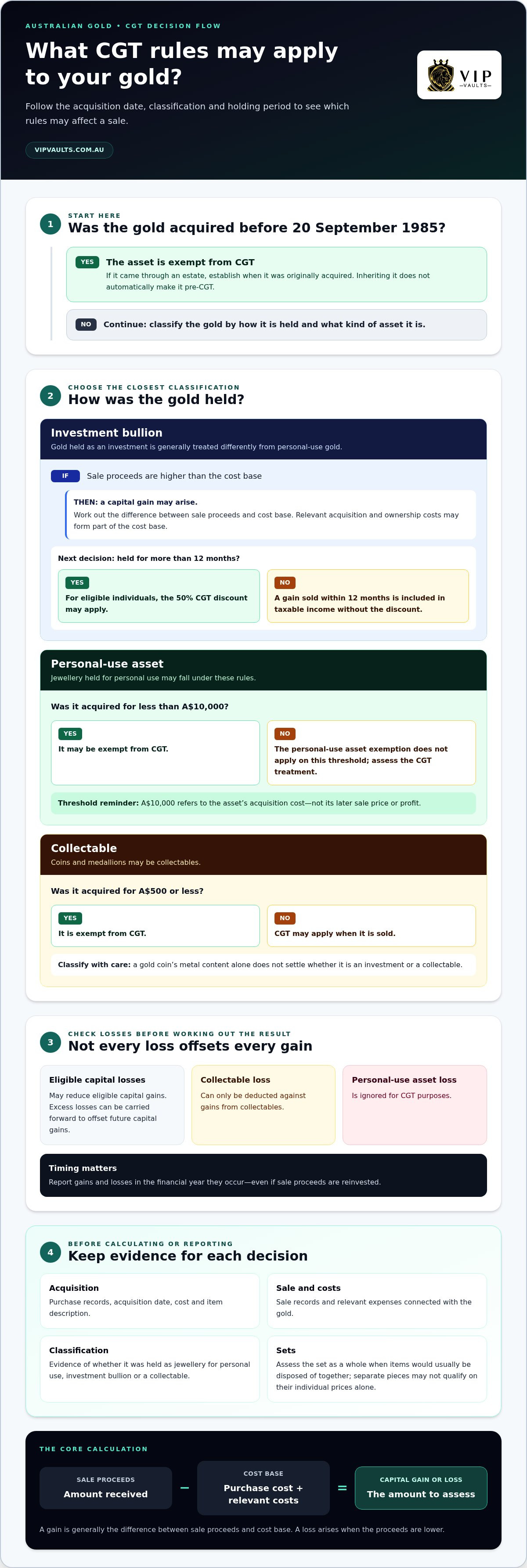
A capital gain is generally the difference between an asset’s sale proceeds and its cost base. A capital loss arises when the proceeds are lower. This calculation identifies the amount that may affect your tax position, rather than treating the entire sale price as profit.
For a straightforward example, subtract the purchase cost from the sale price: gold bought for A$6,000 and sold for A$9,000 produces a A$3,000 gain. Keep purchase and sale records so you can support both figures. The asset’s cost base may also include relevant acquisition and ownership costs, so retain records of expenses connected with the gold.
Gold isn’t the only asset that can produce a gain or loss. Selling shares, jewellery or bullion may also affect your overall result, depending on each asset’s classification and cost base. Calculate the result for each asset separately before combining eligible gains and losses.
Offsetting Gains with Capital Losses
Capital losses can reduce eligible capital gains, lowering your net capital gain for the relevant financial year. If you sell gold at a profit and another asset at a loss, that loss may reduce the amount remaining after eligible offsets.
For example, a A$5,000 gold gain offset by a A$3,000 loss from shares leaves a A$2,000 net capital gain. Capital losses from the same financial year can offset capital gains, and any excess losses can be carried forward to offset future capital gains.
Timing matters because gains and losses are accounted for in the financial year they occur. The sale date determines which year a gain or loss can be considered against other eligible amounts. Review completed and planned sales together before working out your net position for the year.
Not every loss can offset every gain. A capital loss on a collectable can only be deducted against gains from collectables, while losses on personal-use assets are ignored. Classify gold coins, jewellery and investment bullion correctly before applying a loss, and keep separate calculations where the rules treat asset types differently.
Personal jewellery and personal-use asset exemptions
Gold jewellery and coins don’t all receive the same CGT treatment. The relevant factors include whether an item is a personal-use asset, a collectable or an investment, and what it cost to acquire.
A gold item classified as a personal-use asset may be exempt from CGT if it was acquired for less than A$10,000. This threshold is about the asset’s acquisition cost, not its eventual sale price or the profit made. Keep purchase records and identify the item being sold, because the classification and acquisition amount both matter.
Jewellery held for personal use may fall under personal-use asset rules, while gold held as an investment is generally treated differently. For Australian tax residents, most gold and silver investments are CGT assets under Part 3-1 of the Income Tax Assessment Act 1997. Holding an item for personal enjoyment doesn’t by itself establish how it is treated for tax purposes; the asset’s character and purpose remain relevant.
Collectables have a separate threshold. A collectable acquired for A$500 or less is exempt from CGT, while gold collectables bought for more than A$500 can trigger CGT when sold. Coins and medallions are among the items that may be collectables. A gold coin’s metal content alone doesn’t settle its classification: consider whether it is held as an investment or as a collectable.
Sets require particular care. If collectables are acquired individually but would usually be disposed of as a set, the exemption applies only when the set was acquired for A$500 or less after 16 December 1995. For personal-use assets usually sold as a set, disposing of items separately qualifies for the exemption only if the set was acquired for A$10,000 or less. Assess the set as a whole rather than relying only on the price of each piece.
There is also a key acquisition-date rule: assets acquired before 20 September 1985 are exempt from CGT. If jewellery or a coin has passed through an estate, establish when the asset was originally acquired and whether the rules treat it as pre-CGT. Don’t assume an inherited item automatically qualifies based only on the date you received it.
Keep invoices, descriptions and evidence of how items were held. These records help distinguish jewellery for personal use from investment bullion or collectable coins, and support the relevant exemption when you prepare your tax return.
Is There a Tax on Selling Gold in Australia?
Selling gold may create a capital gain if the sale proceeds exceed the asset’s cost base. For eligible individuals, the holding period can affect whether the CGT discount reduces the gain included in taxable income.
The Minimum Holding Period
The minimum holding period for the CGT discount is more than 12 months between acquiring an asset and selling it. That timing matters because a gain on gold sold within 12 months of purchase is included in taxable income without the discount.
Keep evidence of the acquisition and sale dates, such as purchase and transaction records. For example, a gold investment held for 13 months before sale passes the stated holding-period threshold, while an investment sold within 12 months does not qualify on that basis.
Applying the CGT Discount to Gold
The CGT discount reduces an eligible capital gain by 50% for individuals in Australia who hold an asset for more than 12 months, according to the Australian Taxation Office. This can reduce the gain included in taxable income, but it doesn’t mean the sale is tax-free.
For example, a A$5,000 gain on gold held for more than 12 months becomes a A$2,500 discounted capital gain. The discount applies to the gain, not the full sale proceeds or the gold’s total value.
Consider an investment bought for A$10,000 and sold for A$15,000 after 18 months. Its A$5,000 gain may be reduced to A$2,500 under the 50% discount, if the individual and asset meet the relevant conditions. The resulting amount is the discounted capital gain, not a calculation of the final tax bill. Tax payable depends on the taxpayer’s circumstances and applicable tax rates.
Both the holding period and the asset type matter. Gold bullion acquired as an investment differs from jewellery held for personal use or a coin treated as a collectable. Classify the asset before applying the discount, because personal-use and collectable rules may affect whether a gain is taxable or a loss can be used.
To assess a sale, establish when you acquired the gold, when the CGT event occurred and whether the asset qualifies for the discount. Calculate the gain from the sale proceeds and cost base, then account for eligible capital losses before applying any discount. Understanding the rules for capital gains tax on gold in Australia helps you distinguish a discounted gain from one that receives no discount.
A dealer’s description of gold as investment-grade doesn’t determine the holding period. Use your own acquisition records to establish how long you held it. The same timing principle applies whether you sell a gold bar or an eligible bullion coin.
How capital gains tax works and is reported
In Australia, a CGT event can occur when an asset is sold, lost or destroyed. For gold, calculate the profit rather than treating all sale proceeds as a gain.
Keep purchase and sale records, evidence of relevant costs, and documents showing when you acquired the gold. If tax law requires a market valuation, it must be objective and supportable.
Reporting Gold Sales on Tax Returns
Report any capital gain or loss from a gold sale in your tax return for the financial year the CGT event occurs. This applies even if you reinvest the proceeds rather than keeping the sale money.
For example, a gold bar bought for A$20,000 and sold for A$30,000 two years later has a A$10,000 gain before eligible adjustments. Work out the cost base, account for applicable capital losses and any discount, then report the resulting amount for that financial year.
The Australian Taxation Office expects taxpayers to report capital gains and losses in the year they occur. A capital loss may affect your net gain, but asset classification can limit which gains it offsets.
Keeping CGT Records
CGT records establish an asset’s acquisition, ownership costs, sale proceeds and relevant dates. Keep them because each figure supports the calculation in your tax return.
Retain purchase invoices, dealer receipts, sale confirmations and evidence of payment. Keep records of shipping or insurance costs that may form part of the cost base, along with documents identifying the bullion’s description and quantity.
Also retain evidence of when you acquired and sold the gold, along with calculations showing how you arrived at any gain or loss. If a market valuation is required, keep the valuation and its supporting evidence so you can substantiate the figure.
AUSTRAC has a separate role from the Australian Taxation Office. As Australia’s financial intelligence agency, it oversees financial transaction monitoring and anti-money-laundering regulation. That oversight doesn’t replace your obligation to calculate and report a CGT outcome in your tax return.
Keep tax calculations distinct from transaction monitoring. A bullion sale may involve records relevant to both, but CGT focuses on the asset’s cost base, sale proceeds and the financial year of the CGT event. AUSTRAC’s oversight concerns financial intelligence and compliance monitoring.
Before lodging your return, reconcile each gold transaction against your records. Match the acquisition cost to the asset sold, include supported cost-base expenses and record the sale proceeds. Then account for eligible losses and discounts. If gold is lost or destroyed rather than sold, record the event and supporting evidence, as it may also trigger a CGT event.
Capital gains tax on gold bullion
Gold bullion held as an investment can produce a taxable capital gain when sold for more than its cost base. The key calculation uses the asset’s dollar value, not its weight, so a heavier bar doesn’t automatically mean a larger gain.
Start with the sale proceeds and compare them with the bullion’s cost base. The difference is the gain or loss before relevant adjustments. For example, a bar bought for A$6,000 and sold for A$9,000 produces a A$3,000 gain. This is profit on the investment, not tax on the full sale amount.
Include eligible costs when establishing the cost base. Shipping and insurance costs for gold or silver investments can form part of it, so retain invoices and payment evidence. Link each expense to the bullion acquired. This helps distinguish the purchase price and relevant costs from unrelated personal or household expenses.
The length of time you hold bullion can affect the taxable gain. If an individual holds an eligible asset for more than 12 months, the 50% CGT discount may apply. Calculate the gain first, then consider eligible capital losses and whether the discount applies. A discount changes the gain included in taxable income, not the bullion’s sale proceeds.
Buying investment-grade bullion and selling it later can involve both GST and CGT, but they are different taxes. Investment-grade gold is generally GST-free in Australia. That doesn’t make a later capital gain exempt: CGT depends on the sale, cost base, holding period and applicable rules.
Classification also matters. Bullion held as an investment differs from jewellery or a gold item treated as a collectable or personal-use asset. A dealer’s description may help identify what you bought, but your records should show the form of the gold and the purpose for which you held it. Apply the relevant rules to that asset rather than assuming all gold is treated alike.
Before selling gold, gather the purchase documents, sale details and evidence of related costs. Calculate the gain in dollars, check the holding period, then account for eligible losses and any discount. Keep the calculation with your tax records so you can trace the reported amount back to the transaction.
If you hold physical bullion and want a dedicated place for it, explore a Bullion Locker as part of your storage planning.
VIP Vaults & Bullion Exchange Perth: Private Vault Rental
VIP Vaults & Bullion Exchange Perth offers Private Vault Rental and Bullion Locker options for people holding physical precious metals. If you retain bullion rather than sell it, secure storage can support your asset-management arrangements while you keep the purchase records needed to calculate a future gain.
Storage doesn’t change how a later sale is assessed for CGT. Your acquisition date, cost base, sale proceeds and eligible costs remain central to calculating any gain. Keep transaction documents accessible with your records, whether you hold gold or silver bullion.
Choose Private Vault Rental for a dedicated vault for precious metals, or a Bullion Locker for bullion storage. Explore these options and book an appointment at vipvaults.com.au.
Make your next gold decision with clarity
Tax is one part of owning physical gold. How you hold, document and safeguard an asset also deserves careful attention, especially as your plans change over time. Keep your records organised and consider how storage arrangements fit alongside your ownership decisions.
VIP Vaults & Bullion Exchange Perth offers Gold Bullion, Private Vault Rental and Bullion Lockers for people considering precious metals and secure storage. These options can support different needs, from acquiring bullion to storing existing holdings. Understanding capital gains tax on gold in Australia can help you make these decisions with a clearer view of the tax considerations.
Explore the available options and take the next step at VIP Vaults & Bullion Exchange Perth. A considered approach to ownership and storage can help you move forward with confidence.
Frequently Asked Questions
Do Gold Buyers Report Gold Sales?
A buyer’s transaction reporting and your CGT reporting are separate matters. AUSTRAC oversees financial transaction monitoring and anti-money-laundering regulations, but doesn’t calculate or lodge your personal capital gain. Keep the buyer’s sale record and your acquisition documents. You’re responsible for reporting a taxable gain or loss in your tax return for the financial year the CGT event occurs.
Do you have to declare Gold to ATO?
You generally report a taxable capital gain or loss when a CGT event occurs, rather than declaring every gold item simply because you own it. For example, a gold gift from a friend or relative isn’t taxable income and doesn’t need to be included as income on your return. A later sale may still have CGT consequences, so keep information about the gift and any subsequent transaction.
How is capital gains tax calculated on gold in Australia?
Work out the gain by comparing the sale proceeds with the gold’s cost base, then account for relevant adjustments, eligible losses and any applicable discount. For instance, if an inherited coin was valued at A$4,000 and later sold for A$4,300, the example gain is A$300. The taxable amount may differ after applying the rules that fit the asset and the taxpayer.
Is physical gold considered a CGT asset by the ATO?
Yes, gold held as an investment is generally a CGT asset for Australian tax residents. Most gold and silver investments are treated as CGT assets under Part 3-1 of the Income Tax Assessment Act 1997. Physical form alone doesn’t settle the treatment: a bar held for investment may be treated differently from jewellery for personal use or a coin classified as a collectable.
What is the CGT discount for gold held longer than 12 months in Australia?
Individuals may receive a 50% CGT discount on eligible assets held for more than 12 months, according to the Australian Taxation Office. The period runs from acquisition to the CGT event, so retain dated purchase and sale records. The discount reduces an eligible capital gain, not the gold’s full selling price, and it doesn’t mean the transaction is automatically tax-free.
How are gold bullion, coins, jewellery and gold ETFs taxed differently in Australia?
Tax treatment depends on an asset’s character and how it is held. Investment bullion is generally a CGT asset; jewellery may fall under personal-use asset rules, while some coins may be collectables. A gold ETF is a fund investment, not physical bullion in your possession, so don’t assume the personal-use rules for jewellery apply. Use transaction and tax records for the specific asset sold.
Are there CGT exemptions or thresholds for personal-use gold assets in Australia?
Some personal-use gold assets acquired for less than A$10,000 may be CGT-exempt. Collectables have a separate threshold: an item acquired for A$500 or less is exempt, while a collectable acquired for more may have CGT consequences. Coins and medallions can be collectables. If items are usually disposed of as a set, assess the acquisition cost of the set, not just each piece.
How is the cost base of gold calculated, including premiums, storage and selling fees?
Start with records showing what you paid for the gold, including the purchase price on the invoice. Shipping and insurance costs for gold or silver investments can form part of the cost base. Keep storage and selling fees itemised separately rather than assuming they qualify. Invoices, dealer statements and payment records help identify each cost and support the calculation in your tax return.