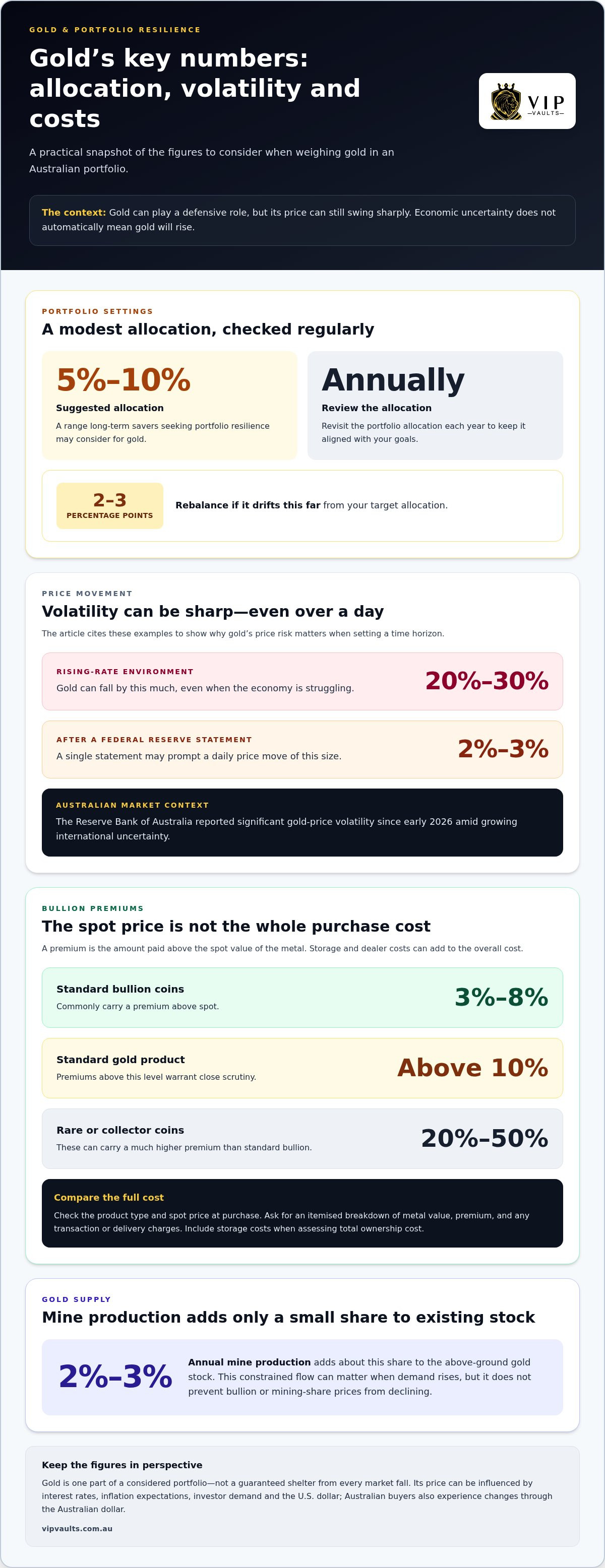

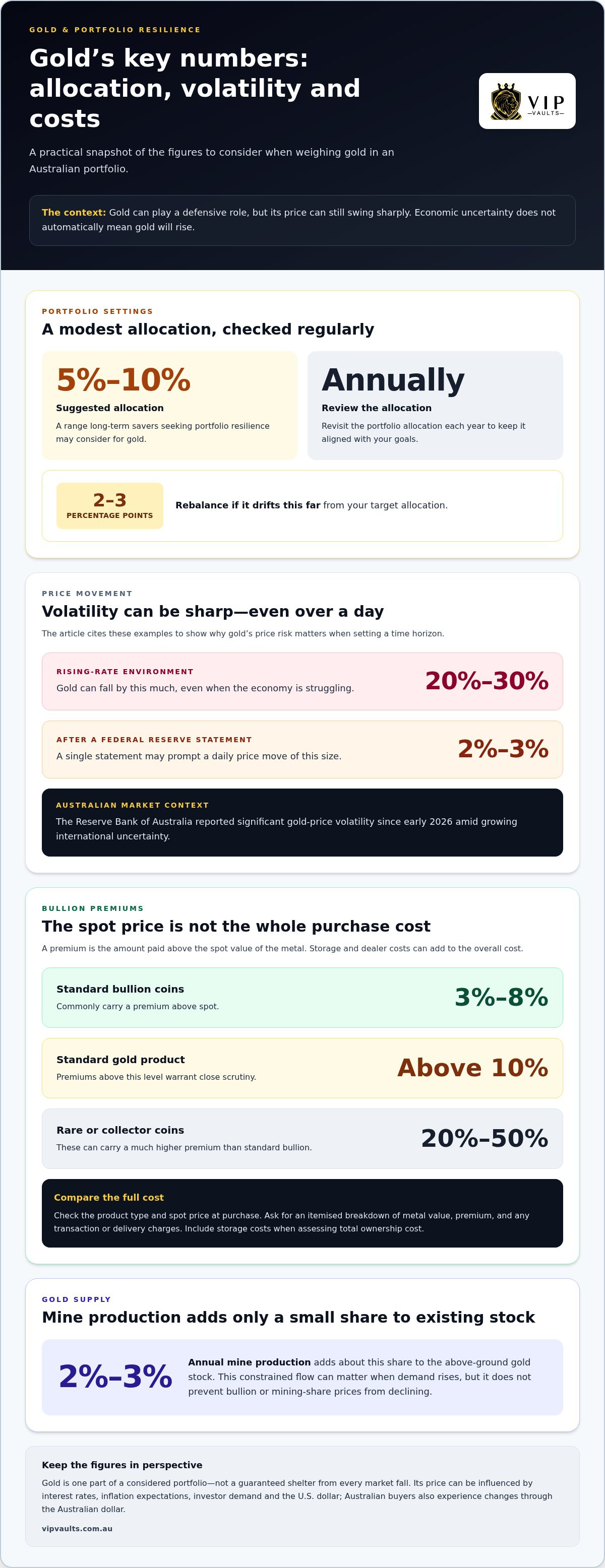
Gold can play a defensive role without offering a steady price. For Australians buying gold during economic uncertainty, a suggested allocation for long-term savers seeking portfolio resilience is 5%-10%; review it annually and rebalance if it drifts more than 2-3 percentage points from your target. The key is to treat gold as one part of a considered portfolio, not a guaranteed shelter from every market fall.
It’s understandable to look for an asset that may help balance uncertainty. But gold prices can swing as inflation expectations, interest rates, investor demand and the U.S. dollar shift. Economic uncertainty does not automatically mean gold will rise.
This article explains how these forces shape gold’s price, why volatility matters, and how allocation and rebalancing can keep your approach aligned with your goals. It also covers why your time horizon and the Australian-dollar value of gold matter when weighing its place in a portfolio.
Key Takeaways
- Compare physical bullion, exchange-traded funds, mining shares, futures and digital gold by considering what you own, how its price behaves and how you access it.
- Gold can be volatile: the Reserve Bank of Australia reported significant price volatility since early 2026 amid growing international uncertainty.
- Gold may act as a safe haven during some crises, but its performance varies with investor demand, market conditions and policy responses.
- Inflation expectations and movements in the U.S. dollar can influence gold prices, while Australian buyers also experience changes through the Australian dollar.
- Look beyond the spot price when comparing ways to buy gold. Ownership structure, transaction costs and secure storage all affect the overall decision.
Investing in Gold: Is Gold Still Considered a Safe Bet in Uncertain Economic Times?
Gold can provide exposure that differs from shares, but its price can still fall sharply. Australians assessing a bullion purchase can review the dealer’s reputation and transaction records, then check the product’s stated weight, purity and identifying marks against its documentation.
Ways to invest in gold
Gold investments range from physical metal to contracts and digital claims, each offering a different kind of exposure. Physical bullion means owning gold directly. An exchange-traded fund (ETF) provides market exposure through units, while mining shares represent ownership in companies whose results depend on more than gold prices.
Futures are contracts tied to a future transaction, while digital gold generally represents a claim recorded electronically. Compare what you own, how you can sell it and what costs apply. An ETF may suit someone who prioritises convenient market access; physical bullion may suit someone seeking direct ownership. Neither removes price risk.
For physical gold, follow a clear verification process. Match the item’s description, weight and purity to the invoice or product documentation, and inspect its identifying marks. Ask how the dealer establishes authenticity and what records accompany the sale. A hallmark or certificate can help, but make sure the documentation refers to the specific item you’re buying.
Mining shares add company risks, including operating costs, mine development and production disruptions. Gold supply also responds slowly: annual gold mine production adds about 2% to 3% to the above-ground gold stock. That constrained flow can matter when demand rises, but it doesn’t prevent share prices or bullion prices from declining.
Costs of buying bullion
The bullion premium is the amount paid above the spot value of the metal; storage and dealer costs add to the overall purchase cost. Standard bullion coins commonly carry premiums of 3%-8% above spot. Premiums above 10% for a standard gold product warrant close scrutiny, while rare or collector coins can carry premiums of 20%-50%.
Compare the quoted premium with the product type and spot price at the time of purchase. A collector coin’s higher premium reflects a different market from standard bullion, so don’t assume you’ll recover the extra cost when selling. Before deciding, request an itemised breakdown of the metal value, premium and any transaction or delivery charges.
Storage costs depend on how you hold the metal. Keeping bullion yourself avoids a separate vault fee, but makes you responsible for physical security and records. Third-party storage may involve fees and conditions. Compare these with your holding period and access needs, and include them in your total cost of ownership.
Gold volatility, interest rates and investment time horizons
The Reserve Bank of Australia reports significant gold-price volatility since early 2026 amid growing international uncertainty. Interest-rate shifts and your investment horizon can change how that volatility affects a portfolio.
Choosing a gold investment
Match the investment vehicle to your goals, holding period and capacity to manage risk. This distinction matters: exposure to gold through a fund is not the same as owning bullion directly.
Start by considering access and ownership. Physical bullion gives you direct possession; ETFs and mutual funds provide exposure through fund units. Fund flows can affect investment demand, while fees, fund structure and market movements shape returns. Mining shares add company-specific risks, and futures can magnify gains and losses through leverage.
Next, weigh your time horizon against price swings. Gold can fall 20%-30% in a rising-rate environment, even when the economy is struggling. A single Federal Reserve statement may prompt a 2%-3% daily move. Long-term savers seeking portfolio resilience may consider a 5%-10% allocation, then review it annually and rebalance if it drifts more than 2-3 percentage points from its target.
In Australia, profit from selling gold held as an investment asset is subject to capital gains tax. GST treatment depends on the product’s classification and the transaction, so don’t assume bullion, jewellery and collectibles receive identical treatment. Keep purchase records and consider the product type when assessing tax consequences.
U.S. tax treatment is separate: long-term gains on physical gold and gold ETFs may face a maximum collectibles rate of 28% when held for more than one year. These U.S. rules are not an Australian tax calculation.
Gold investment risks
Investment risks include price declines, misleading sales practices and the difference between a buying price and a resale offer. Understand these risks: the quoted gold price alone doesn’t show how much you may recover when selling.
Scams can involve counterfeit products, false claims or pressure to act quickly. Before paying, verify the dealer’s identity and transaction records, compare the product’s stated weight and purity with its documentation, and avoid decisions driven by urgency. Physical gold also requires secure storage and careful record-keeping.
Resale spreads reduce your proceeds: a dealer’s buying price may be below its selling price even if the spot price hasn’t changed. Ask how resale value is determined and compare the buy-back terms with your original purchase price. Include premiums and holding costs in your break-even calculation.
Leverage increases the stakes. A futures position or borrowed investment can amplify losses if gold moves against you. Set a maximum exposure and avoid risking money needed for near-term expenses. For an ETF or mutual fund, understand its structure and how market-price changes affect the value of your units.
Gold’s role as a safe-haven asset during economic uncertainty
Gold’s safe-haven reputation comes from its performance during some periods of financial stress, not from guaranteed protection. The 2008 global financial crisis and later European sovereign debt crisis show why investors assess the conditions behind each price movement.
Gold during financial stress
A safe-haven asset is one investors may favour when confidence in other assets weakens. Demand can lift gold during a crisis, but changing conditions can also reverse that movement.
After the stock-market collapse, gold doubled in value between 2007 and 2011 as investment demand rose. During the global financial crisis, investors faced falling share prices and uncertainty about financial institutions. Gold’s response reflected that demand, rather than a fixed relationship with every market decline.
Consider the source of market stress before interpreting a gold rally. A banking shock may prompt investors to seek assets outside financial markets, while rising interest rates can pressure gold. The same crisis can have different effects over time as central banks respond and investors reassess risk.
Gold also differs from cash. Bullion has no issuer whose promise determines its value, but its market price still changes. Anyone holding physical gold must consider storage, access and the price offered when selling. The safe-haven label doesn’t remove these practical risks.
Gold in recessions
During a recession, gold may help diversify a portfolio when company earnings and share prices come under pressure. Its relevance depends on investor demand and policy conditions, so it shouldn’t replace cash you may need soon.
In the United States, gold outperformed the S&P 500 during most of six of the last eight recessions. Results varied by episode and policy environment, making that history context rather than a forecast for Australia’s next downturn.
For Australian investors, a global recession can affect local holdings through currency movements as well as the international gold price. A weaker Australian dollar can increase gold’s value in local currency, even if its overseas price changes little. A stronger Australian dollar can have the opposite effect.
Assess gold’s role in your portfolio, not in the crisis headlines. Decide whether you want diversification, direct ownership or liquidity, then consider how long you can hold through a downturn. Gold can behave differently from shares, but its price can still fall when investors sell assets to raise cash.
History offers examples, not a reliable timetable. The 2007-2011 rise followed increased investment demand, while another recession may bring different interest-rate decisions, currency movements and investor priorities. Treat gold as one potential component of a broader plan, and judge its value by how it fits your exposure to other assets.
Inflation and the U.S. dollar’s influence on gold
Inflation and currency movements affect gold in different ways. For Australian investors, the international gold price is commonly quoted in U.S. dollars, while its local value also reflects the Australian dollar. Gold can therefore rise in Australian-dollar terms even when its U.S.-dollar price is steady, if the Australian dollar weakens. A stronger Australian dollar can reduce local returns, so assess both movements rather than relying on one headline price.
Inflation can make gold attractive when investors worry that money will buy less over time. But the relationship isn’t automatic: gold prices also respond to interest rates, currency strength and investor demand. Distinguish nominal returns, which reflect changes in the quoted price, from real returns, which account for inflation. If gold’s price rises more slowly than consumer prices, its purchasing power may still fall.
The modern era of gold pricing began in 1971, when the Bretton Woods system ended and gold was no longer fixed to the U.S. dollar. Since then, gold has traded in response to market forces, including changing inflation expectations. January 1980 marked an inflation-adjusted peak in gold’s historical record. That example shows why a long-term store-of-value reputation doesn’t mean every purchase preserves purchasing power over every period.
The U.S. dollar is another important influence because gold is priced internationally in that currency. When the dollar strengthens, gold can become more expensive for buyers using other currencies, potentially affecting demand. When it weakens, gold may become more accessible to those buyers. For Australians, the exchange rate adds another layer: consider the global gold price alongside AUD/USD movements when assessing local performance.
Recent history also illustrates that inflation alone doesn’t determine the direction. Gold reached new all-time highs against the U.S. dollar in 2018, while pandemic-era stimulus injected trillions of dollars in cash into the U.S. economy. Those events provide context, not a simple forecast. An investor weighing gold against inflation should consider the entry price, holding period, currency exposure and costs of ownership.
One comparison says gold lost money relative to inflation over the last 30 years. That finding underlines the importance of choosing a clear purpose for holding gold, rather than assuming it will always outpace rising prices. For an Australian portfolio, compare gold’s performance in Australian dollars with the purchasing power of those dollars, and review how currency changes affect the result over your intended timeframe.
What premiums, storage fees, and dealer costs apply when buying gold in Australia?
The spot price is a reference point, not the full cost of buying bullion in Australia. Your total outlay may include a product premium, dealer charges, delivery and storage. Separate each cost before comparing products. This helps show whether a higher-priced coin reflects its format or added collector appeal.
Understand the premium above spot
A bullion premium is the amount charged above the metal’s spot value. Standard bullion coins commonly carry premiums of 3%-8% above spot. The premium can vary with product type, demand and the cost of producing and distributing a particular item. Compare like with like: a coin and a bar aren’t automatically equivalent purchases.
For a standard gold product, a premium above 10% warrants close scrutiny. Rare or collector coins can carry premiums of 20%-50%, but that doesn’t mean the resale value will include the same premium. Before buying, identify whether you’re paying for bullion content or collectability. Then compare the quoted premium with the product’s stated weight and purity.
Use the spot price and premium to understand your purchase price, then consider the resale spread. A dealer’s selling price and buy-back offer can differ. That difference affects how far the market price must move before a sale covers your original premium. Ask how the buy-back price is determined and keep your purchase invoice for your records.
Account for dealer and transaction costs
Dealer costs may be included in the quoted price or itemised separately. Review the quote for transaction, payment, delivery and insurance charges. Compare the final amount payable for the same form and quantity of bullion, not just the headline spot price. A clear breakdown separates the metal’s value from the costs of completing the purchase.
Delivery can affect the overall cost and handling of physical gold. Check how the product will be transported, what documentation accompanies it and whether delivery includes insurance. Keep invoices and product records together. These details help establish what you bought and make later valuation or resale discussions more straightforward.
Include storage in the holding cost
Storage costs depend on where and how you hold bullion. Home storage avoids a separate storage fee but leaves you responsible for physical security and records. A professional vault arrangement may involve fees and access conditions. Compare its terms with your intended holding period, access needs and preference for keeping bullion separately secured.
Jewellery has different storage needs from investment bullion because its form and condition matter. Consider secure jewellery storage options when planning how to protect valuable pieces. Include any storage charge in your ownership-cost calculation, alongside the purchase premium and likely resale spread. This gives you a more complete basis for comparing ways to hold gold.
VIP Vaults & Bullion Exchange Perth: Private Vault Rental
VIP Vaults & Bullion Exchange Perth offers private vault rentals and bullion lockers for people holding physical precious metals. If you choose bullion rather than a fund, include storage and access in your ownership plan.
The business also sells gold and silver bullion. Keeping purchase and storage decisions together can help you organise records for the assets you hold. A private vault rental or bullion locker can provide dedicated storage for bullion.
If your gold investment includes physical metal, consider how you’ll store it. Contact VIP Vaults & Bullion Exchange Perth to discuss private vault rental or bullion locker options.
Make your next gold decision with a clear plan
Before buying gold during economic uncertainty, decide what role you want it to play in your portfolio. Set your priorities, whether direct ownership, diversification or holding physical metal, then consider how you’ll manage and store the asset. A written plan can help keep decisions grounded in your objectives rather than the latest market headline.
Owning physical gold brings practical considerations beyond the purchase. VIP Vaults & Bullion Exchange Perth sells gold bullion and offers private vault rentals and bullion lockers. These options may be relevant if you’re considering both acquiring bullion and arranging storage for it.
Take the next step by setting out your priorities and considering how physical ownership fits your approach. Contact VIP Vaults & Bullion Exchange Perth to discuss its bullion and storage offerings. A considered decision begins with a clear purpose and a plan that suits your circumstances.
Frequently Asked Questions
Is it wise to invest in gold during a recession?
Gold may have a place in a recession strategy, but it isn’t a dependable short-term rescue asset. Consider the role you expect it to play, how long you can hold it and whether you might need to sell during a downturn. Someone seeking portfolio diversification, for example, can assess gold differently from someone relying on it for near-term expenses. Don’t decide solely because recession headlines are prominent.
What affects gold prices?
Gold prices respond to several forces at once, including interest-rate expectations, inflation concerns, investor demand and movements in the U.S. dollar. Australian buyers must also consider the Australian dollar: exchange-rate changes can alter the local price even when the international gold price is steady. An Australian-dollar quote reflects the metal’s global market value, currency conversion and the product’s premium.
Why do investors buy gold during economic uncertainty?
Investors buy gold to diversify their holdings, own a tangible asset or reduce reliance on other parts of a portfolio. Physical bullion has no company earnings or fund issuer behind its value, although its market price still fluctuates. Someone concerned about concentrated share exposure might consider gold as one part of a broader plan. The intended role matters: bullion ownership involves storage and resale considerations that fund investments handle differently.
How has gold performed during past recessions and market crises?
Gold has risen during some crises, but its performance has varied across periods. These examples show substantial gains in those periods, not a pattern investors can rely on in the next recession or market shock.
Is gold a good investment for Australians during economic uncertainty?
Gold may suit Australians who understand its price risk, currency exposure and role in their broader finances. Assess its value in Australian dollars rather than relying only on an international price quoted in U.S. dollars. Also account for how you plan to own it and the costs of purchase, storage and sale. In Australia, profit from selling gold held as an investment asset is subject to capital gains tax.
How can Australians buy physical gold bullion, coins, or bars?
Choose whether you want a bar or coin, then compare its stated weight, purity, premium and resale terms. Buy from a dealer whose identity and transaction records you can assess, and obtain an invoice describing the specific item. Check that its markings and documentation match the product. Before completing the purchase, decide how you’ll store the gold and keep records for future valuation and tax purposes.
How much gold should an Australian investor hold in a diversified portfolio?
A suggested allocation for long-term savers seeking portfolio resilience is 5%-10% of a portfolio. Treat this as a reference range, not a personal prescription: consider your goals, time horizon, existing assets and capacity to tolerate price movements. Set a target allocation, review it annually and rebalance if gold’s share drifts more than 2-3 percentage points from that target. Rebalancing restores the planned mix; it doesn’t guarantee a return.
What Australian tax rules apply to investment gold, including GST and capital gains tax?
In Australia, profit from selling gold held as an investment asset is subject to capital gains tax. GST treatment depends on the product’s classification and the transaction, so bullion, jewellery and collectible pieces may receive different treatment.