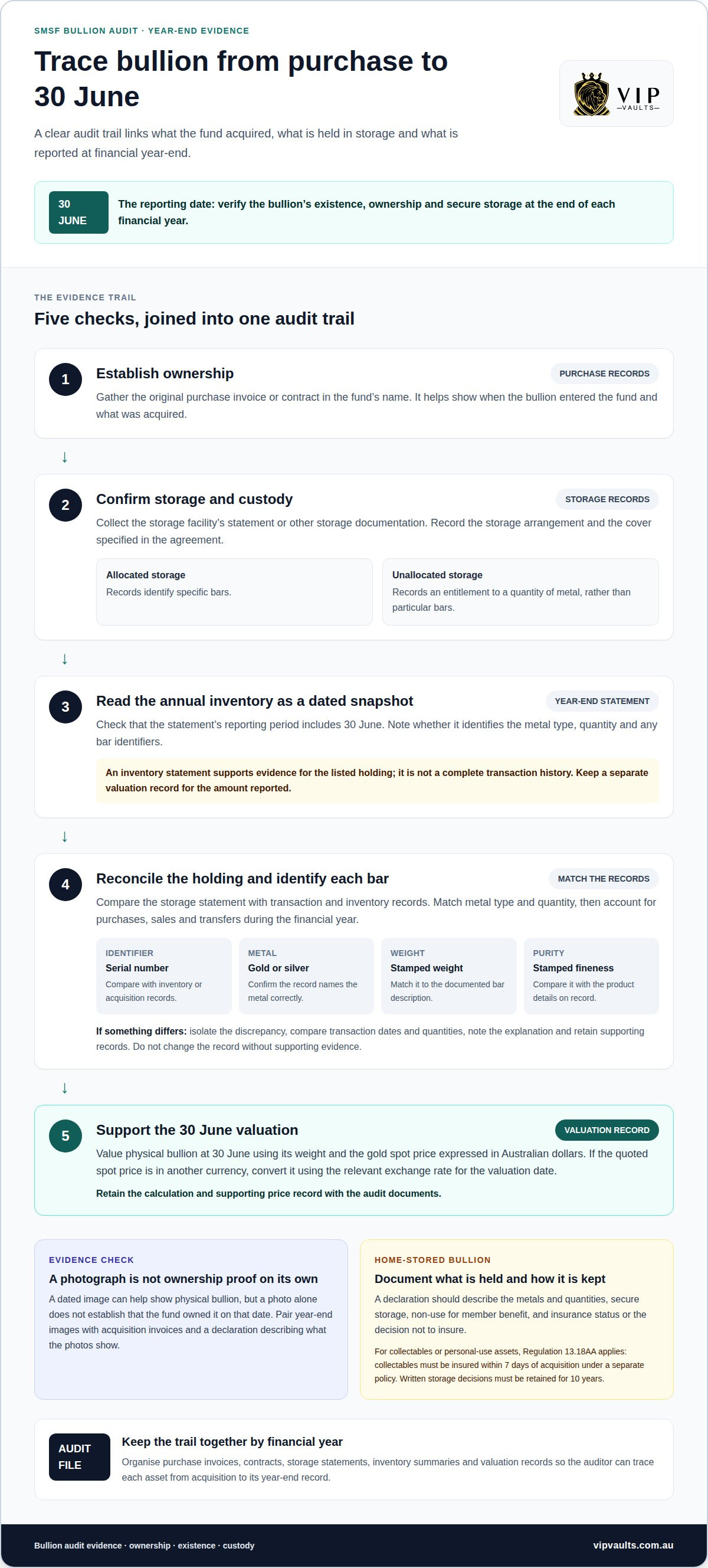
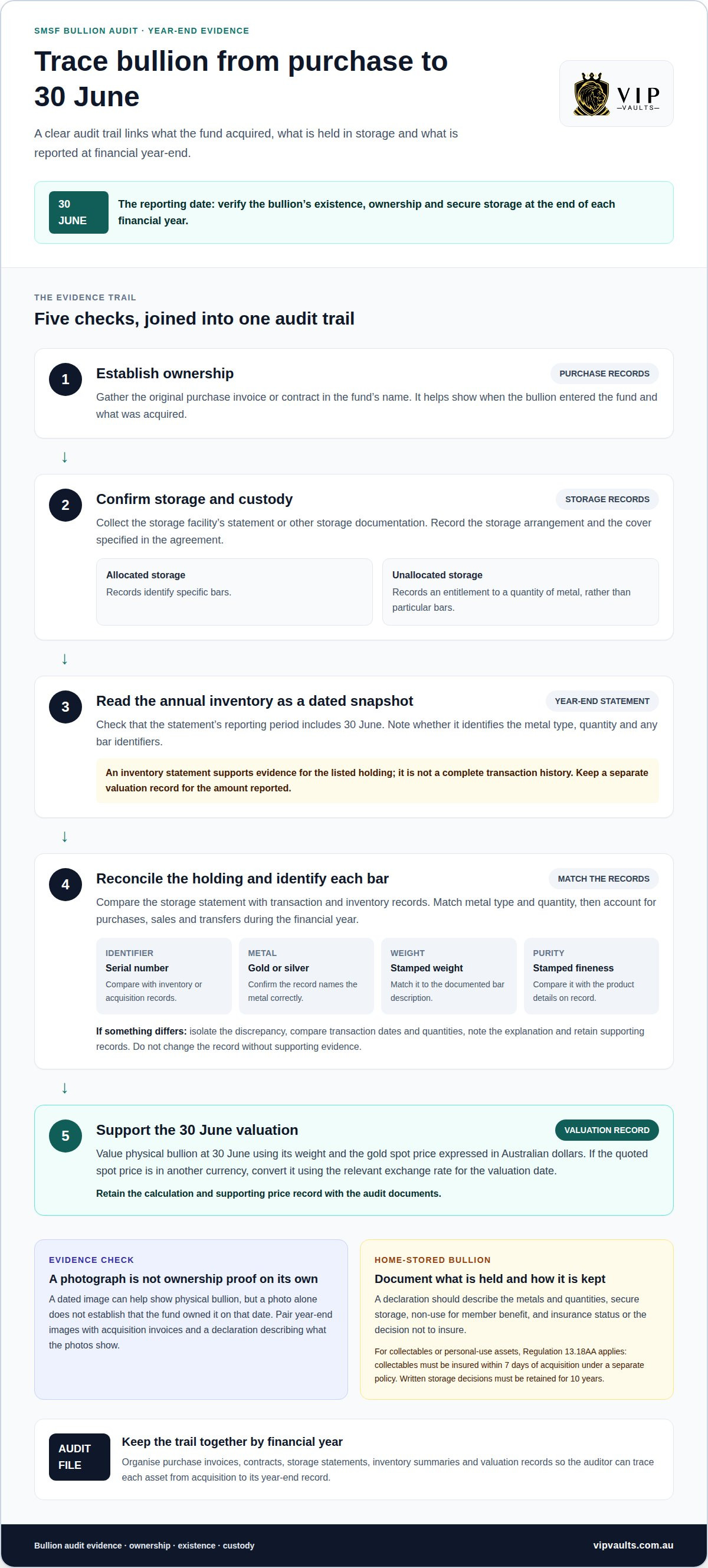
A bullion audit is only as strong as the evidence linking ownership to metal held at the reporting date. To understand how to audit your stored bullion, bring together purchase records, an annual holding statement or inventory summary, and details identifying the bars. For an SMSF, trustees must verify the bullion’s existence, ownership and secure storage at the end of each financial year, with holdings evidenced at 30 June.
When you hold physical bullion, you need more than a balance on a statement. Clear records connect what you own with what is in storage and support your annual review.
This article explains how to evidence ownership and existence, review annual inventory statements, check bar details and decide when a physical audit may help. It also covers how storage arrangements affect the evidence available, so you can review your bullion with greater clarity.
Key Takeaways
- Use purchase records and storage documentation together to support evidence of bullion ownership, existence and custody.
- For an SMSF, keep annual holding statements and inventory summaries ready to support the year-end review at 30 June.
- Match each bar’s recorded details, including its weight, purity and serial number, against the inventory.
- A physical check can provide additional evidence when records alone do not clearly establish which bullion is held.
Verifying bullion existence and ownership
For an Australian SMSF, the Australian Taxation Office requires trustees to verify bullion’s existence, ownership and secure storage at the end of each financial year. Knowing how to audit your stored bullion starts with evidence linking the fund’s records to its physical gold or other bullion, not just a statement of value.
Ownership evidence can include the original purchase invoice or contract in the fund’s name, together with an annual holding statement from the storage facility. A third-party vault statement can support evidence of existence and secure custody. The inventory should identify the holding clearly enough to reconcile it against purchase and storage records.
A photograph can help show physical bullion, but a dated image alone does not establish ownership. For example, a photograph taken on 30 June 2024 does not necessarily prove the fund owned that gold on that date. Pair year-end images with acquisition invoices and a declaration describing what the photographs show.
When bullion is stored at home, trustees should document the metals, quantities, storage arrangements and insurance status in a declaration. It should describe the metals and quantities, secure storage, non-use for member benefit, and insurance status or the decision not to insure. If the bullion is a collectable or personal-use asset, Regulation 13.18AA applies; collectables must be insured within 7 days of acquisition under a separate policy. Written storage decisions for these assets must be retained for 10 years.
Allocated storage records identify specific bars. Unallocated storage records an entitlement to a quantity of metal, rather than particular bars. As fees and insurance depend on the storage agreement, distinguish the arrangement in your audit records and document the cover specified in the agreement.
For trustees learning how to audit your stored bullion, value physical bullion at 30 June using its weight and the gold spot price expressed in Australian dollars. If the quoted spot price is in another currency, convert it using the relevant exchange rate for the valuation date, then retain the calculation and supporting price record with the audit documents.
Annual audits and inventory statements
For an Australian SMSF, the annual audit tests whether recorded precious metals assets match the fund’s year-end position. An inventory summary helps organise that evidence around the reporting date, 30 June.
Keeping audit documents and records
Bring together records that explain each bullion transaction and the holding reported by the fund. Keep purchase invoices, contracts, storage statements, inventory summaries and valuation records organised by financial year.
For an SMSF, these documents help the auditor trace an asset from acquisition to its year-end record. Separate files for each year make it easier to establish when bullion entered the fund, how its quantity is recorded and which valuation supports the reported balance. Retain these records with the fund’s other annual audit material.
Reviewing annual inventory statements
An annual inventory statement summarises bullion recorded as held with a storage facility. It can support audit evidence for the listed assets and help the auditor assess their year-end value against prices published by the bullion provider.
Read the statement as a dated snapshot, not as a complete transaction history. Check that its reporting period includes 30 June, then note whether it lists metal type, quantity and any bar identifiers. An inventory summary can help present those details clearly, while a separate valuation record supports the amount reported for the financial year.
Reconciling statements with personal records
Reconciliation means comparing the storage statement with the fund’s transaction and inventory records. First match the metal type and quantity, then account for purchases, sales and transfers recorded during the financial year.
If the statement shows a different holding, isolate the discrepancy rather than immediately changing the fund’s records. Compare transaction dates and quantities, for example, to see whether the difference reflects timing or an incomplete entry. Note the explanation and retain supporting records to keep the audit trail clear.
If storage forms part of your record-keeping plan, consider a Bullion Locker as a dedicated holding option.
Checking bar serial numbers and weights
For Australian bullion bars, stamped weight and purity help match each item to its inventory record. A serial number can distinguish one bar from another, so compare it with the storage statement or purchase documents where recorded. This helps link the specific bar to the fund’s purchase and asset records.
Match each available identifier, then check the metal, stated weight and purity. A gold bar recorded at a particular weight, for example, should correspond with the weight stamped on it and listed in the inventory. Apply the same check to silver. Record any mismatch as a discrepancy rather than changing the record without supporting evidence.
- Serial number: compare the number on the bar with the inventory or acquisition record.
- Metal: confirm the record identifies gold or silver correctly.
- Weight: match the stamped weight to the documented bar description.
- Purity: compare the stamped fineness with the product details in the records.
These details help distinguish individual bars from a general account balance. A document showing total weight but no bar-level identifiers offers less detail for matching specific bars. Keep the original record and note any difference between the bar information and the inventory entry.
A stamped weight is not the same as a fresh weighing. Bureau Veritas checks the weight of randomly selected bullion bars against the product description. As this check samples selected bars, it does not mean every bar in a holding has been weighed individually. Keep this distinction in mind when assessing what the report establishes.
For gold and silver, clear records link each bar’s available identifiers to its purchase and storage entries. Trustees can then present a consistent trail from purchase to current inventory, with any discrepancies visible for review.
Customer physical audits
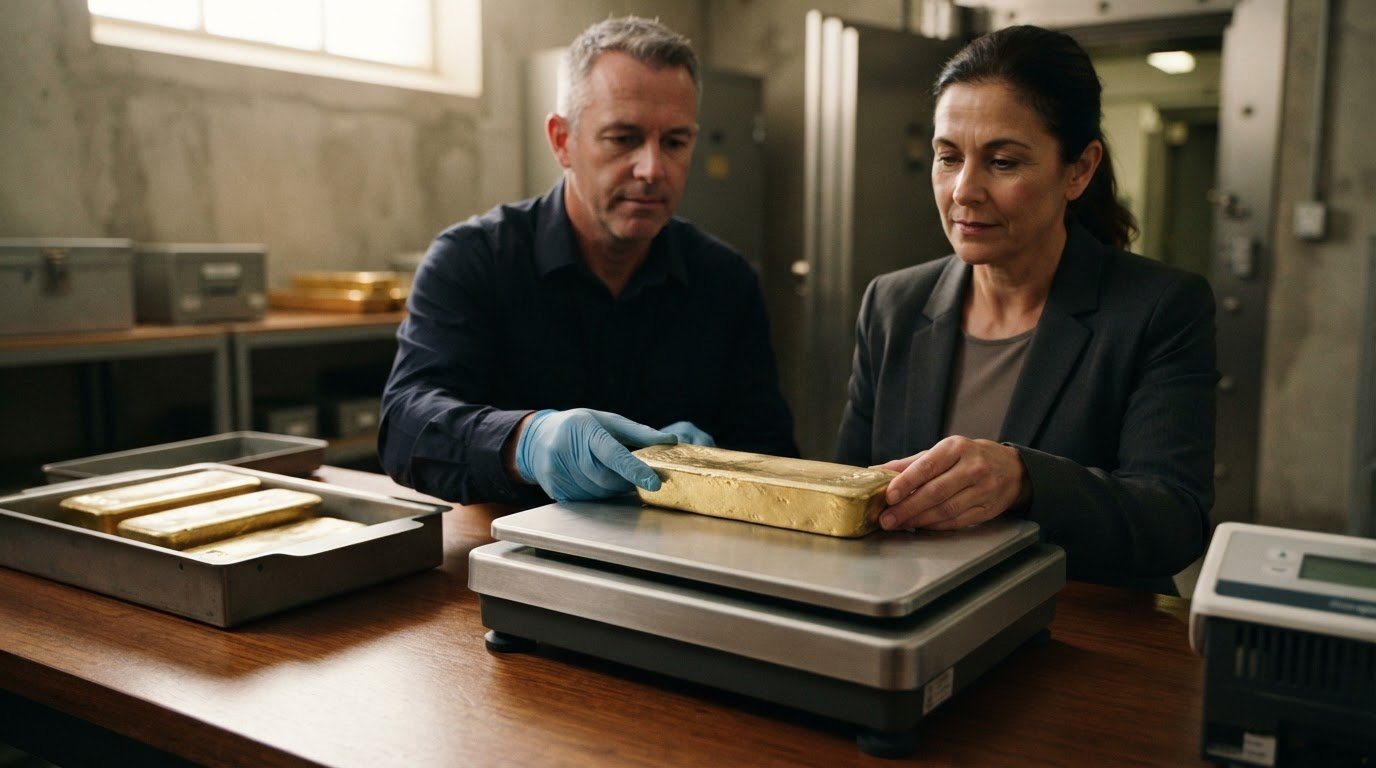
A physical audit adds an in-person check to the documents and inventory used to evidence a bullion holding. It may be useful if a statement does not clearly identify individual bars, or if bullion is stored at home rather than in commercial facilities. For SMSF trustees, the auditor may assess home security arrangements and decide whether an independent physical check is warranted.
Home storage places more responsibility on trustees to describe and evidence the arrangement. Records may need to show what metal is held, where it is kept and how it is secured. A commercial vault statement can provide independent evidence of existence and custody; home-held bullion relies more heavily on trustee records and the auditor’s assessment.
A physical check compares the bullion present with the inventory, rather than relying solely on a written statement. A useful review follows a clear sequence:
- Identify the holding and storage location covered by the audit.
- Compare the available bars with their recorded descriptions and identifiers.
- Record any difference between the physical items and the inventory.
- Retain the outcome with the evidence supporting the annual review.
For silver as for gold, a physical check should identify the metal and recorded quantity. For an SMSF audit, the evidence must support the fund’s reported holding at the relevant year-end date. A physical check supplements, but does not replace, purchase documents or other ownership evidence.
Home storage also requires attention to asset classification. Australian SMSF collectables cannot be stored at a trustee’s or related party’s residence, while bullion bars may be stored at a trustee’s residence under the rules described for these assets. Classification therefore affects which storage arrangements meet audit requirements.
For a holding where documented custody is important, consider exploring private vault rental as a storage option.
VIP Vaults & Bullion Exchange Perth
VIP Vaults & Bullion Exchange Perth offers storage for people holding bullion. Private Vault Rental and Bullion Locker provide dedicated storage options for physical bullion held outside the home. The business also sells Gold Bullion and Silver Bullion.
When organising an audit, keep storage records and purchase documents together so they can be reviewed alongside the inventory evidence. Storage does not replace your responsibility to maintain appropriate ownership and valuation records, particularly for SMSF holdings. Consider whether a private vault or bullion locker suits your intended arrangement, and keep the relevant paperwork with your annual audit file.
Contact VIP Vaults & Bullion Exchange Perth for information about bullion storage options.
Make bullion oversight part of your ongoing plan
Knowing how to audit your stored bullion is most useful when you keep records organised between annual reviews, not just when an audit is due. Update your records after each purchase, sale or storage change. This creates a clearer history of your holding and a practical reference for reviewing its arrangements over time.
Storage is one part of that decision. VIP Vaults & Bullion Exchange Perth offers Private Vault Rental and Bullion Locker options, as well as Gold Bullion. These services and products can help you plan where to hold physical metal and how to organise a bullion investment. Choose an option that suits your holding and storage preferences.
If you’re considering a storage arrangement or bullion purchase, contact VIP Vaults & Bullion Exchange Perth to discuss your next step. A considered approach can help you manage your bullion with greater clarity.
Frequently Asked Questions
How to make an inventory of stored gold and silver bullion in Australia?
If you're working out how to audit your stored bullion, create a register linking each item to its supporting records. Record the metal, product type, refiner or mint, stated weight, fineness, serial number where present and storage location. Add purchase invoices, certificates and dated photographs. List each bar separately rather than combining several into one total, so a later check can pinpoint a discrepancy.
How to verify bullion bars and coins using serial numbers, weight, dimensions and testing?
Compare each item with its invoice and the manufacturer’s specifications, checking serial numbers, markings, weight and dimensions. Use a suitably precise scale and callipers, and record the instruments and results. Packaging and assay certificates can support a check, but are not proof on their own. If a reading or appearance is inconsistent, avoid damaging the item and arrange assessment by a qualified bullion professional using appropriate testing equipment.
How often should you audit bullion held in an Australian vault or depository?
Set a regular review at least once a year, and reconcile your records whenever you buy, sell, transfer or change storage arrangements. Compare the latest holding statement with your inventory and promptly investigate missing serial numbers, unexplained weight differences or changes in ownership details. The right schedule depends on how often your holdings change and the reporting requirements you follow. An annual review is a practical baseline, not a universal legal rule.
How to independently confirm an Australian bullion vault's holdings and custody controls?
Request a dated holding statement that identifies the metal, quantity, ownership basis and, where applicable, individual bar serial numbers. Ask what independent assurance covers, who performed it and which period it examines. A security certification alone does not verify your specific holdings. Review the custody agreement, reconciliation process, access records and insurance terms. With personally controlled storage, a Bullion Locker supports your own inspection and inventory checks under its access arrangements.
What to do if an audit finds missing, damaged or counterfeit bullion
Record the discrepancy, compare the physical holding with the inventory and transaction records, and retain the outcome with supporting evidence. Do not change the fund’s records without supporting evidence.