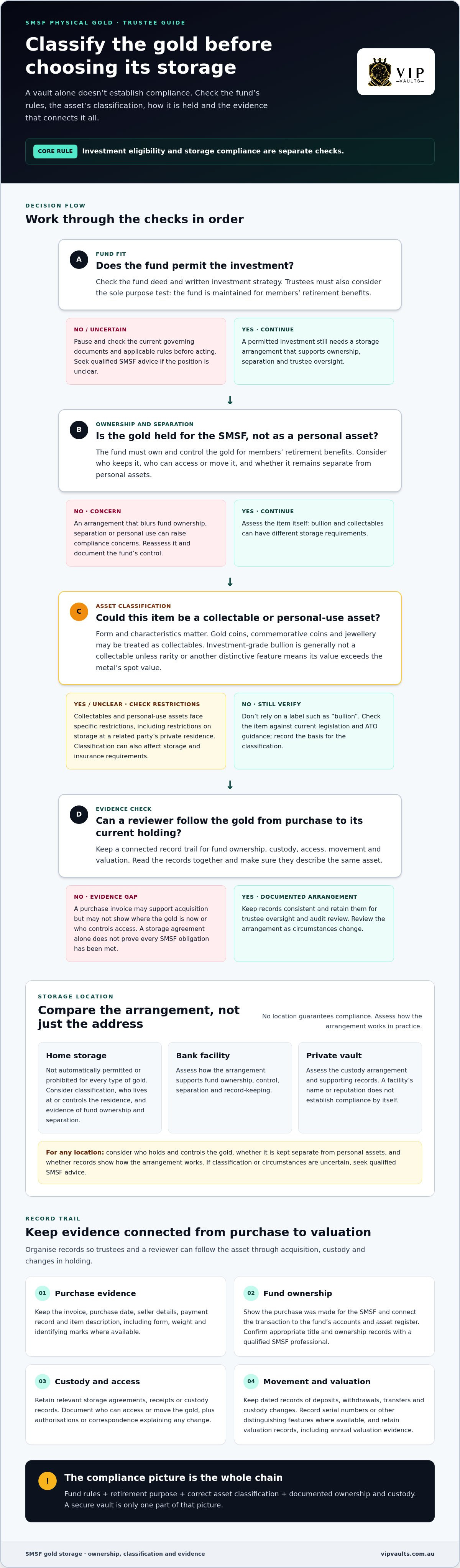

A secure vault doesn’t, by itself, make SMSF-owned gold compliant. The ATO rules for storing gold in SMSF holdings involve more than location: trustees need to establish that the fund owns the metal, keep it separate from personal assets and retain evidence of how it is held. The distinction matters because investment-grade bullion and coins treated as collectables can face different storage requirements.
It’s understandable to be cautious about keeping gold at home or relying on a private vault without clear records. Storage is only one part of the compliance picture; ownership, the fund’s investment strategy and supporting evidence matter too. This guide explains what trustees should consider before choosing where SMSF gold is held, including how bullion may differ from collectible coins. It also covers records for purchases, storage, insurance and valuation, and why no single storage location guarantees compliance. Use it to prepare informed questions for your SMSF adviser and keep fund decisions clear, documented and focused on retirement benefits.
Key Takeaways
- The ATO rules for storing gold in SMSF holdings sit alongside the fund deed, investment strategy and sole-purpose requirements. Treat investment eligibility and storage compliance as separate checks.
- Build a clear record trail from purchase and fund ownership through custody and annual valuation to support trustee oversight and audit review.
- Compare home storage, bank facilities and private vaults by how each arrangement supports control, separation and record-keeping. No location guarantees compliance.
- Before buying, confirm the fund-purpose and investment-strategy fit, then document the storage arrangement and review it as circumstances change.
- Private vault rentals and bullion lockers offer physical custody options to consider as part of a trustee’s documented storage plan.
What ATO rules apply when an SMSF stores physical gold?
An SMSF may hold physical gold if the investment is permitted by the fund’s governing rules and investment strategy, and trustees meet their superannuation obligations. The ATO rules for storing gold in SMSF holdings are not satisfied simply by choosing a particular vault: investment eligibility and storage compliance are separate questions. Trustees must consider the fund deed, the written investment strategy and the sole purpose test, which requires the fund to be maintained for retirement benefits. Check the current wording of the governing documents and applicable rules before acting.
Storage is one part of the arrangement, not a compliance shortcut. A facility’s name or reputation does not, on its own, establish that the fund owns the gold, that personal use is excluded or that trustees have met their responsibilities. The key questions are how the asset is owned, held and controlled, and whether the records support that account.
Holding fund property means the SMSF owns and controls the gold for its members’ retirement benefits; storing it personally means trustees keep or use it as their own asset. Physical proximity alone may not settle the question, but an arrangement that blurs this distinction can raise concerns about ownership, separation or present-day benefit.
Does an SMSF have to store gold in a particular place?
There is no universal vault label that makes every bullion storage arrangement compliant. Trustees need to assess custody and control against the asset’s classification and the fund’s circumstances, then retain evidence showing how the arrangement works in practice.
Home storage should not be treated as automatically permitted or prohibited for every type of gold. The position can depend on whether the asset is bullion or a collectable, who lives at or controls the residence, and how the fund’s ownership and separation are evidenced. Collectables and personal use assets face specific restrictions, including restrictions on storage at a related party’s private residence. If classification or circumstances are uncertain, obtain advice from an SMSF professional before settling the arrangement.
Is SMSF gold bullion treated like collectible gold?
Not necessarily. Investment-grade bullion is generally not a collectable or personal use asset, unless its value exceeds the metal’s spot value because of rarity or another distinctive feature. Gold coins, commemorative coins and jewellery may be treated as collectables, so an item’s form and characteristics matter.
Don’t assume every coin is automatically a collectable, or that anything described as bullion is exempt from collectables rules. Check the asset against current legislation and ATO guidance, and seek qualified SMSF advice if its status is unclear. Classification can affect the storage and insurance requirements, so record the basis for the decision alongside the purchase and custody documents.
Ownership, separation and records: the foundations of compliant SMSF gold storage
Clear records help trustees show that physical gold belongs to the SMSF, remains separate from personal assets and is held under the fund’s custody arrangements. These are distinct questions: an invoice may support a purchase, but it won’t necessarily show where the gold is now or who controls access. The ATO rules for storing gold in SMSF holdings must be considered alongside the fund’s governing documents and the facts of its custody arrangement.
For independently held SMSF gold, preserve a connected record trail from purchase and fund ownership through custody, access, movement and valuation. No single document will necessarily establish every part of that trail. Read the records together and keep them consistent.
How should an SMSF document ownership and custody?
Organise evidence so a reviewer can follow the asset from acquisition to its current holding. The appropriate ownership documentation can depend on the fund’s circumstances, so don’t assume one legal title format suits every SMSF. Ask a qualified SMSF professional how the fund should document title and ownership for its arrangement.
- Purchase evidence: retain the invoice, date, seller details, payment record and a description of the item, such as its form, weight and identifying marks where available.
- Fund ownership: keep records showing the purchase was made for the SMSF and connect the transaction to the fund’s accounts and asset register.
- Custody evidence: file relevant storage agreements, receipts or custody records that describe where the gold is held and the basis on which it is held for the fund.
- Access and control: document who can access or move the asset, and retain authorisations or correspondence explaining any change.
A storage agreement can help explain an arrangement, but it doesn’t, by itself, prove that every SMSF obligation has been met. For example, purchase and storage records should describe the same asset and make a coherent link to the fund.
What evidence supports storage and audit review?
Keep dated records of deposits, withdrawals, transfers and changes in custody. Where a bar or coin has a serial number or other distinguishing feature, record it accurately. Where it doesn’t, use the available description and supporting documents to identify it. Update the asset register and retain valuation evidence used for financial reporting, so the chain remains clear over time.
Make the file accessible to the SMSF administrator and independent auditor, and organise it so they can trace the gold without relying on trustees’ recollection. Argent Advisory’s discussion of SMSF gold storage rules covers storage considerations and compliance risks. A dedicated physical custody option, such as private vault rental and bullion locker options, can form part of a trustee’s documented storage plan. The fund’s records and compliance decisions remain the trustees’ responsibility.
Home storage, bank facilities or private vaults: compare the compliance considerations
Each storage arrangement presents different questions about access, separation and evidence. The ATO rules for storing gold in SMSF holdings don’t make a home, bank facility or private vault automatically compliant, risk-free, insured or ATO-endorsed. Trustees need to assess the actual arrangement against the fund’s circumstances, the type of gold and current requirements.
| Arrangement | Control and separation considerations | Records to consider |
|---|---|---|
| Home | Personal access can make it harder to demonstrate that the gold is held only for the fund. Consider who can access it and whether it is clearly separate from personal assets. | Purchase evidence, a clear description of the storage location, access arrangements and records distinguishing fund property from household assets. |
| Bank facility | Access is shaped by the facility’s terms and the people authorised to use it. Trustees still need to show the asset is held for the SMSF, not personally. | Relevant facility or custody documents, access authorisations and records identifying the fund’s gold. |
| Private vault | A dedicated storage arrangement may help define physical custody, but the vault itself doesn’t determine SMSF compliance. | Storage agreement, custody records, asset descriptions and dated records of any movement or change in arrangement. |
What should trustees consider before storing SMSF gold at home?
Home storage calls for particular care around personal access and separation. If a trustee or another household member can handle the gold freely, questions may arise about who controls it and whether the fund has a genuine, documented custody arrangement. Collectables and personal use assets have specific rules, including restrictions on storage at a related party’s private residence. Assess the asset’s classification and circumstances with an SMSF professional rather than relying on a blanket assumption about home storage.
How does a private vault fit into an SMSF storage plan?
A private vault rental or bullion locker can provide a defined physical storage option for precious metals. Trustees must still keep records identifying the SMSF’s asset and explaining its custody arrangement. A vault is not a compliance certification; the fund’s ownership, documentation and obligations remain the trustees’ responsibility.
For any option, document who can access or authorise movement of the gold, how the asset is identified and what evidence will be retained. Compare the arrangement with the fund’s governing documents and the asset’s classification, then revisit the records if custody changes. A bank facility’s documents, for example, may describe account access without identifying the particular gold held for the SMSF, so trustees may need supporting asset records. Similarly, a home inventory alone may not explain how the asset is separated from personal property.
Private storage can be considered as part of a planned custody arrangement, not as a substitute for trustee oversight. Compare how each option works in practice: who holds or controls the gold, how the fund’s interest is evidenced, and whether the records tell a consistent story.
A practical SMSF gold storage checklist for trustees and auditors
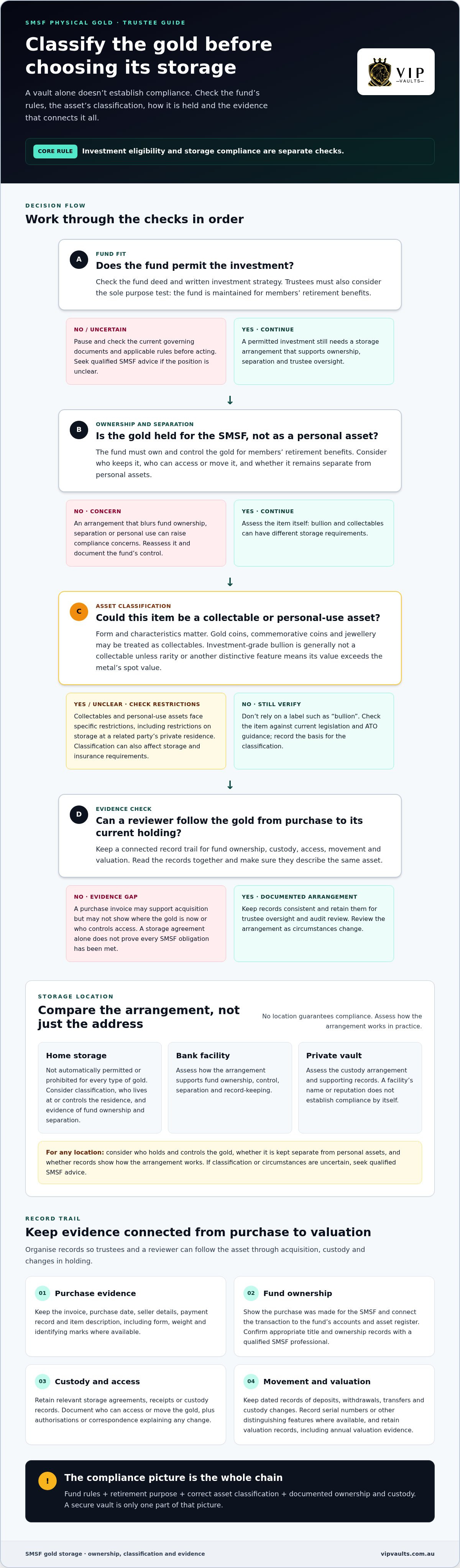
A staged process helps trustees make the decision, establish custody and keep supporting evidence aligned. Check the ATO rules for storing gold in SMSF holdings against current legislation, ATO guidance and the fund’s circumstances. This checklist is a record-keeping aid, not a personal investment recommendation or a substitute for SMSF advice.
Before purchase: confirm the fund’s investment and asset classification
Start with the fund’s deed and written investment strategy. Record how the proposed purchase fits the fund’s stated approach and retirement purpose through the fund’s usual decision-making process. Then assess the asset: investment-grade bullion may be treated differently from a coin or object with collectible characteristics. Ask a qualified SMSF professional to review uncertain classifications or related-party issues before proceeding.
- Check fund authority and purpose. Confirm the deed permits the investment and document how the decision aligns with the investment strategy and sole-purpose requirements.
- Classify the asset. Record its form, description and relevant characteristics. Verify whether current rules treat it as bullion or a collectable, rather than relying only on a seller’s label.
- Review the transaction. Keep the purchase decision and payment process clear, especially where a related party is involved. Obtain professional advice if the arrangement raises questions about market value or conflicts.
After purchase: maintain a clear storage and audit trail
Once the fund acquires the gold, create a file that links the purchase to its present custody. Reconcile each record when the asset moves, access arrangements change or the fund’s circumstances shift. Keep evidence organised for the annual audit, and make the relevant documents available to the SMSF administrator and auditor in a usable format.
- Record the asset and acquisition. Retain the invoice, payment evidence and a precise description, including identifying details such as serial numbers where available. Ensure the records connect the purchase to the SMSF.
- Document storage and access. File the agreement or custody record, note where the gold is held and record who can access or authorise its movement. Keep dated evidence of transfers or changes in custody.
- Review insurance and valuation. Check the policy terms, insured party, asset description and responsibility for maintaining cover against the actual arrangement. Collectables and personal use assets must be insured in the fund’s name within seven days of acquisition. Don’t assume a policy covers the gold without reviewing its terms. Record the market value used for financial reporting, including the annual valuation at 30 June.
Before each audit, compare the asset register with purchase, custody, insurance and valuation records. Resolve discrepancies and document changes rather than relying on memory. A dedicated bullion locker or private vault rental can form part of the fund’s storage plan, while compliance remains the trustees’ responsibility. Explore private vault and bullion locker options for physical precious-metals storage.
Using a private vault for SMSF gold: a considered next step
After reviewing ownership, classification and record-keeping, trustees can consider where physical bullion will be held. A dedicated private storage arrangement can provide a defined location separate from everyday personal holdings. VIP Vaults & Bullion Exchange Perth offers private vault rentals and bullion lockers for precious metals, options trustees can consider within a documented storage plan.
That choice is one part of the arrangement, not a compliance outcome. The ATO rules for storing gold in SMSF holdings still require trustees to consider the fund’s circumstances, asset classification and responsibilities. Selecting a vault does not replace professional SMSF advice, trustee oversight or the evidence needed for an audit.
What a dedicated private storage arrangement can contribute
A private vault or bullion locker can help distinguish stored bullion from assets kept for personal use. The value of that separation depends on how the arrangement works and is recorded, including how the SMSF’s interest in the gold is identified. Trustees should keep storage documentation consistent with purchase and ownership records, and retain evidence of any change in custody.
VIP Vaults & Bullion Exchange Perth provides private vault and bullion locker storage for precious metals. The facility itself doesn’t establish who owns the bullion or whether the fund has met its obligations. Trustees remain responsible for assessing the arrangement against current requirements and ensuring the records accurately reflect how the gold is held.
How to take the next step without overlooking trustee responsibilities
Before arranging storage, organise the fund’s purchase and ownership documents, asset description and proposed custody details. Take these to an SMSF professional for advice specific to the fund, especially if the item’s classification or storage arrangement raises questions. Agree how records will be maintained and updated if the bullion is moved or access arrangements change.
Keep the roles clear. VIP Vaults & Bullion Exchange Perth provides storage options, not SMSF administration, audit or financial advice. Trustees and their advisers remain responsible for compliance decisions, fund records and audit evidence. No storage location, including a private vault, guarantees that an SMSF meets every requirement.
Once trustees have considered those responsibilities, they can weigh whether private storage suits their documented plan. Explore private vault and bullion locker storage as an option for holding physical precious metals, while keeping ownership evidence and trustee obligations firmly in view.
Make your storage decision part of the fund’s plan
Before settling on a storage arrangement, turn the trustee’s decision into a practical plan: identify the intended custody approach, the documents that will support it and who will maintain those records over time. Have the proposed arrangement reviewed against current requirements by an SMSF professional. This creates a clear reference point if the fund’s circumstances or storage needs change.
The ATO rules for storing gold in SMSF holdings don’t make a vault choice a substitute for trustee judgement. Treat physical storage as one considered part of managing the fund’s assets, with the decision supported by appropriate advice and records.
VIP Vaults & Bullion Exchange is an independent, privately owned Australian operator offering private vault rentals and bullion lockers for precious metals. If you’re considering a dedicated physical storage option, explore private vault and bullion locker storage.
Take the next step with a documented plan and the right professional guidance behind your decision.
Frequently Asked Questions
Can an SMSF store gold at a trustee’s home?
Not on the address alone. The ATO rules for storing gold in SMSF holdings depend on who owns and controls the asset, how it is separated from personal property and which rules apply to its classification. For example, a trustee keeping fund bullion alongside personally owned gold needs clear records to distinguish each holding. Collectables can face additional restrictions, so assess the specific arrangement against current legislation and retain supporting evidence.
Does the ATO approve a private vault for SMSF gold?
No private vault should be treated as automatically approved by the ATO or as making an SMSF compliant. Trustees remain responsible for investment decisions, ownership documentation, separation and other applicable duties. A vault may form part of the fund’s storage arrangement, but its suitability depends on the facts and records. Trustees should be able to explain how the stored asset is identified as fund property. Seek SMSF-specific advice on the proposed arrangement.
Can an SMSF buy gold coins, or only bullion bars?
An SMSF may invest in precious metals, but a coin’s treatment depends on its characteristics, not simply its gold content or the seller’s description. A standard investment coin and a rare or commemorative coin may not be treated alike under collectable and personal-use-asset rules. Before buying, document how the item fits the fund’s investment strategy and have its classification reviewed by a qualified SMSF professional if there’s any doubt.
Do SMSF-owned gold assets need to be insured?
Insurance needs to be assessed against the asset type, current rules and the fund’s storage arrangement; don’t assume one answer applies to every gold holding. Collectables and personal-use assets have specific insurance requirements, including cover in the fund’s name within seven days of acquisition. Review the policy wording, insured party and asset description, and retain evidence of the decision. Don’t assume a storage provider’s arrangements insure the SMSF’s bullion.
What records should an SMSF keep for physical gold?
Keep enough evidence to identify the item and connect it to the fund. A practical file might include the invoice, payment record, a description with serial numbers where available, and documents showing the current custody arrangement. Add dated records if the asset moves or custody changes, then reconcile the file with the fund’s asset register. Make the documents accessible to the auditor, and obtain advice if ownership or control is difficult to establish.
Can an SMSF use a bank safe deposit box for gold?
A bank safe deposit box may be considered as a storage arrangement, but using one doesn’t guarantee compliance. Trustees should establish how the box is held, who has authority to access it and how the specific gold is recorded as an SMSF asset. For example, a box agreement may identify account holders without describing the bullion inside, so separate asset records may be needed. Keep relevant documents with the fund’s audit records and seek advice on the arrangement.
What happens if SMSF gold is treated as a collectible?
Collectable classification can bring additional storage, insurance and transaction rules, so resolve the question before purchase where possible. Don’t classify an item solely by its metal content: rarity, design, form and other characteristics may affect how it’s treated. If an asset’s status is uncertain, document the features considered and obtain advice from a qualified SMSF professional using current legislation. That assessment helps trustees understand which requirements apply to the particular item.