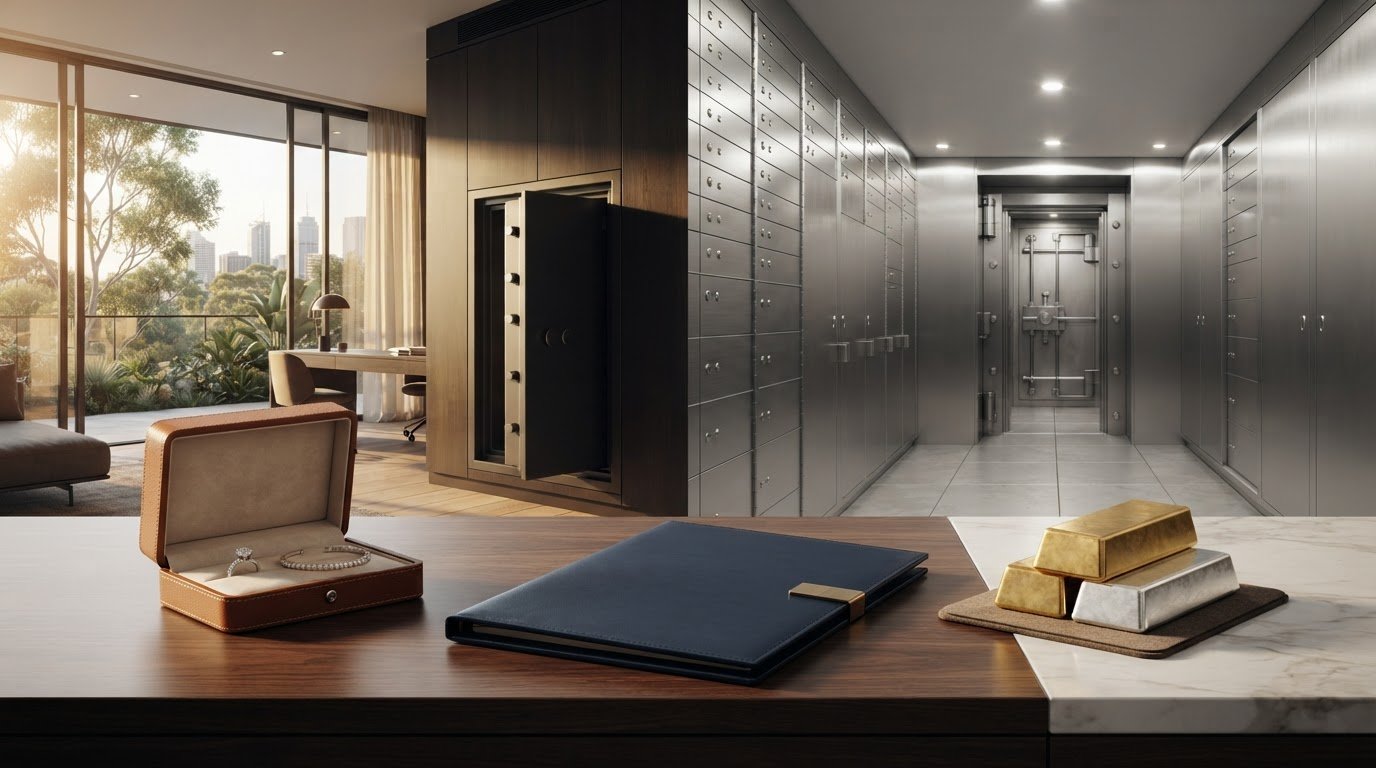
The most convenient place to keep valuables may not be the one that gives you the most control. If you’re weighing alternatives to bank safe deposit boxes, start with what you’re storing, how often you’ll need access and how the storage arrangement handles custody and retrieval.
A bank box can seem straightforward, but access arrangements, insurance and written terms deserve a close look. A home safe offers access at home, while a private vault may suit precious metals or jewellery that call for specialist storage. General self-storage serves different needs and isn’t automatically designed for valuables.
This guide compares practical physical storage options and the trade-offs that matter, including protection, access, privacy and insurance. You’ll learn how to match an option to items such as documents, jewellery or bullion, and where private vault rental and bullion lockers may fit. The aim is to help you make a considered choice beyond traditional banking.
Key Takeaways
- Compare alternatives to bank safe deposit boxes by considering who holds your items, who controls access and how retrieval works.
- Match the storage method to what you’re keeping: a home safe, private vault and insurance address different needs and risks.
- Before choosing a private vault, understand its custody arrangements, access rules, privacy practices and written terms.
- Start with your valuables’ storage requirements, then weigh how often you’ll need access and the level of privacy you prefer.
- Private vault rental and bullion lockers offer specialist storage options for precious metals and jewellery.
Why look for alternatives to bank safe deposit boxes?
Wanting physical storage outside traditional banking is a reasonable priority, whether you’re safeguarding jewellery, bullion or important papers. A bank box, home safe and private vault all hold physical items, but differ in where those items are kept, who manages access and how you retrieve them. Exploring alternatives to bank safe deposit boxes is about finding an arrangement that fits your assets and preferences, not assuming one option suits everyone.
A safe deposit box is a secured container kept within a financial institution’s premises, generally accessed under the institution’s procedures. A home safe keeps items at your residence, with access managed by you. A private vault provides specialist storage outside a bank; the provider’s custody arrangements and terms shape how access works. Insurance is different: it may help transfer some financial risk, but it doesn’t physically store or protect an item.
What does a safe deposit box alternative need to protect?
First, separate physical valuables from information. Jewellery and bullion need physical storage, while important documents may need both protection from loss and a practical retrieval plan. Keep an organised record of stored jewellery and clear documentation of bullion. Digital records, such as scanned documents or photographs, need secure electronic storage and backups, not a physical vault. Physical vault storage safeguards tangible items; digital data storage protects electronic files.
Why consider storage outside a bank?
You might compare non-bank storage for greater choice, a specialist focus on valuables or independence from traditional financial institutions. Those priorities don’t make bank boxes universally unsuitable. They do make it useful to understand what each arrangement provides. Terms, access procedures, privacy practices and protections vary, so compare the written conditions rather than relying on the label “vault” or “safe”.
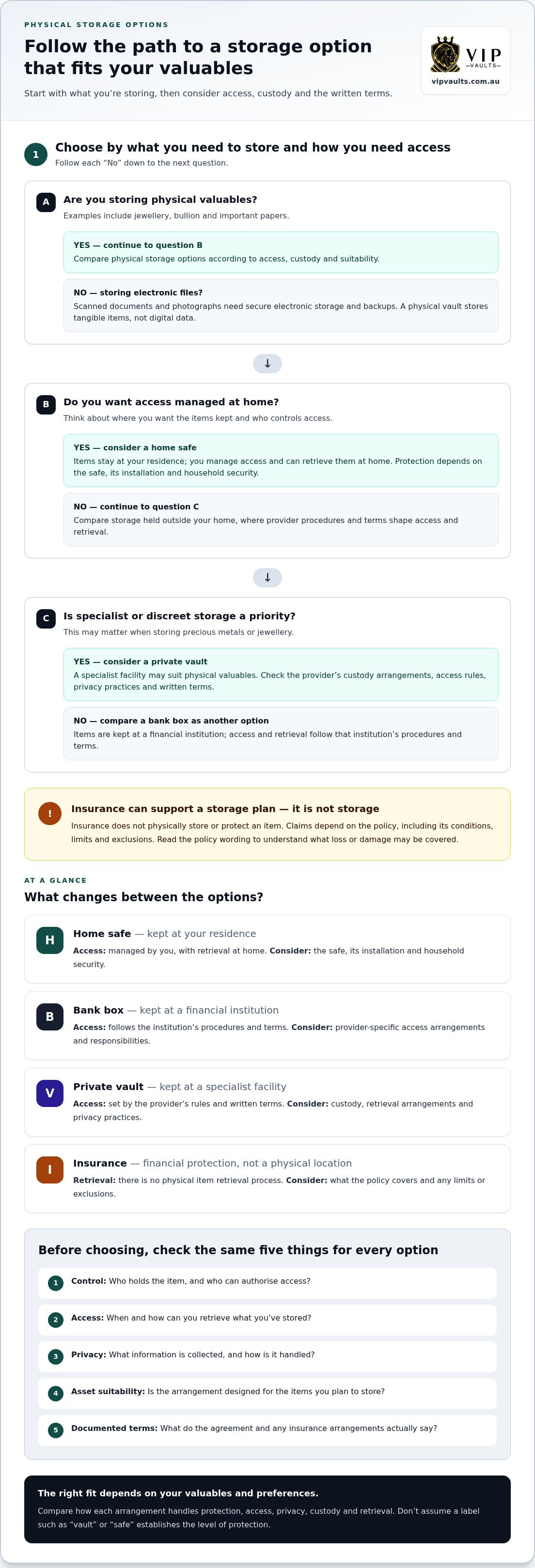
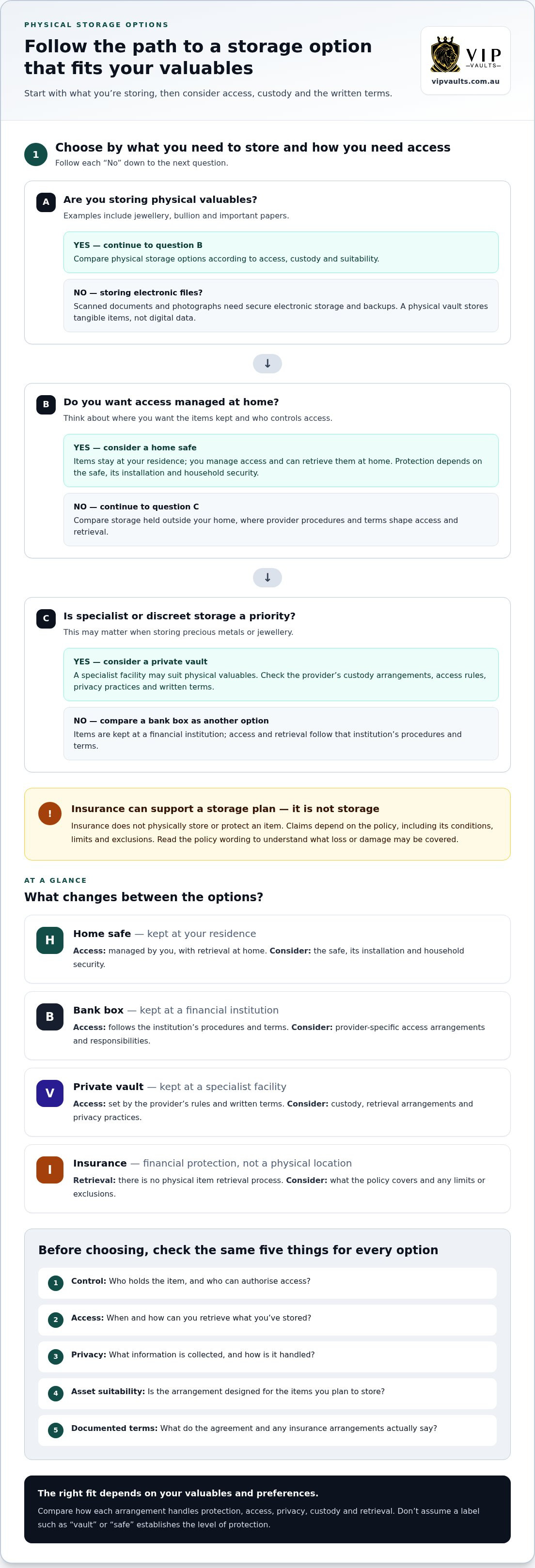
Use the same criteria for every option:
- Control: Who holds the item, and who can authorise access?
- Access: When and how can you retrieve what you’ve stored?
- Privacy: What information is collected and how is it handled?
- Asset suitability: Is the arrangement designed for the items you plan to store?
- Documented terms: What do the agreement and any insurance arrangements actually say?
These distinctions help narrow the comparison before you assess individual storage options. The right fit depends on what you’re safeguarding and the balance you want between personal control, specialist custody and convenient retrieval.
Compare the main alternatives to bank safe deposit boxes
The main alternatives to bank safe deposit boxes differ in where items are held, who controls access and what happens when you need to retrieve them. A home safe keeps valuables close, while a bank box or private vault places them in a separate facility under provider-specific arrangements. Insurance can help address financial loss, but it isn’t a place to store belongings. No option is best for everyone: let your assets, access needs and circumstances guide the choice.
| Option | Where items are kept | Access and retrieval | Key consideration |
|---|---|---|---|
| Home safe | At your residence. | You manage access and can retrieve items at home. | Convenient, but protection depends on the safe, its installation and the security of the household. |
| Bank box | At a financial institution. | Access and retrieval follow the institution’s procedures and terms. | Items are held outside your home, but access arrangements and responsibilities are provider-specific. |
| Private vault | At a specialist storage facility. | The provider’s access rules and written terms determine retrieval. | May suit people seeking discreet, specialist physical storage; understand the custody and access arrangements. |
| Insurance | Doesn’t store items. | There’s no physical retrieval process; claims depend on the policy. | Read the policy wording to understand what loss or damage is covered and any limits or exclusions. |
Home safe, bank box or private vault: what changes?
A home safe offers direct control and convenient access, but the surrounding household environment matters. Bank boxes and private vaults keep items away from home, with custody and retrieval shaped by each provider’s procedures. Compare convenience alongside privacy, responsibility for the items and the written terms. Don’t assume that a particular label alone establishes the level of protection.
When insurance or digital storage is not a physical substitute
Insurance may help reduce the financial impact of a covered loss, but it won’t safeguard jewellery or bullion in place. Coverage depends on the policy wording, including its conditions and exclusions. Encrypted apps and digital file vaults can help organise electronic records, such as photographs or scanned documents, but they can’t hold physical valuables. Keep digital records as a separate part of your storage plan.
For a closer look at specialist options, read this guide to private vaults in Australia. If discreet storage for precious metals or jewellery is a priority, explore private vault rental and bullion lockers as physical-storage options.
Is a private vault a secure alternative to a bank box?
An unfamiliar provider isn't automatically risky, just as a familiar institution doesn't explain exactly how belongings are protected. Assess the actual arrangements: who has custody of your items, how access is authorised, what privacy practices apply and what the written agreement says. Private vaults and banks don't necessarily operate under identical regulatory or operational frameworks, so compare their terms directly rather than assuming the same rules apply.
Security depends on the provider's actual safeguards and documented arrangements, not simply whether storage is called a bank box or a private vault. A clear agreement should explain the provider's responsibilities, your access process and what applies if circumstances change. Privacy also deserves careful attention: discreet storage doesn't mean anonymous storage, and the provider's stated practices and obligations matter.
Security, privacy and control are separate considerations
Physical protection concerns how the facility and stored items are safeguarded. Confidentiality concerns how your information is handled. Access control sets out who can retrieve items and under what process, while personal control is about your ability to make decisions about your assets. These are related, but one doesn't guarantee the others. VIP Vaults & Bullion Exchange Perth is an independent, privately owned Australian business, separate from government and financial institutions. That independence describes its position, not anonymity or a specific security feature.
For any storage arrangement, understand the custody terms, permitted access, identity or authorisation requirements, privacy practices and process for ending the arrangement or retrieving belongings. These details help you assess the service on its documented terms.
What to understand about insurance and responsibility
Don't assume that items are automatically insured because they're held in a bank box or private vault. Any cover may depend on policy wording, the type of asset, its declared value and the conditions under which it's stored. Clarify what the relevant policy covers, including limits, exclusions and any documentation needed to support a claim. The storage agreement and an insurance policy address different responsibilities.
SMSF trustees considering bullion storage should check current Australian Taxation Office guidance and seek advice from a qualified SMSF professional. Requirements can depend on the fund's circumstances, so don't rely on a general storage comparison to determine compliance. Read more about SMSF gold storage as a starting point.
For independent storage of jewellery or precious metals, compare private vault rental and bullion locker options with the written terms that shape access, custody and responsibility: explore private vault rental and bullion lockers.
How to choose an alternative for your valuables
Choose storage by starting with the items themselves, then consider how you’ll use and access them. A method that suits bullion held for the long term may not suit documents you need to retrieve regularly. Use these steps to compare alternatives to bank safe deposit boxes against your practical requirements.
- List what you’ll store. Separate bullion and jewellery from documents or records you may need to access often. Consider each item’s size, value and handling needs, and decide what records you’ll want to keep.
- Match the arrangement to the asset. Precious metals may call for storage designed around bullion and clear records of what is held. Jewellery has different handling considerations, while frequently used documents may be more practical somewhere you can retrieve them readily.
- Set your retrieval expectations. Decide how often you’ll need access before comparing convenience. Occasional retrieval may suit a different arrangement from items you expect to access frequently. Read the written access process so you understand how retrieval is arranged.
- Weigh privacy and custody. Consider where the items will be held, who is responsible for their custody and how your information is handled. Private vault rental and bullion lockers are specialist physical-storage options for precious metals and jewellery; suitability depends on your assets and preferences.
- Read the documents before committing. Review the storage agreement, access conditions, responsibilities and rental terms. Read any applicable insurance documents separately, including wording on covered items, declared values, limits and exclusions. Keep relevant ownership and item records organised.
Compare access, terms and long-term practicality
Think beyond the day you place an item into storage. Your needs may change, so understand how access works, what responsibilities the agreement assigns and how retrieval or ending the arrangement is handled. Check that the process suits your likely routine instead of relying on assumptions about convenience or privacy. Assess each specialist storage option on its documented terms.
Compare access, privacy, custody and written terms before choosing where your valuables will be held. This keeps the decision grounded in practical details instead of labels or general claims. For precious metals or jewellery, include private vault rental and bullion locker options in your comparison.
Consider private vault rental for discreet physical storage
If your priority is specialist storage for physical precious metals or jewellery, private vault rental may be a practical alternative to a bank box. It offers a different arrangement, with custody and retrieval governed by the provider’s terms rather than a bank’s procedures. Compare the written access arrangements, responsibilities and conditions with your own needs before deciding.
VIP Vaults & Bullion Exchange is an independent, privately owned Australian business, separate from government and financial institutions. It provides private vault rentals and bullion lockers for precious metals and jewellery. These options are for tangible assets, not digital records or documents you need to retrieve frequently. Their suitability depends on what you’re storing and how you expect to access it.
Who may value a private vault or bullion locker?
Bullion investors may value specialist physical storage for gold, silver or other precious metals. Jewellery owners may prefer storage outside the home for items they don’t need to access often. A bullion locker may suit precious metals, while private vault rental can serve broader storage needs. Consider the asset, retrieval frequency and written terms; neither option is automatically right for every owner.
SMSF holders considering bullion storage need to assess their fund’s circumstances separately. Storage arrangements alone don’t establish whether an investment or custody arrangement meets applicable requirements. Refer to current Australian Taxation Office guidance and seek professional SMSF advice before making decisions. Treat compliance as a distinct question from the physical-storage comparison.
Explore a private storage option
A bank box and a private vault are different custody arrangements, each with its own access process and terms. A private vault isn’t universally superior, but it can suit people seeking discreet, specialist storage independent of traditional financial institutions. Read the agreement carefully to understand how custody, access and retrieval work.
If you’re comparing alternatives to bank safe deposit boxes for bullion or jewellery, consider whether a private vault or bullion locker aligns with your priorities. Explore private vault and bullion locker options.
Choose storage that fits your priorities
The right alternative to a bank safe deposit box depends on what you’re storing, how often you need access and which custody arrangements you’re comfortable with. Compare physical storage options on their written terms, and treat insurance and digital records as separate parts of your protection plan.
For precious metals and jewellery, VIP Vaults & Bullion Exchange offers private vault rentals and bullion lockers. The business operates independently of government and financial institutions, and its bullion is sourced from recognised refiners, including LBMA-accredited manufacturers. These options may suit people seeking discreet, specialist physical storage; the right fit depends on your assets and access needs.
Explore whether this approach aligns with your priorities: Explore private vault and bullion locker options. With clear terms and a considered choice, you can take a confident next step in protecting the valuables that matter to you.
Frequently Asked Questions
What are the best alternatives to bank safe deposit boxes?
Common alternatives to bank safe deposit boxes include a home safe, an independent private vault and specialist bullion storage. Insurance may help address financial loss, but it doesn’t physically store valuables. The best fit depends on what you’re protecting, how often you need to retrieve it and your privacy preferences. Compare custody arrangements, access procedures, written terms and any applicable insurance documents rather than assuming one option suits every asset or situation.
Are private vaults safer than bank safe deposit boxes?
There’s no universal answer: security depends on the specific facility, safeguards, access procedures, custody arrangements and documented terms. A private vault and a bank box may operate under different arrangements, so the label alone doesn’t establish how well an option suits your needs. Compare how items are held and retrieved, then weigh those details against your assets and access preferences before deciding.
Can I store gold and jewellery in a private vault?
Yes. Private vault rentals and bullion lockers provide physical storage for precious metals and jewellery. Before storing items, understand the access process, responsibilities and rental terms. Keep purchase records and consider whether your insurance arrangements cover the items in their intended storage conditions. If the gold belongs to an SMSF, assess storage separately against current Australian Taxation Office guidance and seek advice from a qualified SMSF professional.
Does home insurance cover valuables kept in a safe deposit box?
It depends on your policy wording, the item, its declared value and where it’s stored. Don’t assume a home policy covers valuables kept in a bank box or private vault, or that the storage provider automatically insures them. Review the relevant policy documents for limits, exclusions and conditions. If you’re unsure how the wording applies to your belongings, seek advice from a qualified insurance professional before relying on the cover.
Are private vaults the same as bank safe deposit boxes?
No. Both can hold physical valuables, but the provider, custody arrangement, access process and terms can differ. A private vault provides specialist storage; it isn’t a banking service simply because it stores valuables. Read the agreement to understand access, responsibilities, privacy practices and any applicable cover. Compare these details with your needs rather than assuming a bank box and private vault follow identical arrangements or offer the same conditions.
Can an encrypted digital vault replace a safe deposit box?
No. An encrypted digital vault can help protect electronic files such as photographs, notes or scanned documents, but it can’t physically store jewellery, bullion or original papers. Digital privacy tools and physical storage address different needs. You might keep secure digital copies of receipts or item details alongside an appropriate physical storage arrangement for valuables. Keep backups of important files and consider how you’ll access them if a device is lost.
Can SMSF gold be stored outside a bank safe deposit box?
It may be possible, but SMSF storage decisions depend on the fund’s circumstances and current superannuation requirements. Don’t assume that a particular storage arrangement automatically meets those obligations. Trustees should consult current Australian Taxation Office guidance, review their fund documents and seek advice from a qualified SMSF professional. Specialist bullion storage may be relevant to the physical-storage decision, but compliance must be assessed separately for the fund.