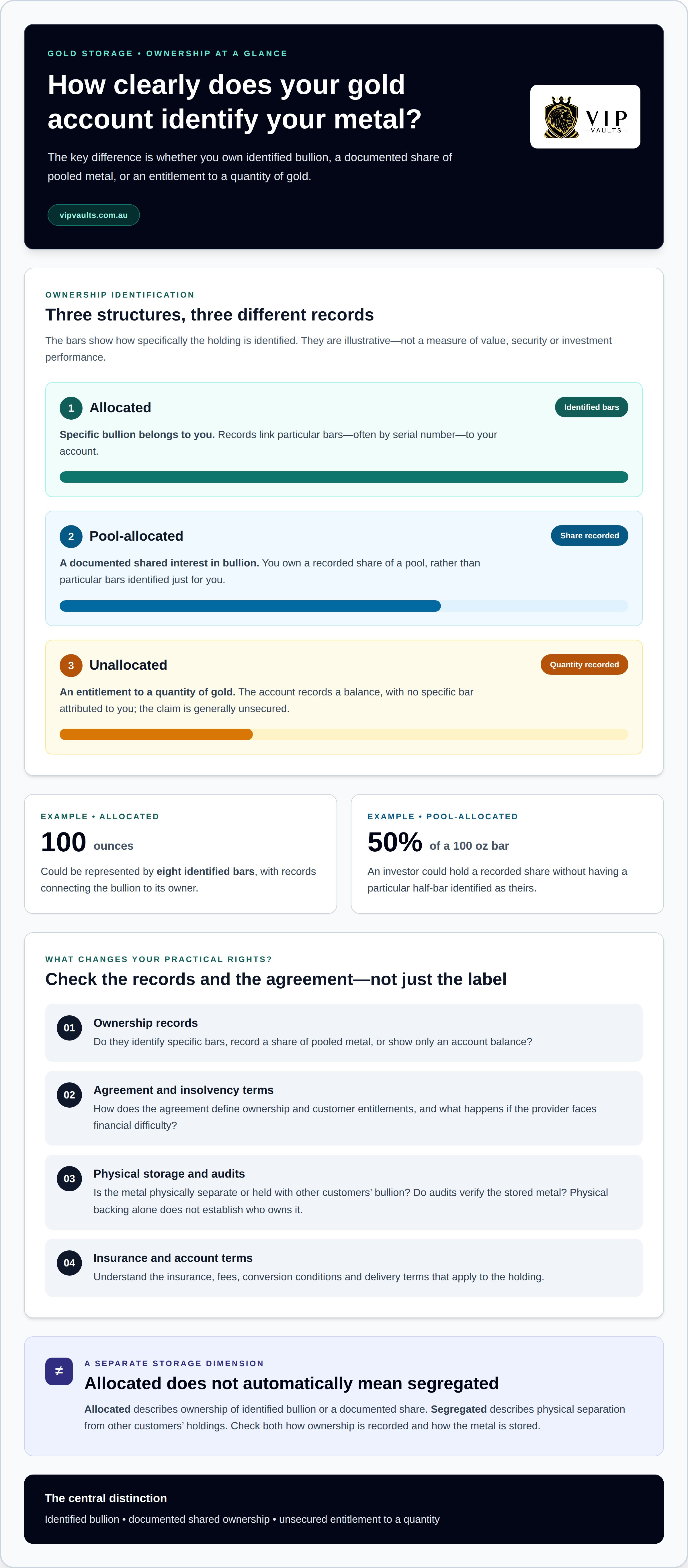

A gold holding can track bullion without giving you ownership of particular bars. The key distinction in allocated vs unallocated bullion storage is whether specific physical metal belongs to you or you hold an entitlement to a quantity of gold. The Reserve Bank of Australia describes allocated holdings as specific bars attributable to the customer, while unallocated holdings are an unsecured entitlement to a share of a gold pool.
It’s understandable to focus on the amount of gold and its price, but the storage structure also shapes your ownership rights and what you may be able to take delivery of. This guide explains allocated, pooled allocated, segregated and unallocated storage, and what each arrangement means in practice.
You’ll also learn what to ask about ownership records, audits, insurance, fees, conversions and delivery terms. These details can help you assess how a bullion arrangement fits your priorities, whether you value identified metal, shared holdings or simpler account-based exposure.
Key Takeaways
- Distinguish ownership of identified bullion from an entitlement to a quantity of gold, and understand how custody records help show the difference.
- Assess pooled arrangements by looking at how ownership is documented and how the agreement treats the metal if the provider faces financial difficulty.
- Separate the meaning of allocated, pooled allocated and segregated storage before deciding which arrangement suits your priorities.
- Use focused questions about audits, insurance, fees, conversions and delivery terms to understand the practical conditions of a storage arrangement.
What is an Allocated Gold Investment?
An allocated gold investment gives you ownership of specific physical bullion, rather than only a claim to a quantity of gold. In Australia, the distinction between allocated and unallocated holdings comes down to how ownership and custody are recorded.
Direct ownership of identified bullion
With allocated gold, particular bars are identified as yours, usually through records linking each bar to your account. The Reserve Bank of Australia explains that allocated accounts attribute specific bars and serial numbers to the customer. The Australian Bureau of Statistics describes allocated ownership as ownership of a specific piece of gold, which remains with the entity placing it in safe custody.
For example, 100 ounces could be represented by eight identified bars. That record distinguishes your bullion from an unallocated claim, where you hold an unsecured entitlement to a share of a gold pool and may be a creditor rather than owner of particular bars.
Allocated bullion custody
In Australia, allocated bullion storage links identified precious metals to your ownership records while a custodian holds the physical items for safekeeping. To open an allocated account, complete the provider’s account process, agree to its storage terms and arrange the purchase or transfer of bullion for allocation.
For an unallocated account, the usual steps are to open an account, accept its terms and acquire a recorded entitlement to gold rather than specific bars. The agreement explains how the holding is recorded. Trading an allocated holding may involve dealing with the identified metal, while an unallocated account records a quantity instead.
Pool-allocated gold is a form of shared ownership. For example, an investor could own 50% of a 100 oz bar without having a particular half-bar identified as theirs. This differs from individually allocated bullion, where records connect specific bars to one customer.
| Option | Ownership | Identification | Custody record |
|---|---|---|---|
| Allocated | Specific bullion | Bars may have serial numbers | Linked to your account |
| Pool-allocated | Shared interest in bullion | Share of a bar or pool | Ownership share recorded |
| Unallocated | Entitlement to a quantity | No specific bar attributed | Account balance recorded |
Choose by deciding whether you need ownership of identified bars or are comfortable holding a recorded share or entitlement.
Is pooled storage the same as allocated storage?
Pooled storage isn’t automatically the same as individually allocated storage. The key distinction is whether you own identified bullion, a documented share of pooled metal or an unsecured claim against an institution.
Physical backing and counterparty risk
Physical backing means bullion exists to support an account, but it doesn’t by itself establish who owns that metal. An unallocated account may be backed by physical gold, depending on the provider and account arrangement, while still giving the account holder an unsecured entitlement rather than ownership of specific bullion.
In pooled allocated storage, customers may share ownership of bullion held together. The governing document determines how each share is recorded and what rights attach to it. An audit can help confirm holdings, but the account terms explain whether the metal is allocated to customers or simply held against account balances.
Insolvency and creditor risk
Allocated bullion is treated differently from an institution’s own assets because specific metal is recorded as belonging to its owner. That distinction can reduce counterparty exposure, but the legal effect depends on the ownership records and storage agreement. A named bar in a record is useful evidence, but it doesn’t replace understanding the governing documents.
With unallocated gold, the customer is generally an unsecured creditor for the amount owed under the account arrangement. If the financial institution becomes insolvent, the customer’s position may depend on its obligations and the process for resolving claims. The customer doesn’t have a specific bar to identify as their own.
Pooled arrangements establish shared ownership rights only if their documents say so. Read how the agreement treats bullion, customer entitlements and insolvency, and whether independent audits verify the stored metal. Physical backing alone doesn’t settle legal ownership or creditor priority.
If your priority is secure custody for jewellery rather than bullion, explore Jewellery Storage as a separate option.
Allocated, pooled allocated and segregated storage
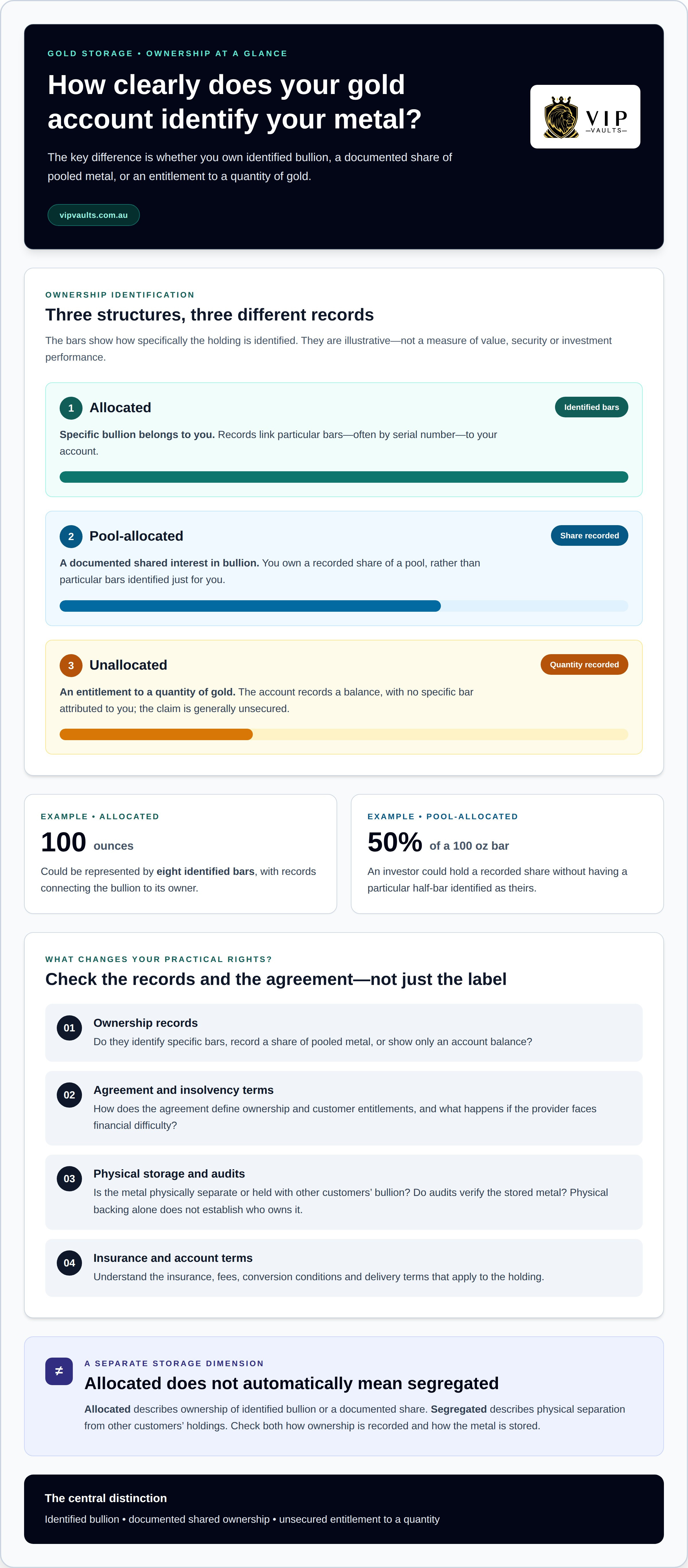
Australian bullion dealers and vault providers compare storage by ownership, whether the metal is physically separate and the account terms. These are distinct criteria: segregated storage describes separation, while allocated storage describes ownership of identified bullion or a documented share.
Allocated storage
Allocated storage links specific bullion to its owner, with records identifying the metal held in custody. It differs from unallocated storage, which records an entitlement to a quantity, and pooled allocated storage, where an owner holds a documented share rather than particular bars.
For example, a statement may identify bars by serial number or record a share in a pool. Read the storage agreement to see how it defines ownership, custody and access. The word “allocated” alone doesn’t explain whether the metal is also physically separated.
Segregated and commingled storage
Segregated storage keeps a customer’s bullion physically separate from other customers’ holdings, such as in a dedicated vault space. Commingled storage holds multiple customers’ bullion together. Segregation concerns where metal is stored, so it can apply alongside allocated ownership without changing the ownership basis.
A segregated pool may still represent shared backing rather than individually identified bars. Check how the provider’s documents describe the quantity assigned to each customer and whether the metal is subject to shared ownership. Physical separation and legal allocation answer different questions.
Dealer and vault provider options
Compare Australian dealer and vault arrangements using the same criteria: ownership structure, physical separation, records, audits and access terms. A dealer’s account may record a quantity for trading, while a vault arrangement may focus on custody of bullion already owned. The agreement determines the specific arrangement.
Review the documents to see how holdings are identified, whether audits verify them, and how retrieval or selling works. Charges and access conditions depend on the agreement. The right choice is the one whose records and terms match whether you prioritise identified metal, a shared quantity or physical separation.
Questions to ask bullion storage providers
Use the storage agreement and account statements to understand what your holdings represent. A comparison of allocated vs unallocated bullion storage should start with ownership, then consider fees, insurance, audits and access. Ask for clear explanations of how the terms apply to buying, holding, converting or selling your metal.
In Australia, storage arrangements alone don’t determine an investor’s tax or reporting position. The transaction, ownership structure and personal circumstances matter, including when buying, selling or converting bullion.
- What exactly do I own? Ask whether your account records identified bars, a share of pooled metal or an unsecured quantity entitlement.
- Is the holding backed by physical bullion? Ask how the provider documents backing and distinguishes customer holdings from its own assets.
- How are holdings audited? Ask whether audits are independent, how often they occur and whether you receive confirmation of your specific position.
- What does insurance cover? Establish who is insured, which perils are covered, whether aggregate limits apply and whether transit is included.
- How does access work? Ask about delivery options, minimum quantities, conversion requirements and waiting times under the account terms.
Fees depend on the arrangement. Allocated storage may involve an initial fee, retrieval charges and an ongoing annual fee based on the value held. Unallocated holdings may cost less, but trading, account and conversion fees can still apply. Ask for the complete fee schedule, including charges for changing from unallocated to allocated metal.
For allocated vs unallocated bullion storage, match the terms to your intended use. If you prioritise identified bullion, consider ownership records and retrieval conditions. If you prefer pooled exposure, focus on how the agreement records your interest and describes access to the metal.
For a physical custody option, explore secure bullion storage and consider whether a Bullion Locker suits your needs.
Allocated storage can carry an initial charge, retrieval costs and an annual fee tied to the value held. Unallocated storage may cost less, though trading, account, conversion and allocation-change fees can still apply.
VIP Vaults & Bullion Exchange Perth: Jewellery Storage
VIP Vaults & Bullion Exchange Perth offers Jewellery Storage for people seeking a dedicated option for safeguarding jewellery. If your priority is holding physical bullion, a Bullion Locker provides a relevant storage option, while Private Vault Rental offers a separate choice for storing valuables.
The distinction matters: Jewellery Storage is suited to jewellery, while bullion storage is for physical precious metals such as gold. Consider what you want to store and whether you need a locker or private vault arrangement. VIP Vaults & Bullion Exchange Perth also offers Gold Bullion for those looking to acquire gold as part of their personal holdings.
For storage suited to jewellery or bullion, contact VIP Vaults & Bullion Exchange Perth to discuss your needs.
Choose storage that fits your next step
The decision between allocated and unallocated bullion storage should support how you intend to hold and manage your assets. Before proceeding, consider whether your priority is custody of physical bullion, flexibility in handling an account-based holding or a secure place for valuables you already own. Let that purpose guide your choice.
For physical storage, VIP Vaults & Bullion Exchange Perth offers Bullion Locker and Private Vault Rental. If you’re looking to acquire metal, Gold Bullion is also available. These options provide a practical next step for readers whose plans involve physical bullion or private storage, rather than an account-based gold entitlement.
Take the next step at your own pace. Contact VIP Vaults & Bullion Exchange Perth to discuss your storage needs and decide which option suits your plans.
Frequently Asked Questions
What is unallocated gold?
Unallocated gold is an account entitlement to a quantity of gold rather than ownership of particular bars. For example, an account might show a gold balance without listing serial numbers for metal belonging to its holder. Whether physical bullion backs that balance depends on the provider and account arrangement, so an account balance alone doesn’t identify specific metal.
Can I convert unallocated to allocated?
Yes, unallocated metal can be converted to allocated metal under arrangements that allow conversion. The change means moving from an account entitlement to allocated holdings, and fabrication and storage fees become payable. Before converting, consider whether you want identified physical bullion and how the agreement handles the process, including any minimum quantities or delivery conditions.
Conclusion: Which Is Right for You?
The right structure depends on what you want your gold holding to do. If owning particular physical bullion matters most, an allocated arrangement may suit that priority. If you prefer an account balance and easier account-based trading, unallocated exposure may fit better. For shared metal, examine how the pool records each holder’s interest before deciding.
How is your gold balance recorded?
Your balance may be recorded as an account quantity, an interest in pooled metal or identified bullion attributed to you. For instance, an allocated statement may connect bars to serial numbers, while an unallocated statement can show a quantity without identifying bars. Read the account statement alongside the storage agreement to understand what the balance represents.
How can an adviser verify a client's metal is allocated?
An adviser can review the storage agreement, an itemised statement and depository documentation naming the client or trust as owner. The documents should make clear whether specific metal is attributed to that party, rather than only recording a general quantity. Independent audit information can provide another way to assess whether recorded holdings correspond with metal in custody.
What is segregated storage?
Segregated storage keeps one customer’s bullion separate from other customers’ holdings, rather than storing multiple customers’ metal together. It describes the physical arrangement, not necessarily the legal ownership structure. For example, metal kept in a separate vault space could still be subject to pooled ownership, so distinguish physical separation from how the agreement assigns rights.