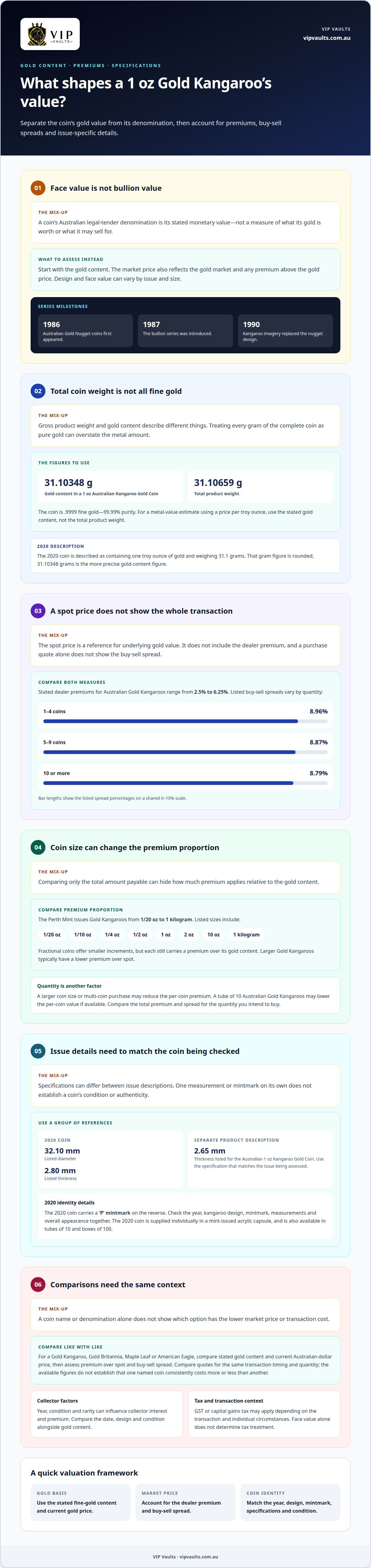
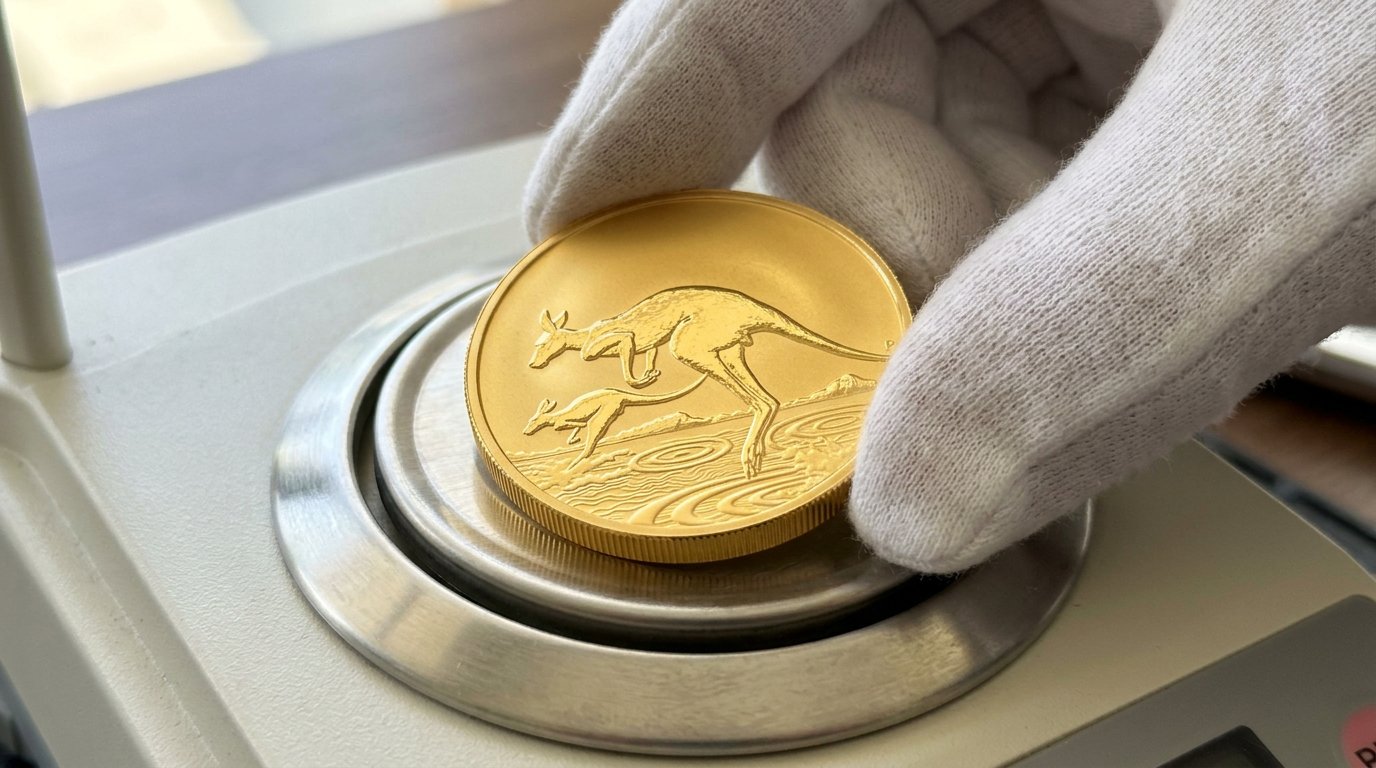
A coin’s face value isn’t the same as its gold value. The 1 oz gold Kangaroo coin’s value is based mainly on its one troy ounce of gold, with the market price also shaped by the premium a buyer pays above the gold price.
If you’re weighing up a coin’s worth, the gold content is a clear starting point. A 1 oz Kangaroo contains 31.10348 grams of gold at .9999 fineness and is issued by The Perth Mint. Its market price can change as gold prices and premiums move, so the denomination alone won’t tell you what it may sell for.
This guide explains the coin’s gold content, Australian legal-tender denomination and mint details, then shows how premiums affect its market price. You’ll have a clearer basis for understanding the value of a 1 oz Gold Kangaroo and the difference between its gold value and its price as a coin.
Key Takeaways
- Separate a coin’s legal-tender denomination from its bullion value; they describe different measures of worth.
- Use its fineness, dimensions and Perth Mint markings to understand the coin’s specifications and identity.
- Assess the premium above the gold price, as it affects the purchase price and the gap between buying and selling.
- Understand how the stated gold content relates to the coin’s total weight before assessing its underlying metal value.
Australian legal-tender denomination
That denomination is separate from the coin’s market price, which reflects its gold content and any premium. Face value is the stated monetary denomination, not a measure of the coin’s bullion value.
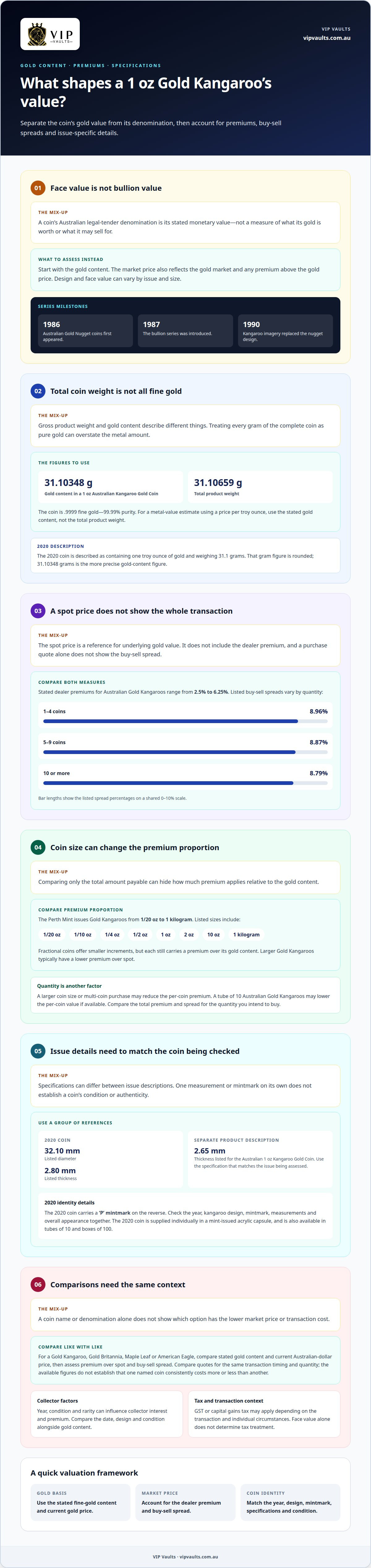
The series has a history spanning several design changes. Australian Gold Nugget coins first appeared in 1986, and the bullion series was introduced in 1987. Kangaroo imagery replaced the nugget design in 1990. The coin remains Australian legal tender, while its design and face value can vary by issue and size. These details help place a coin within the series.
GST or capital gains tax may apply to buying or selling gold coins, depending on the transaction and individual circumstances. Face value alone does not determine the tax treatment. Consider the tax implications of your particular purchase or sale before proceeding.
Year, condition and rarity can influence collector interest and a coin’s premium. A year-specific design may attract a different market price from another issue, while marks or wear can affect its appeal. Compare the date, design and condition alongside the gold content. A higher denomination does not necessarily mean a higher market value.
For a safer Australian transaction, use an established bullion dealer with clear purchase or sale terms, documented payment and a receipt. To assess authenticity, compare the coin’s year, design, mintmark and physical specifications with details for that issue. For example, the 2020 coin carries a ‘P’ mintmark on its reverse. Consider these features together when assessing identity and condition.
Coin dimensions and mint details
Australian Gold Kangaroo coins are struck from .9999 fine gold, equivalent to 99.99% purity. This describes the gold’s fineness, not the coin’s design or market price. The series includes a 1 oz size, and its specifications provide useful reference points when identifying an issue. Match the fineness and size to the coin’s year rather than assuming every Kangaroo issue has identical features.
For the 2020 Australian Kangaroo gold coin, the listed diameter is 32.10 millimetres and its thickness is 2.80 millimetres. A separate specification for the Australian 1 oz Kangaroo Gold Coin gives a thickness of 2.65 millimetres. These measurements refer to different product descriptions, so use the figure that matches the specific issue being assessed.
The 2020 coin was issued by the Australian mint responsible for the series and carries its ‘P’ mintmark on the reverse. The mark identifies the mint, while the date and kangaroo design help distinguish the issue. Consider these details together when reviewing a coin’s identity. A matching mintmark by itself doesn’t establish its condition or authenticity.
Measurements can support a careful visual assessment. For a 2020 coin, compare its stated diameter and thickness with specifications for that same issue, rather than another year’s description. Record measurements in millimetres and note visible marks, wear or design differences. Dimensions provide one reference point; they should be considered alongside the year, mintmark and overall appearance.
Packaging offers another issue-specific detail. The 2020 coin is supplied individually in a mint-issued acrylic capsule, and is also available in tubes of 10 and boxes of 100. Packaging can help identify how that issue was presented, but it doesn’t replace examination of the coin itself. Keep the year, mintmark and measurements together when comparing descriptions or assessing an individual coin.
Price spread and investment premium
A coin’s purchase price reflects the gold market and any premium above it. Compare premiums and buy-sell spreads, as both affect the cost of buying and selling.
Spot price and dealer premiums
The spot price is the reference for the coin’s underlying gold value; a dealer premium is added to that benchmark. Stated dealer premiums for Australian Gold Kangaroos range from 2.5% to 6.25%. The spread also matters: listed buy-sell spreads are 8.96% for quantities of 1-4, 8.87% for 5-9, and 8.79% for 10 or more. Compare both measures, not just the purchase quote.
Fractional sizes and premiums
The Perth Mint issues Gold Kangaroos in sizes from 1/20 oz to 1 kilogram, including 1/10 oz, 1/4 oz, 1/2 oz, 2 oz and 10 oz. Fractional coins provide smaller increments, but each still carries a premium over its gold content. Larger Gold Kangaroos typically have a lower premium over the spot price. Compare the premium proportion, not only the total amount payable.
Comparing other one-ounce gold coins
For a Gold Kangaroo, Gold Britannia, Maple Leaf or American Eagle, compare the stated gold content and current Australian-dollar price. Then assess each coin’s premium over spot and its buy-sell spread. The available figures do not establish that one named coin consistently costs more or less than another, so compare quotes for the same transaction timing and quantity.
To reduce the per-coin premium, consider a larger coin size or a multi-coin purchase. A tube of 10 Australian Gold Kangaroos may lower the per-coin value if available. Compare the total premium and spread for the quantity you intend to buy; a lower per-coin premium doesn’t by itself show the full cost of selling later.
Coin weight and gold content
For valuation, distinguish the gold content from the coin’s total product weight. A 1 oz Australian Kangaroo Gold Coin contains 31.10348 grams of gold, while its total product weight is 31.10659 grams. One figure measures the gold; the other measures the complete coin. That distinction matters when estimating metal value from a gold price quoted per troy ounce. The 1 oz gold kangaroo coin value therefore starts with the fine-gold content, not gross weight alone.
The 2020 Australian Kangaroo gold coin is described as containing one troy ounce of gold and weighing 31.1 grams. The gram figure is rounded, while 31.10348 grams gives a more precise measure of gold content. Use the gold-content figure for a metal-value calculation, rather than treating every gram of total product weight as pure gold.
A practical estimate starts with the coin’s stated gold content and the current gold price for the matching weight unit. This gives an underlying metal-value reference, not necessarily the amount a buyer will pay. A coin’s transaction price can also reflect a premium, so assess the metal estimate separately from the market quote. This distinction is central to understanding the 1 oz gold kangaroo coin value.
For a year-specific coin, keep the issue and its specifications together. The 2020 issue’s stated weight is 31.1 grams; the general one-ounce product specification gives a total weight of 31.10659 grams. Those figures differ in precision and what they describe. Check whether a listing gives gold content or total product weight before comparing it with another listing.
The key takeaway is simple: estimate metal value using fine-gold content, then consider the coin’s market premium separately. For a considered approach to holding physical gold, explore secure physical-gold options.
VIP Vaults & Bullion Exchange Perth: Gold Bullion
VIP Vaults & Bullion Exchange Perth sells gold bullion for readers considering physical gold alongside a Kangaroo coin’s metal value. If your priority is holding bullion rather than assessing a particular coin issue, buying bullion may be a relevant next step.
For precious metals that need secure storage, VIP Vaults offers private vault rentals and bullion lockers. Silver bullion is also available if you are considering another precious metal. Buying bullion and arranging storage are separate decisions, guided by what you hold and how you intend to store it.
Contact VIP Vaults & Bullion Exchange Perth to discuss Gold Bullion or storage options.
Make your next bullion decision with clarity
Use your understanding of the 1 oz Gold Kangaroo coin’s value as a starting point for a broader decision: what role should physical gold play in your plans? Consider your intended holding period, how readily you may need to access the asset, and how you’ll manage its safekeeping. A clear purpose can help keep a purchase aligned with your priorities rather than driven by short-term price movements.
It can also help to separate the decision to acquire bullion from the arrangements for holding it. Think through both before proceeding, so each step supports the same long-term approach. If you’re ready to discuss your options, contact VIP Vaults & Bullion Exchange Perth and take the next step with care.
Frequently Asked Questions
What is the current Australian dollar spot price of gold per troy ounce?
The Australian-dollar spot price is a live market figure quoted per troy ounce, so it changes as gold trades and currency values move. Use an AUD-denominated quote with its timestamp when assessing a coin. A quote in another currency is not an Australian-dollar price without conversion, and a dealer’s coin price may differ because of premiums.
What is the current buy price for a 1 oz Australian Gold Kangaroo coin in Australia?
The amount payable depends on the current A$ gold benchmark and the seller’s premium for the coin. A current quote should identify the transaction currency and specific coin issue, as year and condition can affect its market appeal. Compare the final Australian-dollar amount with the spot reference to understand the premium included.
What is the current sell-back price for a 1 oz Australian Gold Kangaroo coin in Australia?
A sell-back quote is the amount a buyer offers for the coin, not its retail asking price. It may reflect the current gold benchmark, the buyer’s bid and the coin’s condition. For a meaningful comparison, use an Australian-dollar quote and distinguish the buy-back offer from the price charged to purchase a coin.
How much gold does a 1 oz Gold Kangaroo coin contain, and what is its purity?
A one-ounce Australian Kangaroo Gold Coin contains 31.10348 grams of gold and has a purity of .9999, or 99.99%. Its total product weight is 31.10659 grams, so the gross weight is not the same as the gold content. For a metal-value estimate, use the fine-gold amount and a matching troy-ounce gold quote.
How does the value of a Gold Kangaroo compare with a 1 oz Gold Britannia, Maple Leaf, or American Eagle?
Compare each coin’s stated gold content, current Australian-dollar price, premium over spot and buy-sell spread. The available figures do not establish that one consistently costs more or less than another.